

Introduction
Enterprise architecture is not merely about drawing diagrams; it is about creating a structured, consistent, and actionable blueprint for an organization’s future. The Open Group Architecture Framework (TOGAF) provides the industry-standard methodology for achieving this. At the heart of TOGAF lie two critical, interconnected components: the Architecture Development Method (ADM) and the Architecture Content Framework.
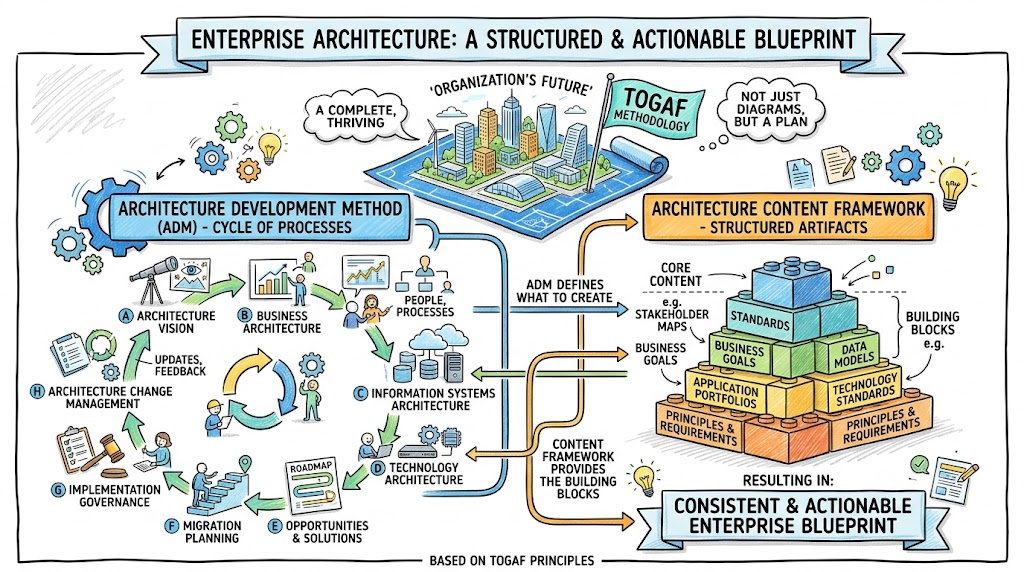
While the ADM describes the process of moving an enterprise from its baseline state to a target state, the Content Framework defines what the output of that process should look like. This guide explores how these two elements work in tandem to drive consistency, clarity, and value in architectural work products. By understanding the relationship between deliverables, artifacts, and building blocks, architects can ensure their outputs are not only comprehensive but also aligned with stakeholder needs and enterprise goals.
The Synergy Between ADM and the Content Framework
The Architecture Development Method (ADM) is a iterative process that guides architects through visioning, definition, planning, and governance. However, a process alone does not guarantee quality outputs. This is where the Architecture Content Framework steps in.
The Content Framework provides a structural model for architectural content. It ensures that the major work products created during the ADM cycles are consistently defined, structured, and presented. Whether you are using TOGAF as a stand-alone framework or mapping it to other frameworks like Zachman, the Content Framework serves as a vital reference point.
Key Distinction: Process vs. Product
-
The ADM answers: What steps do we need to take to create the architecture?
-
The Content Framework answers: What should the architecture look like once we are done?
By using the Content Framework as a companion to the ADM, organizations ensure that every phase of the development method produces standardized, reusable, and understandable outputs.
Core Components of the Architecture Content Framework
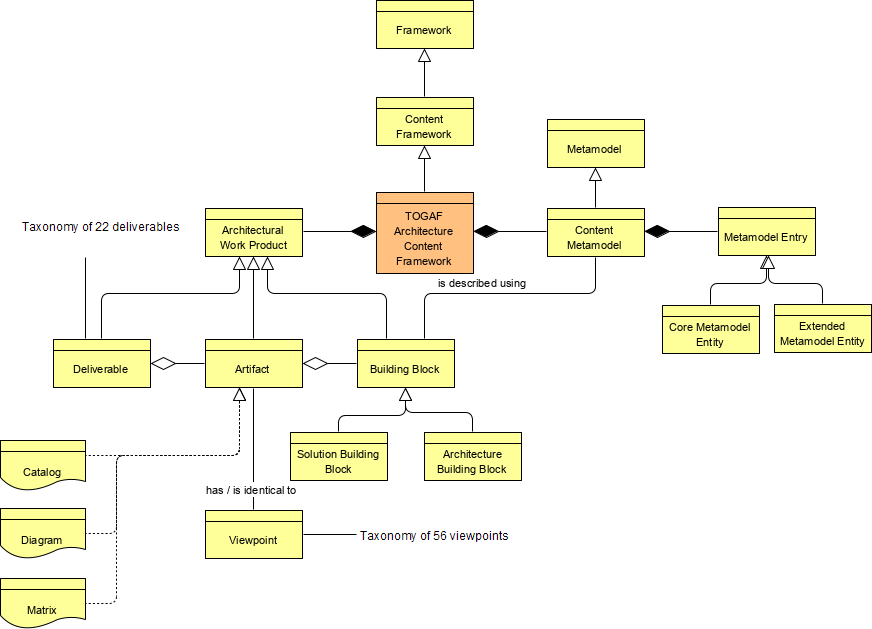
The Content Framework categorizes architectural work products into three distinct but related types: Deliverables, Artifacts, and Building Blocks. Understanding the hierarchy and relationship between these three is essential for any TOGAF practitioner.
1. Deliverables
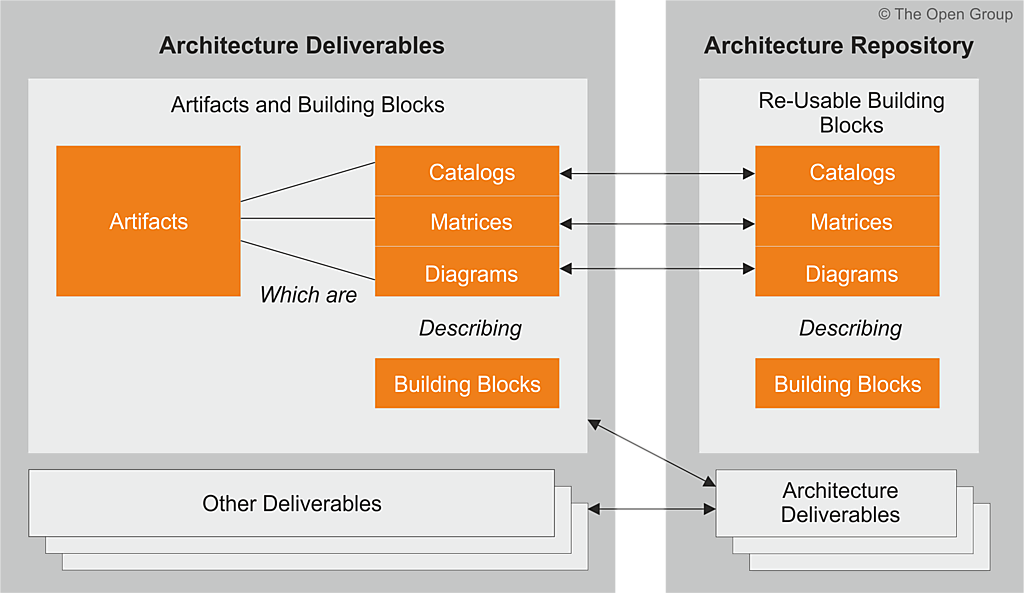
A deliverable is a high-level work product that is contractually specified. It is formally reviewed, agreed upon, and signed off by stakeholders. Deliverables represent the tangible outputs of an architecture project.
-
Characteristics: Formal, signed-off, archived, or transitioned into the Architecture Repository.
-
Purpose: To provide a snapshot of the Architecture Landscape at a point in time or to serve as a reference model or standard.
-
Example: An “Architecture Definition Document” or a “Migration Plan” submitted to the steering committee for approval.
2. Artifacts
An artifact is a specific architectural work product that describes a particular aspect of the architecture. Artifacts are the contents within a deliverable. They are generally classified into three types:
-
Catalogs: Lists of things.
-
Example: A Requirements Catalog listing all functional and non-functional requirements; a Service Catalog listing all business services.
-
-
Matrices: Showings of relationships between things.
-
Example: A Business Interaction Matrix showing which business units interact with each other; an Application/Data Matrix showing which applications manage which data entities.
-
-
Diagrams: Pictures of things.
-
Example: A Use-Case Diagram illustrating user interactions; a Network Diagram showing physical infrastructure connections.
-
Key Insight: A single deliverable (e.g., the Business Architecture Document) will contain many artifacts (e.g., a Business Process Diagram, a Role Catalog, and an Organization Chart).
3. Building Blocks
A building block represents a potentially re-usable component of business, IT, or architectural capability. Building blocks are the fundamental “Lego pieces” that artifacts describe and deliverables package.
-
Characteristics: Modular, re-usable, combinable.
-
Types:
-
Architecture Building Blocks (ABBs): Define the functionality and constraints (e.g., “Customer Relationship Management System”).
-
Solution Building Blocks (SBBs): The actual products or components that realize the ABBs (e.g., “Salesforce CRM”).
-
-
Example: A “Security Authentication Module” can be a building block used across multiple applications.
The TOGAF Content Metamodel
To ensure that building blocks are described consistently and their relationships are clear, TOGAF employs a Content Metamodel. This metamodel defines all the types of building blocks that may exist within an architecture and maps out how they relate to one another.
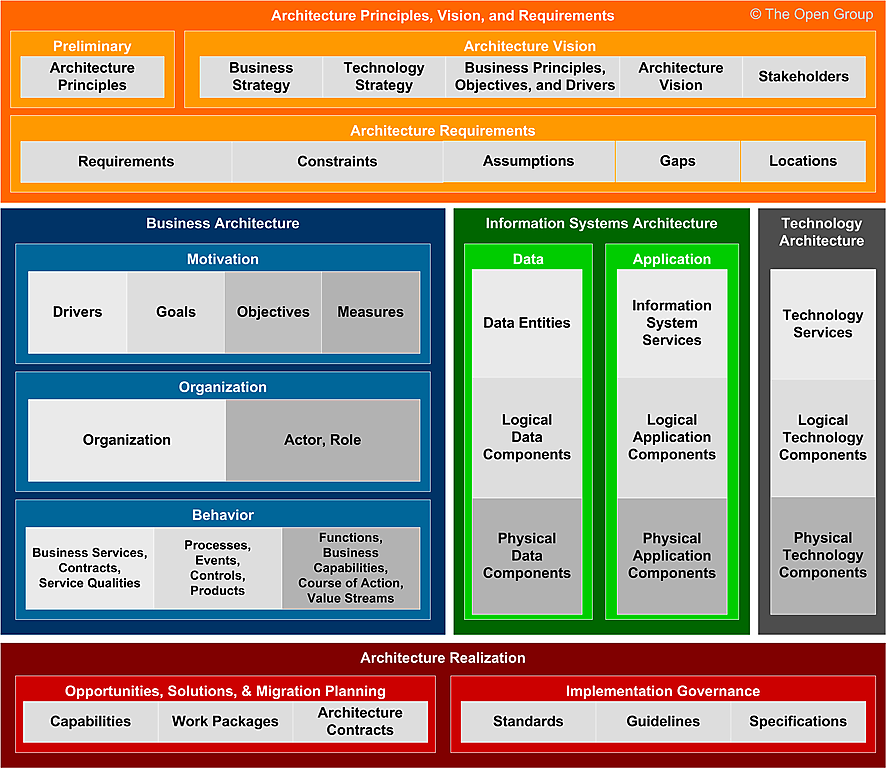
How the Metamodel Works
The metamodel identifies key architectural concerns and links them through logical relationships. For example:
-
Actors (Business Users) consume Business Services.
-
Business Services are realized by Applications.
-
Applications manage Data Entities.
-
Applications are supported by Technology components.
By defining these relationships, the metamodel ensures that when an architect creates an artifact (like a diagram), they are accurately representing the underlying structure of the enterprise. It prevents siloed thinking by forcing the architect to consider how a change in technology impacts data, which in turn impacts the business service delivered to the actor.
Practical Application of the Metamodel
When creating an architecture, the metamodel guides the selection of artifacts:
-
If you need to show who uses what, you create a matrix linking Actors to Business Services.
-
If you need to show how data flows, you create a diagram linking Applications to Data Entities.
Case Study: Modernizing Legacy Banking Systems at “FinCore Global”
To illustrate the practical application of the TOGAF ADM and Architecture Content Framework, consider FinCore Global, a mid-sized regional bank struggling with siloed legacy systems, inconsistent customer data, and slow time-to-market for new digital products. The CIO initiated an architecture transformation project using TOGAF to create a unified “Digital Banking Platform.”
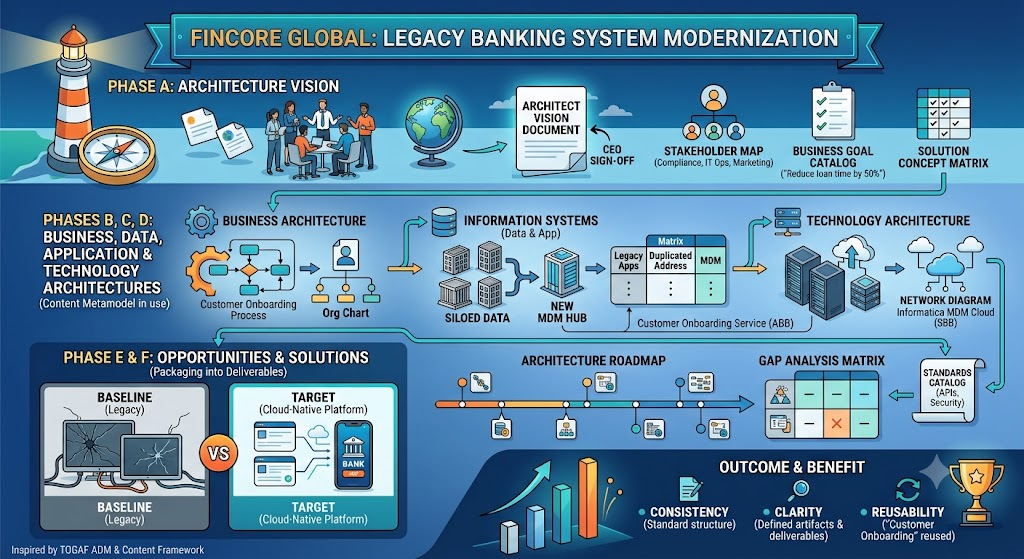
Phase A: Architecture Vision (Defining the Deliverable)
The architecture team began by defining the scope and stakeholders. The primary deliverable for this phase was the Architecture Vision Document, which required formal sign-off from the CEO and Head of Retail Banking.
-
Artifacts Created:
-
Diagram: A Stakeholder Map Diagram identifying key influencers (Compliance, IT Operations, Marketing).
-
Catalog: A Business Goal Catalog listing strategic objectives like “Reduce loan approval time by 50%.”
-
Matrix: A Solution Concept Matrix mapping high-level business needs to potential technology enablers.
-
Phase B-D: Business, Information Systems, and Technology Architectures (Leveraging Building Blocks)
As the team moved into defining the target architectures, they relied heavily on the Content Metamodel to ensure all relationships were captured.
-
Business Architecture:
-
Building Block Identified: “Customer Onboarding Service” (an Architecture Building Block – ABB).
-
Artifact: A Business Process Diagram showing the end-to-end flow of opening a new account.
-
Artifact: An Organization Chart (Catalog) linking roles to the new processes.
-
-
Data & Application Architecture:
-
Relationship Mapping: Using the metamodel, the team linked the “Customer Onboarding Service” to specific applications.
-
Artifact: An Application/Data Matrix revealing that customer address data was duplicated across three different legacy systems.
-
Building Block Defined: A new “Master Data Management (MDM) Hub” (ABB) was proposed to consolidate this data.
-
-
Technology Architecture:
-
Artifact: A Network Infrastructure Diagram showing how the new MDM Hub would sit within the secure cloud environment.
-
Building Block Realization: The abstract “MDM Hub” ABB was mapped to a specific Solution Building Block (SBB): Informatica MDM Cloud.
-
Phase E & F: Opportunities and Solutions (Packaging into Deliverables)
With the target architecture defined, the team needed to plan the migration. The key deliverable here was the Architecture Roadmap and Migration Plan.
-
Artifacts Created:
-
Matrix: A Gap Analysis Matrix comparing baseline artifacts (legacy systems) with target artifacts (cloud-native services).
-
Diagram: A Project Portfolio Diagram visualizing the sequence of implementation projects over three years.
-
Catalog: A Standards Catalog defining the approved APIs and security protocols for the new platform.
-
Outcome
By strictly adhering to the Content Framework, FinCore Global achieved:
-
Consistency: All diagrams and catalogs followed the same structure, making it easy for stakeholders to review.
-
Clarity: The distinction between artifacts (the detailed diagrams) and deliverables (the signed-off roadmap) ensured that governance checkpoints were clear.
-
Reusability: The “Customer Onboarding” building block was designed to be reused in future insurance and wealth management projects, reducing future development costs.
This case demonstrates how the ADM provides the steps to follow, while the Content Framework provides the standardized language and structure to communicate the architecture effectively.
Summary and Best Practices
The TOGAF ADM and Content Framework are inseparable partners in enterprise architecture. The ADM provides the roadmap, while the Content Framework provides the vehicle and the cargo.
-
Consistency is Key: Use the Content Framework to ensure that every architect in your organization produces outputs that look and feel the same.
-
Reusability: Focus on identifying and documenting Building Blocks. Re-using a proven security module or data model saves time and reduces risk.
-
Stakeholder Alignment: Remember that Deliverables are for sign-off. Ensure your artifacts clearly support the narrative required to get stakeholder buy-in.
-
Metamodel as a Guide: Use the Content Metamodel to check for completeness. Have you considered the technology supporting your application? Have you linked your application to the business service it enables?
Conclusion
Mastering the interplay between the TOGAF ADM and the Architecture Content Framework is essential for delivering high-quality, actionable enterprise architectures. By strictly defining deliverables, structuring artifacts into catalogs, matrices, and diagrams, and leveraging reusable building blocks guided by a robust content metamodel, architects can transform complex enterprise needs into clear, structured solutions.
For practitioners looking to implement these concepts efficiently, tooling plays a crucial role. Visual Paradigm offers comprehensive support for TOGAF, providing built-in templates for ADM phases, pre-defined artifact types, and visual modeling capabilities that align perfectly with the TOGAF Content Framework. By leveraging such tools, architects can focus less on formatting and more on designing robust, future-proof architectures that drive real business value.
