

Introduction
In an era where digital transformation is no longer optional but essential, organizations face the challenge of aligning complex IT landscapes with strategic business goals. TOGAF® (The Open Group Architecture Framework) emerges as the global standard for Enterprise Architecture (EA), providing a proven methodology to improve business efficiency, reduce complexity, and ensure consistent communication among professionals. This guide explores the core components of TOGAF, its iterative development method, and how modern software tools like Visual Paradigm streamline the implementation of these standards.
1. What is TOGAF?
TOGAF, introduced by The Open Group, is a globally recognized enterprise architecture framework. It provides a comprehensive approach for designing, planning, implementing, and governing an enterprise information technology architecture.
Key Characteristics
-
Iterative Process Model: Supported by industry best practices.
-
Reusable Assets: Offers a library of existing architecture assets to accelerate development.
-
Standardization: Ensures consistent methods, standards, and communication across EA professionals.
-
Holistic Approach: Covers planning, development, implementation, and maintenance.
Development Overview
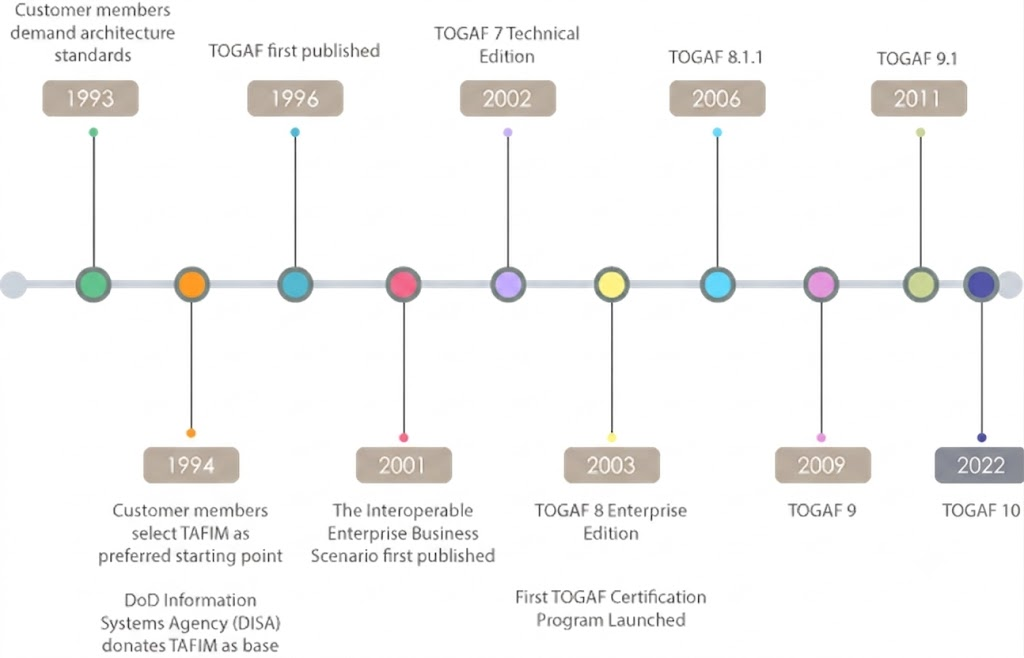
First published in 1995, TOGAF was originally based on the US Department of Defense’s Technical Architecture Framework for Information Management (TAFIM). Since then, The Open Group Architecture Forum has continuously refined and released successive versions to meet evolving industry needs.
2. Core Concepts: Defining Architecture
To understand TOGAF, one must first define “Architecture” within its context. TOGAF extends the standard definition—”the fundamental organization of a system”—into two distinct meanings:
-
A Formal Description: A detailed plan or blueprint at the component level to guide implementation.
-
A Structural View: The structure of components, their inter-relationships, and the principles governing their design and evolution.
What is Enterprise Architecture (EA)?
Enterprise Architecture is a well-defined practice for conducting enterprise analysis, design, planning, and implementation. It uses a holistic approach to execute strategy by aligning:
-
Business processes
-
Data & Information
-
Technology infrastructure
-
Partner relationships
-
Human resources (hiring and training)
The goal is to ensure all aspects of the enterprise work in alignment to achieve superior business performance.
3. The Structure of TOGAF
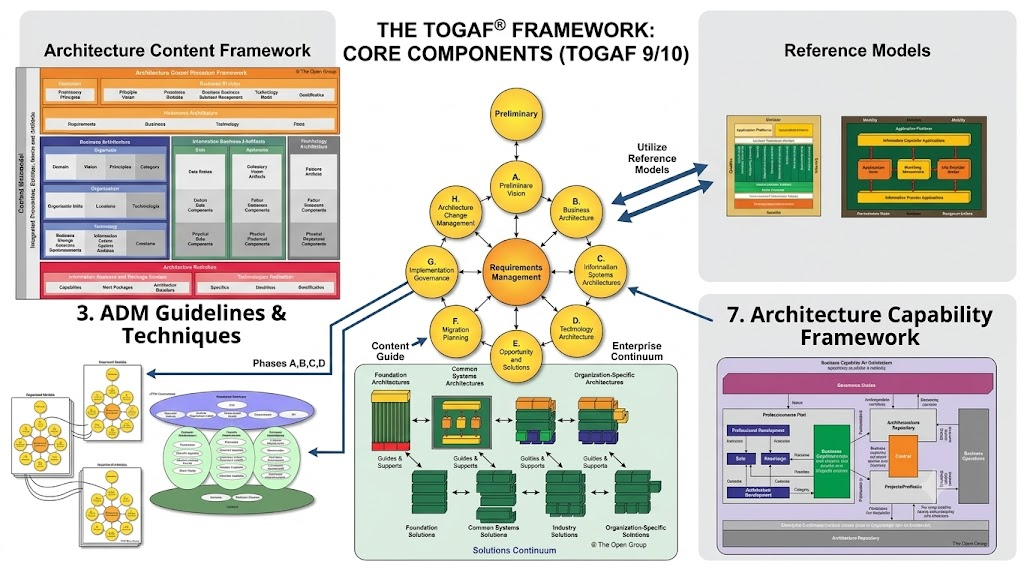
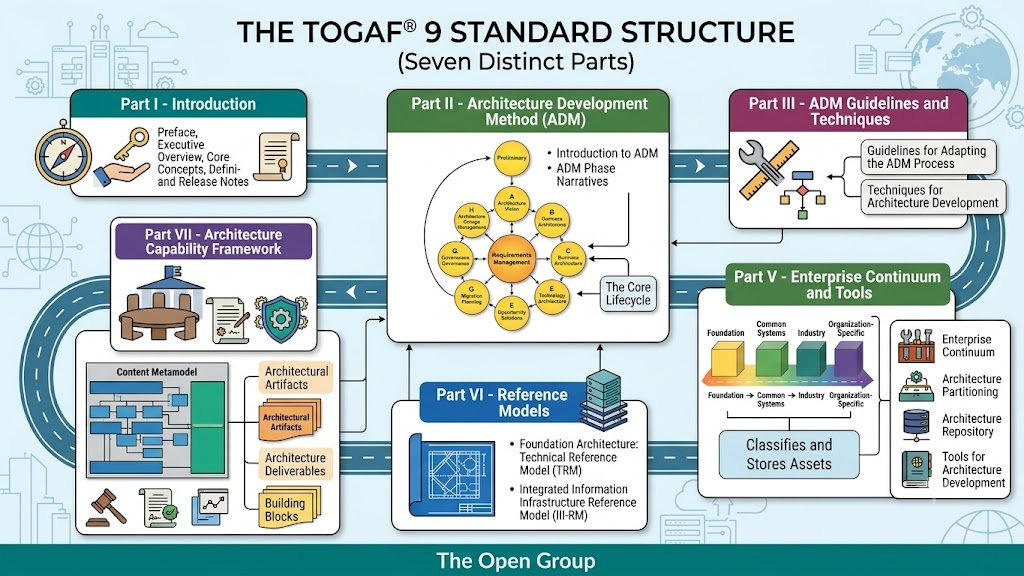
The TOGAF standard is divided into seven distinct parts, each serving a specific function in the architecture lifecycle.
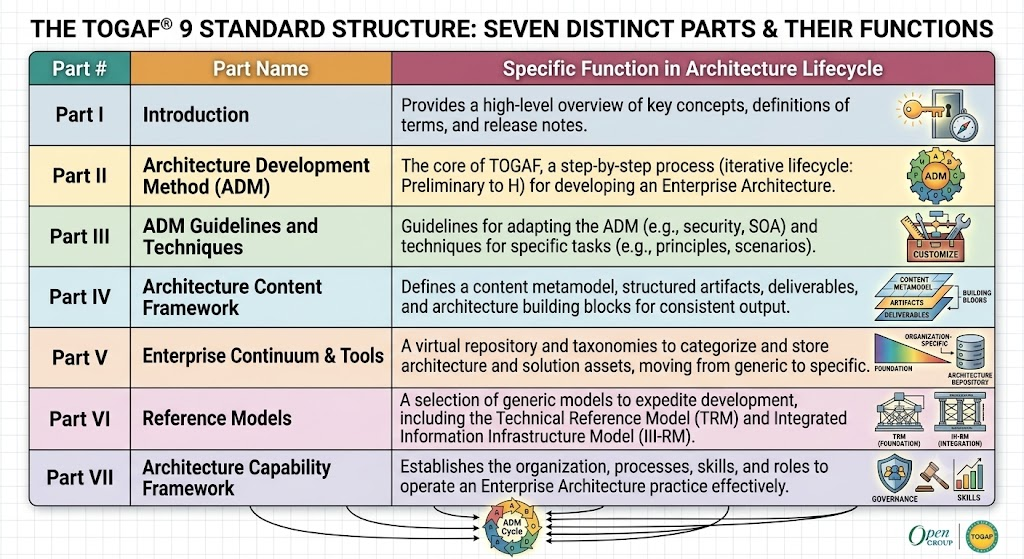
Part I: Introduction
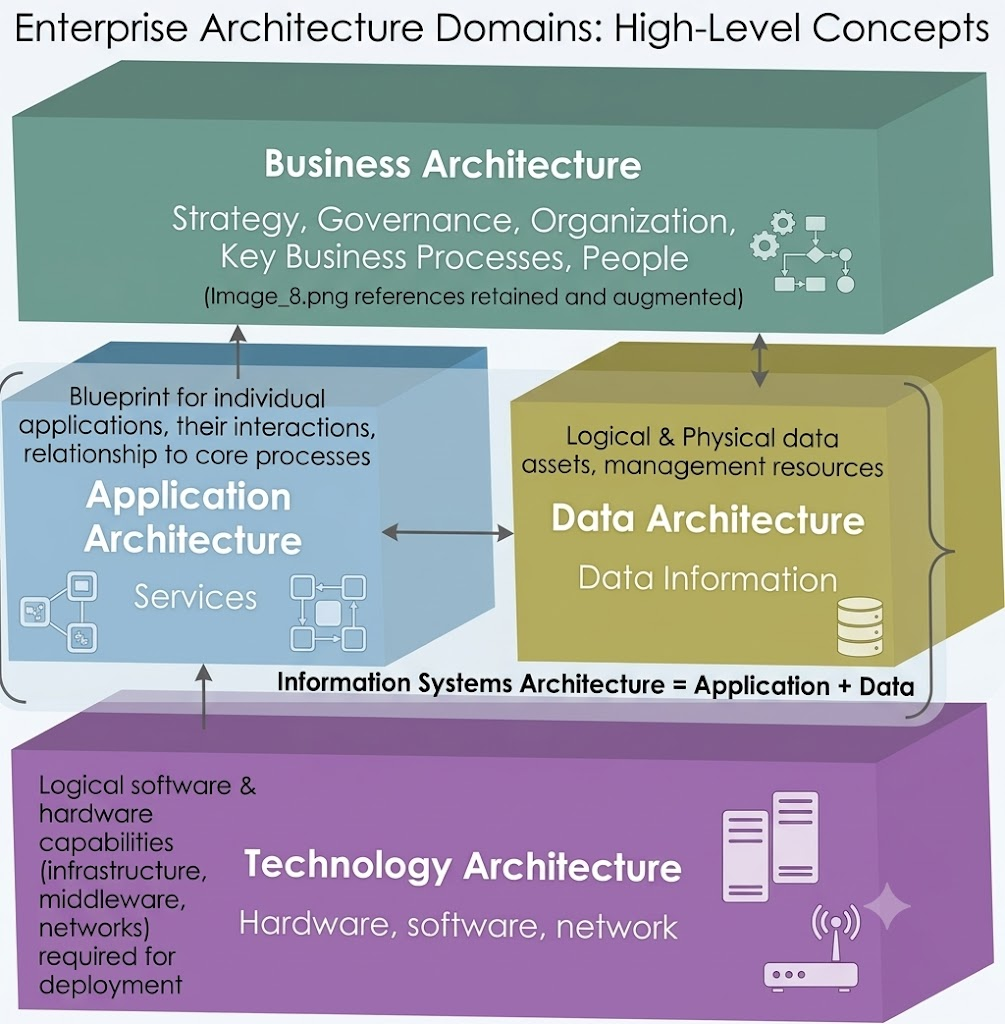
Provides high-level key concepts and defines the four primary architecture domains:
-
Business Architecture: Strategy, governance, organization, and key business processes.
-
Data Architecture: Logical and physical data assets and management resources.
-
Application Architecture: Blueprint for individual applications, their interactions, and relationship to core business processes.
-
Technology Architecture: Logical software and hardware capabilities (infrastructure, middleware, networks) required to support deployment.
Note: Information Systems Architecture = Data Architecture + Application Architecture.
Part II: Architecture Development Method (ADM)
The central core of TOGAF. It is a tested, repeatable process for developing architectures (detailed in Section 4).
Part III: ADM Guidelines and Techniques
Supports the application of the ADM by offering guidelines for adapting the method to different scenarios (e.g., security, iteration) and techniques for specific tasks (e.g., gap analysis, risk management).
Part IV: Architecture Content Framework
Describes the structured model of architectural work products, including deliverables, artifacts, and building blocks, driving greater consistency in outputs.
Part V: Enterprise Continuum & Tools
A model for structuring a virtual repository and classifying architecture and solution artifacts. It helps manage complexity by distinguishing between generic and specific architectures.
Part VI: TOGAF Reference Models
Provides foundational models, including the Technical Reference Model (TRM) and the Integrated Information Infrastructure Reference Model (III-RM), to jumpstart architecture development.
Part VII: Architecture Capability Framework
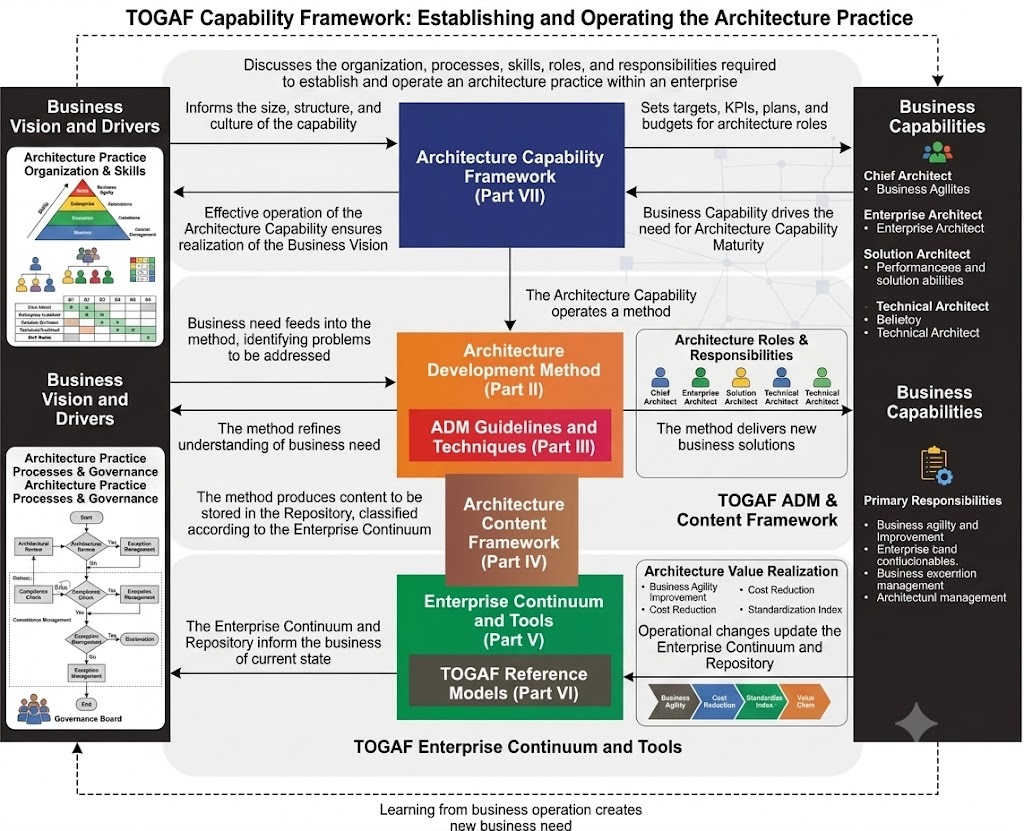
Discusses the organization, processes, skills, roles, and responsibilities required to establish and operate an architecture practice within an enterprise.
4. The Architecture Development Method (ADM)
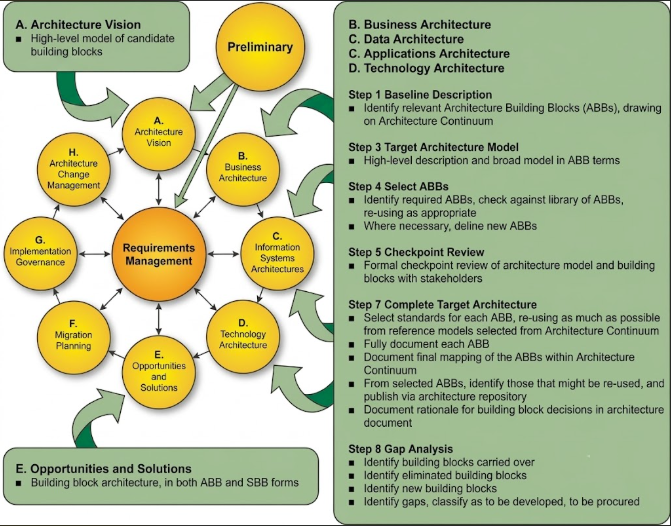
The ADM is the heart of TOGAF, often visualized as a cycle. It provides a step-by-step process for developing an enterprise architecture.
The ADM Phases
-
Preliminary Phase: Defining the “where, what, why, who, and how” of architecture in the organization.
-
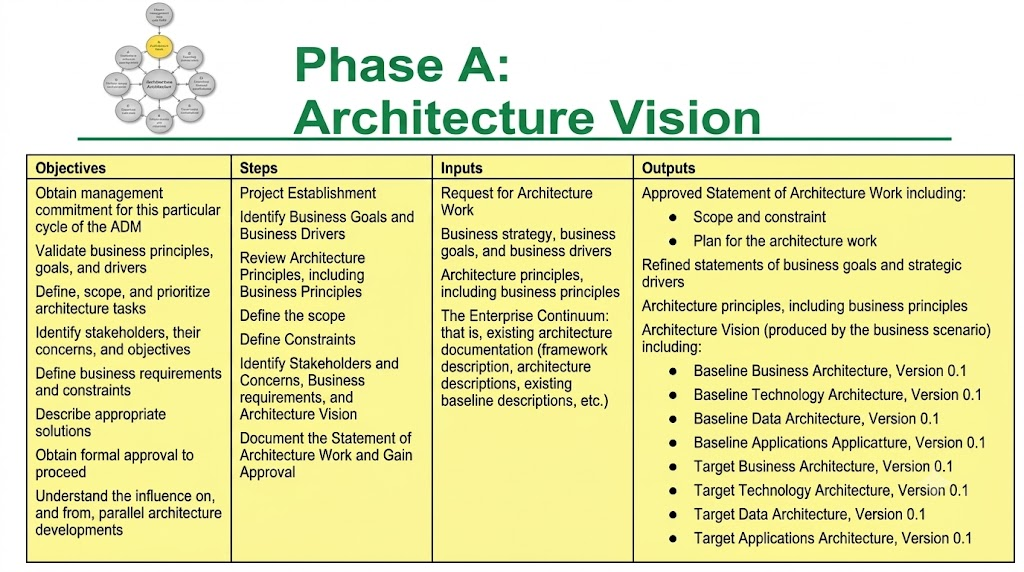
Phase A: Architecture Vision: Defining the scope, stakeholders, and high-level vision.
-
Phase B: Business Architecture: Developing the baseline and target business architecture.
-
Phase C: Information Systems Architectures: Developing Data and Application architectures.
-
Phase D: Technology Architecture: Developing the technology infrastructure architecture.
-
Phase E: Opportunities & Solutions: Identifying delivery vehicles and major work packages.
-
Phase F: Migration Planning: Prioritizing projects and creating a detailed implementation roadmap.
-
Phase G: Implementation Governance: Providing oversight during implementation.
-
Phase H: Architecture Change Management: Managing changes to the architecture post-implementation.
-
Requirements Management: A central process that ensures requirements are tracked throughout all phases.
ADM Narratives
Each phase follows a structured narrative consisting of four major sections to guide the architect, ensuring consistency and completeness in every step.
5. ADM Guidelines & Techniques
This section supports the ADM by providing flexibility and specific tools for common challenges.
Key Topics Covered:
-
Iteration in ADM: Adapting the linear process for agile or iterative needs.
-
Stakeholder Management: Identifying and engaging key players.
-
Gap Analysis: Comparing baseline and target architectures.
-
Risk Management & Security Architecture: Ensuring robustness and compliance.
-
Migration Planning Techniques: Strategies for moving from current to target state.
-
Business Scenarios: Deriving architectural requirements from business goals.
6. Architecture Content Framework
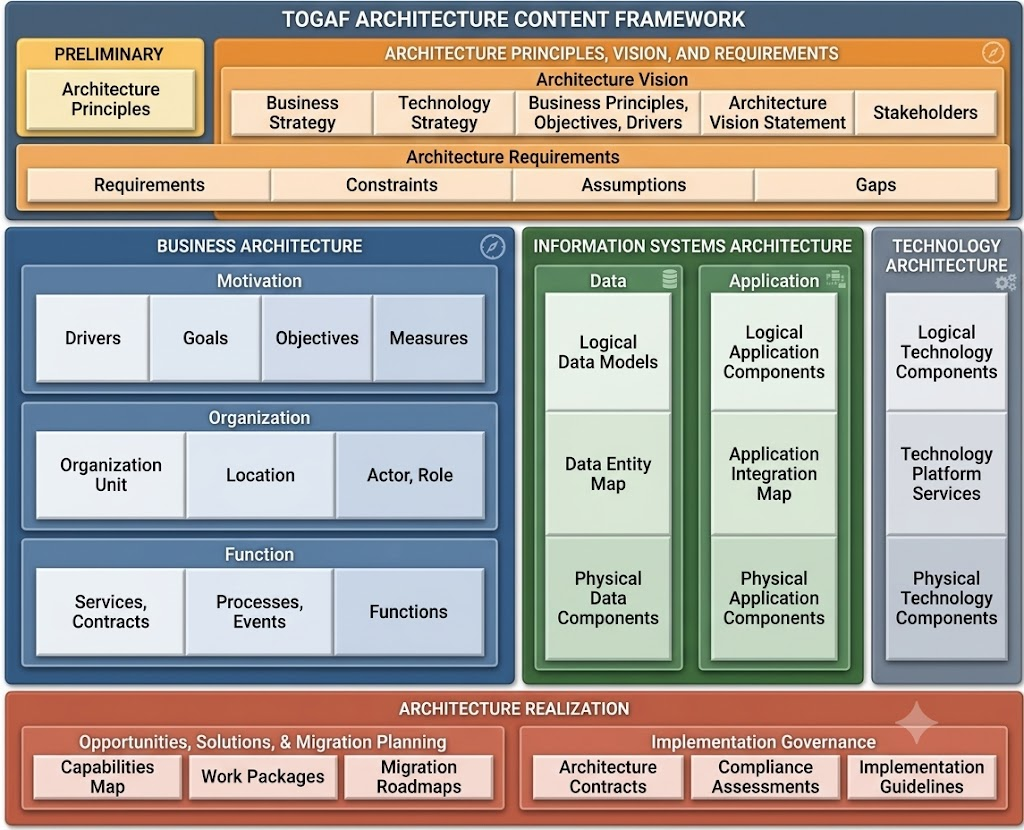
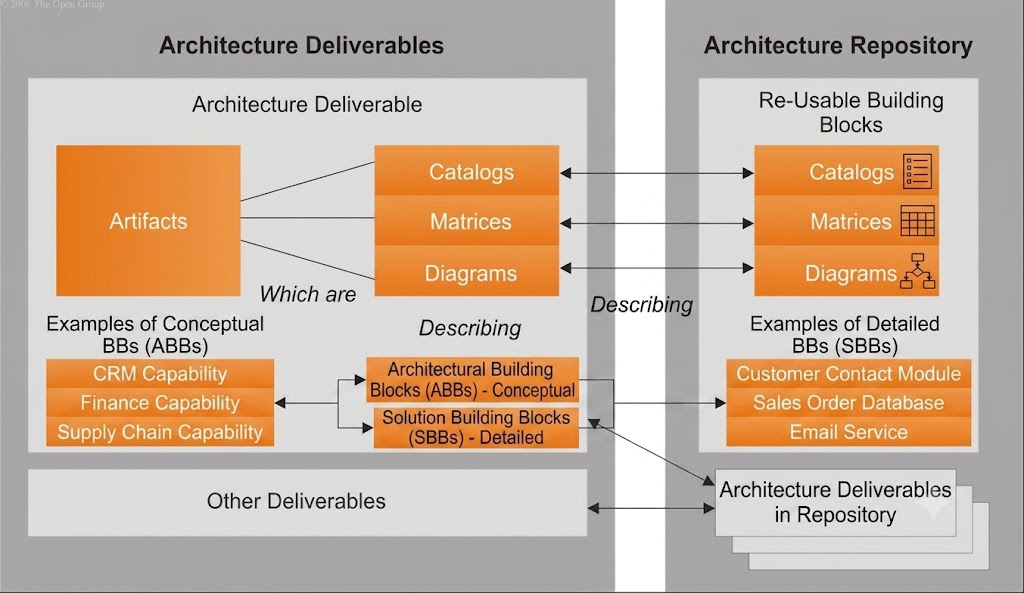
Introduced in TOGAF 9, this framework provides a detailed model of architectural work products. It categorizes outputs into three types:
1. Deliverables
Work products that are contractually specified and formally reviewed, agreed upon, and signed off by stakeholders. These are often archived in the Architecture Repository.
2. Artifacts
Work products that describe an aspect of the architecture. They are classified as:
-
Catalogs: Lists of things (e.g., list of applications).
-
Matrices: Relationships between things (e.g., application-to-function matrix).
-
Diagrams: Visual pictures of things (e.g., network diagrams).
3. Building Blocks
Packages of functionality defined to meet business needs. They can be conceptual (e.g., “CRM Capability”) or detailed (e.g., “Customer Contact Module”).
7. Enterprise Continuum & Tools
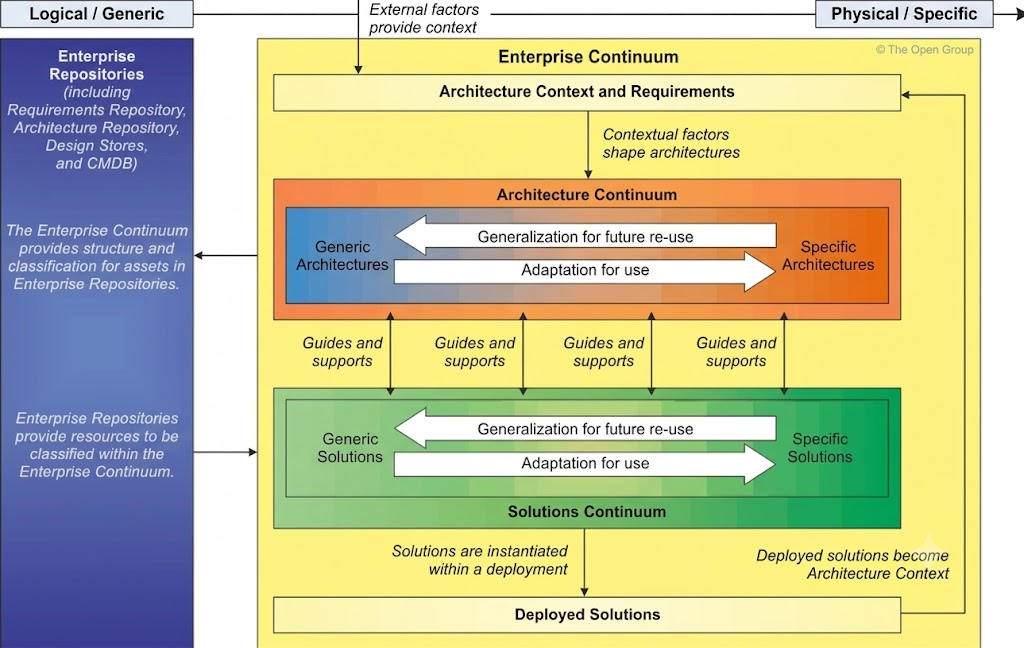
The Enterprise Continuum is a model for classifying architecture and solution artifacts, ranging from generic to specific.
Architecture vs. Solution Continuum
-
Architecture Continuum: The logical picture, moving from Foundation Architectures to Organization-Specific Architectures.
-
Solution Continuum: The physical realization, describing the actual solutions deployed.
Generic vs. Specific
The continuum allows architects to refine architectures from left (generic/logical) to right (specific/physical). This progression helps in reusing generic components while customizing specific solutions.
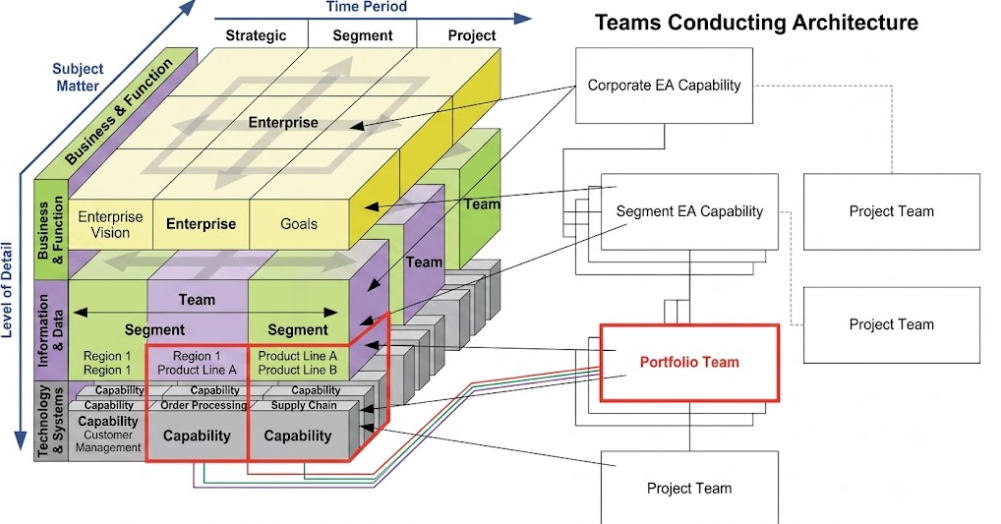
Partitioning
Architecture Partitioning divides the enterprise to manage cost and complexity, assigning roles and responsibilities to different units while maintaining an integration framework.
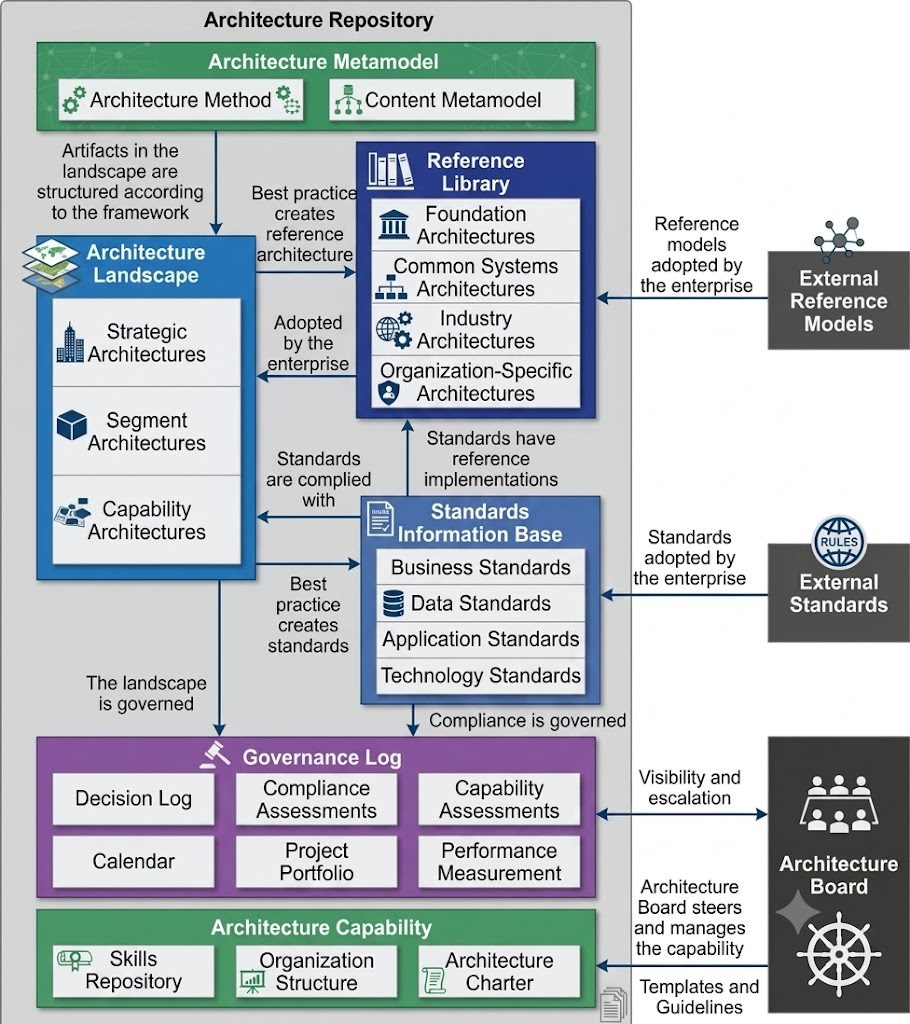
The Architecture Repository
A logical place to organize reference material and results. Key components include:
-
Architecture Metamodel: Tailored application of the framework.
-
Architecture Landscape: View of building blocks currently in use.
-
Standards Information Base (SIB): Standards new architectures must comply with.
-
Reference Library: Templates, patterns, and guidelines.
-
Governance Log: Record of governance activities.
8. Reference Models
TOGAF provides two key reference models to accelerate architecture development:
-
Technical Reference Model (TRM): A foundation architecture providing a taxonomy of generic platform services.
-
Integrated Information Infrastructure Reference Model (III-RM): A model focusing on boundary-less information flow and infrastructure applications.
These models relate to the Architecture Continuum, guiding the process from Foundation (TRM) through Common Systems (III-RM) to Industry and Organization-specific architectures.

9. Architecture Capability Framework
This framework addresses the “people and process” side of EA. It defines the organization, skills, roles, and responsibilities needed to operate an architecture practice.
Key Components:
-
Architecture Board: Oversees governance and maintains the architecture.
-
Architecture Compliance: Ensures projects align with the enterprise architecture.
-
Architecture Contracts: Agreements between partners and sponsors on deliverables.
-
Architecture Maturity Models: Tools to evaluate the organization’s current EA capability.
-
Skills Framework: Defines competency levels for architecture roles.
10. Implementing TOGAF with Visual Paradigm
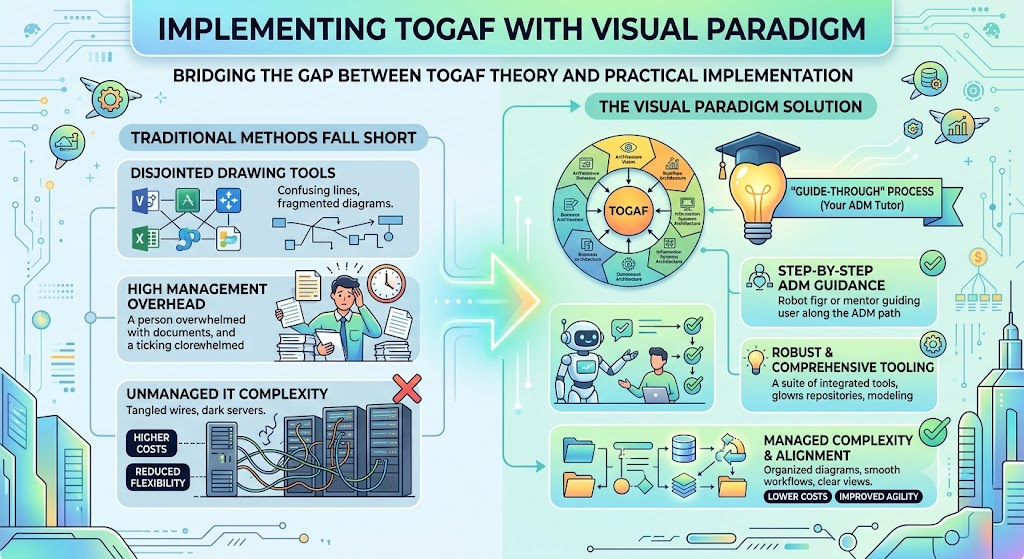
While TOGAF provides the methodology, executing it requires robust tooling. Unmanaged complexity in IT landscapes leads to higher costs and reduced flexibility. Visual Paradigm offers a comprehensive suite designed to bridge the gap between TOGAF theory and practical implementation.
Why Use Software for TOGAF?
Traditional methods involving disjointed drawing tools (like Visio) or expensive, rigid repository tools often fail due to management overhead. Visual Paradigm provides a “Guide-Through” process that acts like a tutor, guiding users step-by-step through the ADM.
Key Features of Visual Paradigm for TOGAF:
-
ADM Process Navigator: Guides users through each phase, activity, and step with instructions and samples.
-
Automated Deliverables: Generates reports and artifacts automatically upon phase completion.
-
Architecture Repository: Automatically archives deliverables for future reference.
-
ArchiMate 3 Integration: Fully certified support for ArchiMate 3, the open modeling language that complements TOGAF by providing standardized visualization for business, application, and technology layers.

Guide-Through vs. Just-In-Time (JIT) Processes
Visual Paradigm offers two flexible approaches to process management:
1. Guide-Through Process
Ideal for teams following standard methodologies strictly.
-
Sequential series of well-defined phases.
-
Progress indicators show completion status.
-
Automatic transcription of data between steps.
-
Task assignment and scheduling integrated into the workflow.

2. Just-In-Time (JIT) Process
Ideal for dynamic environments requiring flexibility.
-
Allows selection of pre-defined or custom work items as needed.
-
Form-based interface for quick data entry and automatic document generation.
-
Adaptable to different project sizes and domains without restrictive structures.

Conclusion
TOGAF remains the gold standard for Enterprise Architecture, offering a structured, iterative, and comprehensive framework for aligning IT with business strategy. By understanding its seven parts, mastering the ADM cycle, and leveraging the Architecture Content Framework, organizations can reduce complexity and drive value.
However, methodology alone is not enough. The successful adoption of TOGAF requires robust tooling that supports collaboration, automation, and standardization. Tools like Visual Paradigm, with their integration of ArchiMate 3 and guided ADM processes, empower architects to move from theoretical frameworks to actionable, compliant, and efficient enterprise architectures.
References
- Professional TOGAF ADM Tool: Features a guided process for developing enterprise architecture.
- What is TOGAF ADM?: Tutorial explaining the Architecture Development Method.
- Try Visual Paradigm FREE: Download link for the free version of the software.
- TOGAF ADM Guide-through: Details on the step-by-step guidance features.
- Just-in-Time TOGAF Templates: Information on flexible, form-based TOGAF implementation.
- ArchiMate Tools: Overview of certified ArchiMate 3 modeling capabilities.