

Introduction
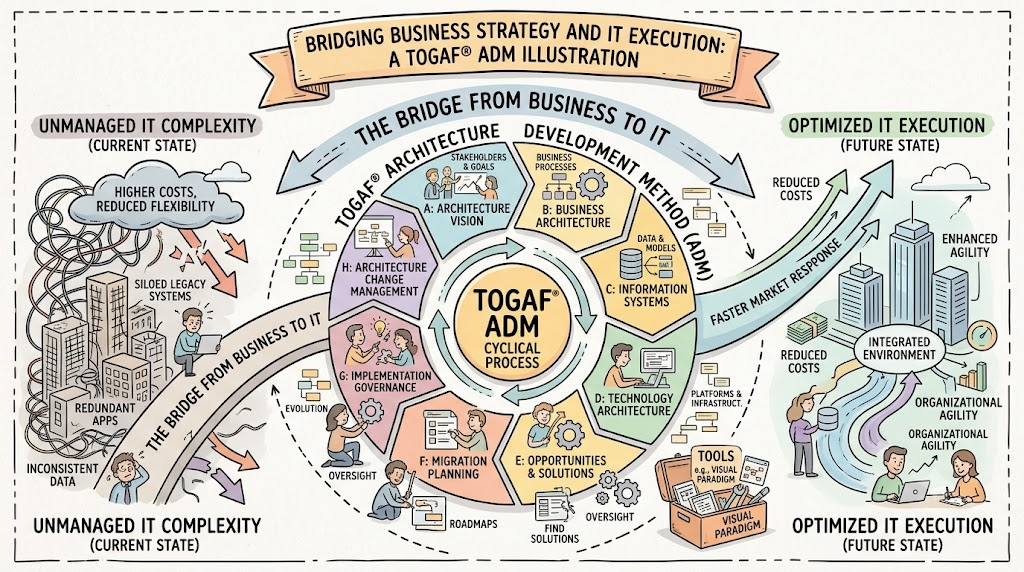
In today’s rapidly evolving digital landscape, organizations face increasing pressure to align their IT capabilities with business strategy. Unmanaged complexity in the IT landscape—characterized by siloed legacy systems, redundant applications, and inconsistent data—leads to higher costs, reduced flexibility, and an inability to respond to market changes.
Enterprise Architecture (EA) serves as the bridge between business strategy and IT execution. It transforms fragmented processes into an integrated environment, optimizing operations and enabling organizational agility. At the heart of modern EA practice lies TOGAF® (The Open Group Architecture Framework), a globally recognized standard for developing and managing enterprise architecture.
This guide explores how TOGAF’s Architecture Development Method (ADM) works in practice, illustrated through a real-world case study, and demonstrates how tools like Visual Paradigm can streamline the adoption of these complex frameworks.
Part 1: Understanding TOGAF and Its Benefits
What is TOGAF?
TOGAF stands for The Open Group Architecture Framework. It is not just a theoretical model but a comprehensive method for developing and managing the lifecycle of an enterprise architecture. TOGAF provides:
-
A detailed method for designing Business, Data, Application, and Technology architectures.
-
A set of supporting tools and techniques.
-
A common vocabulary and structure that ensures all stakeholders “speak the same language.”
Why Adopt TOGAF?
Organizations that implement TOGAF often realize significant benefits:
-
Reduced Complexity: Provides a better overview of the business landscape.
-
Strategic Alignment: Ensures IT initiatives directly support business vision and strategy.
-
Cost Efficiency: Saves time and money by identifying redundancies and optimizing resource utilization.
-
Risk Management: Offers clearer exposition of costs, benefits, and risks associated with different plans.
-
Reusability: Encourages the development of shared architectural components, reducing future development costs.
-
ROI: Achieves demonstrable return on investment through streamlined operations and faster time-to-market.
Part 2: The TOGAF Architecture Development Method (ADM)
The core of TOGAF is the Architecture Development Method (ADM). It is an incremental and iterative process that guides architects from high-level concepts to detailed implementation plans.
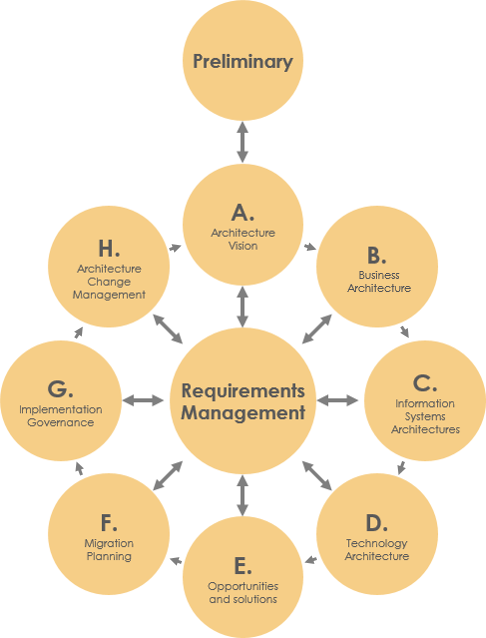
The ADM cycle progresses through several phases:
-
Preliminary Phase: Defining the “where, what, why, who, and how” of architecture work.
-
Phase A: Architecture Vision: Defining the scope, stakeholders, and high-level vision.
-
Phase B: Business Architecture: Defining the business strategy, governance, organization, and key business processes.
-
Phase C: Information Systems Architectures: Developing Data and Application architectures.
-
Phase D: Technology Architecture: Defining the hardware, software, and network infrastructure.
-
Phase E: Opportunities & Solutions: Identifying delivery vehicles and major work packages.
-
Phase F: Migration Planning: Creating a detailed implementation and migration plan.
-
Phase G: Implementation Governance: Providing oversight during implementation.
-
Phase H: Architecture Change Management: Managing changes to the architecture over time.
Part 3: Case Study – Modernizing Legacy Banking at “FinCore Global”
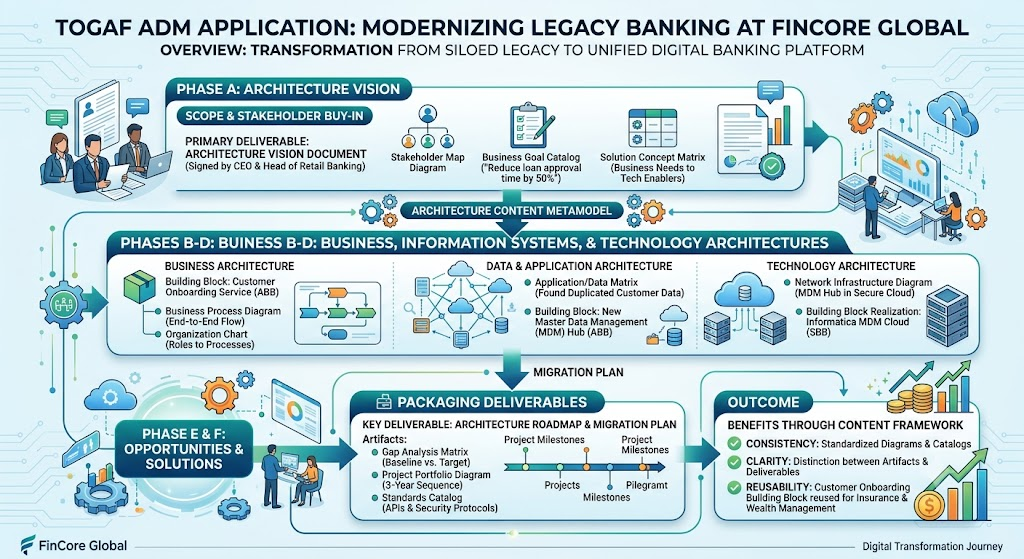
To illustrate the practical application of TOGAF ADM, let’s examine FinCore Global, a mid-sized regional bank struggling with siloed legacy systems and slow product launches. The CIO initiated a transformation project to create a unified “Digital Banking Platform.”
Phase A: Architecture Vision (Defining the Deliverable)
The team began by defining the scope and securing stakeholder buy-in. The primary deliverable was the Architecture Vision Document, signed off by the CEO and Head of Retail Banking.
Artifacts Created:
-
Stakeholder Map Diagram: Identified key influencers such as Compliance, IT Operations, and Marketing.
-
Business Goal Catalog: Listed strategic objectives, e.g., “Reduce loan approval time by 50%.”
-
Solution Concept Matrix: Mapped high-level business needs to potential technology enablers.
Phase B-D: Business, Information Systems, and Technology Architectures
As the team defined target architectures, they used the Content Metamodel to ensure all relationships were captured accurately.
Business Architecture
-
Building Block Identified: “Customer Onboarding Service” (an Architecture Building Block – ABB).
-
Artifact: A Business Process Diagram showing the end-to-end flow of opening a new account.
-
Artifact: An Organization Chart linking roles to the new processes.
Data & Application Architecture
-
Relationship Mapping: Linked the “Customer Onboarding Service” to specific applications.
-
Artifact: An Application/Data Matrix revealed that customer address data was duplicated across three legacy systems.
-
Building Block Defined: A new “Master Data Management (MDM) Hub” (ABB) was proposed to consolidate this data.
Technology Architecture
-
Artifact: A Network Infrastructure Diagram showing how the new MDM Hub would sit within a secure cloud environment.
-
Building Block Realization: The abstract “MDM Hub” ABB was mapped to a specific Solution Building Block (SBB): Informatica MDM Cloud.
Phase E & F: Opportunities and Solutions (Packaging into Deliverables)
With the target architecture defined, the team planned the migration. The key deliverable was the Architecture Roadmap and Migration Plan.
Artifacts Created:
-
Gap Analysis Matrix: Compared baseline artifacts (legacy systems) with target artifacts (cloud-native services).
-
Project Portfolio Diagram: Visualized the sequence of implementation projects over three years.
-
Standards Catalog: Defined approved APIs and security protocols for the new platform.
Outcome
By strictly adhering to the Content Framework, FinCore Global achieved:
-
Consistency: All diagrams and catalogs followed the same structure.
-
Clarity: Clear distinction between artifacts (detailed diagrams) and deliverables (signed-off documents).
-
Reusability: The “Customer Onboarding” building block was designed for reuse in future insurance and wealth management projects.
Part 4: The Role of ArchiMate in TOGAF
While TOGAF describes the process of developing architecture, it does not mandate a specific modeling language. This is where ArchiMate® comes in.
ArchiMate is an open and independent modeling language for Enterprise Architecture, also maintained by The Open Group. It is designed to be complementary to TOGAF.

Why Combine TOGAF and ArchiMate?
-
Unambiguous Visualization: ArchiMate allows architects to describe, analyze, and visualize relationships among business domains clearly.
-
Standardization: As a certified standard, it ensures consistency across different teams and projects.
-
Alignment: ArchiMate 3 was specifically improved to align with TOGAF, making it easier to map ArchiMate elements to TOGAF content metamodel entities.
Part 5: Choosing the Right Tool – Why Visual Paradigm?
Implementing TOGAF and ArchiMate manually can be daunting. Many organizations struggle with:
-
High-Cost EA Tools: Often provide only tree-like repositories with rigid templates.
-
Generic Drawing Tools (e.g., Visio): Require excessive manual management and lack integration between diagrams and data.
Visual Paradigm offers a unique approach by combining powerful modeling capabilities with guided process automation.

Key Features of Visual Paradigm for TOGAF
-
ADM Process Navigator: Acts like a tutor, guiding users step-by-step through each phase of the TOGAF ADM.
-
Automated Deliverable Generation: Generates reports and deliverables automatically upon completion of phases.
-
Architecture Repository: Automatically archives deliverables for easy retrieval and governance.
-
Comprehensive Toolset: Includes ArchiMate 3 diagrams, Implementation Plan Diagrams, Migration Roadmaps, RACI Charts, and Gap Analysis Matrices.
Two Process Management Approaches
Visual Paradigm supports two types of process management to suit different organizational needs:
1. Guide-Through Process
Ideal for well-defined methodologies like TOGAF.
-
Step-by-Step Guidance: Embedded instructions, samples, and input references.
-
Progress Tracking: Shows completion status for phases, activities, and steps.
-
Automation: Transcribes data from one step to another and carries forward deliverables as inputs.
-
Task Management: Assigns activities to team members with schedules and roles.

2. Just-In-Time (JIT) Process
Ideal for dynamic, flexible projects where strict methodology may be too restrictive.
-
Flexibility: Allows teams to select pre-defined or custom Work Items as needed.
-
Customization: Can be tailored to fit different project sizes and domains.
-
Ease of Use: Inline instructions and samples mean no extensive training is required.

Conclusion
Enterprise Architecture is no longer optional for organizations seeking to thrive in a digital-first world. By adopting TOGAF, companies gain a structured, proven method for aligning IT with business strategy. When combined with ArchiMate for visualization and a robust tool like Visual Paradigm for execution, the complexity of EA is significantly reduced.
Whether you choose the structured Guide-Through Process for strict compliance or the flexible Just-In-Time Process for agile adaptation, the goal remains the same: to create an integrated, efficient, and responsive enterprise architecture that drives real business value.
