

Introduction
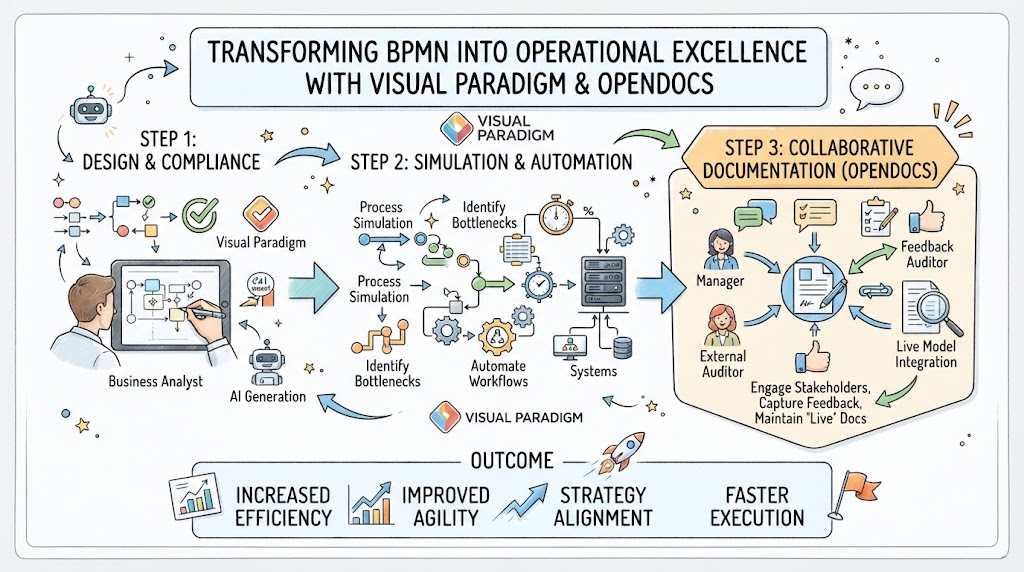
Business Process Model and Notation (BPMN) 2.0 has established itself as the universal language for process mapping, yet organizations frequently struggle to bridge the gap between static diagrams and active business strategy. Visual Paradigm addresses this challenge by providing a comprehensive environment that combines strict standard compliance with advanced automation and artificial intelligence. Beyond simple drawing, the platform serves as a dynamic ecosystem where business analysts and technical teams can design, simulate, and automate professional workflows.
A critical differentiator in this ecosystem is Visual Paradigm OpenDocs. While many tools stop at diagram creation, OpenDocs extends the lifecycle into collaborative documentation, stakeholder feedback, and live model integration. This guide explores how to leverage Visual Paradigm’s core modeling features alongside OpenDocs to create a seamless, collaborative process modeling workflow. By integrating AI generation, simulation, and interactive documentation, teams can transform BPMN from a documentation exercise into a driver of operational excellence.
Key Concepts in Modern BPMN Modeling
Before diving into specific tips, it is essential to understand the foundational capabilities that distinguish professional BPMN tooling from basic flowchart software.
-
AI-Driven Narrative Translation: The ability to convert unstructured text descriptions directly into editable, standards-compliant BPMN diagrams, significantly reducing initial modeling time.
-
Hierarchical Process Decomposition: The practice of managing complexity through drill-down functionality, allowing high-level strategic views to coexist with detailed operational sub-processes.
-
Dynamic Simulation & KPI Validation: Moving beyond visual representation to test process logic mathematically, identifying bottlenecks and resource constraints before implementation.
-
Live Documentation Integration: The concept of embedding source models directly into documents so that updates to the diagram automatically propagate to all published reports and guides.
-
Cross-Discipline Traceability: Linking BPMN elements natively to UML, ERD, and UI wireframes to ensure alignment between business processes, data architecture, and system design.
Core Modeling Guidelines and AI Features
Visual Paradigm provides specialized features designed to enforce best practices while accelerating development. Adhering to these guidelines ensures your models are both compliant and actionable.
Leveraging the AI Text-to-BPMN Generator
One of the most powerful entry points for new models is the AI Text-to-BPMN generator. Instead of manually dragging shapes, users can input plain-text narrative descriptions of a workflow. The AI instantly constructs an editable diagram complete with appropriate gateways, tasks, and flows. This feature is particularly useful for capturing “As-Is” processes during stakeholder interviews or rapidly prototyping “To-Be” scenarios. However, treat AI output as a draft; always validate against BPMN 2.0 semantics to ensure logical correctness.
Mastering Process Drill-Down
Complex processes become unreadable when crammed into a single canvas. Use the Process Drill-Down feature to collapse intricate sub-processes into a single shape. This maintains a clean top-level view for executive stakeholders while preserving detailed operational logic in child diagrams. When expanding these collapsed shapes, ensure that input and output data objects are correctly mapped between the parent and child levels to maintain end-to-end traceability.
Smart Connectors and Flow Types
Manual routing often leads to non-compliant diagrams. Utilize Smart Connectors to automatically generate sequence flows, message flows, and data associations. The tool enforces BPMN rules regarding which elements can be connected, preventing common modeling errors such as connecting a message flow to an internal task. For data-centric processes, pay special attention to Data Object mastery; configure inputs, outputs, and stores with specific metadata states to accurately reflect information lifecycles.
As-Is vs. To-Be Analysis
Effective process improvement requires clear baselines. Replicate current process models to establish an “As-Is” baseline, then use branching or versioning to design “To-Be” optimization models. Visual Paradigm allows you to contrast these models side-by-side, making it easier to quantify improvements and communicate change impacts to stakeholders.
Advanced Technical Capabilities for Practitioners
For teams integrating BPMN with broader enterprise architecture or software development, Visual Paradigm offers deep technical interoperability.
Cross-Standard Mapping and Code Generation
Business processes rarely exist in isolation. Use cross-standard mapping to link BPMN tasks directly to UML use cases, ERD entities, or UI wireframes. This traceability ensures that when a business requirement changes, the impact on data models and user interfaces is immediately visible. Furthermore, finalized visual models can be transformed into development-ready code skeletons or database schemas, reducing translation errors between business analysts and developers.
Process Simulation for Validation
Never deploy a redesigned process without testing. The built-in Process Simulation engine validates workflows dynamically by calculating KPIs such as cycle time, cost, and resource utilization. This allows you to identify structural bottlenecks and validate that your “To-Be” model actually delivers the expected performance improvements under realistic load conditions.
Visual Paradigm OpenDocs: Collaborative Documentation and Feedback
OpenDocs is the collaborative backbone of the Visual Paradigm ecosystem, addressing the often-neglected post-modeling phase of review and delivery.
Integrating Live Models into OpenDocs
Unlike traditional word processors where diagrams are static images, OpenDocs embeds live models. When a BPMN diagram is updated in the central repository, every OpenDoc referencing that diagram reflects the change automatically. This eliminates version control nightmares and ensures stakeholders are always reviewing the current state of the process.
Stakeholder Feedback Workflows
Collaborative BPMN requires structured feedback mechanisms. OpenDocs supports multi-user real-time co-editing and comment threads directly attached to specific diagram elements or document sections. Establish a feedback workflow where reviewers can annotate concerns, suggest optimizations, or approve changes without leaving the document environment. This keeps contextual discussions tied to the visual model rather than lost in email chains.
Dynamic Report Generation and Export
Deliverables matter. Use Dynamic Documentation to auto-generate formal business reports from your live models. Whether exporting to PDF for archival, HTML for web-based sharing, or Word for further editing, the export formats retain the integrity of the underlying model data. This capability streamlines the creation of standard operating procedures, compliance documentation, and training materials.
Cloud Collaboration and Version Control
For distributed teams, cloud collaboration features enable real-time co-editing with instant team sharing. Cloud-based version control tracks every modification, allowing teams to revert to previous states or compare historical versions. This is essential for maintaining audit trails in regulated industries and for managing concurrent workstreams in large-scale transformation projects.
Conclusion
Visual Paradigm transcends traditional BPMN drawing tools by integrating AI-assisted modeling, rigorous simulation, and collaborative documentation into a unified platform. By adhering to guidelines around hierarchical decomposition, smart connectivity, and data object configuration, practitioners can create models that are both standards-compliant and operationally relevant. The addition of OpenDocs transforms these models from isolated artifacts into living components of organizational knowledge, enabling continuous stakeholder engagement and streamlined delivery. Embracing this comprehensive approach ensures that BPMN initiatives deliver tangible value, bridging the persistent gap between business strategy and technical execution.
Relevant Articles and Resources
-
Comprehensive Guide to BPMN Visual Paradigm Tooling AI and Ecosystem: Overview of Visual Paradigm’s BPMN features including AI integration and ecosystem capabilities
-
From Narrative to Diagram How Visual Paradigms AI BPMN Generator Transforms Process Modeling Workflows: Step-by-step guide on using AI to convert text descriptions into editable BPMN diagrams
-
Mastering BPMN Data Objects A Comprehensive Guide to Modeling Information Flow in Business Processes: Detailed tutorial on configuring data inputs outputs and stores within BPMN models
-
Mastering BPMN Flow Types A Comprehensive Guide for Visual Paradigm Users: Explanation of sequence message and data association flows with compliance best practices
-
BPMN Diagram and Tools Feature Overview: Official feature summary covering modeling simulation and automation capabilities