


Introduction
In today’s rapidly evolving business landscape, digital transformation has emerged as a critical imperative for organizations seeking to remain competitive and relevant. The fusion of technology with traditional processes promises increased efficiency, improved customer experiences, and new avenues for growth. However, embarking on this journey is not without its challenges. In this article, we will explore strategies for successful digital transformation, helping you navigate the complex terrain of technological change and emerge as a digitally empowered and future-ready enterprise.
While Business Process Model and Notation (BPMN) is frequently associated with process modeling, UML Swimlane Activity Diagrams offer a powerful, standardized alternative rooted in software engineering and systems analysis. By leveraging swimlanes to represent organizational units, roles, or systems, UML Activity diagrams provide exceptional clarity regarding who does what, making them ideal for identifying responsibility gaps during digital transformation initiatives.
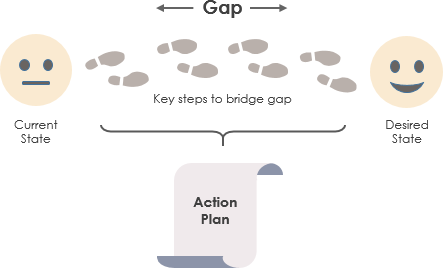
Key Concepts: As-Is, To-Be, and Gap Analysis
Business improvement often begins with a thorough analysis of current processes, identifying areas for enhancement, and envisioning a more efficient future state. This process involves three key stages: As-Is analysis, To-Be analysis, and Gap analysis. Let’s delve into each of these concepts within the context of UML Swimlane Activity modeling:
1. As-Is Analysis
-
Definition: As-Is analysis, also known as current state analysis, involves a comprehensive examination and documentation of an organization’s existing processes, systems, and workflows using UML Activity diagrams partitioned by swimlanes.
-
Purpose: The primary goal is to gain a deep understanding of how things currently operate. Swimlanes explicitly map responsibilities to specific actors (e.g., “Sales Rep,” “Legacy System”), highlighting handoffs and potential silos.
-
Methodology:
-
Swimlane Mapping: Creating UML Activity diagrams where vertical or horizontal partitions represent departments, roles, or external entities.
-
Data Collection: Gathering quantitative and qualitative data related to the activities within each lane, such as cycle times, error rates, and resource utilization.
-
Stakeholder Interviews: Engaging with individuals represented in the swimlanes to gather insights, feedback, and pain points regarding cross-lane interactions.
-
2. To-Be Analysis
-
Definition: To-Be analysis, or future state analysis, involves envisioning and designing an improved version of the existing processes using optimized UML Swimlane Activity diagrams.
-
Purpose: The objective is to create a vision of how processes should ideally function. In UML, this often involves adding new swimlanes for automated systems, merging lanes to reduce handoffs, or introducing fork/join nodes for parallel processing.
-
Methodology:
-
Process Redesign: Reimagining workflows by restructuring swimlanes to eliminate bottlenecks and optimize resource allocation.
-
Technology Integration: Adding new system swimlanes (e.g., “ERP,” “WMS”) to represent automation and integration points.
-
Performance Metrics: Defining KPIs tied to specific activities or transitions within the diagram.
-
Change Management: Planning the transition from the old swimlane structure to the new one, including training for roles that have shifted lanes.
-
3. Gap Analysis
-
Definition: Gap analysis involves comparing the As-Is and To-Be UML Activity diagrams to identify discrepancies between the current and desired future states.
-
Purpose: It serves as a critical step to understand what needs to change. In UML terms, this means identifying missing activities, new swimlanes, removed manual tasks, or altered control flows.
-
Methodology:
-
Diagram Comparison: Structurally compare the As-Is and To-Be UML models. Look for structural changes in partitions and behavioral changes in activity nodes.
-
Gap Identification: Identify specific differences, such as manual activities replaced by system actions, new integration interfaces, or eliminated approval loops.
-
Prioritization: Prioritize gaps based on their impact on the critical path and feasibility of implementation.
-
Action Plan: Develop a detailed roadmap to bridge the gaps, specifying which UML elements need to be developed, configured, or retired.
-
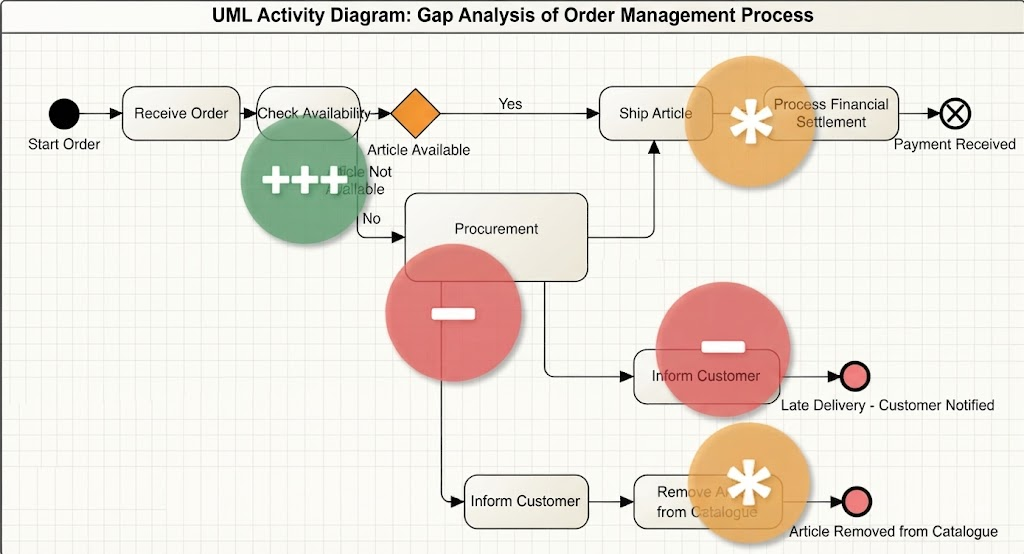
As-Is, To-Be, and Gap analyses are essential components of business improvement efforts. They provide organizations with a structured approach to evaluate their current operations, design more efficient and effective future states, and bridge the divide between the two. By implementing the insights gained through these analyses, businesses can enhance their processes, drive innovation, and ultimately achieve their strategic objectives.
Example: Inventory System (As-Is / To-Be / Gap) with UML Swimlane Activity Diagrams
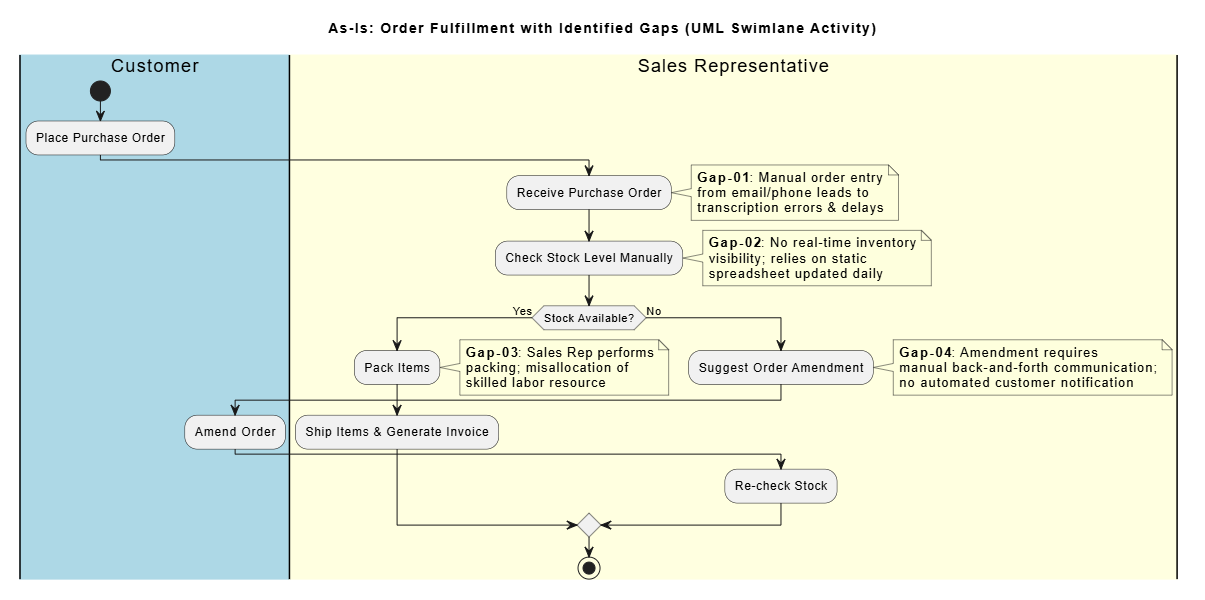
This problem involves an online shop that sells goods and its current order fulfillment process. The process starts when a sales representative receives a purchase order from a customer and involves checking the stock level, packing the items if they are in stock, and shipping them along with an invoice. If there is insufficient stock, the sales representative suggests amending the purchase order. Below, we model this using PlantUML Swimlane Activity Diagrams.
As-Is Process (UML Swimlane Activity)
The current state relies heavily on the Sales Representative lane, with minimal system support.
@startuml
title As-Is: Order Fulfillment with Identified Gaps (UML Swimlane Activity)

|#LightBlue|Customer|
start
:Place Purchase Order;

|#LightYellow|Sales Representative|
:Receive Purchase Order;

note right
  **Gap-01**: Manual order entry
  from email/phone leads to
  transcription errors & delays
end note

:Check Stock Level Manually;

note right
  **Gap-02**: No real-time inventory
  visibility; relies on static
  spreadsheet updated daily
end note

if (Stock Available?) then (Yes)
  :Pack Items;

  note right
    **Gap-03**: Sales Rep performs
    packing; misallocation of
    skilled labor resource
  end note

  :Ship Items & Generate Invoice;
else (No)
  :Suggest Order Amendment;

  note right
    **Gap-04**: Amendment requires
    manual back-and-forth communication
  end note

  |#LightBlue|Customer|
  :Amend Order;
  |#LightYellow|Sales Representative|
  :Re-check Stock;
endif

stop
@enduml
Note: While the image above illustrates the conceptual As-Is flow, the PlantUML code provided demonstrates how to formally model this using UML Swimlane Activity syntax, emphasizing role-based partitioning.
To-Be Process (UML Swimlane Activity)
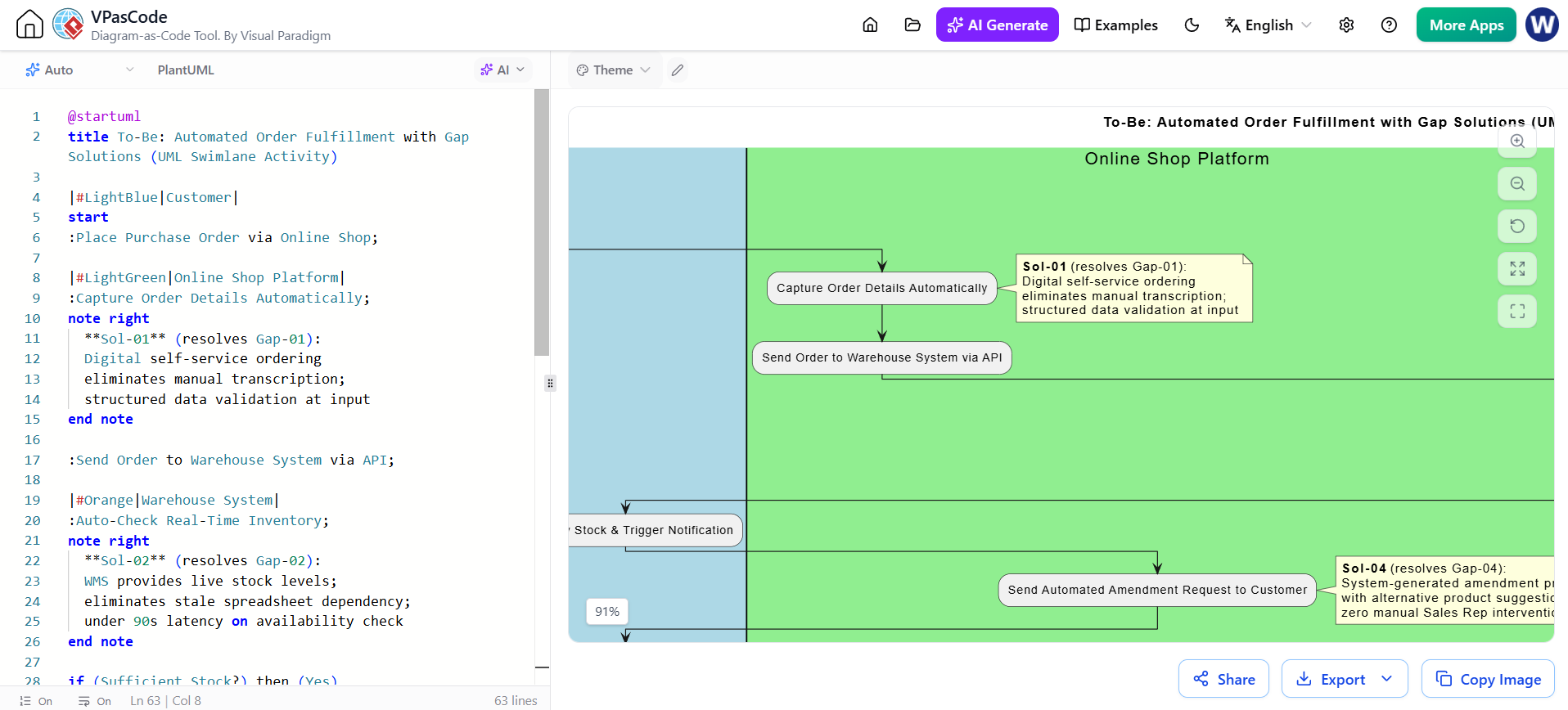
With the introduction of a warehouse and automated inventory management, the UML diagram shifts significantly. A new Warehouse System swimlane is introduced, and manual decision nodes are replaced by system-driven logic.
@startuml
title To-Be: Automated Order Fulfillment with Gap Solutions (UML Swimlane Activity)

|#LightBlue|Customer|
start
:Place Purchase Order via Online Shop;

|#LightGreen|Online Shop Platform|
:Capture Order Details Automatically;
note right
  **Sol-01** (resolves Gap-01):
  Digital self-service ordering
  eliminates manual transcription;
  structured data validation at input
end note

:Send Order to Warehouse System via API;

|#Orange|Warehouse System|
:Auto-Check Real-Time Inventory;
note right
  **Sol-02** (resolves Gap-02):
  WMS provides live stock levels;
  eliminates stale spreadsheet dependency;
  <90s latency on availability check
end note

if (Sufficient Stock?) then (Yes)
  :Allocate Inventory & Trigger Packing;

  |#Purple|Warehouse Staff|
  :Pick & Pack Items;
  note right
    **Sol-03** (resolves Gap-03):
    Dedicated warehouse staff handle
    fulfillment; Sales Reps freed for
    revenue-generating customer engagement
  end note

  :Confirm Shipment Scan;

  |#Orange|Warehouse System|
  :Generate Invoice & Tracking Number;
  |#LightBlue|Customer|
  :Receive Automated Confirmation & Invoice;
else (No)
  :Flag Low Stock & Trigger Notification;

  |#LightGreen|Online Shop Platform|
  :Send Automated Amendment Request to Customer;
  note right
    **Sol-04** (resolves Gap-04):
    System-generated amendment prompt
    with alternative product suggestions;
    zero manual Sales Rep intervention
  end note

  |#LightBlue|Customer|
  :Amend Order via Self-Service Portal;
endif

stop
@enduml
Note: The image above depicts the target state conceptually. The accompanying PlantUML code provides the precise UML Swimlane Activity specification, clearly delineating the new system boundaries and automated decision points.
Identifying the Gaps
By comparing the two PlantUML diagrams, we can extract actionable gaps:
| Gap Category | As-Is State | To-Be State | Action Required |
|---|---|---|---|
| Role/Swimlane | Single “Sales Rep” lane handles all logic | New “Warehouse System” and “Warehouse Staff” lanes | Implement WMS; redefine job descriptions |
| Activity Type | Manual “Check Stock Level” | Automated “Auto-Check Real-Time Inventory” | Integrate API between Shop and WMS |
| Control Flow | Sequential manual decision | System-driven fork/join for parallel notification | Configure event-driven architecture |
| Data Handoff | Verbal/email amendment suggestion | System-triggered customer notification | Build customer portal notification module |
Benefits of the To-Be Process
-
Efficiency: Automation and real-time inventory management make the process more efficient, reducing delays caused by stock checking.
-
Resource Relief: Sales representatives no longer need to manually check stock levels, allowing them to focus on customer interactions and order management.
-
Inventory Accuracy: The warehouse integration ensures better control and accuracy in inventory management, reducing the chances of overstocking or stockouts.
-
Customer Satisfaction: Faster order processing and fewer order amendments lead to improved customer satisfaction.
Transitioning from the As-Is to the To-Be process involves automating inventory management and integrating a warehouse to improve efficiency, reduce errors, and enhance the overall customer experience. Using UML Swimlane Activity diagrams makes these transitions explicit, traceable, and directly mappable to system requirements.
Conclusion: Bridging the Path to Business Excellence
In the realm of business improvement, the journey from the current state to a future state of excellence begins with a profound understanding of where you are, where you want to be, and how to get there. The trifecta of As-Is, To-Be, and Gap analyses serves as the compass, map, and guide along this transformative path.
As-Is analysis lays bare the inner workings of your organization, unveiling the intricacies of your processes and systems through clearly partitioned UML swimlanes. It is a snapshot in time, capturing the present with precision and honesty. To-Be analysis, on the other hand, is the visionary’s canvas where you paint the picture of a better tomorrow. It’s where innovation and optimization take root, creating the blueprint for your business’s evolution—now expressed in rigorous, implementable UML models.
But it is Gap analysis that bridges the gap between the present and the future. It is the place where aspirations meet reality, where strategies meet execution, and where plans meet action. When performed with UML Swimlane Activity diagrams, Gap analysis transforms abstract differences into concrete development tasks, configuration changes, and organizational adjustments.
In this triad of analyses, we find not just a methodology but a philosophy. It is a commitment to growth, adaptability, and staying ahead in a dynamic business landscape. It is the recognition that complacency breeds stagnation, while change fuels progress.
As you embark on your own journey of business improvement, remember that these analyses are not endpoints but waypoints. They are tools for transformation, guiding you toward operational excellence, enhanced customer experiences, and lasting success. So, embrace the power of As-Is, To-Be, and Gap analyses through the lens of UML Swimlane Activity diagrams. Embrace the journey from understanding to innovation to execution. By doing so, you’re not just improving your business; you’re shaping its future, one insightful diagram at a time.