Mastering the TOGAF ADM Cycle: Visualizing Architecture Governance with Visual Paradigm
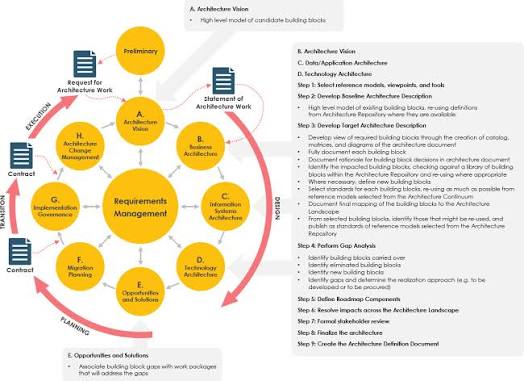
The TOGAF Architecture Development Method (ADM) is not merely a linear checklist; it is a dynamic, iterative engine for enterprise transformation. As illustrated in the architectural cycle diagram, the ADM relies on a central core of Requirements Management to ensure that every architectural decision aligns with the organization’s strategic goals.
In this tutorial, we will deconstruct the eight phases of the ADM (from Preliminary to Architecture Change Management), analyze the critical role of the Requirements Management core, and explore how modern tools like Visual Paradigm streamline this complex workflow.
1. The Core Engine: Requirements Management
At the heart of the diagram lies the Requirements Management module. Unlike the other phases which follow a sequential “P” (Planning) or “E” (Execution) flow, the Requirements Management circle is continuous. It operates throughout the entire ADM cycle.
Key Functions:
- Continuous Validation: It ensures that the architecture being built solves the actual problem, not just the perceived one.
- Traceability: It acts as the bridge between high-level business strategy and technical implementation details.
- Change Control: As the enterprise evolves, requirements change; this core ensures the architecture adapts without losing alignment.
2. The Planning Phases (P): Setting the Vision
The “Planning” side of the cycle prepares the ground for the actual development work. These phases focus on definition, strategy, and high-level design.
Phase A: Architecture Vision
This phase is the initiation point. The goal is to define the scope, identify stakeholders, and obtain a high-level sign-off. It answers the question: “What are we trying to achieve and why?”
- Input: Request for Architecture Work.
- Output: Architecture Vision, Statement of Architecture Work, and Stakeholder Map.
Phase B: Business Architecture
Here, the team describes the current and future business environments. This includes mapping business capabilities, value streams, and organizational structures. It ensures that the IT strategy supports the business strategy.
Phase C: Data & Application Architecture
This phase dives deeper into the logical structure of the system.
- Data Architecture: Defines information flows, data entities, and governance policies.
- Application Architecture: Maps the applications required to support the business, their interactions, and interfaces.
Phase D: Technology Architecture
Finally, the physical environment is defined. This covers the hardware, software, cloud strategies, and network capabilities needed to run the applications identified in Phase C.
3. The Execution Phases (E): Delivering Value
The “Execution” side of the cycle focuses on moving from the “Target State” back to the “Current State” by bridging the gap with concrete solutions.
Phase E: Opportunities and Solutions
This phase converts the architectural gaps into work packages. It involves assessing the complexity and value of different solution approaches. A key concept here is the Transition Architecture—an intermediate state that allows for manageable, incremental migration rather than a risky “big bang” approach.
Phase F: Migration Planning
Once solutions are identified, Phase F creates the implementation roadmap. It prioritizes work packages based on value, cost, and risk, ensuring the organization is ready for the change.
Phase G: Implementation Governance
Architecture work does not end at the drawing board. Phase G ensures that the actual projects being built adhere to the approved architecture. It involves review boards, design reviews, and standards compliance checks.
4. The Iterative Loop: Change Management
Finally, Phase H: Architecture Change Management ensures the architecture remains relevant. Organizations operate in dynamic environments where regulations, competitors, and technologies evolve. This phase monitors the architecture’s performance and initiates new cycles of the ADM as needed.
Visualizing the Cycle with Visual Paradigm
Modern Enterprise Architecture tools like Visual Paradigm offer a robust ADM framework that automates many of these transitions. By utilizing the “VPasCode” feature or integrated modelers, architects can visualize these complex relationships dynamically.
For instance, when defining the Architecture Vision, Visual Paradigm allows you to link stakeholder concerns directly to the business capabilities in Phase B. When designing the Data Architecture, you can generate ER diagrams that automatically link to the Application Architecture services.
The diagram you reviewed serves as a high-level map. In Visual Paradigm, this is realized as an interactive model where a change in the “Requirements” core automatically flags potential impacts on the “Business Architecture” and “Technology Architecture” phases.
Conclusion
The TOGAF ADM is a powerful methodology for managing complex enterprise change, but its true value lies in the iterative nature of the cycle. By continuously managing requirements and bridging the gap between business and technology, organizations can achieve agility and strategic alignment.
To leverage the full potential of the ADM cycle, it is highly recommended to adopt modern tooling that supports both visual modeling and rigorous data management. Specifically, the use of Visual Paradigm TOGAF ADM & AI Assisted features provides a significant advantage. These tools not only automate the generation of standard architecture artifacts but also use AI to assist in gap analysis and requirements validation, ensuring that the architecture remains a living, breathing capability rather than a static document.