


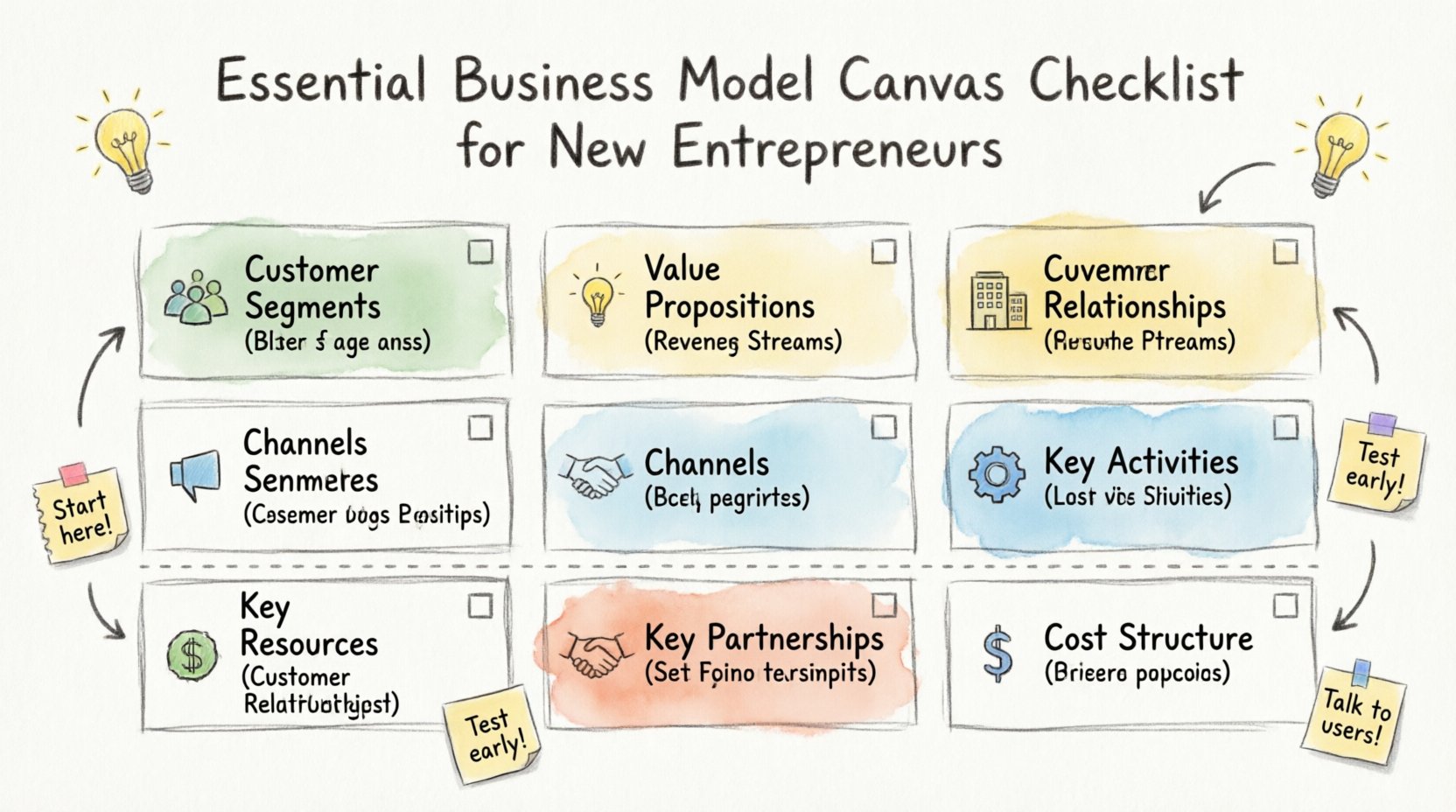
Starting a new venture requires more than just a good idea. It demands a structured approach to understanding how your business creates, delivers, and captures value. The Business Model Canvas (BMC) offers a visual framework that breaks down these complexities into manageable components. This comprehensive guide serves as a checklist for new entrepreneurs to validate their concepts before committing significant resources.
By systematically addressing each of the nine building blocks, you can identify gaps in your strategy and ensure alignment between your operations and market needs. This document is designed to walk you through the process without relying on external software or expensive consultants.
Why Use a Business Model Canvas? 🧠
Traditional business plans often span dozens of pages and can become outdated quickly. The BMC condenses this information into a single page, allowing for rapid iteration. It focuses on the essentials of the business rather than administrative details.
- Visual Clarity: See the entire business at a glance.
- Flexibility: Easy to update as you learn more about the market.
- Alignment: Ensures all team members understand the core strategy.
- Focus: Highlights critical dependencies and assumptions.
The 9 Building Blocks Explained 🧩
Before diving into the details, it is helpful to understand the structure of the canvas. The model is divided into four main areas: infrastructure, offering, customers, and finances. Below is a structured overview to guide your thinking.
| Building Block | Category | Core Question |
|---|---|---|
| Customer Segments | Front Stage | Who are we creating value for? |
| Value Propositions | Offering | What problem are we solving? |
| Channels | Front Stage | How do we reach our customers? |
| Customer Relationships | Front Stage | How do we interact with them? |
| Revenue Streams | Back Stage | How do we make money? |
| Key Activities | Back Stage | What must we do daily? |
| Key Resources | Back Stage | What assets do we need? |
| Key Partnerships | Back Stage | Who helps us succeed? |
| Cost Structure | Back Stage | What are our main costs? |
1. Customer Segments 👥
Every business exists to serve a specific group of people or organizations. Identifying these segments is the foundation of your model. Without a clear target audience, marketing efforts become scattered and inefficient.
Types of Segments
- Mass Market: No distinct segmentation, serving everyone (e.g., consumer goods).
- Niche Market: Focused on a specific group with unique needs (e.g., specialized software).
- Segmented: Distinct groups with different requirements (e.g., banking services for individuals vs. corporations).
- Multisided Platforms: Two or more interdependent customer groups (e.g., credit card users and merchants).
Checklist Questions
- Who are our most important customers?
- What are their specific pain points?
- How do they currently solve these problems?
- What are their preferences regarding service and product delivery?
- Are there underserved segments in this market?
2. Value Propositions 💡
This block describes the bundle of products and services that create value for a specific customer segment. It is the reason why customers choose you over competitors. A strong value proposition addresses a customer need better than any alternative.
Elements of Value
- Innovation: Creating new markets or solving problems in new ways.
- Performance: Higher speed, reliability, or features.
- Customization: Tailoring the service to individual needs.
- Design: Aesthetics and usability.
- Price: Cost leadership or value-for-money positioning.
- Convenience: Ease of use and accessibility.
- Brand Status: Social recognition or prestige.
Validation Steps
- Define the specific problem being solved.
- Ensure the solution is tangible and measurable.
- Compare your offering against existing alternatives.
- Check if the value is communicated clearly to the customer.
3. Channels 📢
Channels are how a company communicates with and reaches its customer segments to deliver a value proposition. This includes both touchpoints for communication and delivery mechanisms for the product.
Channel Phases
- Awareness: How do customers learn about the product?
- Evaluation: How do customers assess the value proposition?
- Purchase: How do customers buy the product?
- Delivery: How does the product reach the customer?
- After Sales: How is support and service provided?
Channel Characteristics
When selecting channels, consider cost, reach, and customer experience. Direct channels offer more control but higher costs. Indirect channels expand reach but reduce margin. A mix is often the most effective strategy.
4. Customer Relationships 🤝
This block defines the types of relationships a company establishes with specific customer segments. Relationships can range from personal assistance to automated services. They drive customer acquisition, retention, and upselling.
Relationship Types
- Personal Assistance: Human interaction at various stages.
- Personal Automation: Automated interactions with a human touch (e.g., personalized emails).
- Self-Service: No direct human interaction.
- Automated Services: Fully automated, no human contact.
- Communities: Creating a platform for users to interact.
- Co-creation: Users help create the value.
Key Considerations
- What is the cost of acquiring a new customer?
- What is the cost of retaining an existing customer?
- Does the relationship model fit the customer segment’s expectations?
- How will feedback be collected and acted upon?
5. Revenue Streams 💰
This represents the cash a company generates from each customer segment. It is crucial to understand how value is monetized. Revenue can come from asset sales, usage fees, subscription fees, lending, renting, licensing, brokerage fees, or advertising.
Pricing Mechanisms
- Fixed Pricing: Prices do not change based on demand.
- Dynamic Pricing: Prices fluctuate based on demand, time, or customer type.
- Yield Management: Maximizing revenue by selling the right product to the right customer at the right time.
- Value-Based Pricing: Pricing based on the perceived value to the customer.
Revenue Questions
- For what value are customers willing to pay?
- How do they currently pay?
- How much does each revenue stream contribute to overall revenues?
- Is the pricing sustainable given the cost structure?
6. Key Resources 🏢
Key resources are the assets required to make a business model work. These can be physical, intellectual, human, or financial. Without these resources, the value proposition cannot be delivered.
Resource Categories
- Physical: Buildings, vehicles, machines, retail locations.
- Intellectual: Brands, patents, copyrights, databases, customer information.
- Human: Staff, management, specialized skills.
- Financial: Cash, lines of credit, stock options.
Assessment
- Which resources are most critical to the value proposition?
- Are these resources owned or leased?
- Do we have the talent required to execute the plan?
- What are the risks associated with resource scarcity?
7. Key Activities ⚙️
Key activities are the most important things a company must do to make its business model work. These vary depending on the business type. For example, a manufacturing firm focuses on production, while a software company focuses on development.
Activity Types
- Production: Designing, making, and delivering a product in significant quantities.
- Solution: Creating and delivering individualized customer solutions.
- Platform/Network: Maintaining the platform and ensuring it functions correctly.
Strategic Focus
- What activities are required to deliver the value proposition?
- Which activities are the most costly?
- Can these activities be outsourced to reduce burden?
- How do these activities align with key resources?
8. Key Partnerships 🤝
Partnerships are networks of suppliers and partners that make the business model work. Companies form partnerships to optimize efficiency, reduce risk, or acquire resources they do not possess.
Types of Partnerships
- Strategic Alliances: Partnerships between non-competitors.
- Coopetition: Strategic partnerships between competitors.
- Joint Ventures: Partners develop new businesses together.
- Buyer-Supplier Relationships: Ensuring reliable supply of inputs.
Why Partner?
- To optimize and economize.
- To reduce risk and uncertainty.
- To acquire specific resources and activities.
- To access new markets.
9. Cost Structure 💸
The cost structure describes all costs incurred to operate a business model. It is defined by the key resources, activities, and partnerships. Understanding costs is vital for profitability.
Cost Drivers
- Cost-Driven: Focus on minimizing costs as much as possible (e.g., low-cost airlines).
- Value-Driven: Focus on creating premium value, where cost is secondary (e.g., luxury brands).
Cost Types
- Fixed Costs: Remain constant regardless of output (e.g., rent, salaries).
- Variable Costs: Vary directly with production volume (e.g., raw materials, shipping).
- Economies of Scale: Costs decrease as volume increases.
- Economies of Scope: Costs decrease when producing a variety of products.
Validating Your Canvas 🧪
Creating the canvas is only the first step. The next phase is validation. You must test your assumptions against reality. This involves talking to potential customers, running small experiments, and gathering data.
- Hypothesis Testing: Treat each block as a hypothesis to be proven or disproven.
- MVP Development: Build a Minimum Viable Product to test the value proposition.
- Feedback Loops: Establish mechanisms to collect customer feedback continuously.
- Pivot or Persevere: Be prepared to change direction based on evidence.
Common Pitfalls to Avoid 🚫
Even with a structured checklist, entrepreneurs often make mistakes. Being aware of these common errors can save time and resources.
- Too Broad: Trying to serve everyone. Focus on a specific niche first.
- Ignoring Costs: Focusing on revenue while neglecting the cost structure.
- Assuming Demand: Believing customers want the product without evidence.
- Static Model: Failing to update the canvas as the market evolves.
- Lack of Alignment: When resources and activities do not support the value proposition.
Iterating for Growth 🔄
Business models are rarely perfect on the first draft. The canvas is a living document. As you gather data, update the blocks. You might find that a different customer segment is more profitable, or a new channel is more effective.
Steps for Iteration
- Review the canvas quarterly.
- Compare actual performance against assumptions.
- Identify which blocks are causing friction.
- Brainstorm alternatives for weak areas.
- Test changes before full implementation.
Final Thoughts 📝
Using a Business Model Canvas checklist provides a disciplined approach to entrepreneurship. It forces clarity and highlights risks early in the process. By focusing on the nine building blocks and validating assumptions, new entrepreneurs can build more resilient ventures. Remember that the goal is not to create a perfect document, but to facilitate learning and strategic decision-making.
Keep the canvas visible. Discuss it with your team. Update it regularly. This ongoing process is what separates successful startups from those that fail to find product-market fit.