


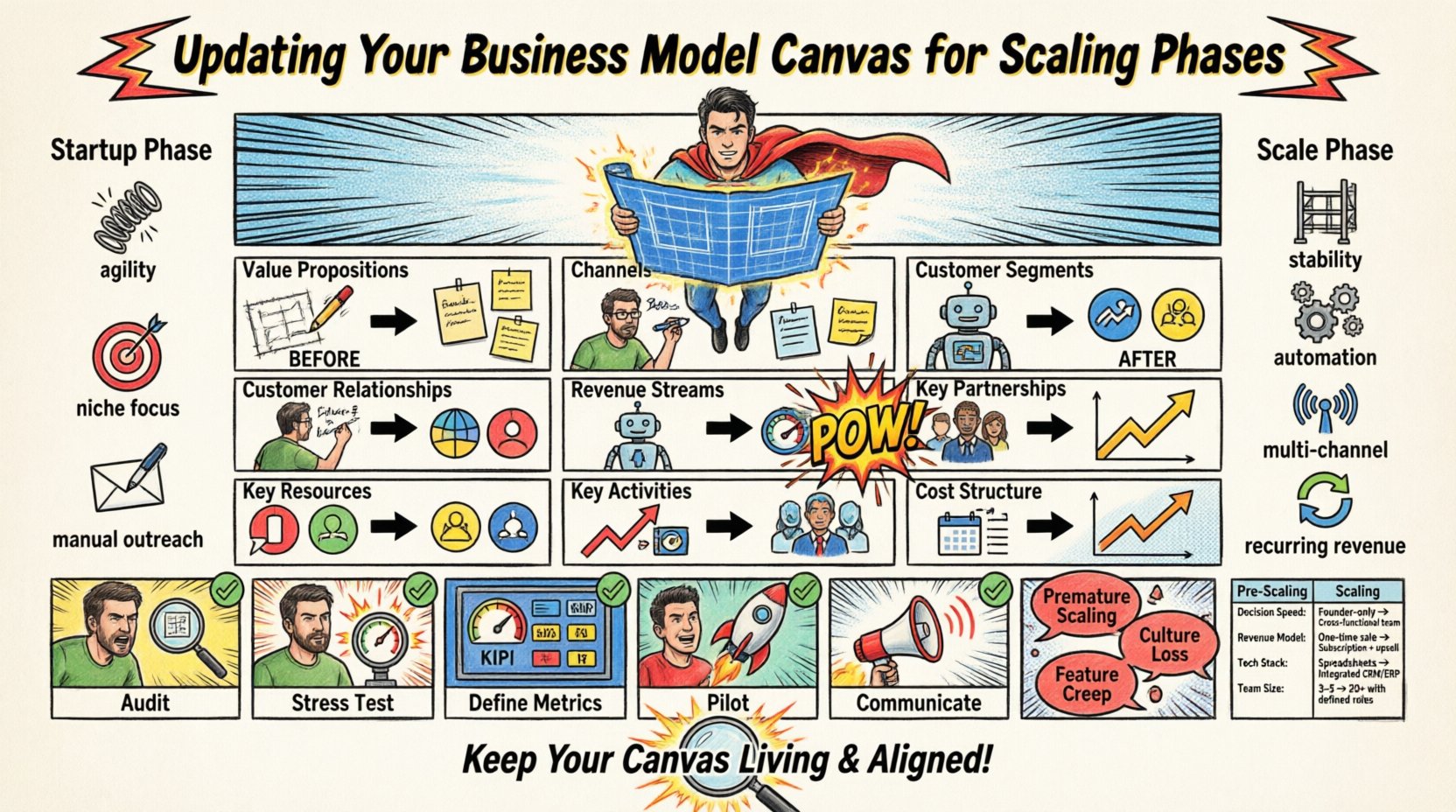
Scaling a business is distinct from simply growing it. Growth often implies increasing volume within an existing framework, while scaling requires restructuring that framework to support exponential growth without a proportional increase in costs. For entrepreneurs and operators, the Business Model Canvas (BMC) serves as the foundational blueprint for this transition. As a venture moves from early validation to market expansion, the assumptions made during the startup phase often become liabilities.
This guide provides a comprehensive approach to updating your Business Model Canvas for scaling phases. We will examine how to reconfigure each of the nine building blocks to ensure sustainability, efficiency, and long-term viability. The goal is not merely to expand reach but to fortify the operational engine that drives the business forward.
🔄 Understanding the Shift from Startup to Scale
Many organizations fail to scale because they attempt to apply early-stage tactics to late-stage problems. In the startup phase, the focus is on survival, product-market fit, and agility. The Business Model Canvas during this stage is often fluid, with assumptions tested through direct customer interaction.
During the scaling phase, the dynamics change:
- Agility shifts to Stability: Processes must be documented and repeatable. Reliance on individual intuition decreases as reliance on systems increases.
- Customer Acquisition shifts to Optimization: Finding the first customer is different from acquiring thousands. Efficiency in acquisition costs becomes paramount.
- Resource Allocation shifts to Leverage: Human effort must be multiplied through technology, partnerships, or automation.
Updating the canvas requires a rigorous audit of current operations against future demands. It involves questioning every assumption regarding cost structures, value delivery, and revenue generation.
🏗️ Deep Dive: Updating the Nine Building Blocks
To effectively update your Business Model Canvas for scaling phases, we must analyze each block individually. Below is a detailed breakdown of the necessary adjustments.
1. 🎯 Value Propositions
In the early stages, value propositions are often broad or tailored to a niche early adopter group. Scaling requires a value proposition that can be delivered consistently to a larger audience without diluting quality.
- Standardization vs. Customization: Determine if the value comes from the core product or the service layer. Scaling often favors standardized core products with modular add-ons.
- Relevance Maintenance: As the market grows, competitors emerge. Ensure the value proposition differentiates the business not just on features, but on reliability and speed of delivery.
- Clarity of Message: Marketing messaging must evolve from educational (“what is this?”) to comparative (“why us?”).
2. 👥 Customer Segments
Scaling often means moving beyond the initial target segment. However, expanding too quickly can lead to a loss of focus. The canvas must reflect a clear hierarchy of customer segments.
- Core vs. Adjacent: Identify the primary revenue segment that funds growth. Adjacent segments should only be targeted once the core is optimized.
- Segmentation Depth: Move from broad demographics to psychographic or behavioral segmentation. This allows for targeted channel strategies.
- Retention Focus: Scaling increases the cost of acquisition. The canvas must account for Customer Lifetime Value (CLV) to justify higher acquisition spend.
3. 📢 Channels
Channels are the touchpoints through which the value proposition reaches customers. In the scaling phase, reliance on direct sales or manual outreach often becomes a bottleneck.
- Automation: Implement self-service options where possible. Digital channels should handle the majority of the onboarding process.
- Partner Channels: Leverage third-party networks. Distributor relationships or platform integrations can extend reach without proportional headcount growth.
- Multi-Channel Consistency: Ensure the customer experience remains seamless whether they interact via social media, email, or direct web access.
4. 🤝 Customer Relationships
Relationships in the startup phase are often personal and high-touch. Scaling requires a shift toward community-driven or automated support models.
- Community Building: Create forums or user groups where customers support each other. This reduces support ticket volume and increases stickiness.
- Proactive Communication: Shift from reactive support to proactive updates regarding service status, new features, or maintenance.
- Feedback Loops: Establish systematic ways to gather feedback at scale, such as automated surveys or NPS tracking, rather than relying on casual conversations.
5. 💰 Revenue Streams
Pricing models that work for beta testers often fail at scale. The revenue stream section of the canvas must be optimized for margin and predictability.
- Pricing Tiers: Implement tiered pricing to capture value from different segment needs. This maximizes revenue per user without increasing service costs linearly.
- Recurring Revenue: Where possible, shift one-off transactions to subscription models. This improves cash flow predictability and valuation metrics.
- Unit Economics: Ensure the contribution margin remains positive after scaling costs (marketing, support, infrastructure) are factored in.
6. 🔑 Key Resources
Resources are the assets required to make the model work. Scaling changes the nature of these assets from “founder-dependent” to “system-dependent”.
- Talent Density: Hire for specialized roles that support scale, such as operations managers or data analysts, rather than generalists.
- Intellectual Property: Protect proprietary processes or technology that provide a competitive moat.
- Financial Capital: Ensure sufficient runway to cover the increased burn rate associated with scaling activities before revenue catches up.
7. ⚙️ Key Activities
Activities are the most important things a company must do to make its business model work. During scaling, the focus shifts from development to execution.
- Process Optimization: Continuously review internal workflows to eliminate bottlenecks.
- Quality Control: As volume increases, quality risks rise. Implement rigorous testing protocols.
- Strategic Planning: Dedicate time to long-term strategy rather than daily firefighting.
8. 🤝 Key Partnerships
Partnerships can provide leverage that internal resources cannot match at the same speed.
- Supply Chain Resilience: Diversify suppliers to prevent disruptions that could halt scaling efforts.
- Strategic Alliances: Form alliances with non-competing businesses that share the same customer base to cross-promote.
- Outsourcing: Consider outsourcing non-core functions (e.g., payroll, logistics) to focus internal resources on value creation.
9. 💸 Cost Structure
Cost structures must be analyzed for scalability. Fixed costs allow for higher margins as volume increases, whereas variable costs can erode margins quickly.
- Fixed vs. Variable: Shift towards fixed costs where possible (e.g., software licenses vs. hourly contractors) to benefit from economies of scale.
- Operational Efficiency: Monitor overhead costs closely. Administrative bloat is a common killer of scaling profitability.
- Investment in Growth: Allocate budget specifically for customer acquisition and retention programs.
📊 Scaling Readiness Comparison
To visualize the differences between the pre-scaling and scaling phases, refer to the comparison table below. This highlights the necessary shifts in strategic focus across the Business Model Canvas.
| Business Model Block | Pre-Scaling Phase | Scaling Phase |
|---|---|---|
| Value Proposition | Flexible, tailored to early adopters | Standardized, scalable, consistent |
| Customer Segments | Niche, broad demographics | Segmented, high CLV focus |
| Channels | Direct, manual outreach | Automated, multi-channel, partners |
| Customer Relationships | Personal, high-touch | Community-driven, self-service |
| Revenue Streams | Variable, one-off transactions | Recurring, tiered pricing |
| Key Resources | Founders, general skills | Systems, specialized teams |
| Key Activities | R&D, validation | Execution, optimization, QA |
| Key Partnerships | Informal, ad-hoc | Formal, contractual, strategic |
| Cost Structure | Low fixed, high variable | Higher fixed, optimized variable |
🛠️ Implementation Steps for the Update
Updating the canvas is not a one-time event but a strategic process. Follow these steps to ensure the transition is managed effectively.
Step 1: Audit the Current State
- Print the current canvas.
- Gather data on unit economics, churn rates, and acquisition costs.
- Identify bottlenecks where the current model fails to support volume.
Step 2: Stress Test Assumptions
- Ask “What happens if we double our customer base tomorrow?”
- Identify which resources would break under that pressure.
- Update the Key Resources and Key Activities blocks to address these weaknesses.
Step 3: Define the New Metrics
- Establish KPIs that reflect scale, such as CAC (Customer Acquisition Cost), LTV (Lifetime Value), and Burn Rate.
- Ensure these metrics are tied directly to the Revenue and Cost blocks.
Step 4: Pilot the Changes
- Test new processes or pricing models with a subset of customers.
- Measure the impact on operational efficiency and satisfaction.
- Iterate before a full rollout.
Step 5: Communicate Internally
- Ensure all teams understand the strategic shift.
- Align incentives with the new business model goals.
- Train staff on new processes and tools.
⚠️ Common Pitfalls During the Update
Even with a well-structured plan, organizations often stumble when updating their Business Model Canvas for scaling phases. Awareness of these risks helps mitigate them.
- Premature Scaling: Expanding marketing spend or hiring before the unit economics are proven. This leads to rapid cash burn.
- Loss of Culture: Growing too fast can dilute company culture, affecting customer relationships and employee retention.
- Feature Creep: Adding too many features to the value proposition to appeal to a broader market, confusing the core offering.
- Ignoring Cash Flow: Focusing on top-line growth while neglecting the timing of cash inflows versus outflows.
- Over-Automation: Removing the human touch entirely before the system is robust, leading to poor customer support experiences.
📈 Monitoring and Iteration
Once the canvas is updated, it becomes a living document. The market environment changes, and the business model must evolve accordingly. Regular reviews are essential.
- Quarterly Reviews: Assess the validity of the assumptions in the Revenue and Cost blocks.
- Annual Strategy Sessions: Deep dive into the Value Proposition and Key Partnerships to ensure alignment with long-term goals.
- Real-Time Dashboards: Maintain visibility on key performance indicators to spot deviations quickly.
Scaling is a dynamic process. The Business Model Canvas provides the structure to navigate complexity, but it requires active management to remain relevant. By systematically updating each block, you create a resilient foundation capable of supporting growth without collapsing under its own weight.
🔍 Final Thoughts on Strategic Alignment
The transition from startup to scale is one of the most critical moments in a company’s lifecycle. It demands a shift in thinking from validation to optimization. The Business Model Canvas is the tool that facilitates this shift, allowing leaders to visualize the interconnections between different parts of the organization.
Success in this phase relies on discipline. It requires the willingness to say no to opportunities that do not fit the scaled model. It demands rigorous attention to cost structures and revenue streams. Most importantly, it requires a commitment to continuous improvement. As the business grows, the canvas must grow with it, reflecting the new realities of the market, the team, and the product.
By following the guidelines outlined in this article, you can ensure that your business model is robust enough to handle the demands of expansion. The focus remains on sustainable growth, where efficiency and value delivery go hand in hand. This approach minimizes risk and maximizes the potential for long-term success.
Remember, the canvas is not a static document. It is a strategic tool that guides decision-making. Keep it visible, keep it updated, and use it to align your entire organization around a shared vision of growth.