


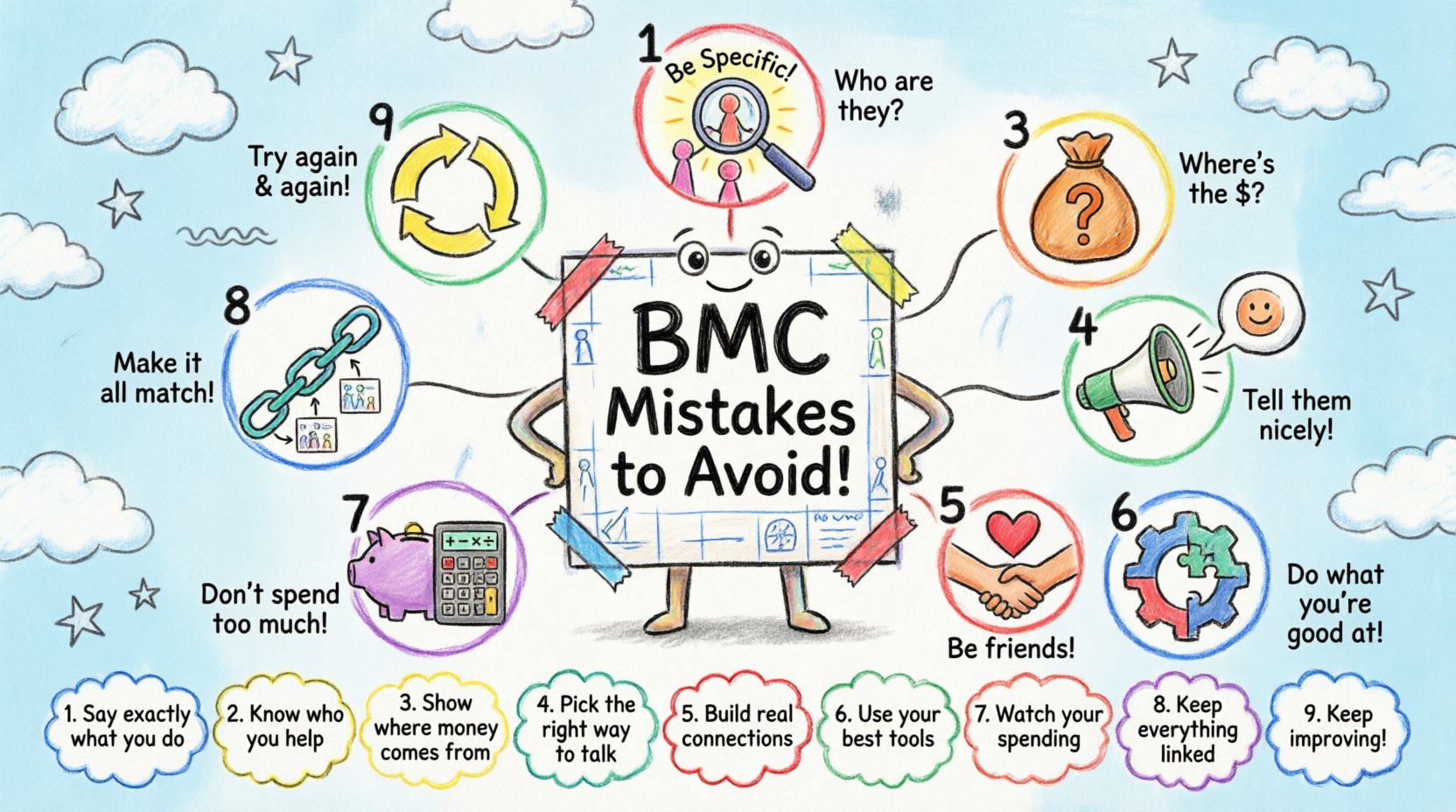
The Business Model Canvas (BMC) remains one of the most utilized frameworks for visualizing, designing, and challenging business strategies. It provides a holistic view of an organization by breaking it down into nine fundamental building blocks. However, the mere act of filling out the boxes does not guarantee success. Many founders and strategists treat the canvas as a static document rather than a dynamic hypothesis testing tool. This approach often leads to significant strategic blind spots.
Designing a robust business model requires a deep understanding of market dynamics, operational realities, and customer psychology. When these elements are misaligned, the resulting strategy becomes fragile. The following guide details the most common pitfalls encountered during the design process, offering actionable insights to correct them. By identifying these errors early, you can build a foundation that supports sustainable growth and resilience.
📉 1. Misdefining the Value Proposition
The core of any business model is the value proposition. It answers the fundamental question: What problem are we solving, and for whom? A common error is creating a value proposition that is too broad or vague. When a strategy attempts to appeal to everyone, it often appeals to no one.
- Generic Statements: Phrases like “we provide high-quality solutions” lack specificity. Customers need to understand exactly how your offering improves their situation compared to alternatives.
- Feature Over Function: Listing features instead of benefits confuses the user. A feature is a characteristic; a benefit is the outcome.
- Ignoring the Competition: Failing to acknowledge existing solutions leads to a false sense of uniqueness. You must articulate why your solution is distinct in terms of performance, design, or accessibility.
To avoid this, be precise. Instead of saying “we help people save money,” specify “we reduce grocery costs by 15% through bulk sourcing.” Specificity builds trust and clarifies the value being delivered.
🎯 2. Vague Customer Segments
Another frequent mistake is assuming the entire market is the target audience. If your customer segment is defined as “everyone,” the subsequent design choices regarding channels and relationships will lack direction.
- Lack of Segmentation: Different groups have different needs. A B2B enterprise client requires different communication and support than a B2C individual consumer.
- Ignoring the Persona: Without a clear persona, messaging becomes diluted. You must understand the demographics, psychographics, and pain points of the specific group you serve.
- Overlooking Secondary Segments: While focusing on a primary segment is necessary, ignoring potential secondary segments can limit scalability and growth opportunities.
Refining your customer segments ensures that resources are allocated efficiently. You can tailor your value proposition and channels to match the specific behaviors of each group, increasing conversion rates and retention.
💰 3. Flawed Revenue Stream Assumptions
Revenue streams are the lifeblood of the business, yet they are often the least understood component of the canvas. Errors here typically stem from a lack of market validation regarding pricing and willingness to pay.
- Guessing Pricing: Setting prices based on costs plus a margin is a common but often flawed strategy. Prices should be based on perceived value to the customer.
- Ignoring Revenue Models: Relying solely on one-time sales ignores recurring revenue opportunities. Subscription models, licensing, or usage-based pricing can provide more stability.
- Unrealistic Volume Projections: Overestimating the number of customers willing to pay leads to cash flow crises. Conservative estimates based on historical data or market research are safer.
A robust revenue model considers multiple sources. Diversifying income streams mitigates risk and provides flexibility when market conditions shift. For example, combining product sales with service fees can create a more resilient financial structure.
📢 4. Ignoring Channel Effectiveness
Channels are the touchpoints through which you deliver your value proposition to your customer segment. A critical error is choosing channels based on convenience rather than customer preference. If your customers do not use the channel, your message never reaches them.
- Channel Mismatch: Selling luxury goods on a discount marketplace can dilute brand equity. The channel must align with the brand positioning.
- Fragmented Presence: Being present on every platform without a cohesive strategy wastes resources. Focus on the channels where your specific segment spends time.
- Post-Sale Neglect: Channels are not just for acquisition. They are crucial for delivery and after-sales support. Ignoring this can damage the customer experience.
Mapping the customer journey helps identify the most effective channels. Understanding where customers discover, evaluate, purchase, and use your product ensures a seamless experience that drives satisfaction.
🤝 5. Underestimating Customer Relationships
The relationship block defines the type of interaction a company establishes with its customer segments. Many businesses assume that once a sale is made, the relationship is complete. This is a strategic oversight.
- Assuming Self-Service: Not all customers want to solve their own problems. Some require dedicated account management or personalized support.
- Ignoring Retention: Acquiring a new customer is often more expensive than retaining an existing one. Failing to invest in retention strategies reduces lifetime value.
- Lack of Feedback Loops: Relationships should be bidirectional. Ignoring customer feedback prevents the business from adapting to changing needs.
Defining the relationship type clearly—whether automated, personal, or community-based—sets expectations. Consistent engagement fosters loyalty and turns customers into advocates.
⚙️ 6. Operational Confusion in Key Activities and Resources
The infrastructure required to deliver the value proposition is detailed in Key Activities and Key Resources. A common error is overcomplicating the operational model or underestimating the resources needed.
- Resource Gaps: Planning for growth without securing the necessary talent or technology leads to bottlenecks.
- Activity Misalignment: Key activities must directly support the value proposition. If the proposition is speed, activities should focus on logistics and automation, not manual customization.
- Ignoring Partners: Relying solely on internal capabilities limits scalability. Strategic partnerships can provide access to technology, distribution, or expertise without heavy investment.
Clarity in operations ensures that the business can actually deliver what it promises. Mapping resources to activities highlights dependencies and potential risks in the supply chain.
💸 7. Cost Structure Blind Spots
Cost structure describes all costs incurred to operate the business. Errors here often involve overlooking fixed versus variable costs or failing to account for hidden expenses.
- Fixed Cost Overload: High fixed costs create rigidity. If demand fluctuates, the business may struggle to cover overhead.
- Hidden Costs: Marketing, customer support, and maintenance costs are often underestimated. A full cost analysis is necessary for accurate profitability projections.
- Cost vs. Value Disconnect: High costs do not always justify high value. If the cost structure is not aligned with the value proposition, margins will suffer.
Optimizing the cost structure involves balancing efficiency with quality. Understanding the cost drivers allows for better decision-making regarding investments and pricing strategies.
🔗 8. Lack of Internal Consistency
The most dangerous error is designing the blocks in isolation. The Business Model Canvas is an interconnected system. A change in one block affects others. Inconsistency leads to a model that looks good on paper but fails in practice.
- Value vs. Cost: A high-cost value proposition must be matched by a customer segment willing to pay a premium.
- Channels vs. Relationships: If the channel is automated, the relationship model must support self-service expectations.
- Resources vs. Activities: The resources available must be sufficient to execute the planned activities.
Reviewing the canvas as a whole system ensures logical coherence. Every decision should reinforce the others, creating a unified strategy rather than a collection of disjointed ideas.
📊 9. Failure to Validate and Iterate
A static canvas is a dead canvas. The market changes, and so must the business model. Many organizations create the canvas and file it away, never revisiting it. This leads to obsolescence.
- Planning vs. Doing: The canvas should be a hypothesis to be tested, not a final plan. Real-world data often contradicts initial assumptions.
- Ignoring Feedback: Customer feedback is the primary source of truth. Ignoring it in favor of internal assumptions is a recipe for failure.
- Resistance to Change: Pivoting is necessary when validation fails. Sticking to the original plan despite evidence of failure wastes capital and time.
Regular reviews and updates keep the strategy relevant. Treating the canvas as a living document allows the business to adapt to market shifts quickly.
📋 Summary of Common Errors and Corrections
| Business Block | Common Error | Corrective Action |
|---|---|---|
| Generic statements | Focus on specific benefits and outcomes | |
| Customer Segments | Targeting everyone | Define specific personas and needs |
| Revenue Streams | Guessing pricing | Test willingness to pay and diversify models |
| Channels | Convenience over preference | Map customer journey to preferred touchpoints |
| Relationships | Focus on acquisition only | Implement retention and feedback loops |
| Key Resources | Resource gaps | Align resources with strategic activities |
| Cost Structure | Hidden costs | Conduct full cost analysis including overhead |
| Consistency | Isolated blocks | Review interdependencies across the canvas |
| Iteration | Static planning | Validate hypotheses and update regularly |
🛡️ Strategic Alignment and Risk Management
Beyond the specific blocks, the overall strategic alignment is crucial. A business model must be internally consistent and externally viable. Internal consistency means the pieces fit together logically. External viability means the market accepts the model.
Risk management should be integrated into the design phase. Identify which assumptions are most critical to the success of the model. These are your “leap of faith” assumptions. Test these assumptions early to reduce uncertainty. If the core assumption fails, the entire model may need to be rethought.
🔄 The Cycle of Continuous Improvement
Building a business model is not a one-time event. It is a continuous cycle of design, testing, and learning. As you gather data from the market, refine the canvas. This iterative process reduces the risk of large-scale failure.
Encourage a culture of transparency where team members feel comfortable pointing out inconsistencies. The canvas should be visible and accessible to the whole organization. When everyone understands the model, execution becomes more aligned.
💡 Final Considerations for Success
Designing a successful business model requires discipline and honesty. It is easy to fall in love with an idea, but difficult to confront the data. By avoiding the errors outlined in this guide, you increase the likelihood of building a viable enterprise.
Focus on clarity in your value proposition. Ensure your customer segments are well-defined. Validate your revenue assumptions before scaling. Align your operations with your promises. And most importantly, treat the canvas as a tool for learning, not just a document for planning.
When these elements work in harmony, the business model becomes a powerful engine for growth. It provides a clear roadmap for decision-making and resource allocation. Avoiding these critical errors sets the stage for long-term stability and competitive advantage.