


Creating a robust business model is only the first step. Translating that static framework into a dynamic narrative for potential investors requires a strategic shift. The Business Model Canvas (BMC) serves as an internal strategic tool, visualizing how an organization creates, delivers, and captures value. However, investors do not fund boxes on a page; they fund narratives backed by data. To secure funding, founders must deconstruct the canvas and rebuild it into a cohesive story that addresses risk, growth, and return on investment.
This guide details the process of mapping your Business Model Canvas to a high-impact investor pitch deck. We will explore the structural differences between the two formats, identify critical gaps in the canvas that must be filled, and provide a step-by-step framework for alignment. The goal is not to copy the canvas, but to interpret its components for an audience focused on scalability and exit potential.
🧐 Understanding the Structural Shift
The Business Model Canvas is inherently static. It is a snapshot of the business architecture at a specific moment. It answers the question: “How does this business work?” An investor pitch deck answers the question: “Why will this business succeed and provide a return?” This distinction is crucial. While the BMC focuses on operational mechanics, the pitch focuses on momentum and opportunity.
When converting the canvas, you must move from a descriptive mode to a persuasive mode. Below are the key differences you must account for during this translation:
- Static vs. Dynamic: The canvas shows the current state. The pitch must show the trajectory. You need to demonstrate how the model evolves from today to Year 3 or Year 5.
- Internal vs. External: The canvas is often for internal alignment. The pitch is an external communication tool designed to build trust with strangers who have limited time.
- Components vs. Story: The canvas lists components (Key Resources, Partners). The pitch weaves these into a logical story of problem-solving and market capture.
🗺️ Mapping the Canvas to the Pitch Deck
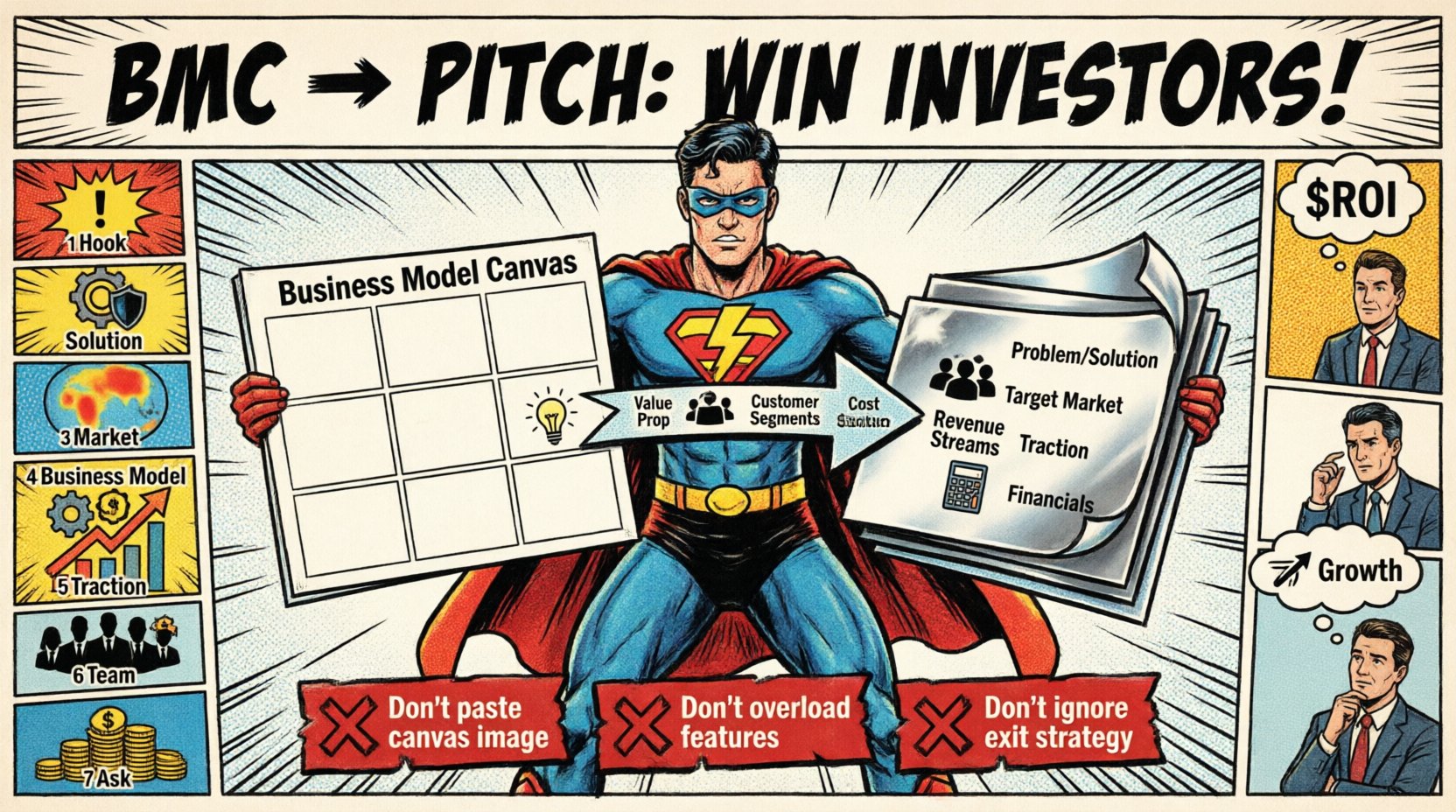
The most effective pitch decks follow a standard flow. You can map the nine building blocks of the Business Model Canvas directly to specific slides within that deck. This mapping ensures you do not miss critical information while avoiding the common mistake of simply pasting the canvas image into the presentation.
| Business Model Canvas Block | Pitch Deck Slide Equivalent | Key Translation Focus |
|---|---|---|
| Value Proposition | Problem & Solution | Articulate the pain point and your unique fix. |
| Customer Segments | Target Market | Define who pays and the size of that wallet. |
| Revenue Streams | Business Model & Traction | Explain pricing, unit economics, and current sales. |
| Key Activities & Resources | Product & Technology | Show what you build and the assets you own. |
| Key Partners | Go-to-Market Strategy | Highlight distribution channels and strategic alliances. |
| Cost Structure | Financial Projections | Detail burn rate, margins, and capital efficiency. |
💎 Deep Dive: Translating Specific Blocks
Let us examine the specific translation process for the most critical blocks. These areas often cause friction between founders and investors if not handled with precision.
1. Value Proposition to Problem & Solution
In the canvas, the Value Proposition is a concise statement. In a pitch, it is the headline act. Investors spend the first minute deciding if they care. You must expand this block into a narrative arc.
- The Problem: Describe the friction. Use data to quantify the pain. Is it time wasted? Money lost? Safety risk? Make it tangible.
- The Solution: Introduce your product or service as the remedy. Avoid jargon. Explain the mechanism simply.
- The Differentiator: Why you? This maps to the “Unique Value Proposition” part of the canvas. Is it proprietary technology, a network effect, or a unique cost structure?
Do not simply state the feature. State the outcome. Instead of saying “Our software automates X,” say “Our platform reduces operational overhead by 40%.” This shifts the focus from the tool to the value generated.
2. Customer Segments to Target Market
The canvas lists segments like “B2B” or “Early Adopters.” Investors need to see the Total Addressable Market (TAM), Serviceable Addressable Market (SAM), and Serviceable Obtainable Market (SOM). You must quantify the canvas segments.
- Demographics: Age, location, role, industry. Be specific.
- Psychographics: Behaviors, motivations, and pain points.
- Market Size: Use credible third-party data. If you say the market is $1 billion, cite the source. Investors are skeptical of self-calculated numbers.
Explain why you are targeting this specific segment first. Do not claim you are serving “everyone.” A focused segment is easier to penetrate and easier to defend.
3. Revenue Streams to Business Model & Traction
The canvas shows how you make money. The pitch must prove that you can scale that method. This is where unit economics become vital.
- Pricing Strategy: Subscription, transaction fee, licensing, or freemium? Justify the price point based on value delivered.
- Customer Acquisition Cost (CAC): How much does it cost to get a customer? This relates to the “Channels” and “Customer Relationships” blocks.
- Customer Lifetime Value (LTV): How much revenue does a customer generate over time? The LTV to CAC ratio should ideally be 3:1 or higher.
Include traction data here. Monthly Recurring Revenue (MRR), growth rates, and key logos. Numbers speak louder than the canvas description of “Revenue Streams.”
4. Cost Structure to Financial Projections
Investors know you will spend money. They want to know how you spend it and when you run out. The Cost Structure block in the canvas is too high-level. You need a 3-to-5-year projection.
- Burn Rate: How much cash do you lose per month?
- Runway: How long can you operate with current capital?
- CapEx vs. OpEx: Are you buying assets or paying for services? This affects valuation.
Show that you understand the path to profitability. If you are not profitable yet, explain the milestones that will lead you there. Investors fund the journey to the finish line, not just the starting block.
🚀 Filling the Gaps: What the Canvas Misses
The Business Model Canvas is excellent for strategy, but it lacks critical elements required for a funding conversation. You must add these sections to your pitch deck to complement the canvas data.
The Team Slide
The canvas does not account for the people executing the plan. Investors often bet on the jockey, not the horse. You must introduce the founding team and key advisors.
- Relevant Experience: Show past exits, industry expertise, or technical depth.
- Roles: Clarify who does what. Avoid ambiguity about leadership.
- Advisors: List industry experts who guide the company. This adds credibility.
The Ask Slide
Never leave an investor guessing what you need. The canvas implies a need for resources, but the pitch must be explicit.
- Amount: State the exact capital raise.
- Use of Funds: Break down the allocation (e.g., 40% Engineering, 40% Sales, 20% Operations).
- Milestones: What will this money achieve? “Hire 5 engineers” or “Reach $1M ARR.” Tie the capital to growth metrics.
The Competitive Landscape
The canvas implies competition through “Value Propositions,” but it does not map the market against rivals. You need a dedicated section to show where you stand.
- Direct Competitors: Companies doing the same thing.
- Indirect Competitors: Solutions customers currently use (e.g., Excel spreadsheets).
- Barriers to Entry: Why can’t someone copy you tomorrow? (IP, network effects, switching costs).
⚠️ Common Pitfalls in the Translation
Even with a clear mapping strategy, founders often stumble during the conversion process. Avoid these common errors to maintain credibility.
- Copying the Canvas Image: Do not paste the grid image into the deck. It is too small to read and lacks narrative flow. Use the data from the grid to build slides.
- Overloading with Features: The canvas lists “Key Activities.” In the pitch, this should focus on outcomes. Don’t list every task; list the strategic activities that drive value.
- Ignoring the Exit Strategy: Investors want to know how they get paid back. While the canvas doesn’t show this, the pitch should hint at potential acquisition targets or IPO readiness.
- Weak Financial Logic: Ensure your cost structure matches your growth plan. If you plan to hire 50 people but have no budget for it, the model is broken.
🛠️ Refining the Narrative
Once the mapping is complete, you must refine the narrative flow. The deck should read like a document, not a series of disconnected points. Use transition slides to guide the investor through your logic.
Consider the following flow for your presentation:
- Hook: Start with the problem. Grab attention immediately.
- Solution: Introduce your product.
- Market: Prove the opportunity is large.
- Business Model: Explain how you capture value (Canvas Revenue/Cost).
- Traction: Show proof that people want it.
- Team: Prove you can execute.
- The Ask: Close with a clear request.
Keep the text minimal on slides. You are the presentation; the slides are the backdrop. Use visuals, charts, and diagrams to support the spoken word. If a slide requires reading, it is doing too much work.
🔄 Iteration and Testing
A pitch deck is a living document. It evolves as you learn more about your market and refine your model. Treat the conversion from canvas to pitch as a continuous process.
- Stress Test the Logic: Ask skeptical friends to challenge your numbers. If they cannot follow your logic, simplify it.
- Track Feedback: Record which questions investors ask most frequently. If they keep asking about churn or retention, move those metrics to the front of the deck.
- Update Regularly: As you hit milestones on your canvas (e.g., new partnerships, revenue jumps), update the pitch deck immediately.
Remember that the Business Model Canvas is your internal blueprint. The pitch deck is the sales brochure for your vision. Both are essential, but they serve different masters. The canvas ensures operational coherence. The pitch ensures financial viability.
By systematically translating each block and filling the narrative gaps, you create a document that respects the investor’s time while showcasing the depth of your business strategy. Focus on clarity, data, and a compelling story. The canvas provides the structure; the story provides the soul.
When you stand before an investor, you are not presenting a grid. You are presenting a future. Ensure that every slide supports that vision. Align your canvas logic with your pitch narrative, and you will be in a strong position to secure the capital needed to grow.