


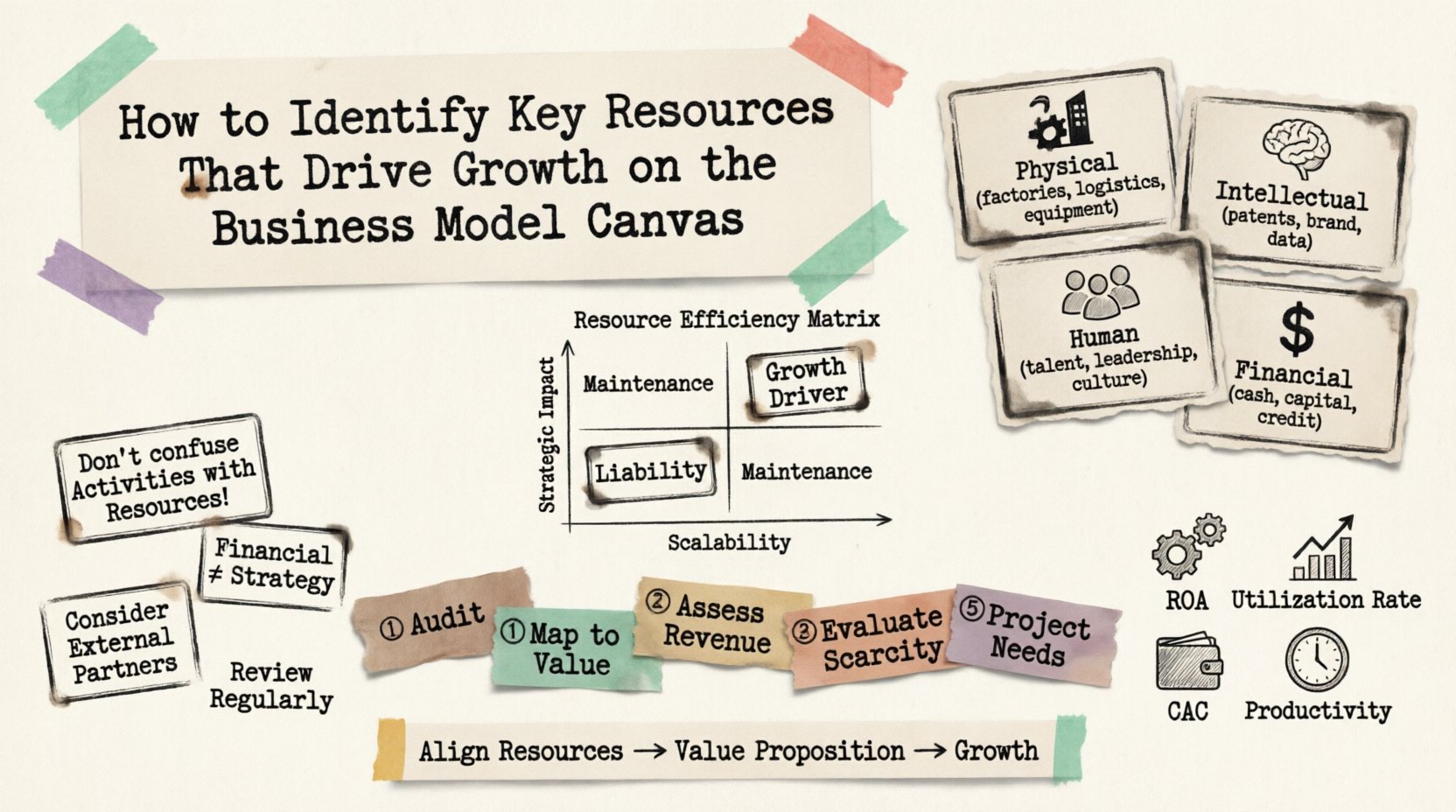
Building a sustainable business requires more than just a great idea. It requires a structured approach to understanding what assets and capabilities make that idea viable. The Business Model Canvas (BMC) is a strategic management template used for developing new or documenting existing business models. Within this framework, the Key Resources block stands out as the foundation upon which value is delivered. Without the right resources, value propositions remain theoretical, and revenue streams stay unfulfilled.
This guide provides a comprehensive look at identifying and leveraging these resources. We will explore how to audit your current assets, categorize them effectively, and align them with your growth objectives. By focusing on these core elements, organizations can ensure they have the necessary leverage to scale operations and maintain competitive advantage.
Understanding the Key Resources Block 💡
Key Resources are the most important assets required to make a business model work. They are not merely inventory or office space; they represent the strategic capabilities that allow a company to create and deliver value. In the context of growth, these resources determine your capacity to expand, innovate, and serve customers efficiently.
When analyzing this section of the canvas, it is crucial to look beyond the obvious. A manufacturing company might list machinery, but the intellectual property behind the design is often the true driver of margin and growth. Similarly, a software company lists developers, but the proprietary algorithms they use are the differentiator.
To identify these effectively, consider the following questions:
- What assets are required to offer a value proposition?
- Which resources make our distribution channels work?
- How do these resources enable our customer relationships?
- What is required to maintain our revenue streams?
Four Pillars of Key Resources 🏗️
Resources generally fall into four distinct categories. Understanding the distinction helps in auditing your business model comprehensively. Not every business needs all four, but growth often requires optimizing specific categories depending on the industry.
1. Physical Resources 🏢
These are tangible assets that support the operation of the business. They are often the most visible and easily quantifiable.
- Production Facilities: Factories, warehouses, or retail spaces.
- Logistics: Transportation fleets, delivery networks, or supply chain infrastructure.
- Tech Infrastructure: Servers, data centers, or hardware devices.
- Equipment: Machinery, tools, or specialized instruments.
Growth Insight: Physical resources often dictate scalability limits. If your production facility cannot handle a 20% increase in demand, your growth is capped. Identifying bottlenecks here is essential for expansion planning.
2. Intellectual Resources 🧠
Innovation-driven economies rely heavily on intangible assets. These resources often provide the highest return on investment because they can be scaled without significant marginal cost.
- Patents & Copyrights: Legal protection for inventions or creative works.
- Brand Reputation: Trust and recognition in the market.
- Proprietary Technology: Algorithms, source code, or unique methodologies.
- Customer Data: Insights gathered from user interactions.
Growth Insight: Intellectual resources protect margins. When competitors cannot easily replicate your IP, you maintain pricing power. This is critical for long-term sustainability.
3. Human Resources 👥
People are the engine of execution. Even the best technology requires skilled operators. This category includes both the talent needed for daily operations and the leadership required for strategic direction.
- Specialized Talent: Engineers, designers, doctors, or analysts.
- Leadership: Executives who navigate market shifts.
- Sales Force: Teams responsible for revenue generation.
- Culture: The collective mindset that drives productivity and retention.
Growth Insight: Human resources define agility. A team with deep domain expertise can pivot faster than one without. Cultivating this talent is a resource strategy in itself.
4. Financial Resources 💰
Cash flow and capital availability determine the speed of execution. Without liquidity, even the best ideas stall.
- Cash Reserves: Operating capital for day-to-day functions.
- Access to Capital: Lines of credit, investor funding, or revenue reinvestment.
- Creditworthiness: Ability to secure loans or vendor terms.
Growth Insight: Financial resources act as fuel. They allow you to invest in the other three categories (physical, intellectual, human) to drive further growth.
Identifying Growth Drivers Through Resource Analysis 📊
Once you have categorized your resources, the next step is identifying which ones specifically drive growth. Not all resources contribute equally to expansion. Some are maintenance assets, while others are growth assets.
The Resource Efficiency Matrix
To differentiate between maintenance and growth assets, use a two-axis evaluation. Plot your resources based on Scalability and Strategic Impact.
| Resource Type | Scalability Potential | Strategic Impact | Classification |
|---|---|---|---|
| Proprietary Software | High | High | Growth Driver |
| Office Lease | Low | Medium | Maintenance |
| Brand Equity | High | High | Growth Driver |
| Legacy Hardware | Low | Low | Liability |
| Expert Team | Medium | High | Growth Driver |
Step-by-Step Identification Process
- Audit Current Inventory: List every resource currently utilized. Be exhaustive.
- Map to Value Proposition: Connect each resource to a specific value offered to the customer.
- Assess Contribution to Revenue: Determine which resources directly influence sales or retention.
- Evaluate Scarcity: Identify resources that are difficult for competitors to acquire.
- Project Future Needs: Determine what resources will be needed for the next phase of growth.
Aligning Resources with Value Propositions 🤝
A common pitfall is accumulating resources that do not support the core value proposition. This leads to bloat and inefficiency. The resources you identify must directly enable the promises you make to customers.
Example: A Logistics Company
Consider a logistics firm promising “Same-Day Delivery”.
- Required Resources: A large fleet of vehicles, real-time tracking software, local warehouses, and a robust dispatch team.
- Non-Essential Resources: A central headquarters in a different city, luxury office furniture, or outdated CRM systems.
If the company invests heavily in the non-essential resources while underfunding the fleet, the growth strategy fails. The alignment is critical. Growth comes from optimizing the essential resources that directly impact the customer promise.
Measuring Resource Efficiency 📈
Identification is only half the battle. You must measure how effectively these resources are being used. Efficiency metrics help determine if a resource is a growth engine or a drag on performance.
Key Metrics to Track
- Return on Assets (ROA): Measures how efficiently assets generate profit.
- Resource Utilization Rate: How much of the available capacity is being used.
- Customer Acquisition Cost (CAC) per Resource: How much specific resource spend is required to gain a customer.
- Employee Productivity: Revenue generated per employee.
When metrics show declining efficiency, it signals a need to re-evaluate the resource allocation. Perhaps a physical asset is underutilized, or a software license is not being fully leveraged by the team.
Common Pitfalls in Resource Identification ⚠️
Even experienced strategists make mistakes when defining key resources. Being aware of these traps helps maintain clarity.
1. Confusing Activities with Resources
Key Activities (another block of the canvas) describe what the company does. Key Resources describe what the company has. Confusing the two leads to vague planning. Activity: Manufacturing. Resource: The factory and the workers.
2. Overestimating Financial Resources
Cash is vital, but it is not a growth strategy in itself. Having money allows you to buy other resources, but it does not guarantee value creation. Do not rely solely on financial reserves to drive growth without a plan for deploying them.
3. Ignoring External Resources
Not all key resources need to be owned. Partnerships and outsourcing can provide access to resources without the overhead of ownership. A company might not own its delivery trucks but still relies on the logistics partner as a key resource.
4. Static Thinking
Resources change over time. A resource that is key today may be obsolete tomorrow. Continuous review is necessary. What drives growth in a startup phase differs from what drives growth in a mature phase.
Strategic Questions for Leadership 💬
To deepen the analysis, leadership teams should engage in regular workshops focused on these specific inquiries.
- If we double our revenue, which resource will break first?
- Which resource do our competitors lack that we possess?
- Can we automate this resource to reduce cost and increase speed?
- Is this resource scalable without a linear increase in cost?
- How dependent are we on a single vendor for this resource?
Building a Resilient Resource Portfolio 🛡️
Growth is not just about expansion; it is about stability during expansion. A resilient resource portfolio ensures that the business can withstand market fluctuations. Diversification within your resource categories is a smart move.
For example, relying on a single source for raw materials (Physical Resource) creates risk. Sourcing from multiple suppliers mitigates this. Relying on a single founder for leadership (Human Resource) creates risk. Succession planning mitigates this.
Conclusion 🏁
Identifying key resources that drive growth is a dynamic process. It requires a clear understanding of your business model, a rigorous audit of your assets, and a strategic alignment with your value proposition. By categorizing resources into physical, intellectual, human, and financial buckets, and by measuring their efficiency, you can pinpoint exactly what powers your expansion.
Remember that resources are tools. Their value lies in how they are deployed. Focus on the assets that directly enable your customer promise and provide a competitive edge. Regularly review these assets to ensure they continue to serve your evolving goals. With the right foundation, growth becomes a manageable and predictable outcome rather than a gamble.