


In the landscape of modern strategy, the ability to articulate exactly why a customer should choose your offering over a competitor is paramount. This articulation sits at the heart of the Value Proposition Canvas, a vital component within the broader Business Model Canvas. It bridges the gap between what you offer and what the customer actually needs. Without this alignment, even the most innovative products may fail to find traction in the market.
This guide provides a deep dive into designing a compelling value proposition. We will explore the structural elements, the psychological drivers of customer behavior, and the mechanics of achieving fit. By the end, you will have a clear framework for mapping your strategy to real-world demand.
Understanding the Core Components 🧩
The Business Model Canvas is a strategic management tool that allows teams to visualize, design, and pivot their business model. Within this framework, the Value Proposition block describes the bundle of products and services that create value for a specific customer segment. However, to make this block effective, it requires granular detail. This is where the Value Proposition Canvas comes in.
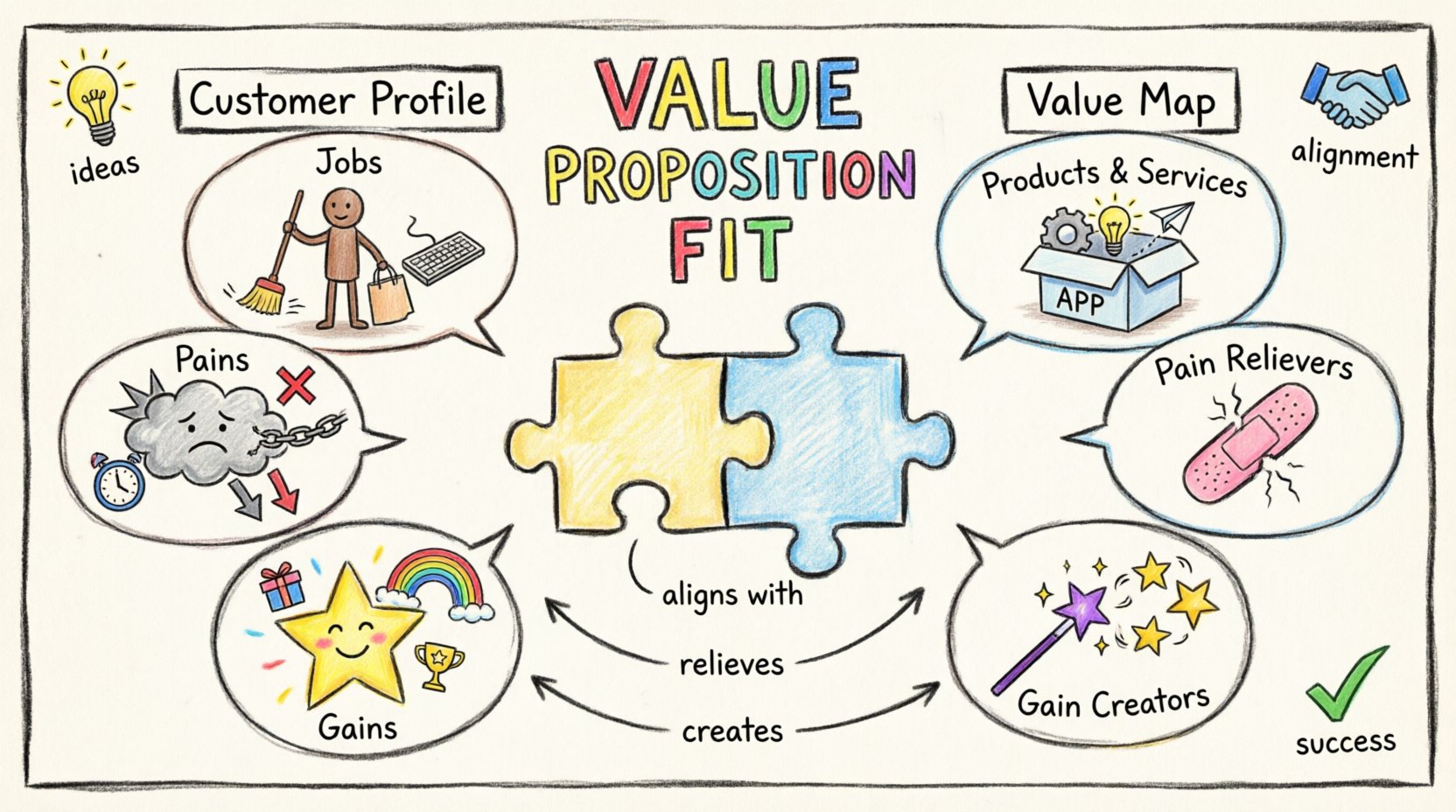
It operates on two distinct but interconnected sides:
- The Customer Profile: This section focuses entirely on the customer. It details the jobs they are trying to get done, the pains they experience, and the gains they desire.
- The Value Map: This section focuses on your solution. It outlines the products and services you offer, how they relieve pains, and how they create gains.
When these two sides align perfectly, the result is a Value Proposition Fit. This fit is not static; it requires constant validation and iteration as market conditions shift.
Deep Dive into the Customer Profile 🧠
To design a value that resonates, you must first understand the customer. This goes beyond demographics like age or location. It requires an analysis of the underlying motivations and behaviors. We break this down into three core pillars.
1. Customer Jobs to be Done
Customers are not just buying products; they are hiring them to do a job. This concept shifts the focus from features to outcomes. There are three categories of jobs:
- Functional Jobs: These are the practical tasks customers want to accomplish. For example, a commuter needs to travel from point A to point B quickly. A business owner needs to process payroll accurately.
- Social Jobs: These relate to how customers want to be perceived by others. Buying a luxury item might satisfy a job of signaling status. Adopting eco-friendly practices might satisfy a job of signaling responsibility.
- Emotional Jobs: These are about how a customer wants to feel. They might seek peace of mind, confidence, or excitement. A security system sells the feeling of safety, not just a camera.
Identifying these jobs helps you understand the context in which your product exists. If you miss a key job, your value proposition will feel incomplete to the user.
2. Customer Pains
Pains are anything that annoys the customer before, during, or after trying to do a job. They can be obstacles, risks, or undesirable costs. Understanding these is critical because solving a pain is often the primary motivator for purchase.
Pains can be categorized as:
- Obstacles: Things that prevent the customer from completing the job. For example, complex interfaces in software can obstruct productivity.
- Risks: The potential negative outcomes of completing the job. Using a cheap airline might risk safety or luggage loss.
- Undesirable Costs: Financial or non-financial costs associated with the job. High maintenance costs or the time spent learning a new tool.
3. Customer Gains
Gains are the benefits or outcomes customers expect, want, or would be surprised to receive. They represent the positive side of the equation. While pains stop you from acting, gains drive you to act.
Gains fall into several buckets:
- Required Gains: Minimum expectations. If a bank does not offer a website, it fails this basic requirement.
- Expected Gains: Outcomes customers assume will happen. A delivery service is expected to arrive on time.
- Desired Gains: Outcomes customers would love to have. A delivery service offering real-time tracking.
- Unexpected Gains: Things that delight the customer. A free upgrade or a personalized note.
Deep Dive into the Value Map 🚀
Once the customer profile is clear, you can design the Value Map. This is where your strategy meets the customer reality. It consists of three main elements.
1. Products and Services
This is the tangible list of what you provide. However, simply listing features is not enough. Each item must serve a specific function in the customer’s life. You should ask: Which customer job does this product support? Which pain does it address?
2. Pain Relievers
Pain relievers describe how your product eliminates or reduces specific customer pains. This is a direct response to the obstacles, risks, or costs identified in the Customer Profile. A pain reliever should be specific, not generic.
For example, if a customer pain is “fear of data loss,” a pain reliever is “automated cloud backup with encryption.” If a pain is “high setup time,” a pain reliever is “one-click installation.”
3. Gain Creators
Gain creators describe how your product produces specific customer gains. They turn potential benefits into actual outcomes. They ensure that the customer receives the required, expected, desired, or unexpected value.
If a customer gain is “saving time,” a gain creator is “streamlined workflow automation.” If a customer gain is “status,” a gain creator is “exclusive membership tiers.”
Achieving Strategic Fit 🔗
The goal of the canvas is to achieve Value Proposition Fit. This occurs when your Value Map aligns perfectly with the Customer Profile. It is not enough to have a product that works; it must work for the right person in the right way.
Fit is demonstrated when:
- Products and Services address specific Customer Jobs.
- Pain Relievers directly mitigate Customer Pains.
- Gain Creators directly produce Customer Gains.
When this alignment exists, marketing becomes easier because the message is clear. Sales become more efficient because the objection handling is built into the offer. Retention improves because the customer feels understood.
Mapping Pains to Relievers and Gains to Creators 📊
To visualize this relationship, it is helpful to map them side-by-side. This table illustrates how specific customer issues translate into your strategic offerings.
| Customer Profile (Pain/Gain) | Value Map (Reliever/Creator) | Example Application |
|---|---|---|
| Pain: High cost of entry for new users. | Pain Reliever: Free trial period or freemium model. | SaaS platforms offering 14-day access. |
| Pain: Complexity of setup and configuration. | Pain Reliever: Guided onboarding wizard. | Software that auto-configure settings. |
| Gain: Need for speed and efficiency. | Gain Creator: Automated processing speeds. | Cloud computing reducing wait times. |
| Gain: Desire for social recognition. | Gain Creator: Public badges or leaderboards. | Fitness apps showing user achievements. |
Common Pitfalls in Value Design ⚠️
Even with a solid framework, teams often stumble when crafting their value proposition. Awareness of these common traps can save significant time and resources.
1. Focusing on Features Over Outcomes
A common error is listing technical specifications rather than customer benefits. A customer does not care about the processor speed; they care about the software running smoothly without crashing. Always translate features into functional, social, or emotional benefits.
2. Assuming One Size Fits All
Not all customers have the same jobs or pains. A value proposition for enterprise clients will differ vastly from one for individual consumers. Segmentation is key. If you try to serve everyone, you often end up serving no one effectively.
3. Ignoring the Competition
Value is relative. Your competitor might already be solving the pain you intend to solve. You must analyze the existing landscape to understand what customers are already using. Differentiation comes from solving the pain better or creating a gain that no one else provides.
4. Sticking to the First Idea
The first value proposition is rarely the best one. Market feedback often reveals hidden pains or new opportunities. Be prepared to pivot your Value Map based on real-world data. Rigidity leads to irrelevance.
Integrating with the Business Model Canvas 🏗️
The Value Proposition Canvas is a detailed view of one block in the larger Business Model Canvas: the Value Proposition block. However, its impact ripples through the other blocks.
- Customer Segments: The Value Proposition Canvas defines exactly which segments you are targeting. If the profile does not match, the segment is incorrect.
- Channels: How you communicate your value depends on where the customer looks for solutions. If they research online, your channel must be digital.
- Revenue Streams: Customers pay for gains and pain relief. The pricing model must reflect the value delivered, not just the cost of production.
- Key Resources and Activities: You need specific assets and actions to deliver the promised value. If you promise speed, you need logistics infrastructure.
Ensuring consistency across the entire canvas prevents strategic dissonance. For instance, marketing might promise speed (Value Proposition), but the operations team might lack the resources to deliver it (Key Resources). The VPC ensures the promise is grounded in reality.
Validation and Iteration 🔄
Designing the canvas is the beginning, not the end. You must validate your assumptions through testing. This process involves moving from hypothesis to evidence.
1. Customer Interviews
Go directly to the people who represent your Customer Profile. Ask them about their current jobs, pains, and gains. Do not pitch your solution yet. Listen to their language. If they use different terms than you, you may not understand them deeply enough.
2. Prototype Testing
Create low-fidelity prototypes of your Value Map. Show them to potential users. Observe their reactions. Do they understand the pain relief? Do they see the gain? Feedback on the prototype is more valuable than feedback on a finished product.
3. Metrics and KPIs
Define what success looks like. Are you measuring conversion rates? Retention? Customer satisfaction scores? These metrics indicate whether your Value Proposition Fit is holding true over time.
Summary of Key Takeaways 📝
Creating a compelling value proposition requires a disciplined approach to understanding human needs. It is not about selling a product; it is about solving a problem. By rigorously mapping the Customer Profile against the Value Map, you ensure that every feature serves a purpose.
Remember these core principles:
- Focus on Jobs: Understand the functional, social, and emotional tasks your customer faces.
- Identify Pains: Know the obstacles and risks that hinder their progress.
- Define Gains: Clarify the outcomes they desire and expect.
- Align Relievers and Creators: Ensure your products directly address the profile you have built.
- Iterate: Treat the canvas as a living document that evolves with market feedback.
When executed with precision, this framework transforms the abstract concept of “value” into a concrete strategic asset. It anchors your business model in the reality of the customer, paving the way for sustainable growth and market relevance.