


Creating a sustainable business requires more than just a great product. It demands a clear understanding of who benefits from that product. Within the framework of the Business Model Canvas, the Customer Segments block is foundational. It defines the people and organizations a business aims to reach and serve. Without precision here, other building blocks like Value Propositions or Channels become misaligned, leading to wasted resources and confused messaging.
This guide provides a deep dive into defining customer segments accurately. We will explore the theoretical underpinnings, practical identification methods, and the iterative process required to maintain relevance over time. This is not about guessing; it is about constructing a clear picture of your market based on observable behaviors and needs.
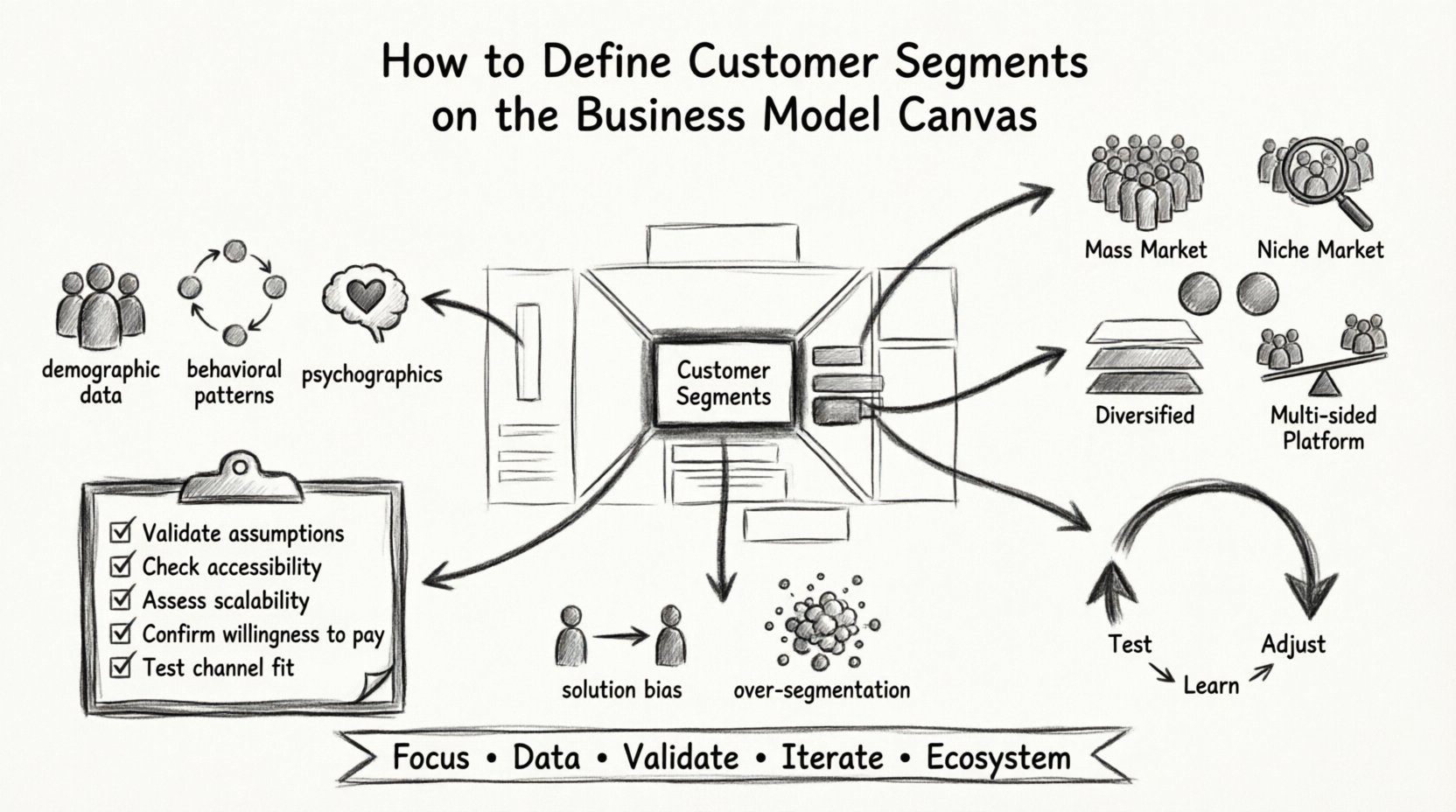
🧩 The Core Purpose of Customer Segments
A customer segment represents a distinct group of people or organizations with shared characteristics and needs. The Business Model Canvas treats these groups as separate entities that may require different value propositions, channels, and revenue streams. It is rare for a single model to serve everyone equally well.
When defining these segments, you must answer specific questions:
- Who are our most important customers?
- Which segments are we creating value for?
- What problems are we solving for them?
- What benefits are they receiving?
Accuracy in this section prevents the common error of trying to sell to everyone. When you target everyone, you often resonate with no one. By narrowing focus, you can tailor your value proposition to solve specific pain points with high efficiency.
🔍 Identifying Your Core Groups
Defining segments starts with observation and analysis. You do not need complex data science tools to begin this process. Fundamental research methods often yield the highest quality insights. The goal is to move from assumptions to evidence.
1. Demographic and Firmographic Data
The first layer of segmentation involves hard data. For business-to-consumer models, this includes age, gender, income level, location, and education. For business-to-business models, you look at firmographics such as company size, industry, location, and annual revenue.
Consider a software solution designed for accounting. A segment might be “Small Business Owners with fewer than 10 employees.” This is a tangible, definable group. Another segment could be “Enterprise Finance Departments.” These two groups have vastly different needs, budgets, and decision-making processes.
2. Behavioral Patterns
Demographics tell you who they are, but behavior tells you what they do. Look at how customers interact with your product or similar products in the market.
- Purchase Frequency: Do they buy once a year or daily?
- Brand Loyalty: Are they loyal to a specific provider or do they switch for price?
- User Status: Are they non-users, first-time users, or regular users?
- Benefits Sought: Are they looking for convenience, quality, or price?
Understanding these behaviors allows you to group customers by how they engage with your value proposition rather than just who they are.
3. Psychographics and Needs
Psychographics delve into the psychological attributes of your customers. This includes values, attitudes, interests, and lifestyle. It helps explain why they make decisions.
For example, two customers might both buy premium coffee. One buys it for the caffeine kick and speed (functional need). The other buys it to support local farmers and ethical sourcing (value-based need). These are two different segments requiring different messaging strategies.
📊 Types of Customer Segments
Not all segments are created equal. Some businesses serve mass markets, while others focus on niche audiences. Understanding the type of segment you are targeting helps determine your strategy.
| Segment Type | Definition | Best For |
|---|---|---|
| Mass Market | No significant difference between the needs of customers. | Products like soap, electricity, or basic smartphones. |
| Niche Market | Targeting a small, specialized group with specific needs. | High-end photography equipment, specialized medical devices. |
| Segmented | Dividing customers based on distinct but similar needs. | Airlines offering economy, business, and first class. |
| Diversified | Targeting two fundamentally different groups with different needs. | Computer manufacturers selling to both consumers and businesses. |
| Multi-sided Platforms | Two or more interdependent customer segments. | Credit card companies serving both cardholders and merchants. |
Selecting the right type of segment structure is critical. A niche strategy often allows for higher margins due to specialized value. A mass market strategy relies on volume and efficiency. Your Business Model Canvas should reflect the chosen structure.
📝 Data Collection Without Tools
You can gather significant insights without investing in expensive Customer Relationship Management (CRM) software. The following methods rely on direct human interaction and observation.
- Customer Interviews: Conduct one-on-one conversations. Ask open-ended questions about their daily struggles. Listen for recurring themes.
- Observation: Watch how customers use your product or service. Note where they hesitate or get frustrated.
- Sales Feedback: Talk to your sales team. They hear objections and questions from prospects daily. This is a goldmine for segment information.
- Support Logs: Analyze customer service tickets. Common complaints often highlight specific segment pain points.
- Surveys: Distribute simple questionnaires to existing users. Ask about their background and goals.
Qualitative data often reveals the nuance that quantitative data misses. Combining both provides a holistic view.
🧪 Validating Your Hypotheses
Defining a segment is a hypothesis until proven true. You must validate that this group actually exists and is willing to pay for your solution. The Business Model Canvas is a living document, not a static poster.
The Validation Checklist
Use this checklist to ensure your segments are accurate:
- Is the segment large enough to be profitable?
- Can we reach them through available channels?
- Do they have the budget to solve their problem?
- Are they actively looking for a solution?
- Does our value proposition specifically address their pain point?
If the answer to any of these is no, the segment may need redefining. It is better to adjust early than to launch a campaign that fails to convert.
🚫 Common Pitfalls to Avoid
Many founders struggle with this block due to specific cognitive biases. Being aware of these traps improves accuracy.
1. The Solution Bias
This occurs when you define the customer based on the product you want to build rather than the problem they face. Start with the problem, not the solution. The problem exists independently of your product.
2. Over-Segmentation
Creating too many segments dilutes resources. If you have five segments, you need five different value propositions and five sets of marketing messages. This is often unsustainable for early-stage ventures. Focus on the most viable segment first.
3. Ignoring the Hidden Segments
Look beyond the obvious users. Sometimes the person buying the product is not the person using it. For example, in the toy industry, children use the product, but parents buy it. You must segment for both.
4. Static Thinking
Customer needs change. A segment that is profitable today might shrink tomorrow due to regulatory changes or technological shifts. Regularly review your segment definitions.
🔄 Iterating and Updating
As you gain traction, your understanding of your customers will deepen. You may find that an initial assumption was incorrect. This is normal. The Business Model Canvas is designed for iteration.
When a segment does not convert:
- Re-evaluate the Value Proposition: Is the offer right for this group?
- Check the Channels: Are you reaching them in the right place?
- Pivot the Segment: Shift focus to a different group that shares similar characteristics but converts better.
Documenting changes helps track the evolution of the business. It provides a history of why certain decisions were made based on new information.
🤝 Multi-sided Platforms and Ecosystems
Some business models involve multiple distinct groups. Marketplaces, for instance, connect buyers and sellers. Both are customers, but they have conflicting interests. One wants low prices, the other wants high prices.
Defining these segments requires balancing the ecosystem. You must ensure that the value provided to one side does not destroy the value for the other. This often requires a subsidy model where one segment is subsidized to attract the other.
Example: A Ride-Sharing Model
- Segment A (Riders): Need reliable, quick transportation. Sensitive to price and wait time.
- Segment B (Drivers): Need flexible income and low fees. Sensitive to payout rates.
Success depends on satisfying both segments simultaneously. If you optimize only for riders, drivers leave. If you optimize only for drivers, riders leave. The Business Model Canvas must reflect the interplay between these two blocks.
📈 Aligning with Revenue Streams
Customer segments dictate how you make money. Different segments have different willingness to pay. Understanding this allows for differentiated pricing strategies.
Consider a SaaS company. They might have:
- Small Businesses: Willing to pay $20/month for basic features. Self-service model.
- Enterprises: Willing to pay $500/month for advanced security and support. Sales-led model.
By defining these segments clearly, you can design different revenue streams for each. This maximizes total revenue without cannibalizing the core offering.
🛠 Practical Steps for Implementation
To implement this on your canvas, follow this structured approach.
- Brainstorming: List all potential groups you can think of. Do not filter yet.
- Categorization: Group them by demographics, behaviors, or needs.
- Selection: Pick the top 1-3 segments based on potential.
- Definition: Write a clear profile for each. Name them (e.g., “The Budget-Conscious Parent”).
- Mapping: Draw the connection between the segment and the Value Proposition block.
- Review: Test the logic. Does the value proposition actually solve the segment’s problem?
This process turns abstract ideas into concrete business strategy. It forces clarity on who you are serving.
🌍 Global Considerations
If you plan to expand internationally, customer segments vary by culture. What works in one country may fail in another. Cultural norms, purchasing power, and regulatory environments change the definition of a customer.
A segment defined in the United States might not exist in Japan. Localization of the Business Model Canvas is often necessary for global expansion. You may need to create separate canvases for different regions to accurately reflect local customer segments.
🔑 Key Takeaways
- Focus is key: Trying to serve everyone usually leads to serving no one.
- Use data: Combine hard data with qualitative insights.
- Validate: Test your assumptions before scaling.
- Iterate: Be willing to change your segments as the market evolves.
- Understand the ecosystem: Recognize interdependencies in multi-sided models.
Defining customer segments accurately is an exercise in empathy and analysis. It requires stepping out of your own perspective to see the world through the eyes of your users. By investing time in this block of the Business Model Canvas, you build a foundation for a business that is resilient, relevant, and profitable. The effort spent here pays dividends across every other component of your model.
📚 Additional Resources for Deepening Knowledge
To further refine your segmentation skills, consider studying behavioral economics. Understanding decision-making psychology provides deeper insights into why customers choose specific solutions. Additionally, review case studies of successful companies. Analyze how they defined their initial segments and how those definitions shifted over time.
Remember, the goal is not perfection on the first try. It is accuracy that improves with feedback. Treat your Business Model Canvas as a hypothesis engine. Test, learn, and adjust. This continuous loop ensures your customer segments remain aligned with market reality.
By adhering to these principles, you establish a clear path for growth. You move from a vague idea of “customers” to a defined strategy for “specific people.” This distinction is the difference between a hobby and a sustainable enterprise.