

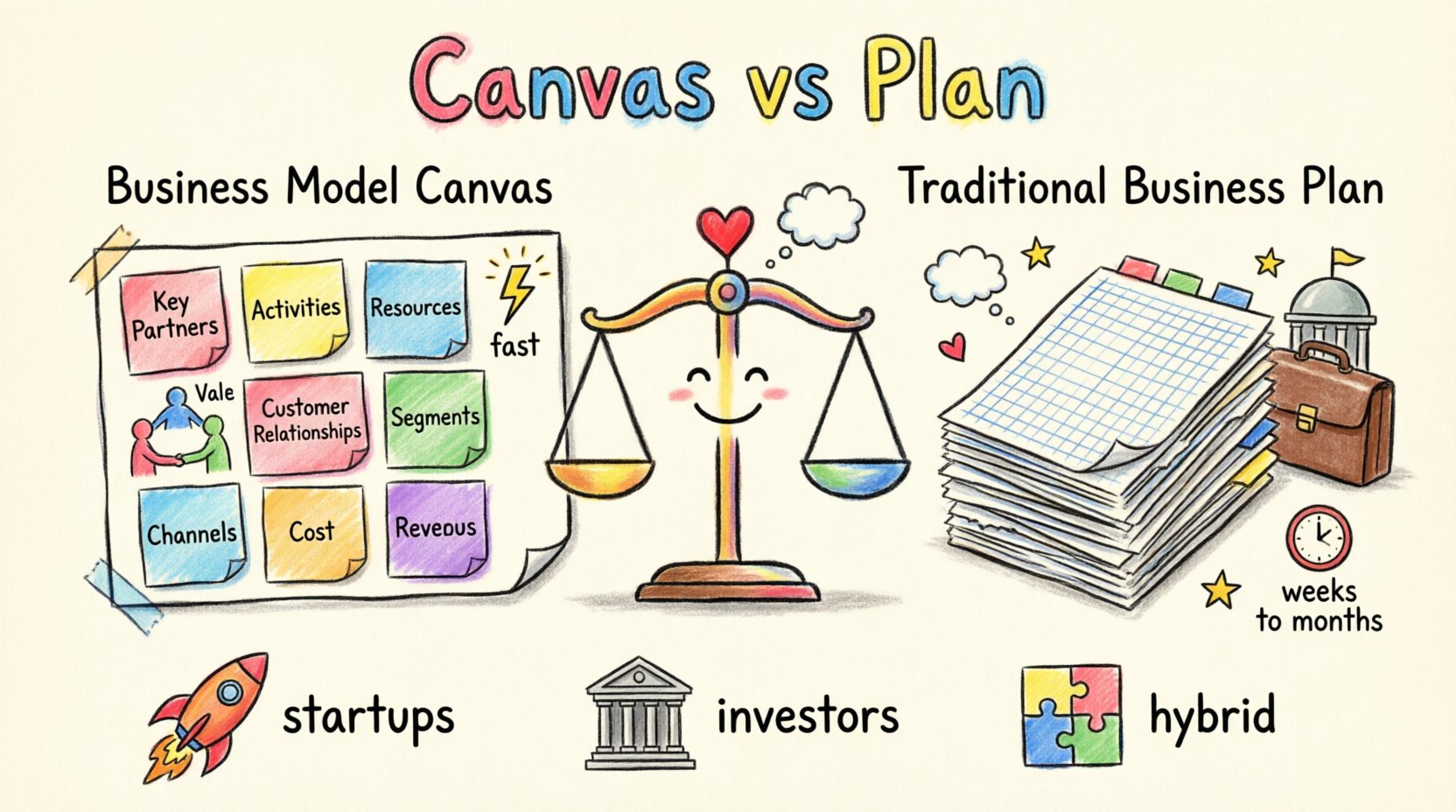
Strategic planning forms the backbone of any successful venture. Whether you are launching a new startup, restructuring an existing organization, or seeking investment capital, the method you choose to document your strategy matters significantly. Two dominant frameworks stand out in the modern business landscape: the Business Model Canvas and the Traditional Business Plan. Both serve the purpose of outlining how a company creates, delivers, and captures value, yet they operate on fundamentally different philosophies.
This guide provides a comprehensive analysis of the Business Model Canvas versus Traditional Business Plan. We will explore the structural differences, the time investment required, and the specific scenarios where each tool excels. By understanding the nuances of each approach, leaders can select the right documentation method for their current stage of growth.
🏛️ The Traditional Business Plan: A Deep Dive
The traditional business plan has been the standard for decades. It is a formal document that details every aspect of a business, typically spanning 15 to 50 pages. This format originated in the mid-20th century and remains the primary requirement for banks and venture capital firms when evaluating loan applications or investment opportunities.
Core Components
A comprehensive traditional plan generally includes the following sections:
- Executive Summary: A high-level overview of the entire document, often written last.
- Company Overview: Mission statements, vision, history, and legal structure.
- Market Analysis: Industry trends, target demographics, and competitor analysis.
- Organization and Management: Organizational charts and biographies of key team members.
- Service or Product Line: Detailed descriptions of what is being sold.
- Marketing and Sales Strategy: Pricing models, promotional tactics, and sales channels.
- Funding Request: Specific capital needs and proposed terms.
- Financial Projections: Income statements, cash flow statements, and balance sheets for 3 to 5 years.
- Appendix: Supporting documents like resumes, permits, or legal agreements.
Strengths of the Traditional Format
- Detail and Depth: It forces the entrepreneur to think through every operational facet.
- Investor Preference: Many institutional investors still require this format due to regulatory standards.
- Long-term Roadmap: It serves as a static reference point for long-range planning.
- Financial Rigor: Detailed projections help in understanding cash flow requirements over time.
Limitations and Criticisms
- Time Consuming: Creating a robust plan can take weeks or months.
- Static Nature: Once printed, it is difficult to update. Market conditions change faster than the document can be revised.
- Low Execution Focus: Teams often read the plan once and set it aside, rarely using it for daily operations.
- False Precision: Financial projections in early stages are often speculative guesses rather than accurate data.
🧩 The Business Model Canvas: A Modern Approach
Developed by Alexander Osterwalder and Yves Pigneur, the Business Model Canvas (BMC) was introduced in 2010 as a response to the rigidity of traditional planning. It is a one-page visual chart that describes the value proposition, infrastructure, customers, and finances of a business. It is designed for agility, allowing teams to pivot quickly as they learn.
Core Components: The 9 Building Blocks
The BMC divides the business into nine distinct building blocks:
- Key Partners: Suppliers and partners that make the business model work.
- Key Activities: The most important things a company must do to operate successfully.
- Key Resources: Assets required to offer and deliver the proposed value.
- Value Propositions: The bundle of products and services that create value for a specific customer segment.
- Customer Relationships: The types of relationships a company establishes with specific customer segments.
- Customer Segments: The different groups of people or organizations an enterprise aims to reach and serve.
- Channels: How a company communicates with and reaches its customer segments.
- Cost Structure: All costs incurred to operate a business model.
- Revenue Streams: The cash a company generates from each customer segment.
Strengths of the Canvas
- Visual Clarity: All critical components are visible at a glance on a single page.
- Collaboration: It is designed for team workshops and brainstorming sessions.
- Agility: Teams can easily modify blocks as hypotheses are validated or invalidated.
- Focus on Value: It forces the team to define value before worrying about financial projections.
Limitations and Criticisms
- Lack of Detail: It does not provide the granular detail required for complex regulatory filings.
- Financial Gaps: It lacks the depth of multi-year financial forecasting found in traditional plans.
- Investor Familiarity: While growing in popularity, some conservative lenders still prefer traditional documents.
- Implementation Risk: Without a detailed plan, execution can drift if the vision is not clearly defined.
🔍 Side-by-Side Comparison
Understanding the structural differences is crucial for making an informed decision. The table below outlines the primary distinctions between the two methodologies.
| Feature | Business Model Canvas | Traditional Business Plan |
|---|---|---|
| Format | Visual, one-page chart | Text-heavy, multi-page document |
| Focus | Value creation and delivery | Comprehensive operational detail |
| Flexibility | High; easy to iterate | Low; difficult to update |
| Time to Create | Hours to days | Weeks to months |
| Primary Audience | Internal teams, lean startups | Investors, banks, stakeholders |
| Financial Detail | Revenue and Cost blocks | Detailed projections, P&L, Cash Flow |
| Strategic Use | Execution and Hypothesis Testing | Long-term Roadmap and Compliance |
🚀 Key Differences Breakdown
While the table provides a snapshot, the operational differences run deeper. Below is an analysis of how these tools function in real-world scenarios.
1. Strategic Planning vs. Operational Execution
- Traditional Plan: Often viewed as a planning exercise. Once approved, it sits on a shelf. It is less useful for day-to-day decision-making.
- BMC: Designed as an execution tool. It is meant to be pinned to a wall and updated weekly. It drives daily decisions regarding resource allocation.
2. Hypothesis vs. Fact
- Traditional Plan: Assumes the business model is sound and focuses on predicting the future based on assumptions treated as facts.
- BMC: Treats the business model as a series of hypotheses. Each block represents an assumption that needs testing in the market.
3. Financial Modeling
- Traditional Plan: Requires complex spreadsheets projecting revenue and expenses for 3 to 5 years. It is essential for calculating burn rate and runway.
- BMC: Focuses on unit economics. It looks at cost per acquisition and lifetime value rather than total yearly revenue projections.
4. Stakeholder Communication
- Traditional Plan: Satisfies the due diligence requirements of banks and institutional investors who need to see risk mitigation strategies.
- BMC: Aligns internal teams and early-stage angel investors who value speed and innovation over detailed risk analysis.
📅 When to Use Which Framework?
Choosing between these tools is not binary. The right choice depends on the specific phase of the business and the audience you are addressing.
Scenario A: Seeking Institutional Funding
If you are approaching a bank for a loan or a traditional venture capital firm, the Traditional Business Plan is likely mandatory. These institutions require evidence of long-term viability, risk assessment, and detailed financial history that the Canvas does not provide.
Scenario B: Early-Stage Validation
When you are in the ideation phase or seeking product-market fit, the Business Model Canvas is superior. It allows you to test assumptions quickly without getting bogged down in writing a 50-page document. It helps you identify the biggest risks before spending money.
Scenario C: Internal Alignment
For internal team meetings, the Canvas is more effective. It provides a shared vocabulary. Everyone can see how the marketing strategy impacts the cost structure immediately. This transparency fosters better cross-departmental collaboration.
Scenario D: Complex Operational Structures
For established companies with complex supply chains, regulatory requirements, or multiple revenue streams, the Traditional Plan offers the necessary granularity to manage operations and compliance.
⚙️ The Process: Building Each Document
Understanding the workflow of each method highlights the difference in effort and mindset required.
Building a Traditional Plan
- Research: Conduct extensive market research to validate demand.
- Drafting: Write sections sequentially, starting with the company overview.
- Financial Modeling: Build detailed spreadsheets for projections.
- Review: Have stakeholders review the document for gaps in logic.
- Refinement: Polish the executive summary and formatting.
- Storage: Archive the document for future reference.
Building a Business Model Canvas
- Workshop: Gather key team members in a room with sticky notes.
- Customer Segments: Define who you are serving first.
- Value Propositions: Brainstorm what problems you solve for them.
- Channels: Determine how you will reach them.
- Revenue Streams: Define how you will monetize the value.
- Iterate: Move blocks around as new information comes in.
- Test: Take the canvas to the market to validate assumptions.
🛑 Common Pitfalls to Avoid
Regardless of the framework chosen, certain mistakes can derail the planning process.
Common BMC Mistakes
- Too Much Detail: Treating the Canvas like a plan rather than a summary. It should remain high-level.
- Ignoring Cost Structure: Focusing only on revenue streams and forgetting the operational costs.
- One-Size-Fits-All: Using the same customer segments for all products without segmentation.
- Lack of Testing: Filling out the blocks with guesses instead of validated customer feedback.
Common Traditional Plan Mistakes
- Over-Optimism: Creating financial projections that are unrealistic and disconnected from market reality.
- Ignoring Competitors: Failing to acknowledge existing solutions in the market analysis.
- Static Document: Creating a plan and never updating it as the market shifts.
- Focus on Product over Market: Describing the product in depth without explaining why customers need it.
🤝 The Hybrid Approach: Best of Both Worlds
Many successful organizations do not choose one over the other. Instead, they utilize a hybrid approach that leverages the strengths of both frameworks.
Step 1: Canvas for Strategy
Use the Business Model Canvas to define the core strategy. Run workshops to map out value propositions and customer segments. This ensures the team is aligned on the fundamental logic of the business.
Step 2: Plan for Execution
Once the strategy is validated, expand the BMC into a Traditional Business Plan for specific purposes. This includes creating the detailed financial models required for funding and the operational details needed for scaling.
Step 3: Continuous Iteration
Keep the Canvas active as a living document. Update it quarterly. Use the Traditional Plan as a static baseline for financial commitments, but update the financial assumptions in the plan based on the learnings from the Canvas.
📈 Financial Implications and Risk
Financial planning is a critical differentiator between these two methods. The approach to money affects how you assess risk.
- Traditional Plan Risks: The risk here is resource waste. Spending months writing a plan that is never executed. Additionally, the risk of over-committing to a financial model that proves incorrect.
- Canvas Risks: The risk is lack of liquidity planning. Without detailed cash flow projections, a business might run out of capital before achieving profitability, even if the value proposition is sound.
For this reason, using the Canvas alone is often insufficient for capital-intensive businesses. Manufacturing, healthcare, and real estate ventures usually require the depth of a traditional financial plan alongside the strategic clarity of a Canvas.
🔄 Future Trends in Business Planning
The landscape of business planning is evolving. The rigidity of the traditional plan is slowly giving way to more dynamic approaches. However, the regulatory environment still favors formal documentation.
- Agile Planning: Companies are moving towards quarterly planning cycles rather than annual static plans.
- Visual Dashboards: Digital versions of the Canvas are replacing paper charts, allowing for real-time data integration.
- Scenario Planning: Instead of one financial projection, businesses are building multiple scenarios (best case, worst case, most likely) to prepare for volatility.
- Integration with Operations: Strategic documents are becoming linked directly to project management tools, ensuring that the plan drives daily tasks.
🧭 Strategic Takeaways
Selecting the right planning tool is a strategic decision in itself. It reflects how an organization values speed versus stability, innovation versus compliance.
The Business Model Canvas is the tool of choice for innovation. It helps founders test ideas, pivot quickly, and maintain focus on customer value. It is ideal for startups, side projects, and internal innovation teams.
The Traditional Business Plan is the tool of choice for stability. It provides the structure needed for large-scale financing, regulatory compliance, and long-term operational management. It is essential for established enterprises and capital-intensive industries.
Neither method is inherently superior. They serve different masters. The most effective leaders understand when to deploy the speed of the Canvas and when to rely on the depth of the Traditional Plan. By mastering the application of both, organizations can navigate uncertainty with confidence and precision.
Consider your current stage, your funding needs, and your team’s capacity. Align your documentation method with your strategic goals. Whether you choose the visual simplicity of the Canvas or the comprehensive detail of the Plan, the act of planning is what separates a vision from a reality.