


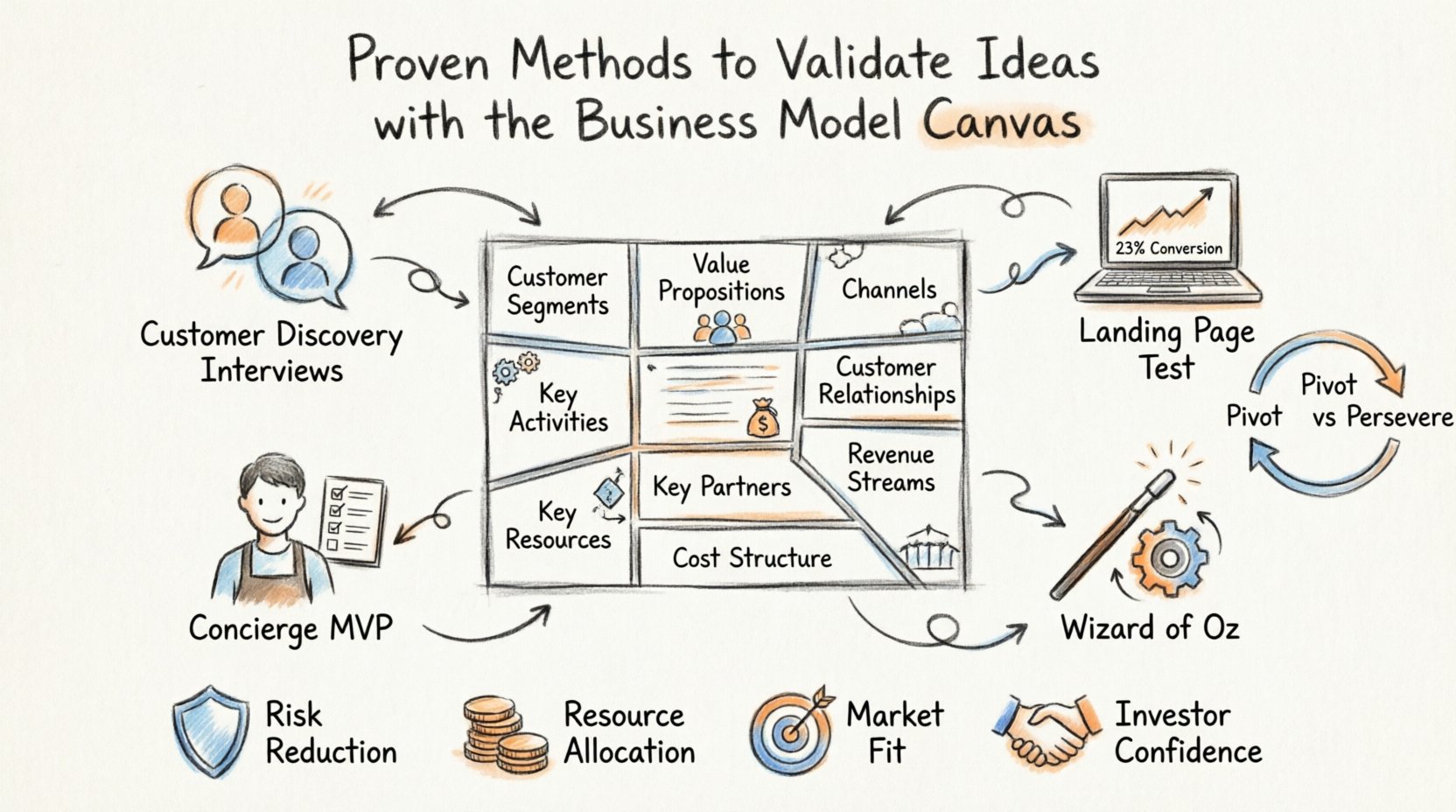
Launching a business involves significant risk. The difference between a venture that thrives and one that stalls often lies in validation. Before committing resources to full-scale development, entrepreneurs must test their core assumptions. The Business Model Canvas (BMC) provides a structured framework for this process. It breaks down a venture into nine building blocks, allowing you to scrutinize each component individually.
This guide details proven methods to validate your ideas using the Business Model Canvas. We will move beyond theory and explore practical steps to test hypotheses, gather data, and refine your strategy. By following these methods, you reduce uncertainty and increase the likelihood of sustainable growth.
Why Validate Before Building? 🔍
Validation is the process of testing whether your assumptions hold true in the real world. Many founders focus on the product, neglecting the business model surrounding it. Without validation, you risk building a solution for a problem that does not exist or cannot be monetized.
Here is why validation is critical:
- Risk Reduction: Identifying flaws early prevents costly mistakes later.
- Resource Allocation: Ensures time and capital are spent on high-value activities.
- Market Fit: Confirms that customers actually want what you are offering.
- Investor Confidence: Data-backed validation attracts partners and funding.
Using the BMC as a validation tool shifts the focus from “what can we build?” to “what can we prove?”.
The Business Model Canvas Structure 🧩
The Business Model Canvas consists of nine strategic elements. To validate effectively, you must understand how each block interacts with the others. Validation is not a single event but a continuous process of refinement.
The Nine Building Blocks:
- Customer Segments: Who are you creating value for?
- Value Propositions: What problem are you solving?
- Channels: How do you reach your customers?
- Customer Relationships: How do you interact with them?
- Revenue Streams: How do you capture value?
- Key Activities: What must you do to make the model work?
- Key Resources: What assets do you need?
- Key Partners: Who helps you deliver value?
- Cost Structure: What are the major costs involved?
Each block represents a hypothesis. For example, the “Revenue Streams” block hypothesizes that customers will pay a specific price for a specific benefit. Validation proves or disproves this.
Step 1: Defining Your Hypotheses 📝
Before testing, you must articulate your assumptions clearly. Vague ideas like “people will like this” are not testable. You need specific, measurable statements.
Example of a Hypothesis:
- Weak: “Small businesses need better accounting.”
- Strong: “Freelance designers will pay $20/month for an automated invoice tool that integrates with PayPal.”
Once you have defined these hypotheses, map them to the relevant BMC blocks. This creates a validation roadmap. You can then select the appropriate testing method for each block.
Method 1: Customer Discovery Interviews 👥
Customer interviews are the most direct way to validate the Value Proposition and Customer Segments. The goal is not to sell your idea but to learn about the customer’s current workflow and pain points.
Best Practices for Interviews:
- Ask Open-Ended Questions: Avoid leading questions that suggest the answer. Ask “How do you currently handle X?” instead of “Do you hate X?”.
- Focus on Behaviors: Past behavior predicts future behavior better than stated intent. Ask about specific instances when they faced the problem.
- Record Sessions: With permission, record conversations to analyze tone and hesitation.
- Speak to the Right People: Ensure you are talking to your defined Customer Segment, not friends or family who may be biased.
Validating Value Proposition:
During the interview, present your proposed solution as a concept. Ask:
- “Does this solve the problem you mentioned?”
- “How much would you pay to make this problem disappear?”
- “What would make this solution unusable for you?”
If customers express interest but refuse to commit to a pre-order, the value may be insufficient. If they say the problem is minor, the segment may be too small. Adjust your BMC based on this feedback.
Method 2: Landing Page & Pre-Sale Tests 🌐
While interviews provide qualitative data, landing pages provide quantitative data. This method is ideal for validating Channels and Revenue Streams.
How to Execute:
- Create a Simple Page: Build a single page describing your offer. Include a clear headline, benefits, and a call to action.
- Drive Traffic: Use social media or search ads to send potential customers to the page.
- Measure Conversion: Track how many visitors click the button or sign up.
Types of Calls to Action:
- Email Capture: Indicates interest but low commitment. Good for early validation.
- Pre-Order: Indicates strong intent and validates willingness to pay.
- Waitlist: Good for gauging demand without immediate financial commitment.
If conversion rates are low, the issue might be the message, the channel, or the value proposition itself. Analyze where users drop off. This data directly informs the “Channels” and “Customer Relationships” blocks of your canvas.
Method 3: The Concierge MVP Approach 🤵
A Minimum Viable Product (MVP) does not always require code. A Concierge MVP involves manually delivering the service you plan to automate. This is highly effective for validating Key Activities and Key Resources.
Scenario:
Imagine you want to build an automated meal planning app. Instead of coding the algorithm, you offer a service where you personally curate meal plans for customers via email.
Benefits of Concierge MVP:
- Direct Feedback: You interact with every user, learning exactly what they need.
- Low Cost: No development costs required initially.
- Process Discovery: You identify the steps required to deliver the value, which later become your “Key Activities”.
If customers are willing to pay for a manual service, the underlying business model has merit. If they are not, automating it will not solve the problem. This method validates the “Cost Structure” by showing you the true cost of delivery before automation.
Method 4: Wizard of Oz Prototyping 🪄
Similar to the Concierge MVP, the Wizard of Oz method creates the illusion of a fully functional product while the backend remains manual or simple. This tests the “Key Partners” and “Key Resources” blocks.
Implementation Steps:
- Front-End Simulation: The user interface looks complete.
- Back-End Manual: A human performs the task behind the scenes.
- Transition Plan: Have a roadmap for when to automate the backend.
Example:
A dating app might match users using a database of profiles, but the actual matching logic could be performed by a human operator. This allows you to test the matching algorithm and user retention without building complex AI.
This method helps determine if the perceived value of the product justifies the resources required to build the full system. If users engage deeply with the manual version, the investment in automation is justified.
Interpreting Data and Iterating 🔄
Validation is not a pass/fail test. It is a learning loop. You will likely find that some hypotheses are correct and others are incorrect. This is valuable information.
Pivot vs. Persevere:
- Persevere: Data supports your hypothesis. Continue refining the execution.
- Pivot: Data contradicts your hypothesis. Change one element of the Business Model Canvas.
Common Pivots:
- Zoom-in Pivot: One feature becomes the whole product.
- Customer Segment Pivot: The product works, but for a different audience.
- Platform Pivot: Moving from mobile to desktop or vice versa.
- Value Proposition Pivot: Changing the core benefit offered.
After each pivot, update your BMC and begin the validation process again. This cycle continues until the model achieves stability.
Common Validation Pitfalls to Avoid ⚠️
Even with a structured approach, errors can occur. Be aware of these common traps.
- Asking Friends and Family: They are biased. They want you to succeed and may not give honest feedback.
- Confirming Bias: Only seeking feedback that supports your idea. Actively look for reasons why the idea might fail.
- Ignoring Negative Data: Dismissing bad feedback. Negative data is often more valuable than positive data.
- Over-Validating: Spending too much time testing and not enough time building. Validation should be efficient, not exhaustive.
- Confusing Interest with Commitment: “I love this” is not the same as “I will buy this.”
BMC Block Validation Checklist 📋
Use this table to track your progress across all nine blocks.
| Building Block | Key Question | Validation Method | Success Metric |
|---|---|---|---|
| Customer Segments | Does this group have the problem? | Interviews | Number of qualified leads |
| Value Proposition | Do they value the solution? | Concierge MVP | Retention rate |
| Channels | Can we reach them cost-effectively? | Landing Page Ads | Cost Per Acquisition (CPA) |
| Customer Relationships | Do they want this type of support? | Onboarding Tests | Support ticket volume |
| Revenue Streams | Are they willing to pay? | Pre-Sales | Conversion rate |
| Key Activities | Can we execute these tasks? | Concierge MVP | Time to deliver |
| Key Resources | Do we have the assets needed? | Resource Audit | Budget variance |
| Key Partners | Will partners cooperate? | MOU Signing | Partner commitment |
| Cost Structure | Is the model profitable? | Financial Modeling | Margin analysis |
Refining the Revenue Model 💰
Revenue validation is often the most critical step. A great product with no revenue is not a business. There are several pricing models to test.
Subscription Model:
Best for recurring value. Test this by offering a beta subscription at a discount. Measure churn. If users cancel immediately after the trial, the value is not sustained.
Freemium Model:
Offer a basic version for free and charge for premium features. Validate this by tracking the conversion rate from free to paid. If the free version is too good, paid conversion will be low. If it is too limited, users will not engage.
Transaction Model:
Charge per use. This works well for marketplaces. Validate by ensuring the volume of transactions is high enough to cover costs.
Iterating the Canvas 🔄
As you validate, your Business Model Canvas will change. It is a living document. Do not treat the initial canvas as the final product.
Iteration Cycles:
- Assumption: Draft the canvas based on your initial idea.
- Test: Run experiments on the riskiest blocks.
- Learn: Gather data and insights.
- Update: Modify the canvas to reflect reality.
- Repeat: Start the cycle again.
Speed is essential in this process. The faster you cycle through these steps, the more quickly you reach a viable business model. Avoid perfectionism. A validated rough draft is better than a perfect unvalidated plan.
Final Thoughts on Validation 🚀
Validation is the bridge between an idea and a business. It transforms speculation into evidence. By systematically testing each block of the Business Model Canvas, you build a venture based on reality rather than hope.
Remember that failure is part of the process. If a hypothesis is disproven, you have saved yourself from a larger failure later. The goal is not to prove you are right, but to find the truth about your market.
Start with your riskiest assumption. Pick a validation method. Execute the test. Update your canvas. Repeat until the model holds up under scrutiny. This disciplined approach is the foundation of successful entrepreneurship.