

Global enterprises operate in an environment defined by complexity, scale, and constant change. The architecture that once supported a monolithic infrastructure is no longer sufficient for modern business requirements. Today, systems are distributed, data flows across borders, and teams operate asynchronously. In this context, The Open Group Architecture Framework (TOGAF) remains a critical reference point. It provides a structured approach to designing, planning, and governing IT landscapes. However, applying TOGAF to distributed architectures requires a nuanced understanding of how standardized processes interact with decentralized technologies.
This guide examines the intersection of enterprise architecture frameworks and distributed system design. It focuses on governance, compliance, and the practical application of the Architecture Development Method (ADM) in a global setting. The objective is clarity and operational stability without sacrificing the agility required for innovation.
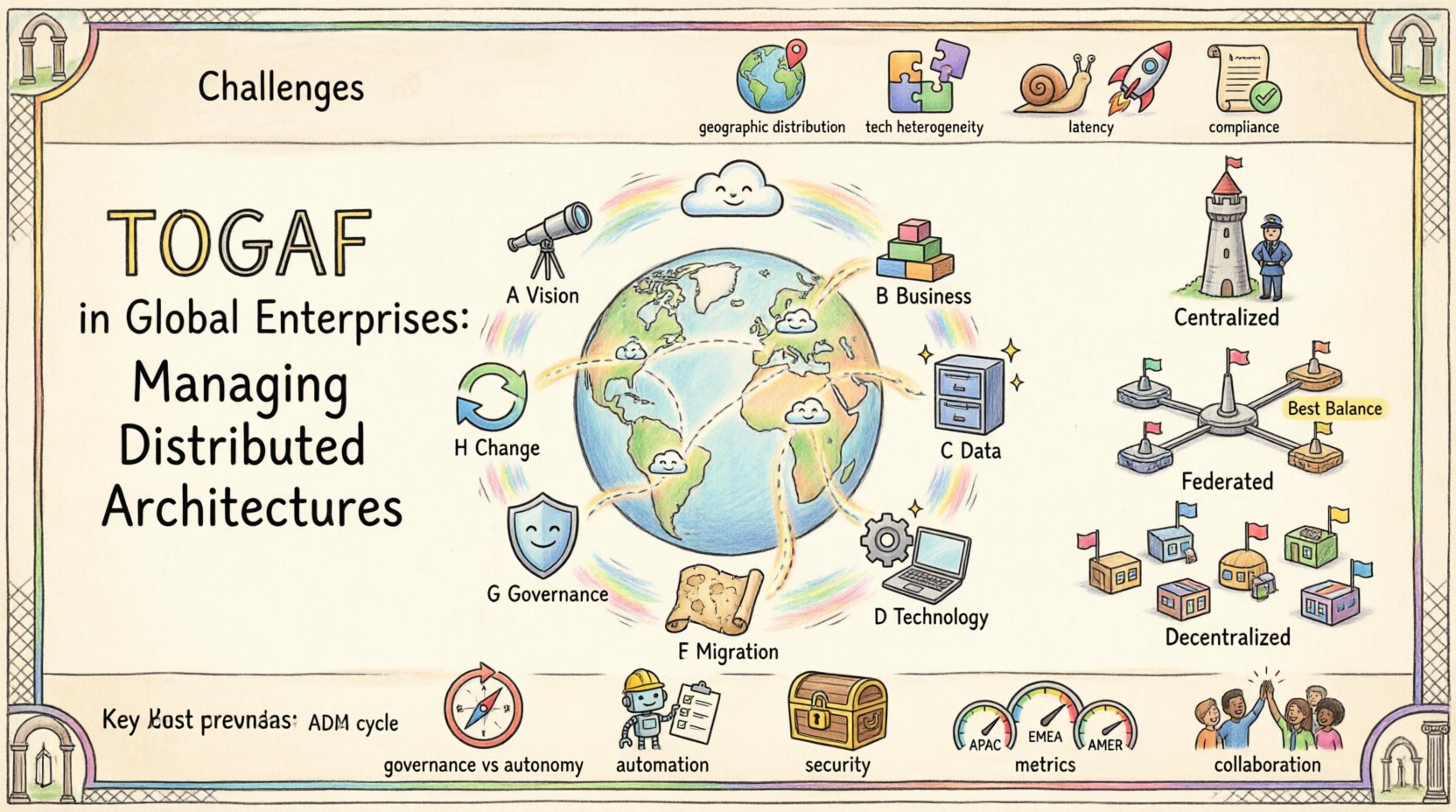
Understanding the Challenge: Centralized Frameworks vs. Distributed Reality 🧩
Traditional enterprise architecture often assumes a certain level of control and centralization. TOGAF offers a robust methodology for creating comprehensive business and IT architectures. Yet, distributed architectures introduce variables that complicate this control. These include:
- Geographic Distribution: Data centers and processing units exist in multiple jurisdictions.
- Technological Heterogeneity: Different regions may utilize different infrastructure providers or legacy systems.
- Latency and Performance: Network distance impacts user experience and system reliability.
- Regulatory Compliance: Data sovereignty laws (such as GDPR or local banking regulations) dictate where data can reside.
When an enterprise adopts a distributed model, it must balance the need for standardization against the need for local autonomy. TOGAF provides the vocabulary and structure to manage this balance. It does not dictate technology choices but rather defines the principles and processes to select and integrate them.
Adapting the Architecture Development Method for Distribution 🛠️
The core of TOGAF is the Architecture Development Method (ADM). This iterative cycle guides architects from vision to implementation. In a distributed environment, each phase requires specific attention to ensure alignment across all nodes.
Phase A: Architecture Vision 🎯
The initial phase defines the scope and constraints. For a global enterprise, the scope must explicitly account for regional constraints. The vision document should outline:
- Which regions require data localization.
- The expected latency thresholds for inter-regional communication.
- The governance model for autonomous teams.
Stakeholder identification here is critical. Regional managers must be involved early to ensure that the architectural vision does not conflict with local operational realities.
Phase B: Business Architecture 🏢
This phase maps business processes to the technology landscape. In distributed systems, business processes are often fragmented. A single workflow might trigger actions in three different cloud environments.
Key activities include:
- Mapping data flow across organizational boundaries.
- Identifying bottlenecks in cross-region business logic.
- Ensuring that process definitions are consistent, even if implementation details vary.
Phase C: Information Systems Architectures 🗃️
Here, data and application architectures are defined. This is where the most significant friction often occurs in distributed systems. The framework must support:
- Data Replication Strategies: Synchronous vs. Asynchronous replication.
- API Management: Standardizing interfaces so services can communicate regardless of location.
- Integration Patterns: Event-driven architectures often outperform request-response models in distributed setups.
Phase D: Technology Architecture 💻
This phase selects the underlying platforms. A global enterprise cannot rely on a single vendor for all infrastructure. The technology architecture must define:
- Standards for container orchestration.
- Networking protocols for secure cross-border traffic.
- Security baselines that apply to all deployed nodes.
It is essential to define a baseline that allows for flexibility. Rigid specifications can hinder local innovation, while loose specifications can lead to technical debt.
Phase E: Opportunities and Solutions 🚀
This phase evaluates the build or buy decisions. In a distributed context, “buy” often means adopting a managed service. “Build” implies maintaining custom code. The decision matrix must consider:
- Long-term maintenance costs in different regions.
- Vendor lock-in risks regarding data portability.
- Support availability for specific time zones.
Phase F: Migration Planning 🗺️
Migration in a distributed system is not a single event. It is a series of coordinated rollouts. The migration plan must include:
- Sequencing of region updates to minimize risk.
- Rollback strategies for each geographic zone.
- Communication plans for distributed teams.
Phase G: Implementation Governance 🛡️
Governance ensures that the implementation adheres to the architecture. In a decentralized environment, this is difficult. Automated compliance checks are often necessary. The framework should support:
- Continuous integration pipelines that enforce architectural standards.
- Policy as code to manage infrastructure.
- Audit trails for data movement across borders.
Phase H: Architecture Change Management 🔄
Change is constant. As the enterprise grows, the architecture must evolve. This phase manages requests for changes. It ensures that modifications in one region do not negatively impact others.
Governance Models for Distributed Systems 🏛️
How control is distributed is as important as the technology itself. There are generally three models of governance used in conjunction with TOGAF.
| Model | Description | Best For |
|---|---|---|
| Centralized | All architectural decisions are made by a single group. Standards are enforced strictly. | Highly regulated industries (Finance, Healthcare) where consistency is paramount. |
| Federated | Core standards are defined centrally, but regions have autonomy over implementation. | Global enterprises with diverse regional needs and autonomy requirements. |
| Decentralized | Teams make independent decisions with minimal oversight. | Startups or innovation labs requiring maximum speed and flexibility. |
For most global enterprises, a federated model offers the best balance. It allows for local adaptation while maintaining global interoperability. TOGAF supports this through the Architecture Board concept, which can include regional representatives.
Interoperability and Standards 🔄
In a distributed architecture, interoperability is the lifeblood of the system. If services cannot communicate, the architecture fails. TOGAF emphasizes the use of standards to facilitate this.
Data Standards
Data formats must be consistent to prevent integration errors. Common practices include:
- Using JSON or XML for data interchange.
- Adhering to ISO standards for date, time, and currency.
- Defining a global data catalog that maps local fields to global definitions.
API Standards
Application Programming Interfaces are the glue of distributed systems. Governance here ensures reliability.
- Versioning strategies must be clear to prevent breaking changes.
- Authentication protocols (such as OAuth or OIDC) must be uniform.
- Rate limiting and throttling policies protect the system from overload.
Security and Compliance in a Global Context 🔒
Security cannot be an afterthought. In a distributed environment, the attack surface is larger. TOGAF provides a structured way to integrate security into the architecture.
Data Sovereignty
Many countries have laws stating that data generated within their borders must remain there. The architecture must support:
- Data residency controls.
- Encryption at rest and in transit.
- Key management systems that respect local laws.
Identity and Access Management (IAM)
Managing who can access what across the globe is complex. A federated identity system is often required. This allows a user to authenticate once and access services in multiple regions without compromising security.
Metrics and KPIs for Distributed Architecture 📊
How do you know if the architecture is working? You need metrics that reflect the reality of a distributed system. Traditional uptime metrics are insufficient.
- Regional Latency: Average response time per geographic zone.
- Data Consistency: Time to sync data between regions.
- Compliance Adherence: Percentage of deployments passing security audits.
- Deployment Frequency: How often changes are pushed to production.
- Change Failure Rate: Percentage of deployments causing incidents.
Tracking these metrics allows the architecture team to identify bottlenecks. If latency spikes in a specific region, the infrastructure team can investigate. If compliance failures rise, the governance model may need adjustment.
Organizational Culture and Collaboration 🤝
Architecture is not just technical; it is social. The success of a distributed architecture depends on how teams collaborate.
- Communication: Establish clear channels for information sharing across time zones.
- Documentation: Maintain living documentation. Outdated docs lead to architectural drift.
- Training: Ensure all teams understand the core principles and the specific constraints of their region.
When teams feel isolated, they build silos. TOGAF encourages a shared repository of artifacts. This ensures that a team in London understands the constraints facing a team in Tokyo.
Common Pitfalls to Avoid ⚠️
Even with a framework, mistakes happen. Here are common issues observed in global enterprises:
- Over-Centralization: Trying to control everything from headquarters slows down local teams.
- Under-Standardization: Allowing too much freedom leads to a fragmented landscape that is hard to maintain.
- Ignoring Latency: Designing a system that works locally but fails globally due to network delays.
- Legacy Debt: Failing to account for legacy systems that must coexist with modern distributed services.
Future-Proofing the Architecture 🔮
The landscape changes rapidly. New technologies emerge, and regulations shift. The architecture must be resilient to these changes.
- Modularity: Design systems as loosely coupled modules. This allows independent updates.
- Abstraction: Hide complexity behind interfaces. If the underlying technology changes, the interface remains stable.
- Scalability: Ensure the architecture can handle growth without a complete redesign.
TOGAF’s focus on principles helps here. Principles are high-level guidelines that remain valid even as specific technologies change. By anchoring decisions in principles, the enterprise maintains direction without being tied to a specific tool.
Summary of Best Practices ✅
To successfully implement TOGAF in a distributed environment, consider these actionable takeaways:
- Define clear boundaries between central governance and local autonomy.
- Use the ADM cycle to guide every major architectural decision.
- Invest in automated governance tools to enforce standards at scale.
- Prioritize security and compliance from the design phase.
- Measure performance across regions to ensure consistent user experiences.
- Foster a culture of shared responsibility and transparency.
Managing distributed architectures is a balancing act. It requires the discipline of a framework like TOGAF and the flexibility of modern engineering practices. When executed correctly, it enables global enterprises to scale efficiently, remain compliant, and innovate continuously.
Final Thoughts on Integration 🤔
The integration of enterprise architecture frameworks with distributed systems is an ongoing process. It is not a one-time project but a continuous effort. As the enterprise grows, the architecture must evolve. The principles established in the preliminary phase provide the compass, but the ADM provides the map.
By adhering to these guidelines, organizations can navigate the complexities of global distribution. They can build systems that are robust, secure, and adaptable. The goal is not just to manage technology, but to enable business value through reliable infrastructure.
Success lies in the details. It lies in the API contracts, the data flows, and the communication between teams. With a solid foundation in TOGAF, global enterprises can turn the challenge of distribution into a competitive advantage.