

Enterprise architecture serves as the backbone for modern digital transformation. As organizations navigate complex IT landscapes, the need for standardized frameworks becomes critical. The Open Group Architecture Framework, commonly known as TOGAF, stands out as the leading methodology for structuring these efforts. For professionals aiming to lead these initiatives, obtaining certification provides a structured path to validation and advancement.
This guide explores the TOGAF certification pathway. It details the examination structure, study strategies, and the tangible impact on professional trajectories. Whether you are an IT manager, a software architect, or a business analyst, understanding this framework is essential for contributing to high-level strategic planning.
📚 Understanding the Framework
Before diving into the certification steps, it is important to define what the framework actually is. TOGAF provides a step-by-step method for designing, planning, implementing, and governing an enterprise information architecture. It is not a set of rules but a collection of tools, methods, and best practices.
- Standardization: It creates a common language for architects across different departments.
- Flexibility: It adapts to various organizational sizes and industry sectors.
- Best Practices: It draws from decades of experience in enterprise planning.
The framework is maintained by The Open Group, a non-profit consortium that develops international standards for the IT industry. Their certification ensures that an individual possesses a verified level of knowledge regarding the methodology.
🎓 The Certification Structure
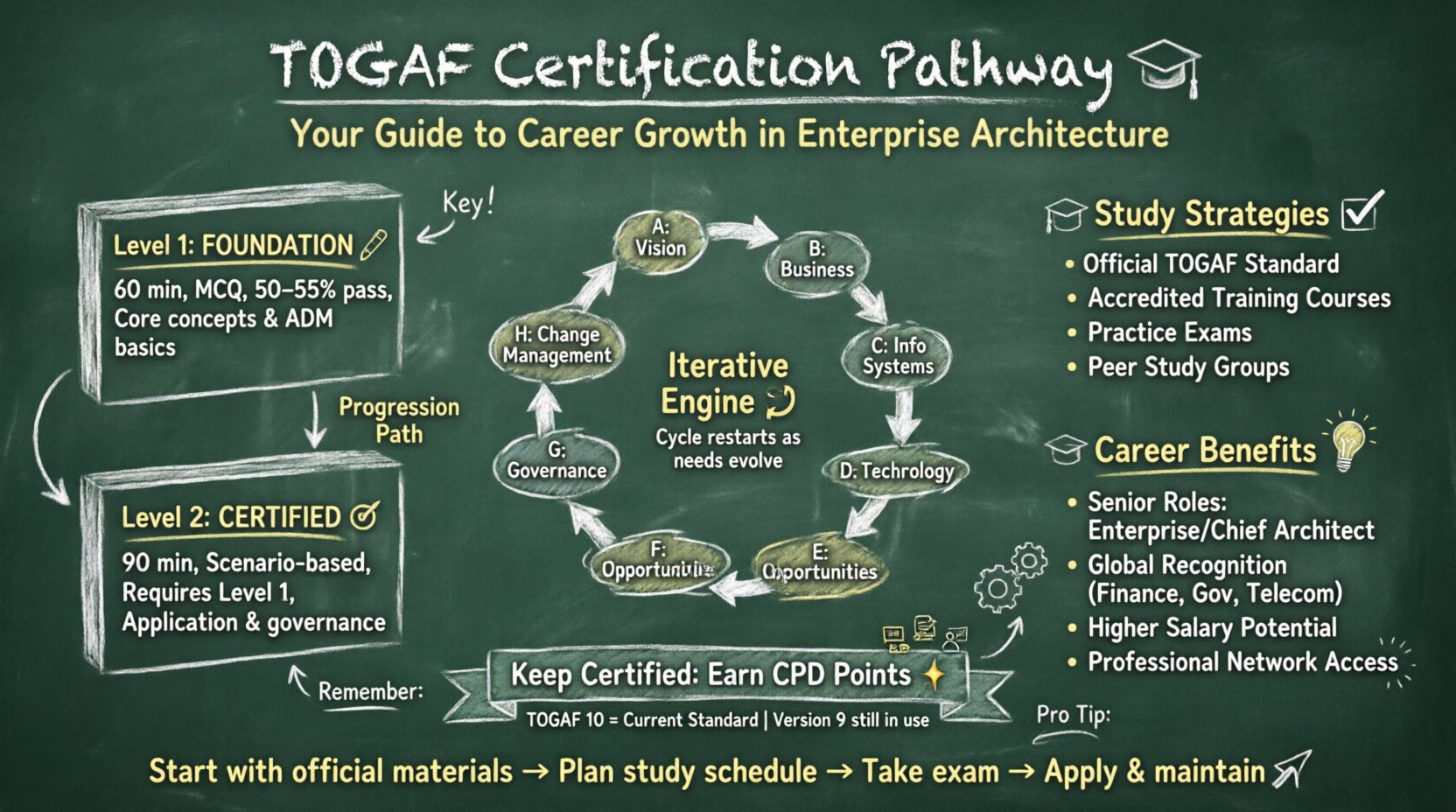
The certification pathway is divided into two primary levels. This tiered approach allows candidates to build foundational knowledge before tackling complex application scenarios. Understanding the distinction between these levels helps in planning your study timeline.
Level 1: TOGAF Enterprise Architecture Foundation
This is the entry point for anyone entering the field. The Foundation level ensures that you understand the core terminology and concepts. It covers the Architecture Development Method (ADM), which is the heart of the framework.
- Exam Format: Multiple-choice questions.
- Duration: Typically 60 minutes.
- Passing Score: Usually around 50% to 55%, depending on the version.
- Content Focus: Definitions, the ADM phases, and key concepts.
Level 2: TOGAF Enterprise Architecture Certified
Once the Foundation level is achieved, candidates can proceed to the Certified level. This exam tests the ability to apply the knowledge in practical scenarios. It moves beyond memorization to critical thinking and problem-solving.
- Exam Format: Scenario-based multiple-choice questions.
- Duration: Typically 90 minutes.
- Prerequisite: You must pass the Foundation level first.
- Content Focus: Application of the ADM, architecture viewpoints, and governance.
| Feature | Foundation (Part 1) | Certified (Part 2) |
|---|---|---|
| Question Type | Recall and Definition | Scenario and Application |
| Time Limit | 60 Minutes | 90 Minutes |
| Prerequisite | None | Pass Foundation |
| Difficulty | Intermediate | Advanced |
🔄 The Architecture Development Method (ADM)
The ADM is the iterative engine of TOGAF. It guides architects through the process of developing an enterprise architecture. To succeed in certification, one must understand the phases thoroughly. Each phase has specific deliverables and outcomes.
Phase A: Architecture Vision
This phase sets the stage. It involves defining the scope, identifying stakeholders, and creating a high-level vision. It is about answering the “why” before the “how”. Without a clear vision, the subsequent work lacks direction.
Phase B: Business Architecture
Here, the focus shifts to the business domain. It involves mapping business processes, organizational structures, and governance. The goal is to ensure the architecture supports business goals effectively.
Phase C: Information Systems Architectures
This phase splits into two parts: Data Architecture and Application Architecture. It deals with the information needed to run the business and the software applications that manage it. Consistency in data standards is crucial here.
Phase D: Technology Architecture
This phase addresses the hardware, networks, and platforms required to support the applications. It ensures that the technical infrastructure is robust, scalable, and secure.
Phase E: Opportunities and Solutions
Once the target architecture is defined, this phase evaluates implementation options. It involves identifying migration projects and determining the sequence of work required to move from the baseline to the target state.
Phase F: Migration Planning
This phase creates the detailed plan for moving the organization. It includes risk assessments, resource allocation, and timeline management. It bridges the gap between planning and execution.
Phase G: Implementation Governance
During implementation, oversight is necessary. This phase ensures that the solution matches the architecture. It involves managing compliance and addressing deviations from the plan.
Phase H: Architecture Change Management
Architecture is not static. This phase handles changes to the architecture over time. It ensures that the framework evolves alongside the business environment.
Key Takeaway: The ADM is cyclical. It does not end with Phase H. As business needs change, the cycle often restarts at Phase A to refine the vision.
📖 Preparation Strategies
Success in certification requires a structured approach. Relying solely on intuition is insufficient. A disciplined study plan increases the likelihood of passing on the first attempt.
1. Official Documentation
The TOGAF Standard is the primary source of truth. It is available through The Open Group website. Reading the official text provides the exact definitions required for the exam. Do not rely on third-party summaries alone.
2. Training Courses
Structured training courses offer guided learning. They often include practice exams and instructor support. Many training providers are accredited by The Open Group. These courses cover the syllabus in depth.
3. Practice Exams
Simulating the exam environment helps manage time pressure. Practice questions reveal gaps in knowledge. They also familiarize you with the wording of the questions.
4. Study Groups
Discussing concepts with peers reinforces understanding. Different perspectives can clarify complex topics. Online forums and local meetups are good places to find study partners.
💼 Career Impact and Growth
Obtaining certification is more than a badge; it is a signal of competence. It demonstrates to employers that you possess a verified skill set. This can open doors to specific roles and higher compensation bands.
Role Advancement
Certified professionals are often considered for senior positions. Titles such as Chief Architect, Enterprise Architect, or Lead Technical Architect often require this credential. It validates the ability to handle complex organizational structures.
Industry Recognition
The certification is recognized globally. It is particularly valuable in sectors like finance, government, and telecommunications. These industries rely heavily on structured architecture to manage risk and compliance.
Salary Potential
Data suggests that certified architects command higher salaries. The specialized knowledge reduces the learning curve for new projects. This efficiency is valuable to employers and is reflected in compensation packages.
Networking Opportunities
Becoming certified connects you with a global community. You gain access to forums, conferences, and local chapters. These networks provide support and keep you updated on industry trends.
🛠️ Maintaining Certification
Certification is not a one-time achievement. It requires ongoing engagement to maintain validity. The Open Group has a Continuing Professional Development (CPD) program. This ensures that certified individuals stay current with updates to the framework.
CPD Points
You must accumulate a specific number of CPD points within a designated period. These points are earned through activities such as:
- Attending training courses
- Writing articles or white papers
- Presenting at conferences
- Participating in working groups
Renewal Process
The renewal process involves submitting evidence of your activities. This can be done online through the member portal. Keeping a log of your professional activities makes this process smoother.
🔄 TOGAF 10 vs. Version 9
The framework has evolved. Version 10 introduced changes to the structure and terminology. Understanding these differences is important for those choosing which path to take.
- Integration: Version 10 integrates the two parts of the certification more tightly.
- Terminology: Some terms have been updated to reflect modern practices.
- Focus: There is a greater emphasis on security and technology trends.
For new candidates, the Version 10 pathway is the current standard. However, many organizations still operate on Version 9 principles. Familiarity with both versions provides a competitive edge.
❓ Frequently Asked Questions
How long does it take to prepare?
This varies by individual. Some candidates study for 4 weeks, while others take 3 months. It depends on prior experience and the amount of time dedicated daily. A full-time study plan is faster than a part-time approach.
Can I retake the exam?
Yes. If you do not pass, you can retake the exam. There is usually a waiting period between attempts. Check the specific policy for your region and exam provider.
Is experience required?
Formal work experience is not a strict requirement for the Foundation exam. However, practical experience helps with understanding the context of the questions. The Certified level benefits significantly from real-world application.
Does it expire?
The certification itself does not expire, but you must maintain your CPD points to keep the status active. Failure to maintain points can result in the loss of certified status.
Is online proctoring available?
Yes. Many exams can be taken remotely with online proctoring. This allows flexibility in scheduling and location. Ensure your technical setup meets the requirements.
🚀 Final Thoughts
Entering the field of enterprise architecture is a significant step. It requires a blend of technical knowledge and strategic thinking. The TOGAF certification pathway offers a proven method to validate these skills. By following the structured approach outlined in this guide, you position yourself for long-term success.
The journey involves dedication and continuous learning. It is not merely about passing an exam but about internalizing a way of thinking. This mindset shift allows you to contribute meaningfully to organizational goals. As technology evolves, the need for structured architecture will remain constant.
Investing time in this certification pays dividends in career stability and opportunity. It provides a common language for collaboration and a framework for decision-making. Whether you are starting your journey or advancing your career, the TOGAF pathway offers a clear direction.
Start by reviewing the official materials. Identify your knowledge gaps. Create a study schedule that fits your life. Take the exam when you are confident. Once certified, focus on applying the knowledge and maintaining your credentials. This disciplined approach leads to sustainable growth.