

Enterprise Architecture frameworks like TOGAF (The Open Group Architecture Framework) have traditionally been associated with detailed planning, extensive documentation, and long-term visioning. Agile methodologies, conversely, prioritize iterative delivery, adaptability, and customer feedback. For many organizations, integrating these two distinct approaches creates friction. The perceived conflict lies in the tension between the need for architectural governance and the desire for rapid iteration.
This guide explores how organizations can successfully apply TOGAF principles within Agile environments. We will examine practical strategies for aligning the Architecture Development Method (ADM) with iterative development cycles, ensuring that structure supports flexibility rather than hindering it. By understanding the nuances of both frameworks, leaders can build systems that are robust yet responsive to change.
🧩 Understanding the Core Frameworks
To integrate effectively, we must first understand the fundamental nature of each approach without relying on buzzwords.
🏛️ The TOGAF Architecture Development Method
TOGAF provides a structured approach to designing, planning, implementing, and governing an enterprise information architecture. The core of this framework is the ADM cycle, which consists of several phases:
- Phase A: Architecture Vision – Establishing the scope and stakeholder requirements.
- Phase B: Business Architecture – Defining the business strategy and processes.
- Phase C: Information Systems Architectures – Covering Data and Application architectures.
- Phase D: Technology Architecture – Defining the infrastructure and technical standards.
- Phase E: Opportunities and Solutions – Planning the implementation roadmap.
- Phase F: Migration Planning – Sequencing the transition steps.
- Phase G: Implementation Governance – Ensuring the solution matches the design.
- Phase H: Architecture Change Management – Managing changes to the architecture.
Traditionally, this cycle is viewed as linear or semi-linear, often requiring a complete definition before implementation begins. This is where the friction with Agile arises.
⚡ The Agile Mindset
Agile is not just a set of practices; it is a mindset centered on the Agile Manifesto. Key principles include:
- Individuals and interactions over processes and tools.
- Working software over comprehensive documentation.
- Customer collaboration over contract negotiation.
- Responding to change over following a plan.
Agile teams typically work in short iterations (sprints) to deliver functional increments. They rely on continuous feedback to adjust the direction of the product. In this context, a rigid architecture plan can slow down value delivery.
🤝 The Integration Challenge
The primary challenge in combining TOGAF and Agile is the difference in time horizons and planning granularity. TOGAF often looks at the enterprise level over years, while Agile operates in weeks or months. If the architecture is too rigid, it stifles the team’s ability to pivot. If it is too loose, the organization risks technical debt and fragmentation.
Here is a breakdown of where the tensions typically occur:
| Aspect | TOGAF Focus | Agile Focus | Potential Conflict |
|---|---|---|---|
| Planning | Long-term roadmap | Short-term sprint backlog | How much future detail is needed? |
| Documentation | Comprehensive models | Working software | Is the documentation overhead justified? |
| Decision Making | Centralized governance | Decentralized ownership | Who approves the change? |
| Change | Controlled evolution | Embraced adaptation | How to manage drift? |
Recognizing these differences allows architects to design a hybrid model that respects the strengths of both.
🔄 Adapting the ADM for Agile Cycles
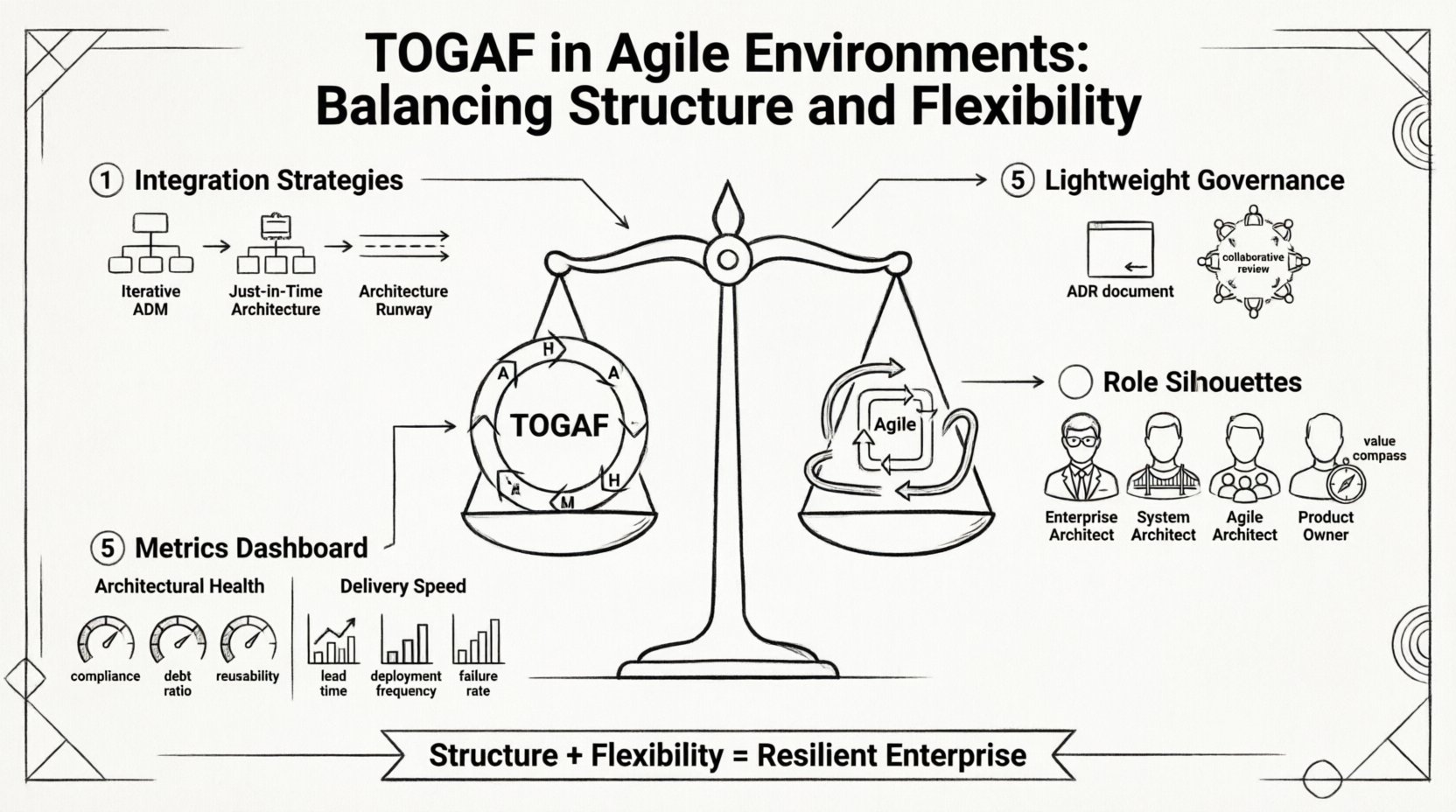
The Architecture Development Method does not need to be abandoned. Instead, it can be made iterative. The concept of “iterative ADM” allows architecture work to happen alongside development work, rather than preceding it entirely.
🌱 Iterative Architecture Vision
Phase A (Vision) should not be a one-time event. In an Agile environment, the vision is treated as a living document. It provides the north star but allows for course correction based on market feedback. Architects collaborate with Product Owners to ensure the vision aligns with the product roadmap.
Key actions include:
- Defining high-level principles that remain constant.
- Identifying non-negotiable constraints (security, compliance).
- Breaking the vision into actionable architectural epics.
🏗️ Just-in-Time Architecture Definition
In traditional models, all four domains (Business, Data, Application, Technology) are defined fully before development starts. Agile suggests defining only what is necessary to proceed. This is often called “just-in-time” architecture.
For example:
- Sprint 1-3: Focus on the Business Architecture and high-level Application logic.
- Sprint 4-6: Refine the Data Architecture as specific data entities are required.
- Sprint 7+: Detail the Technology Architecture for deployment environments.
This approach reduces waste. Architects do not spend time modeling components that might be discarded during an iteration.
🏗️ The Architecture Runway
A critical concept for this integration is the “Architecture Runway.” This term refers to the technical infrastructure and architectural principles that must be in place to support future feature development. Without a runway, developers may have to stop and build foundational components in the middle of a feature sprint, causing delays.
To maintain a healthy runway:
- Identify Enablers: Determine which technical work is required to enable future business value.
- Allocate Capacity: Reserve a portion of sprint capacity (e.g., 20%) for architectural enablers.
- Automate Standards: Use infrastructure as code to enforce technical standards without manual review bottlenecks.
This ensures that the Agile team has the tools and frameworks they need without waiting for a massive architecture project to finish.
🛡️ Lightweight Governance
Governance in an Agile environment must be lightweight. Heavy-handed approval processes kill momentum. The goal is to ensure compliance and quality without creating bottlenecks.
📝 Architecture Decision Records (ADRs)
Instead of massive architecture documents, organizations can use Architecture Decision Records. An ADR captures a significant architectural decision along with its context and consequences. It is a lightweight document that lives in the code repository.
Benefits of ADRs include:
- Traceability: Knowing why a decision was made months or years later.
- Collaboration: Team members can review and comment on decisions easily.
- Transparency: The decision history is accessible to everyone.
🔍 The Architecture Review Board
The traditional Architecture Review Board (ARB) can become a bottleneck. In Agile, the ARB should function as a consulting body rather than a gatekeeper. Reviews should happen at key milestones rather than at every sprint.
Consider these adjustments:
- Focus on Risks: Review only high-risk decisions that could impact the enterprise.
- Async Reviews: Allow architects to provide feedback asynchronously to avoid scheduling conflicts.
- Peer Reviews: Encourage developers to review each other’s architectural compliance before formal ARB review.
👥 Roles and Responsibilities
Successful integration requires clear role definitions. The traditional “Chief Architect” role often needs to evolve into a more distributed model.
🧑💼 The Enterprise Architect
The Enterprise Architect focuses on the long-term vision. They define the standards, principles, and patterns that guide the organization. They ensure that different teams are not building incompatible silos.
🧑💻 The System Architect
The System Architect works closer to the development teams. They translate enterprise principles into specific technical designs for a particular solution. They act as a bridge between high-level strategy and code.
🏃♂️ The Agile Architect
Some organizations embed architects directly into Agile teams. These individuals help the team make decisions that align with the broader strategy while maintaining development velocity. They participate in sprint planning and backlog refinement.
🧭 The Product Owner
The Product Owner represents the business value. They work with architects to ensure that technical constraints are understood in the context of business goals. They prioritize architectural enablers alongside user stories.
🚧 Common Pitfalls to Avoid
Even with a solid plan, integration can fail if specific pitfalls are ignored. Being aware of these common mistakes can save significant time and resources.
- Over-Engineering: Trying to design for every possible future scenario leads to bloated systems. Design for the current requirements with extensibility in mind.
- Under-Engineering: Ignoring architectural constraints leads to technical debt that becomes unmanageable. Ensure non-functional requirements (performance, security) are addressed.
- Communication Gaps: Architects and Developers often speak different languages. Use diagrams and models that are accessible to the whole team.
- Ignoring Technical Debt: Agile teams often prioritize features over refactoring. Establish a rule that a percentage of every sprint must address technical debt.
- Tool Overload: Do not rely on complex modeling tools that require training. Keep documentation simple and integrated with the development workflow.
📊 Measuring Success
How do you know if the integration is working? You need metrics that reflect both architectural health and delivery speed.
📈 Architectural Health Metrics
- Compliance Rate: Percentage of solutions adhering to defined standards.
- Technical Debt Ratio: Ratio of refactoring work to new feature work.
- Reusability: Number of shared components used across different projects.
🚀 Delivery Metrics
- Lead Time: Time from idea to deployment.
- Deployment Frequency: How often code is released.
- Change Failure Rate: Percentage of deployments causing a failure.
By tracking these metrics, leadership can make data-driven decisions about where to invest in architecture or where to relax constraints.
🤔 Frequently Asked Questions
❓ Can TOGAF work with Scrum?
Yes. The ADM phases can be mapped to Sprint cycles. For instance, Phase B and C can be explored over a series of sprints. The key is to view the ADM as a cycle of discovery rather than a linear waterfall.
❓ How much documentation is required?
Documentation should be sufficient to maintain the system but not excessive. A diagram that fits on a single page is often better than a 50-page document. Focus on value-added documentation that aids maintenance.
❓ What if the business requirements change mid-sprint?
This is a core Agile principle. The architecture must be flexible enough to accommodate changes. Use abstraction layers and interfaces to decouple components so that changes in one area do not break the whole system.
❓ Do we need a separate Agile framework like SAFe?
Not necessarily. While frameworks like SAFe (Scaled Agile Framework) provide structure for large organizations, TOGAF can be adapted without adopting a full-scale framework. The choice depends on the organizational size and complexity.
❓ How do we handle legacy systems?
Legacy systems often require a different approach. You may need to create a “Strangler Fig” pattern where new functionality is built around the legacy system, gradually replacing it. TOGAF helps map the transition from the legacy state to the target state.
🔍 Key Takeaways
Integrating TOGAF with Agile is not about choosing one over the other. It is about finding the equilibrium between structure and agility. By making the Architecture Development Method iterative, adopting lightweight governance, and clearly defining roles, organizations can achieve both stability and speed.
Success depends on communication, flexibility, and a shared understanding of goals. When the architecture team and the development team work as partners, the result is a resilient enterprise that can adapt to market changes without compromising on quality or compliance.
Start small. Pilot the approach in one team. Measure the results. Adjust the process. Repeat. This iterative approach to architecture itself mirrors the Agile philosophy it seeks to support.