

Modern enterprises face a complex financial landscape where technology spend often outpaces tangible value delivery. Organizations invest millions in digital transformation, cloud migration, and software licenses, yet many struggle to trace the direct return on these expenditures. This disconnect between capital allocation and strategic outcomes is where Enterprise Architecture becomes critical. By applying the TOGAF framework, leadership can bring structure to chaos and ensure every dollar spent aligns with business goals.
Optimizing IT investments is not merely about cutting costs; it is about maximizing value through disciplined architecture governance. This guide explores how to leverage the Architecture Development Method (ADM) to scrutinize, prioritize, and manage technology spending effectively. We will examine the specific mechanisms within the TOGAF standard that facilitate better decision-making, risk management, and capability mapping without relying on proprietary software tools.
Why IT Investment Optimization Matters Now 📉
IT budgets are frequently treated as operational overhead rather than strategic assets. When spending is uncoordinated, shadow IT emerges, leading to data silos, redundant systems, and security vulnerabilities. Without a unified view, organizations risk funding legacy maintenance while neglecting innovation. The challenge lies in visibility—seeing the full picture of how technology capabilities support business objectives.
Adopting a structured approach allows stakeholders to answer critical questions before funds are committed:
- Does this initiative directly support the current business strategy?
- Are we building a capability we already own elsewhere?
- What is the long-term cost of ownership for this solution?
- How does this investment impact our risk profile?
- Can we measure the return on this specific technology spend?
The TOGAF framework provides the vocabulary and the process to answer these questions systematically. It moves the conversation from “what software should we buy?” to “what capabilities do we need to deliver business value?”.
Core Components of TOGAF for Financial Alignment 🏛️
To optimize investments, one must first understand the relevant components of the framework. TOGAF is not a rigid set of rules but a modular approach to designing, planning, implementing, and governing an enterprise information architecture.
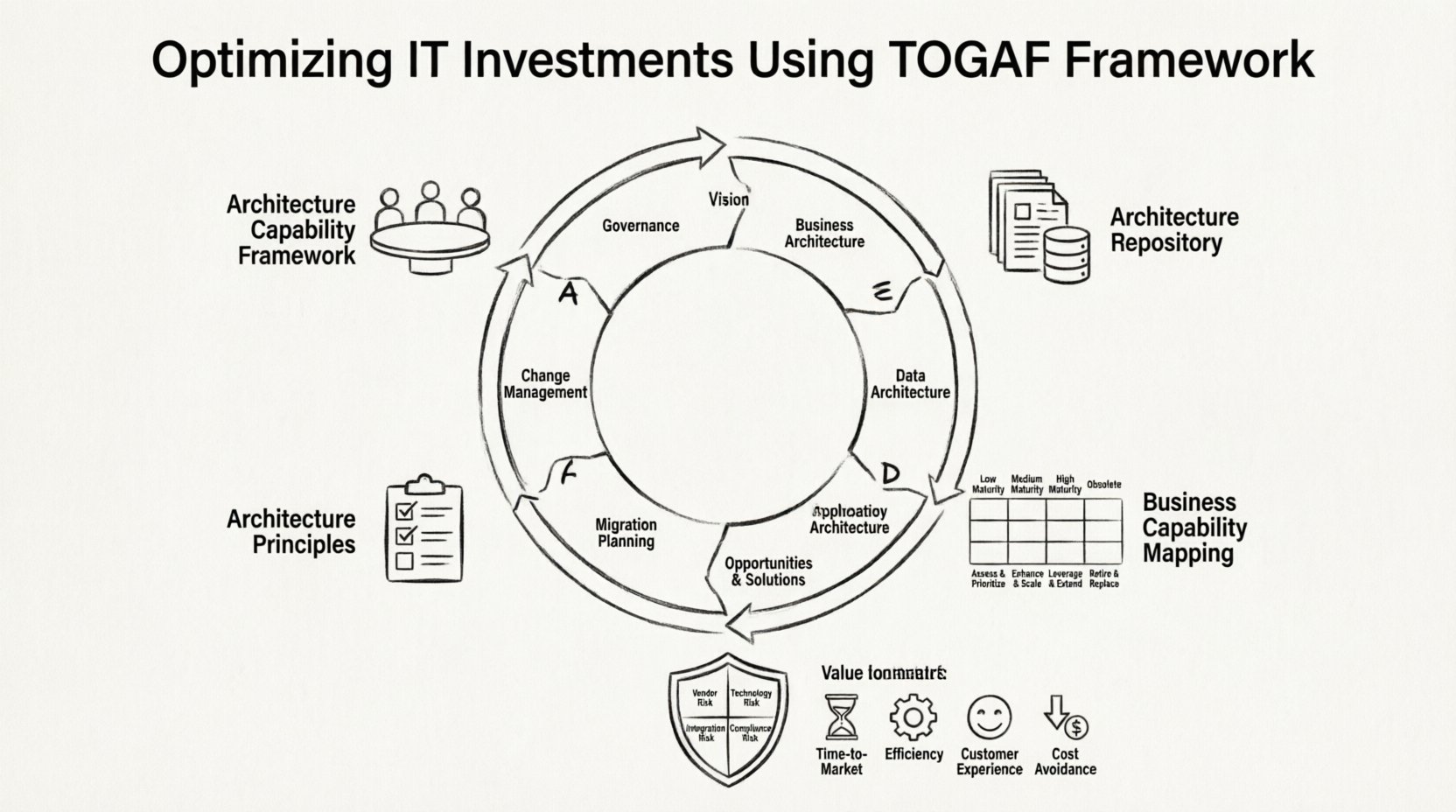
1. The Architecture Capability Framework
Before starting specific projects, an organization must establish its own capability. This involves defining the Architecture Board, the roles of architects, and the governance processes. Investment decisions flow through this board, ensuring that funding aligns with the strategic vision rather than individual departmental desires.
2. The Architecture Repository
This is the central storehouse of architecture assets. It holds all documentation, models, and standards. When evaluating a new investment, architects consult the repository to check for existing solutions. This prevents duplication and encourages the reuse of components, directly reducing costs.
3. The Architecture Principles
Principles are statements of general rules and guidelines. They act as the litmus test for investments. For example, a principle might state: “Data is an asset that must be shared.” If a proposed investment locks data into a proprietary silo, it violates this principle and should be rejected or re-evaluated.
Applying the ADM Cycle to Investment Decisions 🔄
The Architecture Development Method (ADM) is the heart of TOGAF. While often described as a project lifecycle, each phase has specific implications for financial planning and investment management. Mapping investment activities to these phases ensures that capital is released in stages, tied to value realization.
Phase A: Architecture Vision
This phase defines the scope and high-level business goals. It is the primary checkpoint for investment approval. Before a large budget is allocated, the Architecture Vision document must articulate the business case.
- Strategic Fit: Confirm the project supports the corporate roadmap.
- Stakeholder Management: Identify who funds the initiative and who benefits.
- High-Level Cost Estimation: Establish rough order of magnitude for budgeting.
Phase B, C, and D: Business, Information Systems, and Technology Architectures
These phases dive deeper into the specific capabilities required. This is where the financial granularity happens.
- Business Architecture: Defines the business processes. Investing in technology that does not streamline or enable these processes is wasteful.
- Data Architecture: Identifies data flow. Poor data management leads to costly reconciliation efforts later.
- Application Architecture: Maps applications to business functions. This highlights redundant applications that can be retired to free up budget.
- Technology Architecture: Specifies hardware and software platforms. Standardizing here reduces licensing and maintenance costs.
Phase E: Opportunities and Solutions
Here, the focus shifts to selection. The framework guides the organization in categorizing projects into specific workstreams. Investments are grouped to maximize synergies. For example, instead of funding ten small projects, the organization might fund one platform that satisfies the needs of all ten.
Phase F: Migration Planning
This phase translates the architecture into an implementation plan. It details the transition from the baseline to the target state. Crucially, it includes a schedule and resource plan. This allows finance teams to forecast cash flow requirements accurately over time.
Phase G: Implementation Governance
During execution, this phase ensures that the actual build matches the plan. It monitors compliance with the architecture. If a project deviates, it risks technical debt. Governance ensures that scope creep does not inflate the budget unexpectedly.
Phase H: Architecture Change Management
Even after implementation, the environment changes. This phase ensures the architecture evolves with the business. It prevents “architecture drift,” where systems become obsolete or misaligned, which would require expensive rework later.
Strategic Alignment: Bridging Business and IT 🎯
The most common failure in IT investment is misalignment. The business asks for a solution, and IT provides technology, but the two do not mesh. TOGAF addresses this through Business Capability Mapping.
By defining capabilities (e.g., “Customer Onboarding,” “Risk Management,” “Supply Chain Logistics”), organizations can prioritize investments based on capability gaps rather than technology trends. This ensures funding goes to areas where the organization is weak and needs support.
Consider the following matrix for prioritizing capabilities:
| Capability Maturity | Investment Strategy | Expected Outcome |
|---|---|---|
| Low Maturity | High Priority Funding | Build or Buy Core Capability |
| Medium Maturity | Maintenance Funding | Incremental Improvement |
| High Maturity | Low Priority Funding | Optimization & Efficiency |
| Obsolete | Divestment | Retire and Reallocate Budget |
This approach shifts the budget conversation from technology features to business capabilities. It allows leaders to cut funding for obsolete capabilities and redirect those funds to high-priority growth areas.
Risk Management and Compliance 🛡️
Investment optimization is not just about saving money; it is about mitigating risk. Poorly chosen technologies can introduce security vulnerabilities, regulatory non-compliance, or operational fragility. These risks carry a hidden cost that often exceeds the initial savings.
TOGAF integrates risk management into the architecture process. The Risk Register is updated throughout the ADM cycle. When evaluating a potential investment, the architecture team assesses:
- Vendor Risk: Is the supplier financially stable? Are they likely to disappear?
- Technology Risk: Is the technology mature, or is it experimental?
- Integration Risk: How difficult is it to connect this new system with existing ones?
- Compliance Risk: Does this solution meet data privacy and industry regulations?
By quantifying these risks, organizations can adjust their investment estimates to include contingency buffers. This leads to more realistic budgeting and prevents surprise overruns.
Performance Measurement and Value Realization 📊
One of the most difficult aspects of IT investment is proving value. Traditional metrics like “uptime” or “number of tickets resolved” do not capture business impact. TOGAF encourages the use of Architecture Business Value metrics.
These metrics link technical performance to business outcomes. For example:
- Time-to-Market: How much faster can we launch products with this architecture?
- Operational Efficiency: How many manual hours are saved through automation?
- Customer Experience: How has response time or satisfaction improved?
- Cost Avoidance: How much did we save by not building a custom solution?
Tracking these metrics requires a feedback loop. The Architecture Board reviews these outcomes periodically. If a project fails to deliver the promised value, the framework allows for a pivot or a stop. This accountability ensures that investment decisions remain grounded in reality.
Governance Mechanisms for Investment Control 📋
Without governance, architecture plans are ignored. To optimize investments, an organization needs a robust governance model. This involves defining clear decision-making authorities.
The Architecture Board
This group is responsible for approving architecture designs and investment proposals. Membership typically includes senior IT leadership, business unit heads, and finance representatives. Their role is to ensure that proposals meet the Architecture Principles.
Compliance Reviews
Before a project moves to the next phase, it must pass a compliance review. This is a gate in the process. If a project violates a principle (e.g., using non-standard hardware), it is sent back for redesign. This gatekeeping function prevents wasteful spending on non-compliant solutions.
Architecture Compliance Scorecard
This tool measures how well projects adhere to the defined architecture. It provides a quantitative score. Projects with low scores might face funding restrictions until they align with the strategy. This creates a financial incentive for developers and managers to follow the architecture.
Common Pitfalls in Investment Optimization ⚠️
Even with a framework like TOGAF, organizations can stumble. Understanding common pitfalls helps avoid them.
- Over-Engineering: Creating architecture that is too complex for the business needs. This leads to high maintenance costs and slow delivery. Keep the architecture pragmatic.
- Under-Investing in Data: Focusing only on applications and ignoring data quality. Bad data renders expensive applications useless.
- Ignoring Technical Debt: Taking shortcuts to save money now, leading to higher costs later. Technical debt must be budgeted for as a recurring expense.
- Disconnect from Finance: Architects and Finance teams often speak different languages. Regular collaboration is necessary to translate technical value into financial terms.
Building a Sustainable Investment Roadmap 🗺️
The output of the TOGAF process should be a roadmap. This document outlines the sequence of investments over time. It balances immediate needs with long-term strategy.
A sustainable roadmap considers the Capability Maturity Model. It prioritizes foundational capabilities (like security or data governance) before advanced capabilities (like AI or predictive analytics). You cannot build a skyscraper on a swamp.
Here is a checklist for validating your roadmap:
- Are the phases sequential or can they run in parallel?
- Do we have the funding available for each phase?
- Are the dependencies between projects clearly mapped?
- Is there a mechanism to adjust the roadmap if the business changes?
- Have we accounted for the cost of change management and training?
Final Thoughts on Strategic Investment 🏁
Optimizing IT investments is a continuous process, not a one-time event. The landscape changes, technology evolves, and business strategies shift. The TOGAF framework provides the stability needed to navigate these changes without losing focus.
By aligning architecture with business strategy, organizations can ensure that every dollar spent contributes to growth and efficiency. The discipline of the ADM cycle, combined with strong governance and clear metrics, creates an environment where technology truly serves the enterprise. This approach transforms IT from a cost center into a strategic partner capable of driving tangible business results.
Start by reviewing your current architecture repository. Identify where duplication exists. Engage your Architecture Board to review your upcoming budget requests against your strategic principles. The path to optimization begins with clarity.