

Digital transformation is not merely about adopting new technologies. It is a fundamental shift in how an organization operates, delivers value, and interacts with its stakeholders. In complex environments, the risk of fragmentation is high. Without a cohesive structure, initiatives often become siloed projects that fail to integrate. This is where the TOGAF (The Open Group Architecture Framework) provides essential guidance. It offers a proven method for designing, planning, implementing, and governing an enterprise information architecture.
Integrating TOGAF principles into digital transformation efforts ensures that technology investments align with business strategy. This guide explores how to leverage this framework effectively. We will examine the Architecture Development Method (ADM), the role of business architecture, and the importance of governance. By following a structured approach, organizations can navigate change with clarity and purpose.
Why TOGAF Matters in Digital Change 🔄
Digital initiatives often move faster than traditional IT planning cycles. This speed can lead to technical debt and architectural drift. TOGAF introduces discipline without necessarily slowing down progress. It acts as a guardrail, ensuring that every new capability supports the broader vision.
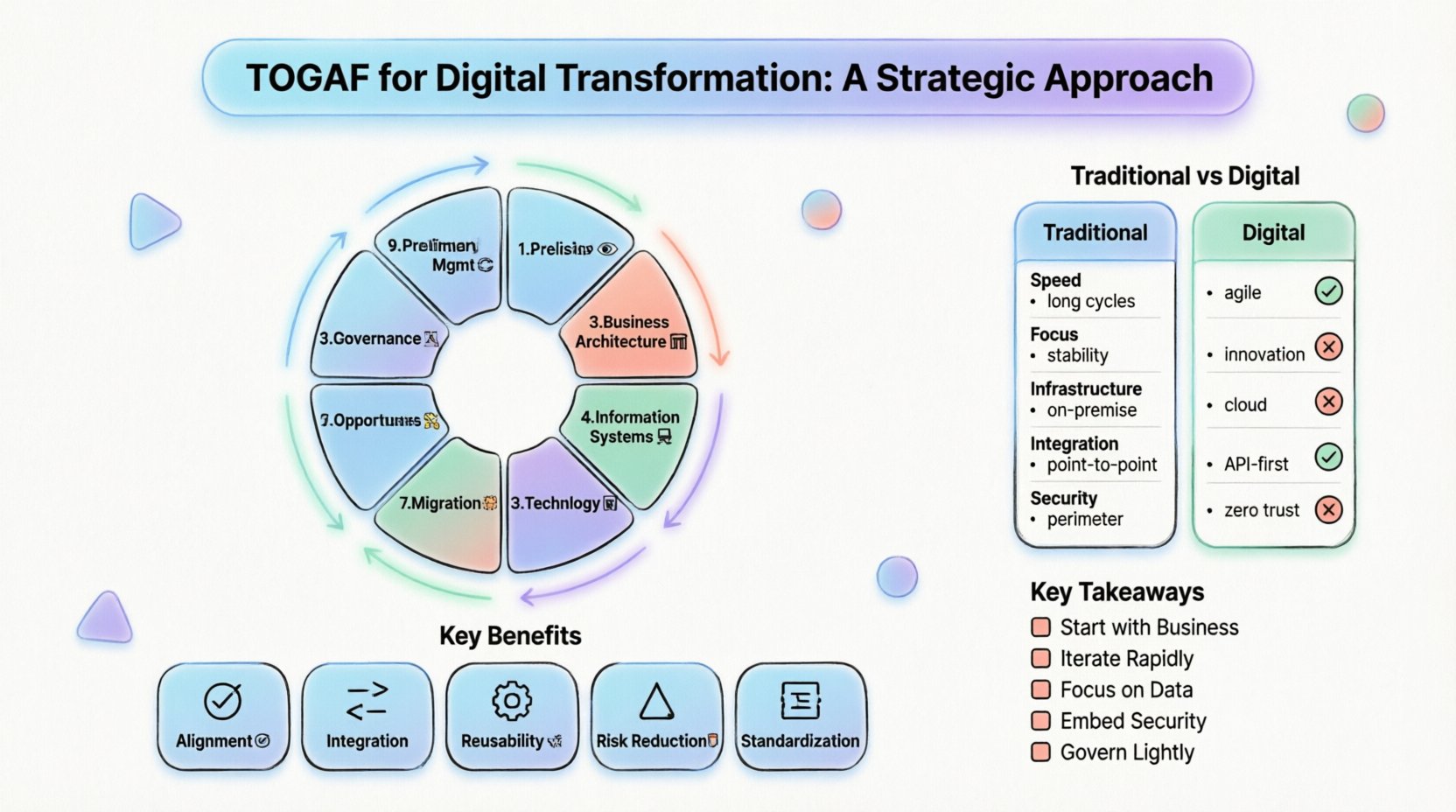
Key benefits include:
- Alignment: Ensures IT capabilities directly support business goals.
- Integration: Facilitates the connection of disparate systems.
- Reusability: Promotes the use of shared components to reduce redundancy.
- Risk Reduction: Identifies potential failures before implementation begins.
- Standardization: Establishes consistent processes across departments.
When organizations skip architectural planning, they often encounter integration issues later. Data becomes inaccessible, APIs conflict, and security gaps emerge. TOGAF helps mitigate these risks by enforcing a holistic view of the enterprise.
The Architecture Development Method (ADM) in Context 📋
The core of TOGAF is the Architecture Development Method (ADM). It is an iterative cycle that guides the creation of an architecture. For digital transformation, the ADM provides a roadmap. It moves from a high-level vision to detailed implementation specifications.
While the standard cycle is robust, digital contexts often require adaptation. Speed is critical. Therefore, architects may run phases in parallel or iterate through them rapidly. Below is a breakdown of how the ADM phases apply to modern digital initiatives.
1. The Preliminary Phase 🛠️
This phase prepares the organization for architecture work. It defines the principles, standards, and architecture capability. In a digital context, this involves assessing the current maturity of the architecture function. Are teams ready to collaborate? Do they understand the need for standards?
2. Phase A: Architecture Vision 👁️
Here, the scope and stakeholders are identified. For digital transformation, this step is crucial for defining the why. It sets the business drivers for change. Key activities include:
- Defining the business case for transformation.
- Identifying key stakeholders and their concerns.
- Establishing the initial architecture vision.
- Obtaining approval to proceed to detailed planning.
3. Phase B: Business Architecture 🏢
Digital transformation starts with business processes. This phase defines the business strategy, governance, and organizational structure. It maps out value streams and capabilities. Understanding how value is delivered is more important than understanding the code.
Key considerations include:
- Value Streams: How do customers receive value?
- Capabilities: What functions does the business need?
- Organizational Units: Who is responsible for what?
- Information Mapping: What data supports the business?
4. Phase C: Information Systems Architectures 💾
This phase is split into Data and Application architectures. It focuses on the logical structures needed to support the business.
Data Architecture
- Defines data governance and management.
- Ensures data quality and accessibility.
- Plans for data integration across platforms.
Application Architecture
- Defines the landscape of software applications.
- Plans for interoperability and integration.
- Considers cloud-native patterns and microservices.
5. Phase D: Technology Architecture 🖥️
This phase covers the hardware and software infrastructure. In a digital environment, this often involves cloud services, networking, and security tools. The goal is to ensure the underlying infrastructure can support the applications and data defined in the previous phase.
6. Phase E: Opportunities and Solutions 🧩
Here, the architecture is translated into work packages. The organization decides how to implement the changes. Options might include building new systems, purchasing commercial software, or upgrading existing infrastructure. This phase involves gap analysis to identify what is missing.
7. Phase F: Migration Planning 🗺️
This phase creates the detailed plan for moving from the current state to the target state. It includes sequencing projects, managing risks, and allocating resources. For digital transformation, this often means phasing out legacy systems while introducing new capabilities.
8. Phase G: Implementation Governance 🛡️
During implementation, the architecture must be monitored. This phase ensures that the projects remain aligned with the vision. It involves auditing compliance and managing changes to the architecture.
9. Phase H: Architecture Change Management 🔄
Change is constant. This phase manages updates to the architecture as the business evolves. It ensures the architecture remains relevant over time.
Comparing Traditional vs. Digital Architecture Approaches 📊
Understanding the differences between traditional IT planning and digital-focused architecture is vital. The table below highlights key distinctions.
| Aspect | Traditional Approach | Digital Transformation Approach |
|---|---|---|
| Speed | Long planning cycles | Agile, iterative cycles |
| Focus | Stability and Control | Innovation and Agility |
| Infrastructure | On-premise, physical | Cloud, hybrid, virtualized |
| Integration | Point-to-point | API-first, ecosystem-based |
| Security | Perimeter-based | Zero trust, identity-centric |
Adapting TOGAF to this digital context requires flexibility. Rigid adherence to every step can hinder progress. However, skipping steps entirely leads to chaos. The goal is a balanced approach that maintains structure while enabling speed.
Data Architecture and Governance in Digital Ecosystems 📂
Data is the fuel for digital transformation. Without high-quality data, analytics and AI initiatives fail. TOGAF provides a robust framework for managing data architecture. It treats data as a strategic asset rather than a byproduct of operations.
Key elements of data governance in this context include:
- Data Quality: Ensuring accuracy, completeness, and timeliness.
- Data Security: Protecting sensitive information from breaches.
- Data Privacy: Complying with regulations like GDPR or CCPA.
- Data Sharing: Enabling secure access across departments.
Architects must define data models that support both transactional and analytical needs. This often involves creating data lakes or data warehouses. The architecture must support real-time processing for customer-facing applications. It also needs to support batch processing for reporting. Balancing these requirements requires careful planning.
Security and Risk Management 🔒
Digital transformation expands the attack surface. Connecting external partners and moving to the cloud introduces new risks. Security cannot be an afterthought. It must be embedded into the architecture from the start.
TOGAF supports security through its Security Architecture component. This ensures that security controls are designed alongside functional requirements. Key principles include:
- Zero Trust: Verify every request as if it originates from an open network.
- Least Privilege: Users only get the access they need.
- Defense in Depth: Multiple layers of security controls.
- Compliance: Adherence to industry standards and laws.
Risk management is also integrated into the ADM. Architects identify risks during the vision phase and monitor them throughout implementation. This proactive approach prevents costly security incidents.
Governance and Continuous Improvement ⚖️
Architecture is not a one-time event. It requires ongoing governance to remain effective. An Architecture Board is typically responsible for this. They review proposals and ensure compliance with standards.
Effective governance involves:
- Decision Making: Clear processes for approving changes.
- Compliance Audits: Regular checks to ensure adherence.
- Feedback Loops: Learning from implementation experiences.
- Metrics: Tracking the value delivered by the architecture.
In a digital environment, governance must be lightweight. Bureaucracy slows down innovation. The focus should be on enabling safe innovation rather than blocking it. Automated compliance checks can help reduce the manual burden.
Common Pitfalls to Avoid ⚠️
Even with a solid framework, organizations can struggle. Identifying common pitfalls helps avoid them.
- Over-Engineering: Creating architectures that are too complex for the business need. Keep it simple and practical.
- Ignoring Culture: Architecture fails if people do not adopt it. Change management is as important as technical design.
- Static Planning: Treating the architecture as a finished document. It must evolve with the business.
- Isolation: Keeping architecture in a separate silo. Architects must work closely with development and operations teams.
- Lack of Skills: Failing to invest in training. The team needs to understand the framework and the tools.
Building the Architecture Capability 🚀
Implementing TOGAF requires building internal capability. This involves hiring the right people and training existing staff. It also requires the right tools to manage the architecture repository.
Steps to build capability include:
- Define Roles: Clearly state the responsibilities of architects and stakeholders.
- Establish Standards: Create a library of patterns and templates.
- Create Repositories: Store architecture artifacts in a central location.
- Measure Success: Define KPIs for the architecture function.
Investing in people is critical. Architects need to understand business strategy, not just technology. They must communicate effectively with non-technical stakeholders. This bridges the gap between business vision and technical execution.
Summary of Strategic Value 📝
Integrating TOGAF into digital transformation provides a structured path forward. It reduces risk, improves alignment, and ensures long-term viability. While the framework is comprehensive, it must be adapted to fit the speed of digital change.
Key takeaways for leaders include:
- Start with Business: Ensure the architecture supports business value streams.
- Iterate Rapidly: Use agile methods within the ADM cycle.
- Focus on Data: Treat data as a core asset of the transformation.
- Embed Security: Design security into the foundation, not as a patch.
- Govern Lightly: Enable innovation through streamlined processes.
By following these principles, organizations can navigate the complexities of digital transformation. The result is a resilient enterprise capable of adapting to future challenges. Structure provides the stability needed to innovate with confidence.