

Enterprise Architecture has evolved significantly over the last few decades. As organizations navigate complex digital transformations, the focus has shifted from purely technology-centric views to holistic business capability models. For a Senior Architect, understanding the role of capability within The Open Group Architecture Framework (TOGAF) is not optional—it is foundational. This guide explores how capability drives architectural decisions, ensures strategic alignment, and provides a sustainable foundation for organizational change. 🚀
Defining Enterprise Capability 🧩
Before diving into TOGAF specifics, we must establish what capability means in this context. A capability is what an organization does or what it can do. It is a stable, abstract representation of the business’s ability to perform a task, regardless of who performs it or where it happens. Unlike processes or functions, which can change frequently, capabilities remain relatively constant over time. 🕰️
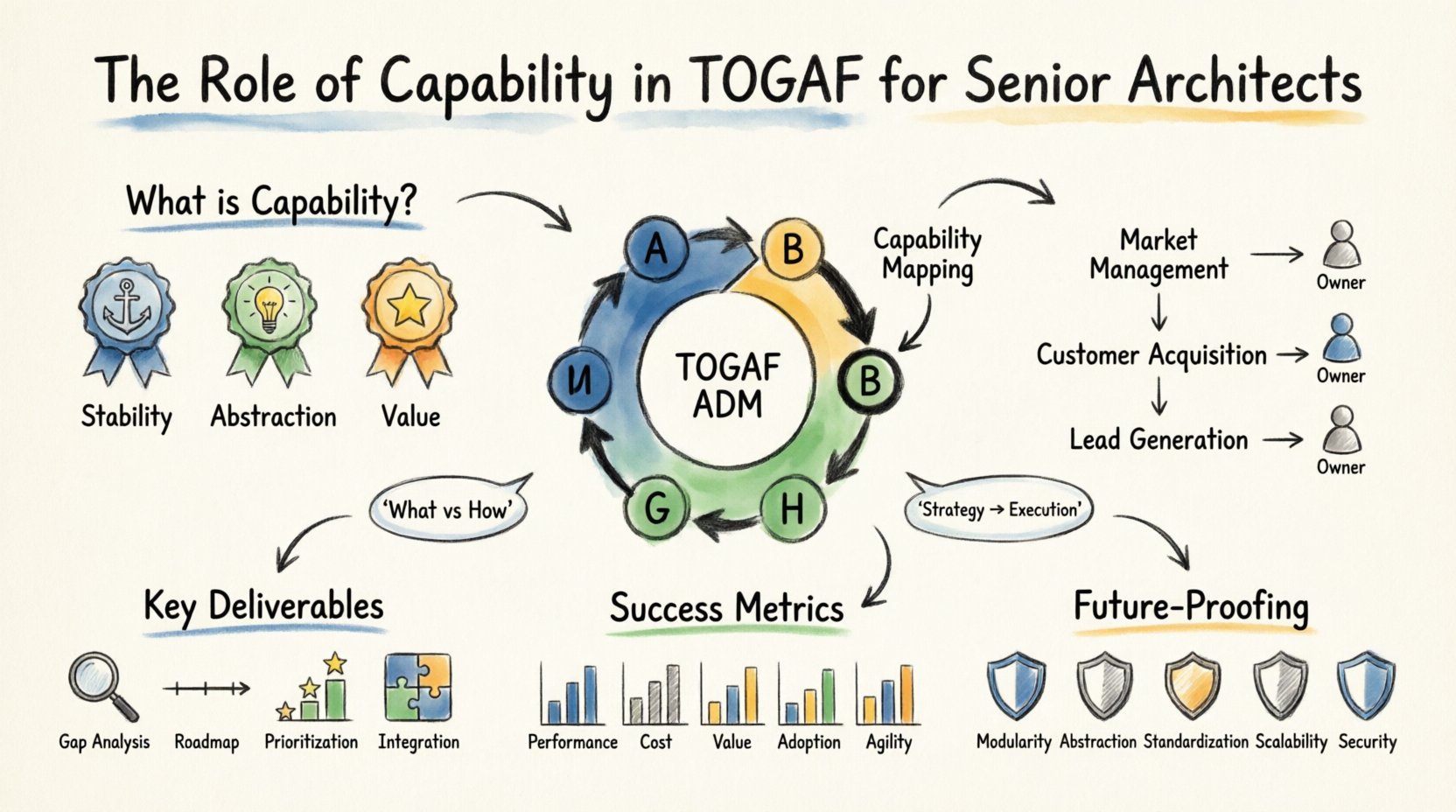
- Stability: Capabilities endure even when the organizational structure changes.
- Abstraction: They describe the “what” rather than the “how”.
- Value: They represent the value delivered to customers or stakeholders.
Senior Architects must distinguish capability from function. A function is a specific job or activity performed by a person or system. A capability is the underlying ability to perform that activity. For example, “Order Processing” is a capability. “The team using System X to process orders” is a function. This distinction is crucial for creating architecture that survives technology shifts. 🔄
TOGAF’s Framework on Capability 📋
TOGAF provides a structured approach to handling capability through its Architecture Development Method (ADM) and specific content artifacts. The framework does not prescribe a specific toolset but rather a logical flow for defining, analyzing, and utilizing capability. 🛠️
Within the TOGAF standard, capability is primarily addressed in the Business Architecture phase. However, its implications ripple through all phases, including Data, Application, and Technology Architecture. Here is how capability integrates into the standard:
- Phase A (Architecture Vision): Defining the scope includes identifying key business capabilities required to meet strategic goals.
- Phase B (Business Architecture): This is the core phase for capability definition. Architects map the current state capabilities against the target state.
- Phase C (Information Systems Architectures): Applications and Data architectures are selected to support the defined capabilities.
- Phase D (Technology Architecture): Infrastructure must be provisioned to enable the application layer supporting capabilities.
This layered approach ensures that technology investments are traceable back to business value. When a Senior Architect reviews a project proposal, they can ask: “Which capability does this support?” If there is no link, the project may lack strategic justification. 🤔
Strategic Alignment and Capability Mapping 🗺️
One of the most critical tasks for a Senior Architect is aligning the roadmap with business strategy. Capability maps serve as the bridge between high-level strategy and technical execution. By mapping capabilities, architects can visualize gaps, redundancies, and opportunities for improvement. 📊
A robust capability map typically includes:
- Capability Name: A clear, descriptive label (e.g., “Customer Management”).
- Level: Hierarchical depth (Level 1: Core Business, Level 2: Sub-Capabilities).
- Ownership: The business unit responsible for the capability.
- Maturity: An assessment of current performance.
- Strategic Importance: How critical the capability is to the business goals.
Consider the following example of a simplified capability hierarchy:
| Level 1 | Level 2 | Level 3 | Owner |
|---|---|---|---|
| Market Management | Customer Acquisition | Lead Generation | Marketing Dept |
| Market Management | Customer Retention | Support Services | Customer Service |
| Product Management | Product Development | Design Engineering | R&D Dept |
This structure allows architects to see that “Lead Generation” is a subset of “Customer Acquisition,” which is part of “Market Management.” If the strategy changes to focus on retention, the architecture team can immediately identify which capabilities need investment and which can be deferred. This clarity prevents wasted resources and ensures alignment. 🎯
The Senior Architect’s Deliverables 📝
Senior Architects are expected to produce more than just diagrams. They must deliver artifacts that facilitate decision-making at the executive level. When dealing with capability, the deliverables must be actionable and clear. 📄
- Capability Gap Analysis: A detailed report showing the difference between current and target capabilities. This highlights where investment is needed.
- Capability Roadmap: A timeline showing how capabilities will evolve. This includes dependencies between capabilities and the technology required to enable them.
- Investment Prioritization: A ranking of capabilities based on value and risk. This helps leadership allocate budget effectively.
- Integration Points: Documentation showing how new capabilities interact with existing ones. This prevents silos and ensures interoperability.
Each of these deliverables requires a deep understanding of the business domain, not just the technical stack. A Senior Architect must be able to speak the language of the business while maintaining technical rigor. This dual competency is what defines the role. 🤝
Integrating Capability into the ADM 🔄
The Architecture Development Method (ADM) is iterative. Capability management is not a one-time activity in Phase B. It requires continuous validation as the architecture evolves. Here is how capability fits into the iterative cycle:
Pre-Phase A: Establish the architecture principles. Does the organization value agility? Stability? Cost efficiency? These principles guide how capabilities are defined.
Phase B (Business Architecture): Define the baseline and target business architectures. Create the capability map. Identify the gaps. This is the heavy lifting phase.
Phase C & D (Information Systems & Technology): Ensure that the applications and infrastructure selected directly support the capabilities identified in Phase B. If a capability is deemed “Critical,” it must have robust support in the technical architecture.
Phase E (Opportunities and Solutions): Identify the projects required to close the capability gaps. This links the architecture to the implementation portfolio.
Phase F (Migration Planning): Plan the transition. This involves sequencing capability improvements to minimize disruption. Some capabilities may need to coexist during the transition.
Phase G (Implementation Governance): Monitor the actual implementation. Does the deployed solution actually deliver the capability? If not, adjustments are needed.
Phase H (Architecture Change Management): Manage changes to the architecture. If a capability evolves, the architecture must adapt. This ensures the framework remains relevant. 🔄
Challenges in Capability Management ⚠️
While the concept of capability is powerful, implementing it is not without difficulties. Senior Architects often encounter specific hurdles that can stall progress if not managed carefully.
- Abstraction vs. Reality: It is easy to define capabilities in a vacuum. The challenge lies in grounding them in the actual operational reality of the organization. If a capability does not exist in the real world, the map is fiction.
- Organizational Silos: Capabilities often span multiple departments. Marketing may own “Customer Acquisition,” but IT must provide the tools. If departments do not collaborate, the capability map becomes fragmented.
- Dynamic Environments: Markets change fast. A capability defined today might be obsolete in two years. The architecture must be flexible enough to accommodate this volatility.
- Resource Constraints: Not all capabilities can be improved simultaneously. Prioritization becomes a political and strategic exercise. Senior Architects must navigate these constraints without compromising the vision.
- Measurement: How do you measure a capability? Unlike a system uptime metric, capability is qualitative. Defining metrics for capability maturity requires careful thought and stakeholder agreement.
To overcome these challenges, Senior Architects must foster a culture of transparency. They must communicate clearly about what is possible and what is not. They must also be willing to iterate on the capability model as the organization learns more about itself. 🧠
Measuring Capability Effectiveness 📊
To ensure that the architecture delivers value, architects need to measure the effectiveness of their capabilities. This moves the conversation from “did we build it?” to “is it working?” 📈
Effective measurement involves several dimensions:
- Performance Metrics: How fast, how accurate, and how reliable is the capability? (e.g., Order processing time).
- Cost Metrics: What is the cost to deliver this capability? (e.g., Cost per transaction).
- Value Metrics: How much value does this capability generate? (e.g., Revenue attributed to the capability).
- Adoption Metrics: How widely is the capability used? (e.g., Number of users or transactions).
- Agility Metrics: How quickly can the capability be modified to meet new demands? (e.g., Time to market for new features).
These metrics should be tracked over time to identify trends. A capability that is expensive and slow may need to be re-engineered. A capability that is low cost and high value may be a candidate for expansion. Data-driven decisions replace guesswork. 📉
Future-Proofing Architectural Decisions 🔮
The landscape of enterprise technology is shifting. Cloud computing, artificial intelligence, and blockchain are changing how capabilities are delivered. A Senior Architect must anticipate these shifts when designing capability architectures. 🌐
Future-proofing involves several strategies:
- Modularity: Design capabilities to be modular. If one part fails or needs updating, it does not break the whole system. This supports agility.
- Abstraction Layers: Use abstraction to separate business logic from technical implementation. This allows the underlying technology to change without affecting the business capability.
- Standardization: Adopt industry standards where possible. This reduces vendor lock-in and increases the portability of capabilities.
- Scalability: Ensure capabilities can scale up or down based on demand. This is critical in a digital-first economy.
- Security: Embed security into the capability design. It is too late to add security after the capability is built.
By focusing on these principles, Senior Architects can ensure that their work remains relevant for years to come. They are not just building for today; they are building for the future. 🛡️
Conclusion on Architectural Responsibility 🏁
The role of capability in TOGAF is central to the success of enterprise architecture. It provides the language needed to translate business strategy into technical reality. For a Senior Architect, mastering this concept is essential for delivering value and ensuring organizational resilience. By focusing on stability, alignment, and measurable outcomes, architects can drive meaningful change without getting lost in the details of implementation. 🌟
The journey does not end with a diagram or a document. It continues through the lifecycle of the architecture. Continuous review, adaptation, and communication are required to keep the capability model accurate and useful. This is the mark of a true expert in the field.
As the industry evolves, the core principle remains: Architecture must serve the business. Capability is the vehicle that makes this possible. Senior Architects who embrace this role will find themselves in a position of significant influence and impact. They will be the ones guiding the organization through complexity with clarity and confidence. 💪
Remember, the goal is not perfection. The goal is progress. Every capability map is a snapshot in time. The value lies in the dialogue it creates and the decisions it enables. Keep the focus on value, keep the stakeholders engaged, and keep the architecture aligned with the mission. That is the path to success. 🛤️