

Enterprise Architecture (EA) is not merely a documentation exercise. It is a strategic capability that aligns business goals with IT infrastructure. Organizations that invest in EA often struggle to quantify their progress. This is where a TOGAF Assessment becomes essential. It provides a structured approach to evaluate the current state of architectural capabilities and identify pathways for improvement.
This guide explores the mechanics of measuring maturity within the TOGAF framework. We will examine the Architecture Capability Framework, define key assessment dimensions, and outline the steps required to conduct a rigorous evaluation. Understanding these elements allows leadership to make informed decisions about resource allocation and governance.
Why Measure Architecture Maturity? 🤔
Without a baseline, improvement is impossible. Many organizations assume their architecture function is mature because they have documentation. However, documentation does not equal capability. A formal assessment reveals gaps between current practices and desired outcomes.
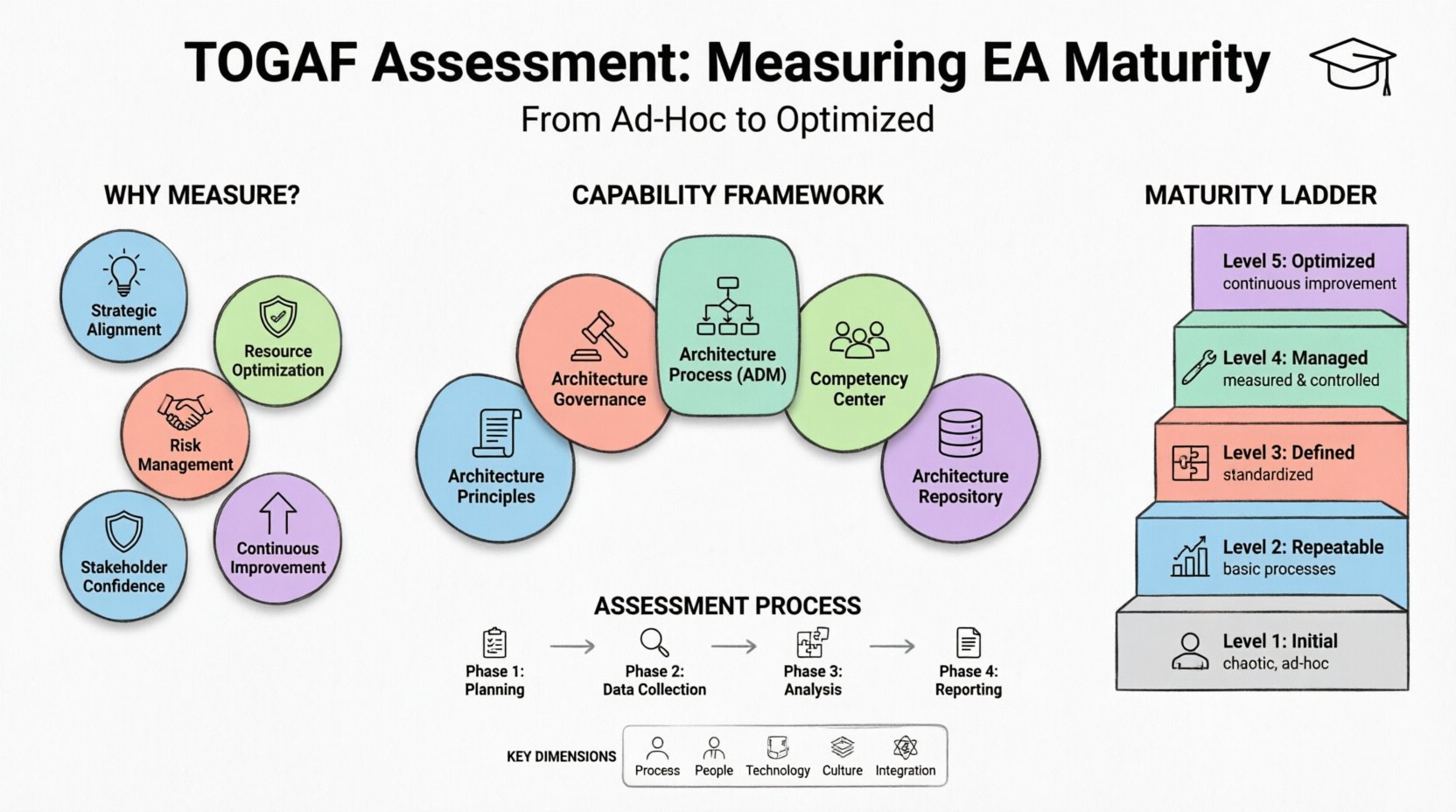
- Strategic Alignment: Ensures architecture efforts support business objectives directly.
- Resource Optimization: Identifies where investment yields the highest return.
- Risk Management: Highlights vulnerabilities in governance or process consistency.
- Stakeholder Confidence: Provides evidence of capability to executive leadership.
- Continuous Improvement: Establishes a baseline for tracking progress over time.
Conducting an assessment is not a one-time event. It is a recurring activity that tracks the evolution of the architecture function. It moves the conversation from subjective opinions to objective data.
The TOGAF Architecture Capability Framework 🏗️
The core of measuring maturity lies in the TOGAF Architecture Capability Framework. This framework defines the prerequisites for an architecture function to operate effectively. It is not about the tools used, but the people, processes, and governance structures in place.
The framework categorizes capabilities into several distinct areas. Assessing each area provides a holistic view of the organization’s architectural health.
1. Architecture Principles
Principles guide decision-making. A mature organization has documented principles that are widely understood and enforced. These principles must be consistent with business strategy. If principles exist only on paper, the maturity is lower than if they influence daily project decisions.
2. Architecture Governance
Governance ensures compliance and standards adherence. This includes the Architecture Review Board (ARB) and its authority. Does the board have the power to halt non-compliant projects? Is the review process transparent? Governance maturity dictates how strictly standards are applied.
3. Architecture Process
This refers to the Architecture Development Method (ADM). A mature process is repeatable and tailored to the organization. It includes specific phases for requirements, vision, and migration planning. Adherence to the ADM cycle ensures consistency across projects.
4. Architecture Competency Center
This is the organizational unit responsible for EA. Maturity here depends on staffing, skills, and budget. A center of excellence should provide services, not just police projects. It acts as an internal consultancy for the business.
5. Architecture Repository
Data management is critical. Where is the architecture stored? Is it accessible? A mature repository allows for versioning, searchability, and integration with other systems. It serves as the single source of truth for architectural artifacts.
Key Dimensions of Assessment 🧩
To perform a detailed assessment, you must look beyond the framework categories. Specific dimensions help drill down into operational realities. These dimensions cover the human, technical, and procedural aspects of the architecture function.
- Process Maturity: How standardized are the workflows?
- People & Skills: Does the team possess the necessary expertise?
- Technology: Are tools supporting or hindering the process?
- Culture: Is architecture viewed as a value-add or a bottleneck?
- Integration: How well does EA integrate with project management?
Each dimension requires specific metrics. For example, under People & Skills, you might measure the ratio of certified architects to total staff. Under Process Maturity, you might measure the average cycle time for an architecture review.
The Maturity Levels Explained 📈
TOGAF assessments typically utilize a maturity model similar to CMMI. This model ranges from initial ad-hoc processes to optimized, data-driven functions. Understanding these levels helps organizations set realistic goals.
| Level | Description | Key Characteristics |
|---|---|---|
| 1. Initial | Architecture work is ad-hoc and chaotic. | No defined processes; success depends on individual heroics. |
| 2. Repeatable | Basic processes are established to track costs and schedules. | Success is repeatable in similar projects; documentation exists. |
| 3. Defined | Processes are documented and standardized across the organization. | Architecture function is integrated into organizational policy. |
| 4. Managed | Processes are measured and controlled quantitatively. | Metrics are used to manage performance and predict outcomes. |
| 5. Optimized | Focus on continuous improvement based on feedback. | Proactive optimization and innovation in architecture practices. |
Achieving Level 5 does not mean the architecture function is perfect. It means the organization has a mechanism to identify and fix issues continuously. Most organizations start at Level 1 or 2. Moving to Level 3 requires significant investment in documentation and training.
Conducting the Assessment Process 📝
Executing a TOGAF assessment requires discipline. It involves planning, data collection, analysis, and reporting. Skipping steps leads to inaccurate results and false confidence.
Phase 1: Planning and Scoping
Define the boundaries of the assessment. Are you assessing the entire enterprise or a specific department? Determine the stakeholders who will participate. Secure executive sponsorship early to ensure cooperation.
- Identify the scope (Business, Data, Application, Technology).
- Select the assessment methodology (Questionnaire, Interview, Workshop).
- Set the timeline and resource requirements.
Phase 2: Data Collection
Gather evidence. This is not about asking for opinions. It is about collecting artifacts and observing behaviors.
- Review existing documentation (principles, standards, policies).
- Conduct interviews with key personnel (CIO, Architects, Project Managers).
- Analyze governance records (meeting minutes, approval logs).
- Survey the broader IT community to gauge perception.
Phase 3: Analysis and Gap Identification
Compare the collected data against the desired maturity model. Identify gaps where current practices fall short of the target. Categorize gaps by severity and impact.
- Highlight critical risks that need immediate attention.
- Identify quick wins that can demonstrate value quickly.
- Map gaps to specific areas of the Architecture Capability Framework.
Phase 4: Reporting and Recommendations
Compile the findings into a clear report. Avoid technical jargon where possible. Focus on business impact. Provide actionable recommendations for closing the gaps.
- Present the current maturity level clearly.
- Outline the roadmap to reach the next level.
- Estimate the effort and cost required for improvements.
Common Barriers to Improvement 🚧
Even with a clear plan, progress can stall. Recognizing common barriers helps in planning mitigation strategies. These obstacles often stem from organizational culture or resource constraints.
- Lack of Executive Support: If leadership does not value EA, funding will be scarce.
- Resistance from Project Teams: Architects are sometimes viewed as blockers. Changing this mindset takes time.
- Inconsistent Governance: If standards are ignored for high-profile projects, the framework loses credibility.
- Skills Gap: The team may lack the technical or business knowledge required for higher maturity.
- Tool Limitations: Manual processes become unmanageable as complexity grows.
Addressing these barriers requires a change management approach. It involves communication, training, and demonstrating the value of architecture to the business.
Actionable Steps for Advancement 🚀
Once the assessment is complete, the focus shifts to execution. Improvement is a journey. Start with the high-impact areas identified in the analysis.
1. Strengthen Governance Structures
Clarify the role of the Architecture Review Board. Ensure it meets regularly and has clear authority. Document the decision-making process. Transparency builds trust.
2. Formalize Processes
Document the Architecture Development Method (ADM) for internal use. Create templates for deliverables. This ensures consistency across different projects and teams.
3. Invest in People
Provide training for architects and stakeholders. Foster a community of practice where knowledge is shared. Encourage certifications where appropriate.
4. Enhance Communication
Report architecture progress to business leaders regularly. Use dashboards to visualize value. Translate technical achievements into business benefits.
5. Iterate and Refine
Do not treat the assessment as a static event. Schedule follow-up reviews. Adjust the maturity model as the organization evolves. Continuous refinement is key to long-term success.
Conclusion
A TOGAF assessment provides a clear picture of where an organization stands in its architectural journey. It moves the conversation from vague promises to measurable reality. By understanding the maturity levels and focusing on the Architecture Capability Framework, leaders can drive meaningful change.
Success in Enterprise Architecture is not about perfection. It is about consistent improvement. Regular assessments ensure that the architecture function remains aligned with business needs and capable of delivering value in a changing environment.