


In the modern digital landscape, the ability of a system to grow without collapsing under pressure is paramount. Organizations require infrastructure that supports expansion, handles increased load, and adapts to changing business needs. The TOGAF framework offers a structured approach to achieving this stability. By adhering to established architectural principles, teams can construct environments that sustain long-term growth.
This guide explores how to apply TOGAF guidelines to design scalable systems. We will examine the Architecture Development Method (ADM), review key principles for expansion, and discuss governance strategies. The focus remains on architectural rigor rather than specific tools or vendors.
📋 Understanding Scalability in Enterprise Architecture
Scalability is not merely about adding more compute power. It involves the entire ecosystem of business processes, data flows, and application logic. When organizations scale, they risk introducing complexity that degrades performance. A robust architecture prevents this by defining boundaries and interfaces early.
Using a standardized framework provides several advantages:
Consistency: Ensures all teams follow the same design patterns.
Visibility: Makes hidden dependencies and bottlenecks visible.
Alignment: Connects technical decisions to business goals.
Maintainability: Simplifies future updates and modifications.
The TOGAF Standard serves as the foundation for this alignment. It provides a blueprint for creating, planning, implementing, and governing an enterprise information architecture.
🔄 The Architecture Development Method (ADM)
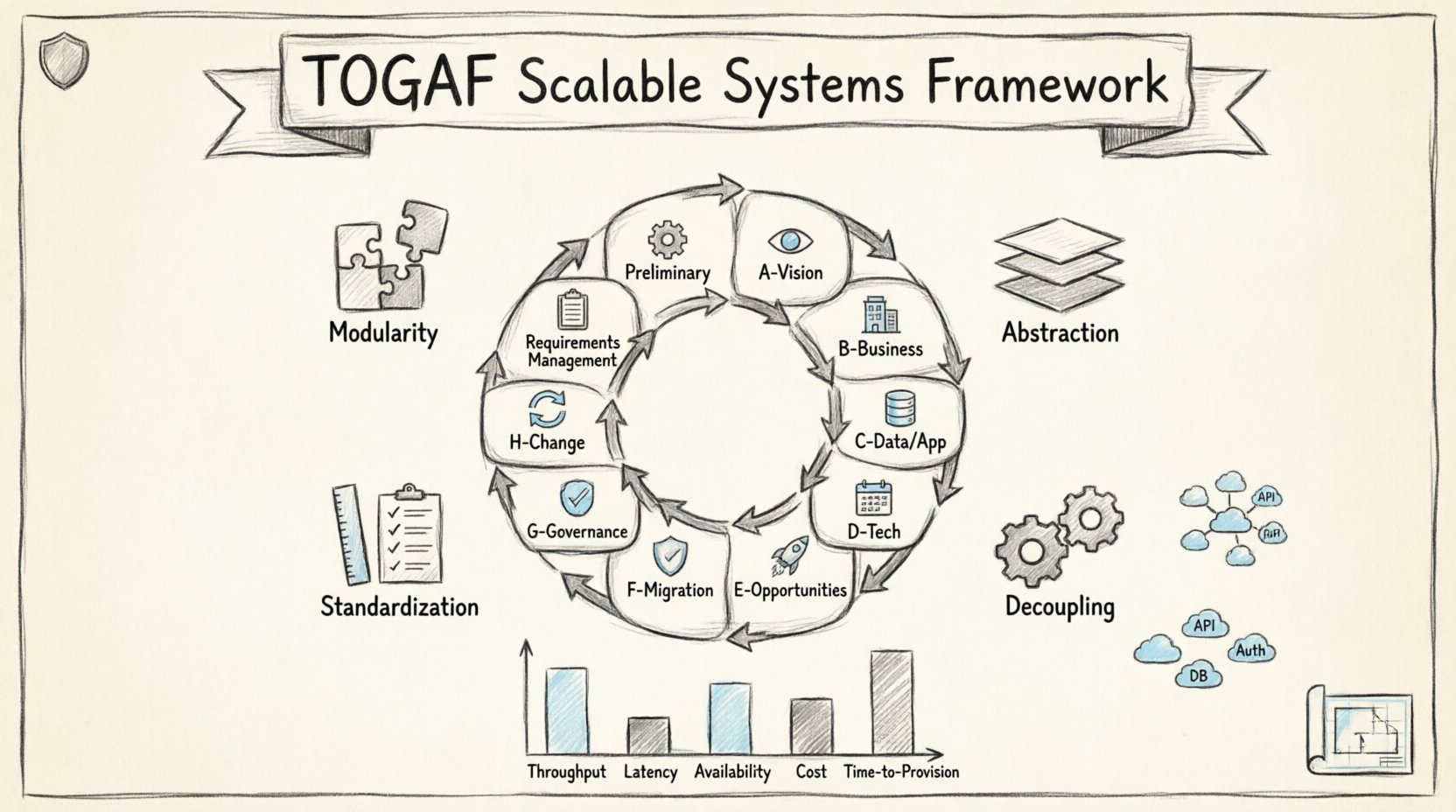
The core of the framework is the Architecture Development Method. This iterative process guides architects through the lifecycle of a project. For scalability, every phase must consider growth potential. The ADM is not linear; it loops back as requirements evolve.
Below is a breakdown of how each phase contributes to building scalable systems:
1. Preliminary Phase: Setting the Stage 🛠️
This phase defines the architecture capability. It establishes the principles and standards that will govern the project. For scalability, the preliminary phase must define what growth looks like.
Define scalability metrics (e.g., latency, throughput, user count).
Establish the architecture governance model.
Identify the stakeholders who will manage expansion.
Set the scope for future growth.
2. Phase A: Architecture Vision 👁️
Here, the high-level vision is created. The scope includes understanding the business drivers for scale. Is the goal to support 10,000 users or 10 million?
Identify business drivers for expansion.
Define the scope of the scalable architecture.
Secure commitment from leadership.
Document the vision in terms of capacity and flexibility.
3. Phase B: Business Architecture 🏢
This phase models the business structure. Scalability often requires changes in business processes. The architecture must support new operational models.
Analyze current business processes.
Identify bottlenecks in current workflows.
Design business capabilities that support growth.
Ensure business rules can adapt without system overhaul.
4. Phase C: Information Systems Architectures 💾
This phase covers data and application architecture. Data volume is a primary driver of scale. Applications must be designed to distribute load.
Data Architecture: Plan for data partitioning, sharding, and replication strategies.
Application Architecture: Design modular components to allow independent scaling.
Integration: Define interfaces that remain stable as services grow.
5. Phase D: Technology Architecture 🖥️
This phase defines the hardware and software platform. It focuses on the infrastructure required to support the application layer.
Select compute resources that allow horizontal scaling.
Design network topology for low latency.
Plan for redundancy and failover mechanisms.
Ensure storage solutions can expand seamlessly.
6. Phase E: Opportunities and Solutions 🚀
Here, the implementation plan is created. Architects must decide whether to build, buy, or reuse. Scalability often favors reuse of proven patterns.
Identify major work packages.
Assess risks related to scaling.
Define migration strategies from legacy to new systems.
Align with budget and resource constraints.
7. Phase F: Migration Planning 📅
This phase details the transition. It ensures that scaling happens without service interruption.
Create a roadmap for incremental deployment.
Plan for testing at scale.
Define rollback procedures.
Manage dependencies between components.
8. Phase G: Implementation Governance 🛡️
During construction, governance ensures adherence to the design. This phase prevents technical debt from accumulating.
Monitor compliance with architecture principles.
Review design decisions against scalability targets.
Manage deviations from the plan.
Ensure quality assurance processes are in place.
9. Phase H: Architecture Change Management 🔄
Architecture is never static. This phase manages changes after deployment. As the business grows, the architecture must evolve.
Establish a change control board.
Review impact of changes on system capacity.
Update architecture documentation regularly.
Learn from operational experience.
10. Requirements Management 📝
Throughout the cycle, requirements are managed. Scalability requirements must be tracked continuously.
Validate that new requirements do not break scalability.
Ensure traceability from business need to technical design.
Update requirements as market conditions shift.
⚙️ Architecture Principles for Scalability
Principles act as the guardrails for decision-making. They provide a consistent basis for evaluating design options. For scalable systems, specific principles are critical.
Modularity: Components should be independent. If one part grows, others should not be affected.
Abstraction: Hide complexity behind interfaces. This allows internal changes without external impact.
Standardization: Use common patterns. This reduces the cost of maintenance and training.
Decoupling: Separate concerns. Data storage should not dictate application logic.
Reusability: Build once, use many times. This reduces redundancy and improves efficiency.
Flexibility: Design for change. The system should adapt to new requirements without significant rework.
Applying these principles ensures that the architecture remains robust as the environment changes.
🏛️ Governance and Oversight
Without governance, architecture degrades over time. An Architecture Board is typically responsible for oversight. This body reviews proposals and ensures alignment with the strategy.
Key responsibilities of the governance body include:
Reviewing architecture compliance.
Approving major design changes.
Resolving conflicts between different projects.
Ensuring resource allocation supports architectural goals.
Effective governance requires clear communication. Architects must explain the why behind decisions. Stakeholders need to understand how governance protects their investment.
📊 TOGAF Phases and Scalability Focus
The following table summarizes the focus of each phase regarding scalability.
Phase | Focus Area | Scalability Impact |
|---|---|---|
Preliminary | Capability | Defines metrics and standards for growth. |
A (Vision) | Strategy | Aligns business drivers with capacity goals. |
B (Business) | Process | Ensures workflows support increased volume. |
C (Data/App) | Design | Structures data and apps for distribution. |
D (Tech) | Infrastructure | Selects hardware for horizontal expansion. |
E (Opportunities) | Planning | Identifies solutions that enable growth. |
F (Migration) | Transition | Plans safe deployment of scale. |
G (Governance) | Compliance | Prevents drift from scalability targets. |
H (Change) | Evolution | Manages continuous improvement. |
🚧 Common Challenges and Mitigation
Implementing these guidelines is not without obstacles. Architects often face specific challenges when trying to scale.
1. Legacy Constraints
Existing systems may not support modern scaling patterns. Mitigation: Use an abstraction layer or API gateway to insulate legacy components from new demands.
2. Organizational Silos
Different teams may build incompatible solutions. Mitigation: Enforce shared standards through the Architecture Board.
3. Performance Monitoring
It is difficult to measure scalability without proper tools. Mitigation: Define key performance indicators (KPIs) early and instrument systems to track them.
4. Budget Limitations
Scalable infrastructure can be costly. Mitigation: Prioritize high-impact areas. Focus on bottlenecks that limit growth the most.
5. Talent Gaps
Few professionals understand large-scale architecture. Mitigation: Invest in training. Create knowledge repositories to share best practices.
🌐 Integrating with Modern Practices
While the framework is established, the technology landscape evolves. Concepts like cloud computing and microservices align well with TOGAF principles.
Cloud Agnosticism: Design systems that do not rely on a single provider. This aids in vendor flexibility.
Service Orientation: Break monolithic applications into smaller services. This allows independent scaling of functions.
Automation: Use scripts to manage deployment. This reduces human error during expansion.
Observability: Implement logging and monitoring. This provides visibility into system health.
These practices complement the framework without requiring a complete overhaul of the methodology.
📈 Measuring Success
How do you know the architecture is successful? Metrics provide the answer. Quantitative data removes ambiguity.
Key metrics to track include:
Throughput: Number of transactions processed per second.
Latency: Time taken to respond to a request.
Availability: Percentage of time the system is operational.
Cost per Transaction: Economic efficiency of the infrastructure.
Time to Provision: Speed at which new resources are added.
Regular reviews of these metrics ensure the architecture meets its targets. If metrics drift, the architecture requires adjustment.
🔍 Deep Dive: Data Architecture for Scale
Data is often the biggest bottleneck in scalable systems. As volume increases, retrieval and storage become difficult. The framework addresses this in Phase C.
Partitioning: Split data across multiple nodes. This distributes the load.
Indexing: Optimize query performance. This reduces resource consumption.
Caching: Store frequently accessed data in memory. This speeds up response times.
Replication: Create copies of data for redundancy. This ensures availability.
Designing the data layer requires careful planning. It must anticipate growth in data volume and velocity.
🔍 Deep Dive: Application Architecture for Scale
Applications must handle concurrent users efficiently. The design dictates how requests are processed.
Statelessness: Avoid storing session data on the server. This allows any server to handle any request.
Load Balancing: Distribute traffic across multiple instances. This prevents overload.
Asynchronous Processing: Handle background tasks separately. This keeps the main system responsive.
Queueing: Buffer requests during high load. This smooths out traffic spikes.
These patterns are standard for high-performance environments. They align with the principles of decoupling and modularity.
🏁 Final Thoughts on Implementation
Building scalable systems is a continuous journey. It requires discipline, planning, and ongoing attention. The TOGAF framework provides the structure needed to navigate this complexity.
Success depends on integrating the framework into daily operations. It should not be a separate activity. Architects must work alongside developers and operations teams.
Key takeaways for implementation include:
Start with clear principles.
Follow the ADM cycle rigorously.
Measure performance continuously.
Adapt to change rather than resisting it.
Focus on business value, not just technology.
By adhering to these guidelines, organizations can build systems that stand the test of time. Scalability becomes a feature, not an afterthought.
The path forward is clear. Apply the framework, respect the principles, and maintain a focus on growth. This approach ensures resilience and longevity in a dynamic market.