

Enterprise Architecture is a complex discipline. Among the many frameworks available, The Open Group Architecture Framework (TOGAF) stands as one of the most recognized standards globally. Despite its widespread adoption, misconceptions persist. These myths often deter organizations from leveraging its full potential or lead to poor implementation strategies. This article aims to clarify these misunderstandings, providing a clear view of what TOGAF actually is and how it functions in modern business environments.
We will explore common narratives surrounding the framework, contrasting them with practical realities. By understanding the core principles, organizations can avoid common pitfalls and align their strategic goals more effectively. Let us dive into the details.
What is TOGAF? A Brief Overview 🏗️
TOGAF is a framework for developing an enterprise architecture. It provides a comprehensive approach for designing, planning, implementing, and governing an enterprise information architecture. The core of this framework is the Architecture Development Method (ADM), a step-by-step approach to managing change.
Unlike a specific software tool, TOGAF is a conceptual guide. It does not dictate a single path but offers a flexible structure that can be adapted to various organizational needs. It focuses on aligning IT strategy with business strategy, ensuring that technology investments deliver tangible value.
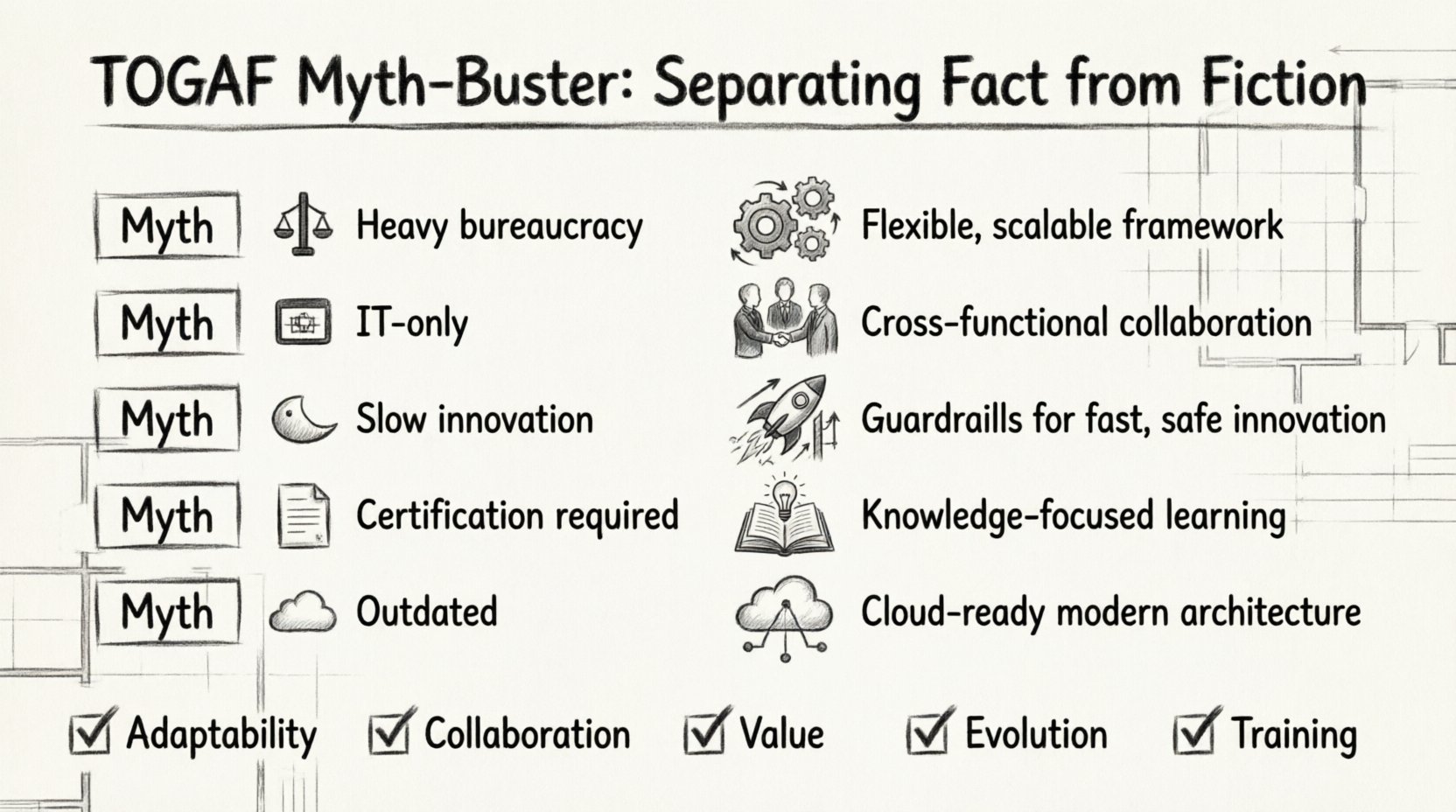
Myth 1: It Is Too Heavy and Bureaucratic ⚖️
The most persistent belief is that adopting this framework requires excessive documentation and rigid processes. Many leaders fear that it will slow down operations and create administrative burdens.
The Reality
While the framework includes detailed guidance, its strength lies in its adaptability. The ADM is iterative, meaning it can be scaled up or down based on the project scope. Small teams do not need to generate massive volumes of paperwork. They can focus on the essential deliverables that drive decision-making.
- Scalability: The framework allows you to tailor the depth of the architecture.
- Essential Deliverables: Focus on artifacts that provide value, not just for the sake of documentation.
- Agile Integration: It works well alongside agile methodologies when applied correctly.
When organizations treat the framework as a checklist rather than a guide, they create bureaucracy. When used as a mental model for decision-making, it streamlines complexity.
Myth 2: It Is Only for IT Departments 💻
There is a common assumption that this architecture framework belongs solely within the technology team. This view limits the framework’s impact and prevents cross-functional collaboration.
The Reality
Business Architecture is a critical component of the framework. It ensures that the technology supports the overall business mission. Executives, finance, human resources, and operations all benefit from a structured approach to planning.
- Business Alignment: The framework starts with understanding business goals before discussing technology.
- Stakeholder Engagement: It encourages input from all parts of the organization.
- Value Delivery: It helps define value in terms of business outcomes, not just system uptime.
By involving business leaders early, the architecture becomes a shared vision rather than an IT project. This shared ownership reduces resistance and increases adoption rates.
Myth 3: It Slows Down Innovation 🐢
Some argue that strict governance kills creativity and slows the pace of innovation. They believe that in a fast-moving market, speed is the only metric that matters.
The Reality
Governance and innovation are not mutually exclusive. A well-defined architecture provides the guardrails that allow teams to move faster safely. Without a clear structure, teams often duplicate efforts or build incompatible systems, which ultimately slows progress.
- Reusability: Standardized patterns allow teams to build on existing assets.
- Reduced Technical Debt: Planning prevents costly rework later in the lifecycle.
- Strategic Focus: Innovation is directed toward areas that actually matter to the business.
When innovation occurs without direction, it often results in siloed solutions. The framework ensures that new ideas fit into the broader ecosystem, making them sustainable.
Myth 4: You Need Certification to Use It 📜
Many professionals believe that TOGAF certification is a mandatory requirement for implementation. While credentials demonstrate knowledge, they are not the only path to success.
The Reality
Organizations can adopt the framework without requiring every team member to hold a certificate. The focus should be on understanding the concepts and applying them effectively. Practical experience often outweighs theoretical knowledge.
- Knowledge vs. Credential: Understanding the content is more important than holding the badge.
- Internal Training: Teams can learn through workshops and internal mentoring.
- Practical Application: Real-world projects provide the best learning environment.
Certification is useful for career development, but it should not be a barrier to entry for the framework itself.
Myth 5: It Is Outdated in the Cloud Era ☁️
With the rise of cloud computing and microservices, some claim that this framework is too traditional for modern infrastructure.
The Reality
The framework has evolved to address modern challenges. It now includes guidance on cloud adoption, security, and digital transformation. The core principles remain relevant because they address fundamental business needs, not just specific technologies.
- Technology Agnostic: It does not prescribe specific vendors or products.
- Continuous Evolution: The content is updated regularly to reflect industry changes.
- Adaptability: It supports hybrid environments and distributed systems.
Modern architecture requires visibility across complex environments. The framework provides the lens needed to see the whole picture, regardless of where the systems reside.
Myth vs. Reality Comparison Table 📊
The following table summarizes the common misconceptions and the actual capabilities of the framework.
| Myth | Reality |
|---|---|
| Too bureaucratic and slow | Adaptable to project size and complexity |
| Only for IT teams | Business Architecture is a core component |
| Stifles innovation | Enables sustainable innovation through structure |
| Certification is mandatory | Knowledge and application matter more than credentials |
| Outdated for cloud | Supports modern technologies and cloud strategies |
| Only for large enterprises | Scalable for organizations of various sizes |
| High implementation cost | ROI increases when aligned with strategic goals |
Implementing the Framework Effectively 🚀
Successful implementation requires a strategic approach. It is not about copying templates but understanding the underlying intent. Here are key considerations for a smooth rollout.
1. Define Your Scope
Start with a clear definition of what you want to achieve. Do not attempt to map the entire organization immediately. Identify a specific area where the architecture can provide immediate value.
- Identify key business drivers.
- Select a pilot project for the initial phase.
- Set measurable success criteria.
2. Engage Stakeholders Early
Communication is vital. Ensure that all relevant parties understand the benefits and their roles in the process. Resistance often stems from a lack of understanding.
- Hold workshops to explain the concepts.
- Listen to concerns and address them.
- Build a community of practice.
3. Focus on Value
Every activity should contribute to a business outcome. If a deliverable does not add value, it should be questioned.
- Link architecture artifacts to business cases.
- Measure the impact of decisions made.
- Review and retire obsolete artifacts.
4. Integrate with Existing Processes
Do not create a parallel process. Integrate the architecture work into existing project lifecycles and governance structures.
- Align with project management methodologies.
- Embed architecture reviews in the delivery pipeline.
- Ensure compliance requirements are met.
Common Questions and Answers ❓
How long does it take to implement?
The timeline varies significantly based on organizational size and complexity. Small implementations can take a few months, while enterprise-wide rollouts may take years. The key is to start small and iterate.
Does it require a specific methodology?
It provides its own methodology (ADM), but it can be integrated with other approaches like Agile or DevOps. The goal is to find the right balance for your context.
What is the role of the Enterprise Architect?
The architect acts as a bridge between business and technology. They facilitate communication, define standards, and ensure alignment. They are enablers, not gatekeepers.
Can it be used for small businesses?
Yes. While it is often associated with large enterprises, the principles apply to any organization seeking structure and clarity. The scale of the artifacts can be adjusted accordingly.
Is it expensive to maintain?
Costs depend on the level of detail and the tools used. Since it is a framework, not a software product, there are no licensing fees. Costs arise from personnel time and training.
Key Takeaways for Success ✅
To summarize, the framework is a powerful tool when understood correctly. It is not a rigid set of rules but a flexible guide for managing complexity. Organizations that succeed are those that focus on the principles rather than the paperwork.
- Adaptability: Tailor the framework to your needs.
- Collaboration: Involve business stakeholders actively.
- Value: Focus on outcomes, not outputs.
- Evolution: Keep the content current with industry trends.
- Training: Invest in knowledge, not just certifications.
By dispelling these myths, organizations can leverage the framework to build resilient, agile, and future-ready enterprises. The goal is not perfection, but continuous improvement and alignment.
Final Thoughts 🌟
Enterprise architecture is a journey, not a destination. The framework provides the map, but the team determines the path. Understanding the facts behind the myths allows leaders to make informed decisions. It removes the fear of the unknown and replaces it with a structured approach to change.
Whether you are planning a digital transformation or optimizing existing systems, the principles remain valid. They provide a common language for discussing complex topics. By adopting a clear and confident stance, you can navigate the complexities of modern business with greater ease.
Remember, the value lies in the application. Use the guidance to solve real problems. Avoid the traps of over-engineering. Keep the focus on the business mission. With these practices in place, the framework becomes an asset rather than a burden.
Start your journey today by reviewing your current practices against the facts presented here. Identify the gaps and create a plan for improvement. The path to architectural maturity is open to those who are willing to learn and adapt.
Thank you for reading this guide on separating fact from fiction in TOGAF. May your architectural endeavors be successful and impactful.