

Implementing The Open Group Architecture Framework (TOGAF) within an organization is a significant undertaking. It requires a shift in mindset, rigorous discipline, and a deep understanding of enterprise architecture principles. However, the path from strategy to execution is often fraught with challenges. Many organizations find themselves stuck in a cycle of stalled initiatives, misunderstood requirements, or architecture artifacts that gather dust on a server. This guide provides a comprehensive look at the most frequent obstacles encountered during TOGAF projects and offers concrete solutions to navigate them effectively.
Enterprise architecture is not merely about drawing diagrams; it is about enabling business value through technology alignment. When the Architecture Development Method (ADM) is applied correctly, it creates a structured approach to planning and execution. Yet, real-world conditions rarely match theoretical models perfectly. By identifying where processes break down, teams can realign their efforts and ensure that architectural investments yield tangible results. We will explore specific areas where projects typically encounter friction and outline how to resolve them without adding unnecessary bureaucracy.
1. Strategic Alignment Issues 🎯
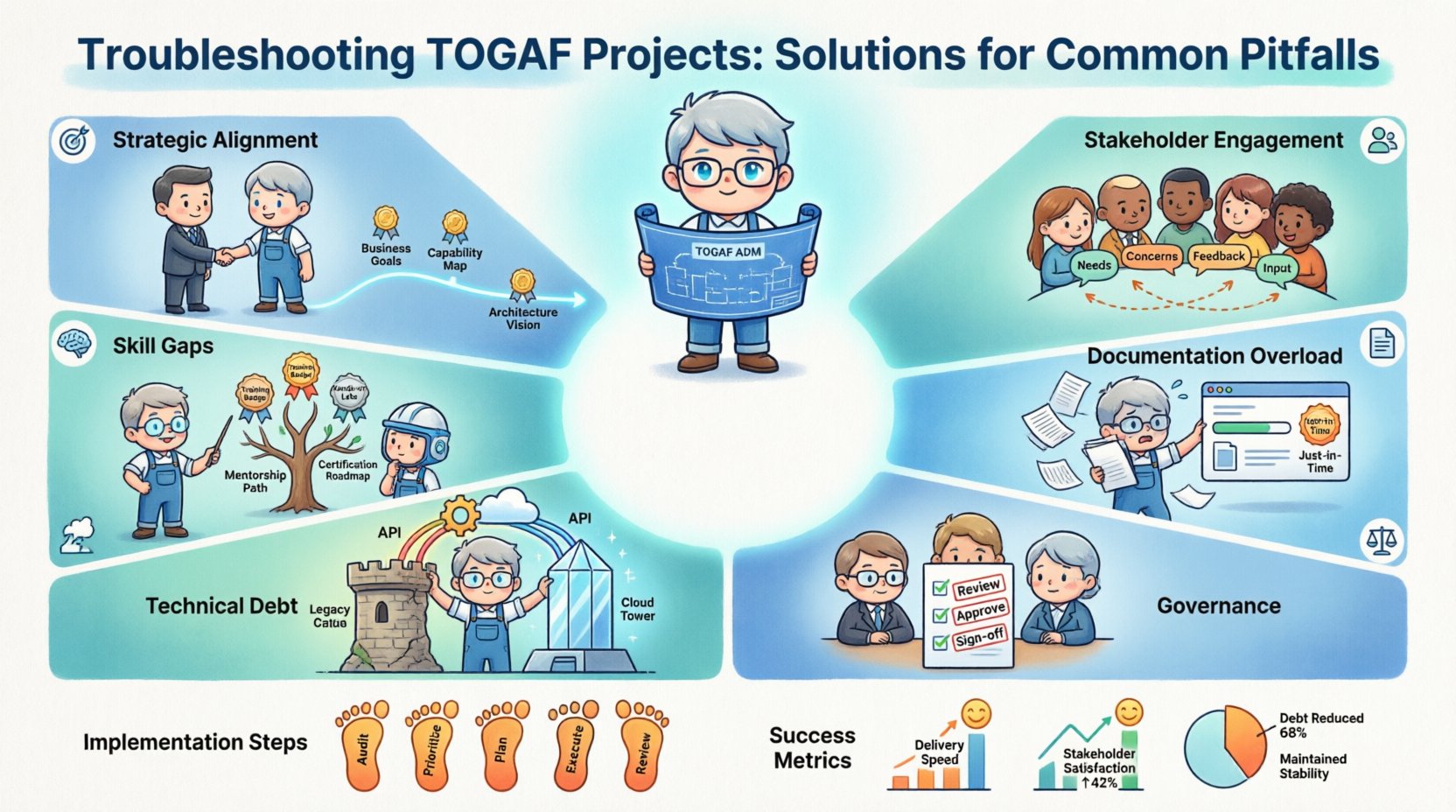
One of the most critical failures in TOGAF implementations is the disconnect between the business strategy and the architectural output. If the architecture does not directly support the organization’s goals, stakeholders will view it as an overhead rather than an asset. This misalignment often stems from a lack of clear communication at the outset of the project.
- The Problem: Architecture teams develop solutions based on technical capabilities rather than business needs. The resulting architecture looks robust on paper but fails to address the actual pain points of the business units.
- The Root Cause: Business stakeholders are not involved in the initial phases of the Architecture Development Method (ADM). The Business Architecture phase is skipped or rushed.
- The Impact: Projects are rejected by steering committees, budgets are cut, and the architecture team loses credibility.
Solutions for Alignment:
- Integrate Business Leaders Early: Ensure that executives and business unit heads participate in the Vision Phase. Their input defines the scope and success criteria.
- Map Architecture to Strategy: Use capability maps to trace every architectural decision back to a specific business objective. If an artifact cannot be linked to a goal, it may be unnecessary.
- Define Success Metrics: Establish clear Key Performance Indicators (KPIs) for the architecture program. These should measure business value, such as time-to-market improvements or cost reductions, not just the number of diagrams created.
2. Stakeholder Engagement Challenges 👥
Architecture is a people-centric discipline. Even the most technically sound plan will fail if the people who need to adopt it are not engaged. Stakeholder management is often cited as a primary reason for project delays or failure in large-scale transformation efforts.
- The Problem: Key decision-makers feel bypassed. Technical teams feel isolated from the business. Information silos develop, leading to conflicting requirements.
- The Root Cause: A failure to identify all relevant stakeholders and a lack of tailored communication strategies for different groups.
- The Impact: Resistance to change, rework due to late feedback, and a lack of sponsorship for the architecture vision.
Solutions for Engagement:
- Stakeholder Mapping: Create a comprehensive matrix that categorizes stakeholders by their level of influence and interest. High-influence stakeholders require direct, frequent engagement.
- Communication Plans: Develop specific communication channels for different groups. Executives may need high-level dashboards, while developers need detailed technical specifications.
- Feedback Loops: Establish regular review cycles where stakeholders can validate progress. This ensures that the architecture evolves alongside changing business needs.
- Change Champions: Identify influential individuals within business units who can advocate for the architecture initiative and help overcome resistance.
3. Documentation and Artifact Overload 📄
TOGAF is known for its extensive set of artifacts. While these documents are designed to provide clarity and governance, they can quickly become a burden. Many projects suffer from “analysis paralysis,” where teams spend more time creating documentation than delivering value.
- The Problem: The architecture repository becomes a graveyard of outdated documents. Teams spend weeks maintaining artifacts that no one reads.
- The Root Cause: A misunderstanding of the ADM phases, where documentation is treated as the deliverable rather than a byproduct of the design process.
- The Impact: Slowed delivery, frustrated teams, and a perception that architecture is purely bureaucratic.
Solutions for Documentation:
- Just-in-Time Creation: Create artifacts only when they are needed for a specific decision. Do not produce a full set of documents for every phase unless required by governance.
- Living Documents: Treat architecture documentation as dynamic. If a document is not updated within a set timeframe, it should be archived or removed.
- Visual First: Prioritize diagrams and visual models over text-heavy descriptions. Visuals are often easier to digest and validate for non-technical stakeholders.
- Tooling Automation: Utilize modeling tools that can generate documentation automatically from the models. This reduces manual effort and ensures consistency.
4. Governance and Compliance Hurdles ⚖️
Governance ensures that the architecture remains consistent with standards and that projects adhere to the defined framework. However, governance structures can become bottlenecks if they are too rigid or opaque. An effective governance model should facilitate decision-making, not hinder it.
- The Problem: Architecture Review Boards (ARB) take too long to make decisions. Projects stall waiting for sign-off. The process feels like a gatekeeper rather than a partner.
- The Root Cause: Unclear criteria for review, lack of authority within the board, or an overly complex approval process.
- The Impact: Development teams bypass architecture controls, leading to technical debt and shadow IT.
Solutions for Governance:
- Clear Authority: Define exactly who has the power to approve or reject decisions. Ensure that the Architecture Board has the backing of senior leadership.
- Standardized Criteria: Publish a checklist of requirements for review. Projects should know exactly what is expected before they submit for review.
- Tiered Reviews: Implement a tiered approach. Small changes may require a lightweight check, while major shifts need a full board review. This speeds up routine decisions.
- Transparency: Make the status of reviews visible to all stakeholders. Delays should be tracked and communicated proactively.
5. Technical Debt and Legacy Systems 🏗️
Most organizations do not start from a blank slate. They inherit complex legacy environments with significant technical debt. TOGAF provides a framework for managing this transition, but it requires realistic planning and resource allocation.
- The Problem: New architectures are designed assuming a greenfield environment. When applied to legacy systems, the solutions become unworkable or prohibitively expensive.
- The Root Cause: Underestimating the complexity of integration and the cost of migration. Focusing only on the future state without a realistic transition plan.
- The Impact: Projects exceed budgets and timelines. The organization gets stuck in a state of perpetual migration without reaching the target state.
Solutions for Technical Debt:
- Realistic Baselines: Conduct a thorough assessment of the current state. Understand the constraints of existing systems before designing the future state.
- Incremental Transition: Break down the migration into manageable increments. Focus on high-value areas first to demonstrate quick wins.
- Refactoring Strategy: Decide which systems to refactor, replace, or retire. Not every legacy system needs to be modernized immediately.
- Integration Patterns: Use established patterns like APIs or middleware to bridge gaps between old and new systems without requiring full rewrites.
6. Resource and Skill Gaps 🧠
A successful TOGAF implementation requires specific skills that are not always present within an existing IT workforce. Architects need a blend of technical knowledge, business acumen, and soft skills. Without the right talent, the framework cannot be applied effectively.
- The Problem: Architects are assigned to tasks without adequate training. The team lacks the depth of experience to handle complex enterprise scenarios.
- The Root Cause: Hiring for technical skills only, ignoring the architectural mindset. Lack of investment in professional development.
- The Impact: Poor quality designs, inability to communicate with stakeholders, and high turnover within the architecture team.
Solutions for Resources:
- Training Programs: Invest in certified training for architects. Ensure they understand both the theory and the practical application of the framework.
- Mentorship: Pair junior architects with senior mentors. This facilitates knowledge transfer and accelerates the learning curve.
- Role Definition: Clearly define the roles within the architecture team. Distinguish between enterprise architects, solution architects, and domain architects to avoid role confusion.
- External Support: Consider bringing in external consultants for specific phases to fill temporary skill gaps and bring in best practices.
Common Pitfalls and Remediation Matrix 📊
To summarize the key troubleshooting areas, the following table outlines common pitfalls, their underlying causes, and actionable remediation steps.
| Pitfall Category | Root Cause | Actionable Remediation |
|---|---|---|
| Strategic Misalignment | Business goals ignored in design | Involve business leaders in Vision Phase; Map artifacts to KPIs |
| Stakeholder Resistance | Lack of communication or engagement | Create stakeholder maps; Implement tailored communication plans |
| Documentation Bloat | Excessive focus on artifacts over value | Adopt Just-in-Time creation; Use visual models; Archive old docs |
| Governance Bottlenecks | Overly complex approval processes | Define clear authority; Use tiered reviews; Publish criteria |
| Legacy Integration Failures | Unrealistic transition planning | Assess current state accurately; Plan incremental migration |
| Skill Deficiencies | Lack of trained personnel | Invest in training; Establish mentorship; Define clear roles |
Implementing the Solutions: A Step-by-Step Approach 🚀
Identifying the problems is only the first step. Applying the solutions requires a structured approach to ensure that the changes are sustained. Here is a practical method to begin troubleshooting your TOGAF project.
- Audit the Current State: Review ongoing projects. Are the artifacts being used? Are the reviews happening? Identify where the friction points are.
- Prioritize Issues: Not all problems can be solved at once. Focus on the issues that are blocking progress or causing the most risk.
- Develop an Action Plan: For each prioritized issue, assign an owner and a timeline. Ensure that the plan is communicated to the wider team.
- Execute and Monitor: Implement the changes. Monitor the impact on project velocity and quality. Adjust the approach if the expected results do not materialize.
- Review and Refine: Architecture is iterative. Regularly review the framework usage itself. Is the TOGAF model still fit for purpose, or does it need adaptation?
Measuring Success in Architecture Projects 📈
How do you know if your troubleshooting efforts are working? You need metrics that reflect the health of the architecture program. Avoid vanity metrics like the number of diagrams created. Instead, focus on outcomes.
- Project Delivery Speed: Are projects moving from concept to implementation faster? This indicates that the architecture is facilitating rather than blocking.
- Rejection Rates: A high rate of project rejection at review boards suggests that the architecture is not aligned with reality. A moderate rate indicates effective governance.
- Stakeholder Satisfaction: Regularly survey stakeholders to gauge their perception of the architecture team’s value.
- Technical Debt Ratio: Track the reduction in legacy debt over time. This shows that the transition strategy is effective.
- Reuse Rates: Measure how often existing components or patterns are reused. High reuse indicates a healthy architecture repository.
Adapting TOGAF to Your Context 🧩
It is important to remember that TOGAF is a framework, not a prescriptive methodology. It is designed to be adapted to the specific needs of an organization. Rigid adherence to the standard without considering the organizational culture can lead to the very pitfalls discussed in this article.
Some organizations may find that they only need specific parts of the ADM. Others may need to integrate TOGAF with Agile or DevOps practices. The goal is to create a sustainable architecture practice that supports the business, not one that exists in isolation.
When troubleshooting, ask yourself if the problem is with the framework or with the implementation. Often, the issue lies in the execution. A flexible mindset allows teams to adjust the process to fit the work, rather than forcing the work to fit the process.
Final Thoughts on Sustainable Architecture 🌱
Troubleshooting TOGAF projects is an ongoing process. The business environment changes, new technologies emerge, and organizational structures shift. An architecture program must evolve alongside these changes. By maintaining a focus on value, engagement, and practicality, organizations can overcome common pitfalls.
The path to successful enterprise architecture is not linear. It involves trial, error, and continuous improvement. By applying the solutions outlined here, teams can build a resilient architecture function that delivers consistent results. The key is to remain pragmatic, keep communication open, and always align technical decisions with business outcomes.