

Enterprise Architecture (EA) serves as the backbone for complex organizations navigating digital transformation. For large-scale entities, the sheer volume of systems, stakeholders, and business units creates a labyrinth of technical debt and strategic misalignment. The TOGAF Framework provides a structured approach to address this complexity. However, adopting this framework without a tailored strategy often leads to bureaucracy rather than value. This guide outlines practical methods for integrating TOGAF into the operational fabric of a large organization.
Success in this context relies on balancing rigor with agility. It requires moving beyond theoretical models to implement governance that actually influences decision-making. The following sections detail the essential components for effective implementation.
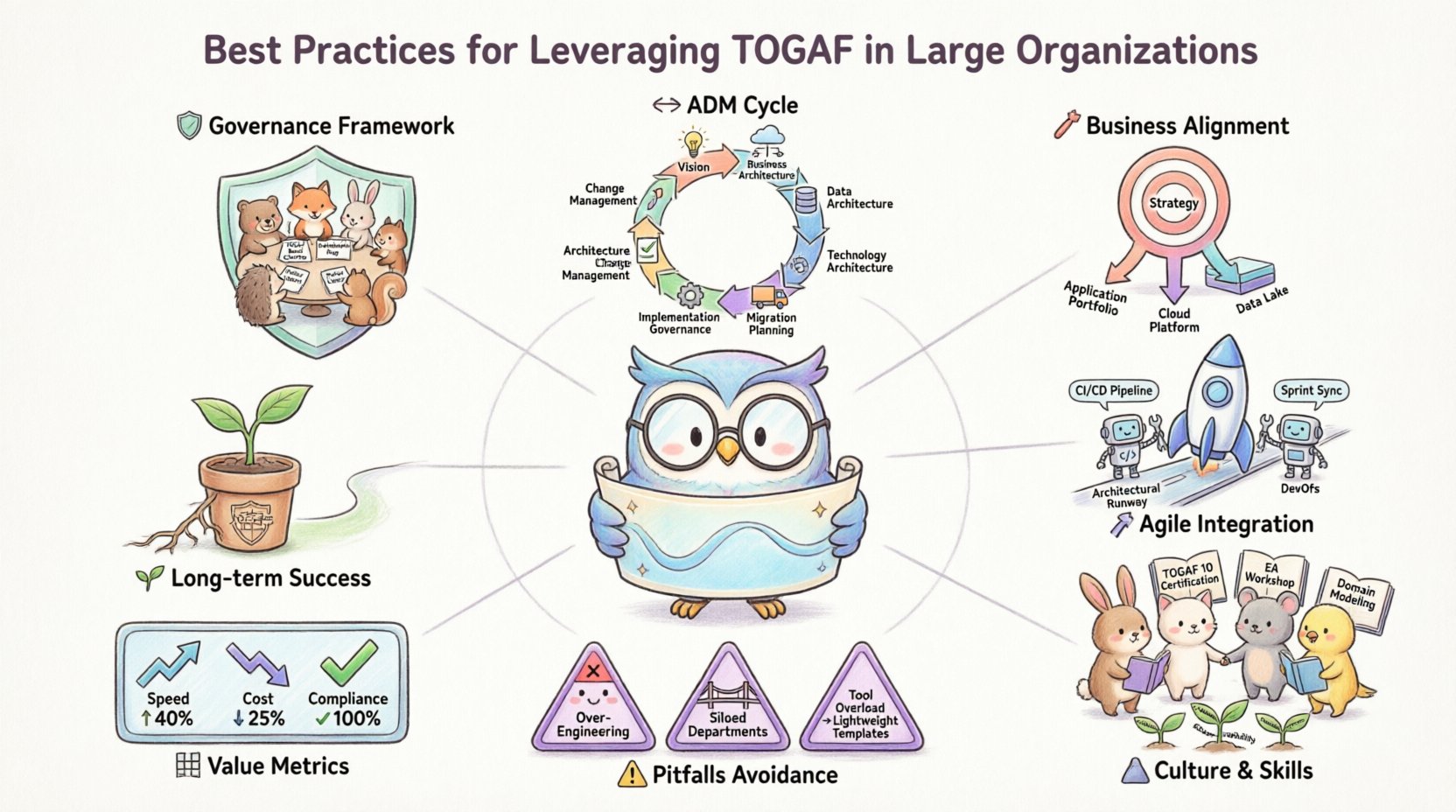
🛡️ Establishing a Robust Architecture Governance Framework
Governance is the mechanism that ensures architecture decisions align with business goals. In large organizations, architecture does not exist in a vacuum; it intersects with finance, operations, and human resources. Without clear governance, architecture recommendations become optional suggestions rather than binding directives.
Defining the Architecture Board
The Architecture Board acts as the primary decision-making body. Its composition is critical for success.
- Membership: Include representatives from business units, IT leadership, and security. This ensures diverse perspectives are considered.
- Authority: The board must have the explicit authority to approve or reject architectural proposals. Vague authority leads to stalled projects.
- Frequency: Meetings should occur regularly, such as monthly, to review active projects and emerging risks.
Compliance and Standards
Large organizations require standards to maintain interoperability. TOGAF supports the creation of a standards repository.
- Technology Standards: Define approved hardware, software, and cloud services. This reduces vendor lock-in and supports cost optimization.
- Process Standards: Establish mandatory steps within the project lifecycle. Every new initiative should undergo an architecture review.
- Data Standards: Ensure data definitions are consistent across departments to facilitate analytics and reporting.
🔄 Navigating the Architecture Development Method (ADM)
The Architecture Development Method (ADM) is the core engine of TOGAF. It is an iterative cycle that guides the creation and management of enterprise architecture. In large organizations, the ADM must be adapted to handle scale and speed.
Adapting the ADM Cycles
Do not treat the ADM as a linear waterfall process. Large organizations benefit from iterative cycles that deliver value incrementally.
- Incremental Delivery: Break down major architectural goals into smaller, manageable iterations.
- Parallel Workstreams: Allow different domains (e.g., Business, Data, Application) to work concurrently where dependencies allow.
- Continuous Refresh: The architecture is never “done.” Regular reviews ensure it remains relevant to changing market conditions.
Phase-Specific Best Practices
Each phase of the ADM requires specific focus areas when applied to complex environments.
| Phase | Key Focus Area | Large Organization Action |
|---|---|---|
| Phase A: Vision | Scope and Stakeholders | Map all affected business units early. Secure executive sponsorship. |
| Phase B: Business Arch | Process Modeling | Document high-level value streams before diving into detailed processes. |
| Phase C: Info Systems | Application Landscape | Identify legacy systems that need migration or decommissioning. |
| Phase D: Technology | Infrastructure | Align cloud strategies with security and compliance requirements. |
| Phase E: Opportunities | Migration Planning | Assess the cost and risk of moving to the target state. |
| Phase F: Migration | Implementation | Ensure projects adhere to the architectural blueprint. |
| Phase G: Governance | Compliance | Conduct architecture compliance reviews for all major projects. |
| Phase H: Change | Optimization | Monitor performance and trigger new ADM cycles if needed. |
🎯 Aligning Architecture with Business Strategy
Architecture that does not support business strategy is merely an exercise in documentation. Large organizations often suffer from a disconnect between the strategy team and the IT team. Bridging this gap is a primary responsibility of the EA function.
Strategy Cascading
Business goals must translate into technical requirements. This process involves:
- Goal Decomposition: Break down high-level corporate objectives into architectural capabilities.
- Capability Mapping: Identify which capabilities are required to achieve the goals. Remove capabilities that do not contribute value.
- Gap Analysis: Compare the current state with the target state to identify what needs to change.
Value Realization
Architecture projects must demonstrate tangible value. It is not enough to deliver a diagram; the outcome must improve efficiency, reduce risk, or increase revenue.
- Define Metrics: Establish KPIs for every architectural initiative before starting.
- Track Outcomes: Measure performance against the baseline established in the As-Is state.
- Report Results: Communicate achievements to stakeholders in business language, not technical jargon.
🚀 Integrating EA with Agile and DevOps
Modern large organizations often operate using Agile methodologies and DevOps practices. Traditional EA can sometimes be perceived as an impediment to speed. The goal is to integrate EA into these workflows without slowing them down.
The Concept of Architecture Runway
Think of architecture as a runway. It provides the foundation upon which teams can land and take off quickly. Without a runway, teams crash. With a runway, they fly safely.
- Enable Self-Service: Provide teams with access to architectural standards and guidelines so they can make decisions autonomously within boundaries.
- Define Guardrails: Set non-negotiable constraints (e.g., security, data privacy) while allowing flexibility in implementation details.
- Continuous Integration: Embed architecture checks into the CI/CD pipeline where automated.
Collaboration Models
Architects should not sit in silos. They must work alongside development teams.
- Embedded Architects: Assign architects to specific squads or product lines to ensure real-time guidance.
- Community of Practice: Create forums where architects from different teams share knowledge and solve common problems.
- Feedback Loops: Ensure developers can provide feedback on architectural constraints that hinder their work.
👥 Building Competence and Managing Culture
Technology is only half the equation. The people and culture surrounding the architecture function determine long-term success. Large organizations face significant challenges in maintaining a unified architectural culture.
Skills and Training
Ensure the architecture team possesses the necessary skills. TOGAF certification is a good baseline, but practical experience is more valuable.
- Certification: Encourage staff to obtain relevant certifications to validate their knowledge.
- Soft Skills: Train architects in communication, negotiation, and facilitation. They must influence without authority.
- Continuous Learning: Keep the team updated on emerging technologies and industry trends.
Cultural Shifts
Adopting EA often requires a shift in mindset across the organization. It moves the culture from “build first, think later” to “design first, build right.”
- Leadership Buy-in: Executives must champion the value of architecture. If leadership ignores it, the rest of the organization will too.
- Transparency: Make architecture artifacts visible to all stakeholders. Avoid creating documents that are never read.
- Recognition: Reward teams that adhere to architectural standards and collaborate effectively with the EA function.
⚠️ Common Pitfalls and How to Avoid Them
Even with the best intentions, implementation can go wrong. Understanding common pitfalls helps organizations navigate these challenges.
| Pitfall | Consequence | Mitigation Strategy |
|---|---|---|
| Over-Engineering | Analysis paralysis; slow delivery | Focus on the minimum viable architecture needed for the next 12 months. |
| Siloed Architecture | Inconsistent standards across departments | Centralize governance while decentralizing execution. |
| Lack of Adoption | Architecture becomes irrelevant | Integrate architecture reviews into project gates. |
| Static Documentation | Outdated information misleads decisions | Use dynamic repositories that update automatically. |
| Ignoring Legacy | System fragmentation and high cost | Include legacy modernization in the migration plan. |
📊 Measuring Value and Outcomes
To sustain investment in architecture, you must prove its worth. Measurement goes beyond counting diagrams produced. It focuses on the impact on the business.
Key Performance Indicators
- Project Delivery Speed: Does adherence to architecture reduce time-to-market?
- System Downtime: Does improved architecture reduce incidents?
- Cost Reduction: Have you reduced redundant systems or licensing fees?
- Compliance Rate: What percentage of projects pass architecture reviews?
Feedback Mechanisms
Regularly solicit feedback from project managers and developers. Ask them if the architecture support they received was helpful. Use this data to refine the EA process continuously.
🌱 Sustaining Long-Term Success
The journey of implementing TOGAF in a large organization is not a destination; it is a continuous improvement process. The landscape changes, technology evolves, and business needs shift. The architecture function must remain flexible enough to adapt.
Focus on building a culture where architecture is seen as an enabler rather than a gatekeeper. When stakeholders understand that architecture protects their investments and accelerates their goals, resistance diminishes. This requires patience and consistent communication. By adhering to these practices, large organizations can harness the full potential of the framework without becoming bogged down by bureaucracy.
The integration of TOGAF is about creating a shared language for change. It allows different parts of a massive organization to speak the same technical dialect. This alignment is the foundation for digital transformation. With clear governance, an adapted ADM, and a focus on value, the framework becomes a strategic asset.
Start small. Pick a critical business capability and apply the methodology there. Demonstrate success. Then expand. This incremental approach builds confidence and momentum. Over time, the architecture function becomes an integral part of how the organization operates, driving efficiency and innovation from the top down.