


Implementing The Open Group Architecture Framework (TOGAF) is a significant undertaking that requires precision, discipline, and a clear roadmap. Many organizations struggle not because the framework is flawed, but because the execution lacks structure. A robust TOGAF Implementation Checklist serves as the backbone for Enterprise Architecture (EA) success. It ensures every phase of the Architecture Development Method (ADM) is navigated correctly and that deliverables are produced consistently.
This guide provides a detailed, actionable checklist designed to guide architects and stakeholders through the lifecycle of TOGAF adoption. We focus on practical verification points, governance structures, and critical artifacts required at each stage. By following this comprehensive guide, you can reduce risk and align architecture initiatives with business strategy effectively.
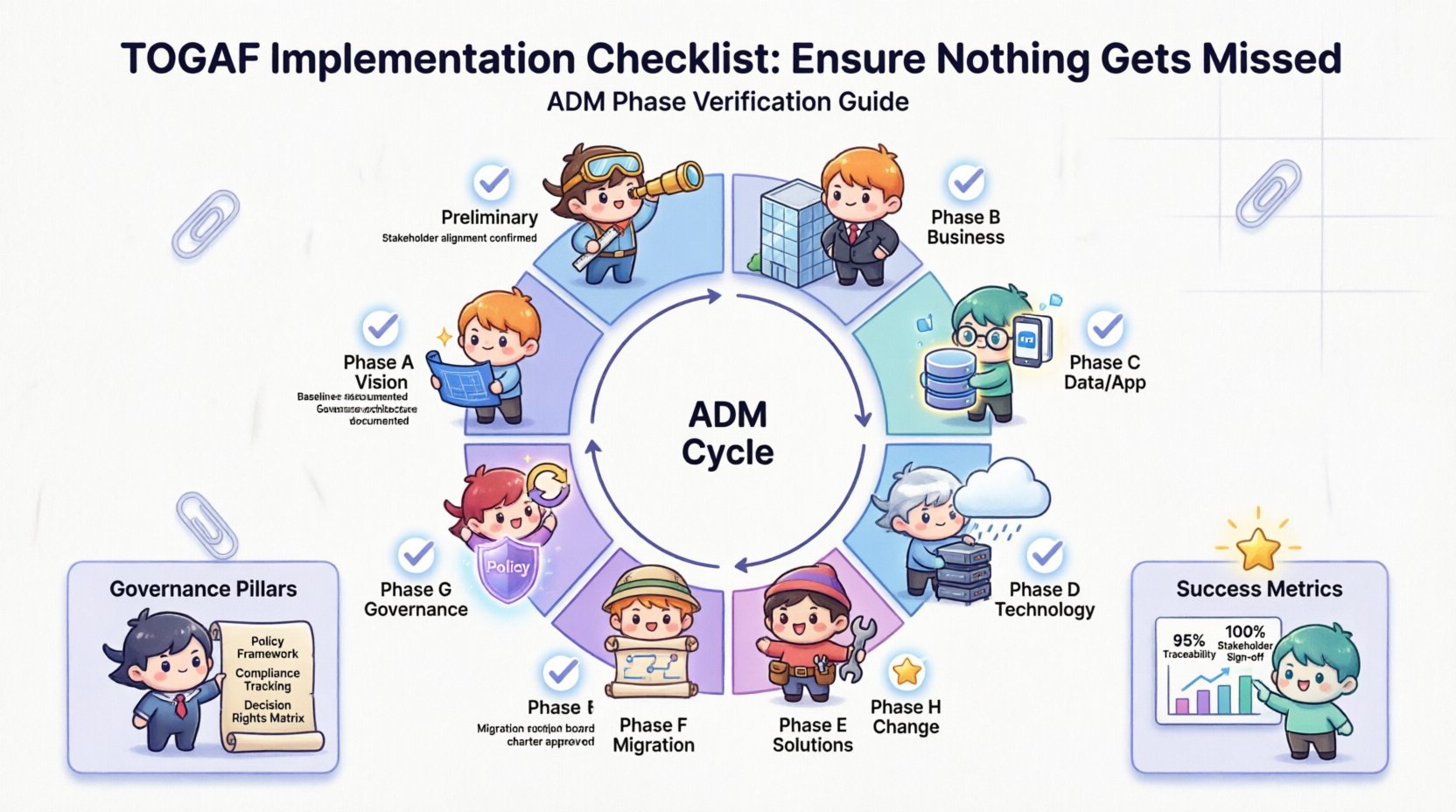
Why a Structured Implementation Checklist Matters 📋
Enterprise Architecture is often viewed as an abstract concept rather than a practical discipline. Without a defined checklist, teams may skip critical validation steps, leading to misaligned technology investments or governance gaps. A checklist enforces consistency across different projects and ensures that the architecture is not just theoretical but actionable.
- Consistency: Ensures all architecture projects follow the same standards and processes.
- Quality Assurance: Provides a mechanism to review work products before they are approved.
- Stakeholder Alignment: Helps identify who needs to approve specific decisions at every stage.
- Knowledge Retention: Captures decisions and rationales for future reference, reducing dependency on individuals.
Phase 0: Preliminary Phase 🚀
The Preliminary Phase sets the context for the architecture effort. It is about defining the framework principles and tailoring TOGAF to fit the organization’s specific needs. Skipping this phase often leads to a generic implementation that does not resonate with the business culture.
Key Verification Points
- Define the Architecture Principles: Are there core rules that govern how architecture decisions are made? These should be visible and accessible.
- Identify Stakeholders: Who has a vested interest in the outcome? Document their roles and influence levels.
- Establish the Architecture Capability: Determine the organizational structure required to support the EA function. Is it a center of excellence, a distributed team, or a hybrid?
- Review Legal and Regulatory Requirements: Ensure compliance constraints are documented early to avoid blockers later.
- Define the Scope: Clearly articulate what is in scope and what is out of scope for the initial implementation.
Phase A: Architecture Vision 🎯
Phase A defines the high-level scope and objectives. It creates a business justification for the architecture project. The goal is to secure agreement on the goals and constraints before diving into detailed design.
Checklist for Phase A
- Business Goals: Have the strategic goals been clearly articulated and linked to the architecture vision?
- Statement of Architecture Work: Is there a signed document defining the scope, timeline, and resources for this specific project?
- Stakeholder Map: Is the list of stakeholders complete, including sponsors, customers, and regulators?
- Architecture Principles: Have the principles been reviewed and accepted by the Architecture Board?
- Impact Assessment: Is there a preliminary assessment of the impact on the organization and existing systems?
Phase B: Business Architecture 🏢
This phase describes the baseline and target business architecture. It focuses on business processes, organization structure, and governance. It answers the question: “What is the business doing and how is it organized?”
Essential Deliverables
| Deliverable | Description | Verification Status |
|---|---|---|
| Business Principles | Guiding rules for business operations | ⬜ |
| Business Processes | Baseline and target process maps | ⬜ |
| Organization Map | Structure and roles definition | ⬜ |
| Business Scenarios | Use cases for the architecture | ⬜ |
- Process Modeling: Ensure processes are modeled at a level of detail appropriate for the current stage. Too granular creates clutter; too high-level lacks utility.
- Gap Analysis: Identify the difference between the baseline and target business capabilities.
- Constraints: Document any limitations on business operations that must be respected during implementation.
Phase C: Information Systems Architectures 📊
Phase C covers two sub-domains: Data Architecture and Application Architecture. It translates the business requirements into information systems requirements.
Data Architecture Checklist
- Data Entity List: Have all critical data entities been identified and defined?
- Data Flow: Is the movement of data between processes and systems documented?
- Data Standards: Are there agreed-upon formats, definitions, and security classifications for data?
- Master Data Management: Is there a strategy for managing critical master data across the enterprise?
Application Architecture Checklist
- Application Portfolio: Have all existing applications been inventoried and categorized?
- Application Interactions: Are the interfaces and integrations between applications mapped?
- Functional Requirements: Do the target applications meet the functional needs defined in Phase B?
- Integration Strategy: Is there a plan for how applications will communicate (e.g., APIs, ESB, Event-driven)?
Phase D: Technology Architecture 💻
Phase D defines the logical software and hardware capabilities required to support the deployment of business, data, and application architectures. It focuses on the infrastructure layer.
Implementation Considerations
- Network Topology: Is the network design capable of supporting the required data flows and security zones?
- Computing Resources: Are there sufficient compute, storage, and memory resources identified for the target state?
- Security Infrastructure: Does the technology architecture include necessary security controls (firewalls, encryption, identity management)?
- Cloud Strategy: If applicable, is there a clear definition of cloud consumption models (IaaS, PaaS, SaaS) and governance?
- Vendor Management: Are the requirements for technology vendors clearly defined to support the architecture?
Phase E: Opportunities and Solutions 🛠️
Phase E identifies the building blocks and implementation options. It involves selecting the specific solutions to bridge the gap between the baseline and target architectures.
Selection Criteria
- Capability Mapping: Have the required capabilities been matched to specific solution building blocks?
- Build vs. Buy: Is there a documented rationale for decisions regarding building custom solutions versus purchasing off-the-shelf products?
- Reuse: Have existing assets been evaluated for reuse to reduce cost and complexity?
- Risk Assessment: Have technical and business risks associated with each solution option been assessed?
- Interdependencies: Are the dependencies between different solution packages clearly understood?
Phase F: Migration Planning 🗓️
Phase F develops the detailed implementation and migration plan. It transforms the high-level strategy into a sequence of actionable projects.
Planning Essentials
- Project Grouping: Are projects grouped logically to maximize value delivery and manage dependencies?
- Resource Allocation: Is there a realistic assessment of the resources (people, budget, time) required for each project?
- Sequence: Is the order of implementation logical, ensuring prerequisites are met before dependent activities begin?
- Migration Roadmap: Is there a visual representation of the timeline and milestones for stakeholders?
- Transition Architectures: Have intermediate states been defined to manage the transition smoothly?
Phase G: Implementation Governance 🛡️
Phase G ensures that the architecture is implemented as designed. It involves oversight, compliance checks, and management of deviations.
Governance Activities
- Architecture Compliance Review: Are there scheduled reviews to check if projects adhere to the defined architecture?
- Deviation Management: Is there a formal process for handling requests to deviate from the architecture?
- Project Oversight: Are architecture representatives involved in key decision points within implementation projects?
- Quality Assurance: Are technical standards being enforced during the development lifecycle?
- Communication: Is there a mechanism to report governance status to senior leadership?
Phase H: Architecture Change Management 🔁
Phase H manages changes to the target architecture. Since business needs evolve, the architecture must be adaptable. This phase ensures that changes are evaluated and integrated systematically.
Change Control Processes
- Change Request Intake: Is there a clear channel for submitting architecture change requests?
- Impact Analysis: Does every change request include an analysis of impact on other parts of the architecture?
- Architecture Board: Does the Architecture Board review and approve significant changes?
- Version Control: Are architecture artifacts versioned and tracked over time?
- Feedback Loop: Is there a mechanism to capture lessons learned from implementation to inform future architecture cycles?
Architecture Governance and Compliance 📜
Beyond the ADM cycle, a sustainable TOGAF implementation requires a strong governance model. This ensures that the architecture remains relevant and valuable over time.
Governance Pillars
- Policies and Standards: Define clear policies that guide decision-making. Standards should be specific and measurable.
- Roles and Responsibilities: Clearly define who is responsible for maintaining the architecture repository, who approves changes, and who audits compliance.
- Decision Rights: Establish who has the authority to make specific architecture decisions to avoid bottlenecks.
- Performance Metrics: Define how the value of the architecture function is measured. Examples include adoption rates, compliance scores, and project success rates.
Measuring Success and Value 📈
To justify the investment in TOGAF, organizations must measure the value delivered by the architecture function. Metrics should be aligned with business outcomes.
Key Performance Indicators
- Time to Market: Has the architecture reduced the time required to deliver new capabilities?
- Cost Efficiency: Has the architecture reduced redundant systems or optimized resource usage?
- Compliance Rate: What percentage of projects are fully compliant with architectural standards?
- Stakeholder Satisfaction: Regular surveys can gauge how well the architecture function supports business needs.
- Repository Usage: Track how often the architecture repository is accessed and updated to ensure it remains a living asset.
Common Pitfalls and How to Avoid Them 🚫
Even with a checklist, organizations often stumble on specific issues. Awareness of these common pitfalls can help teams navigate challenges more effectively.
Typical Challenges
- Over-Engineering: Creating detailed models that are too complex for the business to understand. Keep models high-level where possible and detail only when necessary.
- Isolation: Treating architecture as a separate department that does not interact with project teams. Embed architects within delivery teams.
- Lack of Executive Sponsorship: Without top-level support, architecture decisions may be overridden by short-term tactical needs. Secure a champion in leadership.
- Static Repository: Allowing the architecture repository to become outdated. Enforce regular reviews and updates.
- Ignoring Culture: Forcing a rigid framework on a culture that prefers agility. Tailor the process to fit the organizational culture.
Sustaining the Architecture Capability 🌱
Implementation is not a one-time event. It is a journey of continuous improvement. To sustain the architecture capability, organizations must invest in training, tooling, and community building.
- Training Programs: Provide ongoing training for architects and stakeholders to ensure they understand the framework and its principles.
- Community of Practice: Establish a group where architects can share knowledge, solve problems, and standardize approaches.
- Tooling Strategy: Select tools that support the architecture workflow without becoming a bottleneck. Ensure tools integrate with existing development pipelines.
- Regular Audits: Conduct periodic audits of the architecture practice to identify areas for improvement.
Final Implementation Review 🏁
Before declaring the implementation complete, perform a final review against the checklist. This ensures that no critical steps were skipped during the initial rollout.
- Are all ADM phases documented and archived?
- Is the Architecture Board active and functioning?
- Are stakeholders aware of their roles and responsibilities?
- Is the architecture repository accessible and up-to-date?
- Are metrics being collected and reported regularly?
A well-executed TOGAF implementation provides a stable foundation for enterprise transformation. It aligns technology with business strategy and creates a framework for managing change. By adhering to this checklist, organizations can build a resilient architecture practice that delivers value over the long term.