

Welcome to the role of Enterprise Architect. This position sits at the intersection of business strategy, technology implementation, and operational execution. It is a role defined by clarity, structure, and long-term vision. To navigate this landscape effectively, you need a framework that provides consistency and repeatability. The Open Group Architecture Framework (TOGAF) offers this structure. It is not merely a set of rules; it is a methodology for aligning IT capabilities with business needs.
This guide outlines a practical approach to your first seven days. You will not be expected to redesign the entire organization in a week. Instead, you will focus on understanding the current state, identifying key stakeholders, and familiarizing yourself with the Architecture Development Method (ADM). By the end of this week, you will have a foundation to contribute meaningfully to architectural discussions.
🧭 Understanding the Landscape
Before diving into the specifics of your daily tasks, it is essential to grasp the core philosophy of the framework you are adopting. TOGAF is built on the premise that architecture is a living discipline. It evolves alongside the organization. It is not a static document stored on a shelf, but a dynamic process that guides decision-making.
As a new architect, your primary objective is to understand the Architecture Vision. This vision dictates how the organization sees its future state. Without a clear vision, technology investments become fragmented. You must learn how the organization defines success. Is it through speed to market? Cost reduction? Regulatory compliance? These drivers shape the architecture.
Key Concepts to Grasp Immediately
- Architecture Repository: This is the centralized store of all architectural artifacts. It contains models, standards, and building blocks. You need to know where this lives and how to access it.
- Enterprise Continuum: A mechanism for classifying assets. It ranges from generic industry standards to organization-specific solutions. Understanding this helps you decide what to build and what to buy.
- Architecture Board: A governance body that reviews architectural decisions. You must understand who sits on this board and how proposals are submitted.
🔄 The ADM Cycle Explained
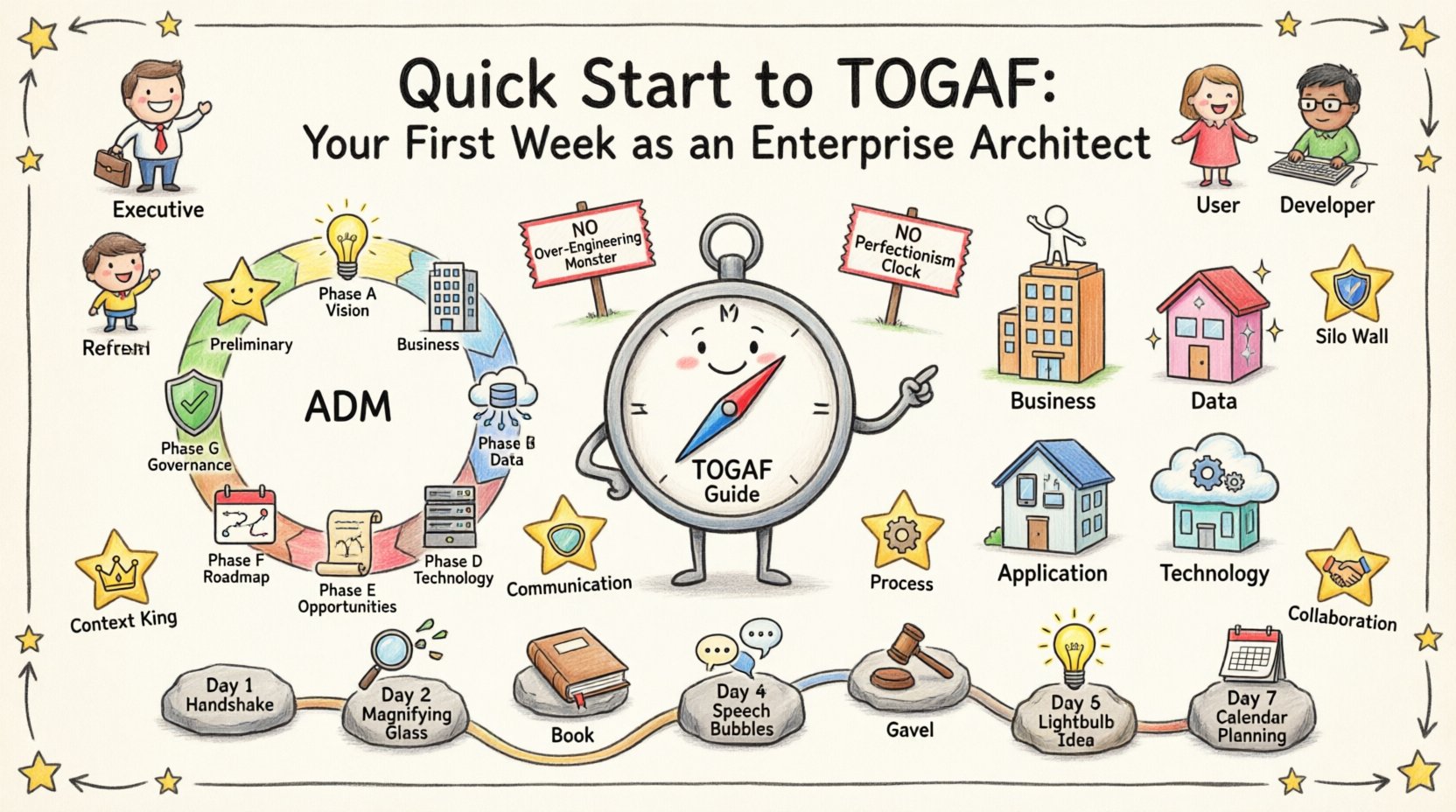
The heart of the framework is the Architecture Development Method (ADM). It is an iterative process that ensures architecture is developed systematically. While you cannot complete a full cycle in one week, you must understand the phases.
The ADM consists of several phases, labeled A through H, plus a Preliminary Phase and Requirements Management. Each phase produces specific outputs. These outputs are known as Artifacts.
Phase Overview for New Architects
- Preliminary Phase: Defines the scope and principles for your specific organization. It sets the rules of engagement.
- Phase A (Architecture Vision): Establishes the high-level view of the project or initiative.
- Phase B (Business Architecture): Describes the business strategy, governance, organization, and key business processes.
- Phase C (Information Systems Architectures): Covers Data and Application architecture. This is often where technical teams spend the most time.
- Phase D (Technology Architecture): Defines the hardware and software infrastructure required to support the business.
- Phase E (Opportunities and Solutions): Identifies implementation projects and migration plans.
- Phase F (Migration Planning): Prioritizes projects and creates a roadmap.
- Phase G (Implementation Governance): Ensures the build matches the design.
- Phase H (Architecture Change Management): Manages changes to the architecture over time.
🏗️ The Four Architecture Domains
Enterprise Architecture is often divided into four distinct domains. You must be comfortable discussing all four, even if your specific role focuses on one.
- Business Architecture: This domain describes the business strategy, governance, organization, and key business processes. It answers the question: “How does the business operate?”
- Data Architecture: This domain describes the logical and physical data assets and data management resources. It answers: “What information do we have, and how is it structured?”
- Application Architecture: This domain describes the blueprint for individual applications and their interactions. It answers: “What software systems support the business?”
- Technology Architecture: This domain describes the logical software and hardware capabilities required to support the deployment of business and data solutions. It answers: “What infrastructure powers the applications?”
Understanding the relationships between these domains is critical. A change in Business Architecture often triggers a change in Application Architecture. A shift in Data Architecture impacts Technology Architecture. You must maintain a holistic view.
🤝 Stakeholder Management
One of the most challenging aspects of the role is managing people. You will be dealing with executives, developers, project managers, and vendors. Each group has different priorities.
Identifying Stakeholders
You must create a stakeholder map. This is a visual representation of who influences the architecture and who is influenced by it.
- Sponsors: Those who provide funding and political support. They care about ROI and strategic alignment.
- Users: The people who will interact with the systems. They care about usability and efficiency.
- Developers: The people building the solution. They care about technical feasibility and standards.
- Regulators: External bodies that enforce compliance. They care about security and data privacy.
Communication Strategies
Different stakeholders require different communication styles. Executives need high-level summaries and strategic value. Technical teams need detailed specifications and constraints. You must adapt your language to your audience without losing technical accuracy.
Regular engagement is vital. Do not wait for a crisis to speak with stakeholders. Establish a rhythm of updates and feedback sessions. This builds trust and ensures that architectural decisions are understood and accepted.
⚖️ Governance and Compliance
Architecture without governance is merely a suggestion. Governance ensures that the architecture is followed during implementation. It involves review boards, compliance checks, and adherence to standards.
The Architecture Board
Most organizations have an Architecture Review Board (ARB). This group reviews major architectural decisions before they are implemented. As a new architect, you should understand the criteria they use.
- Strategic Alignment: Does this decision support the long-term goals?
- Technical Standards: Does this adhere to the approved technology stack?
- Security: Does this introduce new risks?
- Cost: Is this within budget constraints?
You will likely participate in these reviews. Your job is to present the architectural rationale clearly. You must be able to defend decisions based on data and principles, not just personal preference.
Compliance and Standards
Organizations operate under various regulatory requirements. These might include data protection laws, industry-specific regulations, or internal security policies. Your architecture must account for these constraints from the start.
Failure to consider compliance early leads to rework and technical debt. Integrate compliance checks into the design process. This includes data retention policies, access controls, and audit trails.
📅 The 7-Day Roadmap
Here is a structured plan for your first week. This schedule balances learning with practical application. It is designed to help you integrate into the team and begin contributing.
| Day | Focus Area | Key Activities | Deliverable |
|---|---|---|---|
| Day 1 | Onboarding & Context | Meet the team, review org charts, access repositories, read existing strategy docs. | Stakeholder List Draft |
| Day 2 | Current State Analysis | Review existing architecture diagrams, understand legacy systems, identify gaps. | Current State Summary |
| Day 3 | Framework Deep Dive | Study the specific ADM phases used by the org, review architecture principles. | Principles Review Notes |
| Day 4 | Stakeholder Interviews | Conduct brief interviews with key leaders to understand pain points. | Interview Summary |
| Day 5 | Governance Process | Shadow a review meeting, understand the approval workflow, learn about the board. | Governance Process Map |
| Day 6 | Opportunity Identification | Identify one small opportunity for improvement based on week findings. | Improvement Proposal |
| Day 7 | Planning & Reflection | Review week’s learnings, plan the next month, schedule follow-ups. | Month 1 Roadmap |
⚠️ Common Pitfalls to Avoid
Even with the best intentions, new architects often stumble. Being aware of these common traps can save you time and frustration.
- Over-Engineering: Do not create complex models for simple problems. Keep solutions proportional to the need. Simplicity is often the highest form of sophistication.
- Ignoring the Business: Do not get lost in the technology. If the business cannot understand it, it is not a good architecture. Translate technical constraints into business risks.
- Working in a Silo: Architecture is a collaborative effort. Do not design in isolation. Engage with development teams early.
- Prioritizing Perfection: Architecture is iterative. Aim for good enough to move forward, then refine. Waiting for a perfect model delays delivery.
- Neglecting Documentation: If it is not written down, it does not exist. Ensure your artifacts are stored in the repository and accessible to the team.
🛠️ Tools vs. Frameworks
It is important to distinguish between the framework and the tools used to implement it. The framework is the methodology. The tools are the applications used to create diagrams, store models, and manage requirements.
You may be asked to use specific modeling software. While these tools are helpful, they are secondary to the thinking process. Do not let the tool dictate the design. Use the tool to support the framework. If you are new to the organization’s tooling, spend time on Day 1 and 2 learning how to create basic diagrams and manage artifacts within the system.
Focus on interoperability. Ensure that the artifacts you create can be shared with other teams. Avoid formats that lock data into a single application. Standardized formats ensure longevity and accessibility.
📚 Continuous Learning
The field of enterprise architecture is constantly evolving. New technologies, methodologies, and business models emerge regularly. Your education does not end with certification or your first week.
- Stay Updated: Read industry reports, follow thought leaders, and attend webinars.
- Network: Connect with other architects. Sharing challenges and solutions accelerates learning.
- Seek Mentorship: Find a senior architect who can guide your development. Their experience is invaluable.
- Practice: Apply the concepts in real projects. Theory only becomes practice through application.
Remember that architecture is a service. You serve the business by providing clarity and direction. Your value is measured by the quality of decisions you enable, not just the diagrams you produce. Maintain a posture of curiosity and humility. You will not know everything, and that is acceptable. What matters is your ability to find the answers and guide the organization toward a better future.
🔍 Key Takeaways
- Context is King: Understand the organization’s strategy before proposing solutions.
- Communication: Translate technical concepts into business value.
- Process: Follow the ADM cycle to ensure structured development.
- Governance: Respect the review process and ensure compliance.
- Collaboration: Work with stakeholders, not just for them.
Your first week is about laying the groundwork. You are building the relationships and understanding the systems that will support your work for years to come. Approach this time with focus and patience. The framework provides the structure, but your judgment provides the value.