

Enterprise Architecture (EA) serves as the backbone for organizational transformation. As businesses navigate digital complexity, the choice of framework becomes critical. The Open Group Architecture Framework (TOGAF) remains the industry standard. However, a significant evolution occurred with the release of TOGAF 10. Understanding the distinctions between TOGAF 10 and TOGAF 9 is essential for architects aiming to build resilient systems. This guide provides a rigorous analysis of both versions, highlighting structural shifts, philosophical changes, and practical implications.
Understanding the Landscape 🌍
The Open Group updates TOGAF periodically to reflect shifts in technology and business needs. TOGAF 9, released in 2009, standardized the Architecture Development Method (ADM). It became the go-to reference for large-scale IT and business alignment. TOGAF 10, introduced in 2018 and updated subsequently, reframes the framework to be more modular and capability-focused. It addresses criticisms regarding rigidity and aligns better with modern agile and DevOps practices.
For organizations, this is not merely a version upgrade. It represents a shift in how architecture is conceptualized, delivered, and governed. Stakeholders must evaluate whether the current maturity of their processes warrants a migration to the newer standard or if the stability of TOGAF 9 suffices for their immediate goals.
Core Philosophy Shifts 🔄
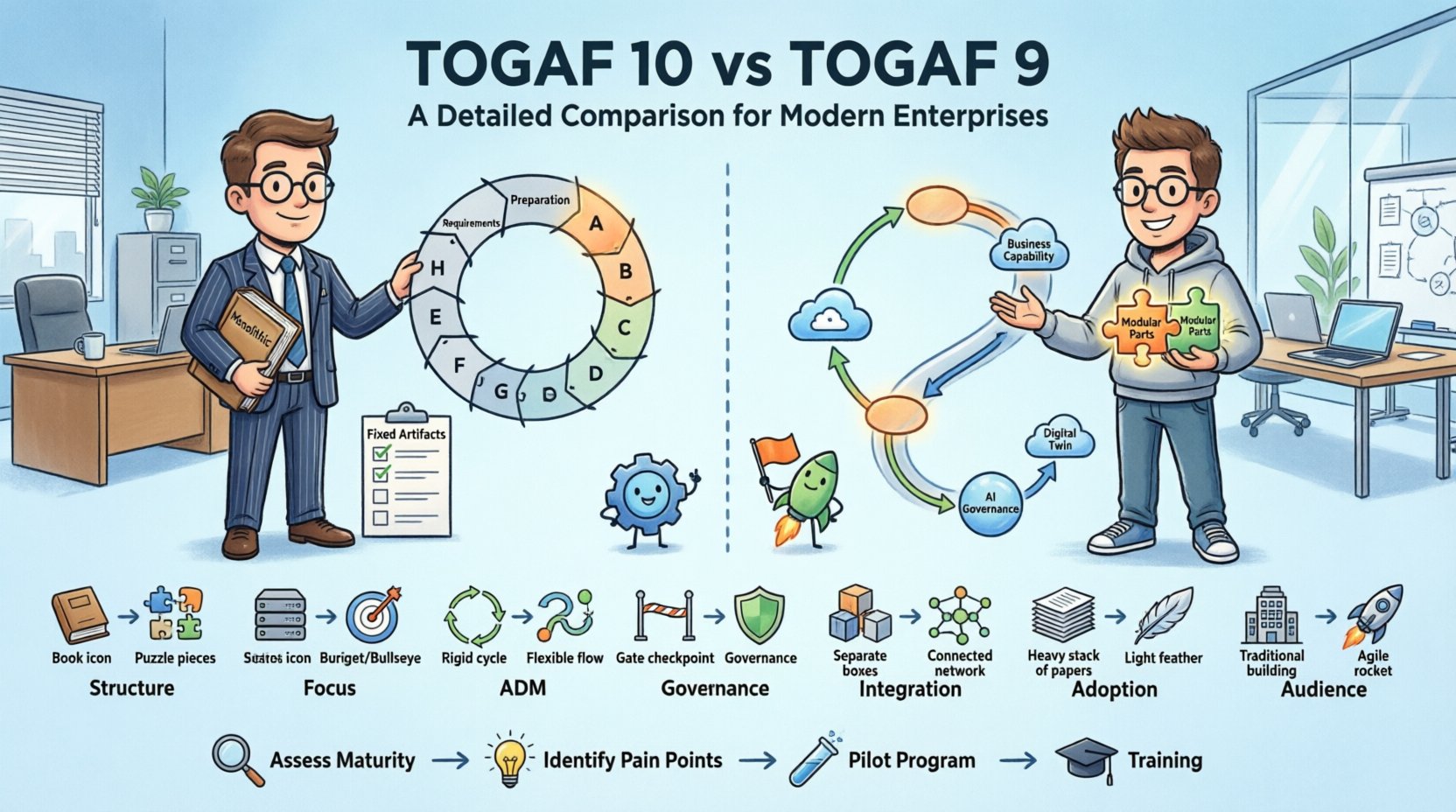
The fundamental difference lies in the underlying philosophy. TOGAF 9 treats the framework as a monolithic document. You read it from cover to cover or select specific chapters. TOGAF 10 treats the framework as a collection of components. This allows organizations to adopt only what is necessary, reducing overhead.
Modularity: TOGAF 10 separates the core principles from the content metamodel and the ADM cycle. This means an organization can use the governance model without adopting the full ADM.
Capability-Based: TOGAF 10 places greater emphasis on capability. It moves away from purely technology-centric views toward business value delivery.
Integration: Version 10 is designed to integrate more seamlessly with other standards like ITIL, COBIT, and PMI. TOGAF 9 had integration guides, but 10 makes compatibility a structural priority.
TOGAF 9: The Established Standard 📜
TOGAF 9 established a robust baseline for Enterprise Architecture. Its primary contribution is the Architecture Development Method (ADM). This cyclic process guides architects from the initial vision to implementation and maintenance.
Key Components of TOGAF 9
The ADM Cycle: A 10-step process (Preparation, A through H, and Requirements Management). It is linear yet iterative, ensuring thoroughness at each stage.
Content Metamodel: Defines the artifacts, building blocks, and deliverables. It standardizes what documents and diagrams are produced.
Enterprise Continuum: Provides a repository for classifying architecture assets. It helps in reusing existing solutions rather than building from scratch.
Architecture Governance: Establishes the rules for compliance and change management within the architecture lifecycle.
While effective, TOGAF 9 is often criticized for being documentation-heavy. The focus on the Content Metamodel can lead to excessive reporting without corresponding business value. Organizations often spend more time creating artifacts than actually solving business problems.
TOGAF 10: The Modern Approach 🚀
TOGAF 10 responds to the need for agility. It acknowledges that a single “one-size-fits-all” approach does not work for every enterprise. The framework is now split into distinct parts, allowing for tailored adoption.
Key Components of TOGAF 10
Building Blocks: The concept is refined to focus on reusable components that deliver specific capabilities. This aligns closer to microservices and modular design patterns.
Capability-Based Architecture: The focus shifts to what the organization can do, rather than just what technology it owns. This ensures alignment with strategic goals.
Expanded Governance: Governance is treated as a continuous activity rather than a phase gate. It supports real-time compliance checks.
Iterative ADM: The ADM is more flexible. It supports incremental delivery and allows for skipping phases if prerequisites are met or risks are low.
Detailed Comparison Table 📊
The following table outlines the structural differences between the two versions. This facilitates a quick assessment of which version aligns with current organizational needs.
Feature | TOGAF 9 | TOGAF 10 |
|---|---|---|
Structure | Monolithic Document | Modular Parts |
Primary Focus | Technology & Deliverables | Capabilities & Value |
ADM Flexibility | Strict Cyclic Phases | Iterative & Tailored |
Content Metamodel | Fixed Artifacts | Dynamic & Customizable |
Integration | Guidance Provided | Structural Compatibility |
Adoption Curve | High Documentation Burden | Reduced Overhead |
Target Audience | Traditional IT Environments | Agile & Hybrid Environments |
Deep Dive: The Architecture Development Method (ADM) 🛠️
The ADM is the heart of TOGAF. Both versions utilize it, but the application differs significantly.
TOGAF 9 ADM Characteristics
Phased Approach: Each phase (A through H) must be completed before moving to the next. This ensures comprehensive documentation.
Gateways: Formal architecture review boards are common. Decisions are made at specific checkpoints.
Deliverables: Emphasis on creating specific documents like Architecture Vision, Business Architecture, and Data Architecture.
TOGAF 10 ADM Characteristics
Capability Focus: Phases are linked to capability maturity. If a capability is already mature, the phase can be condensed.
Continuous Flow: The boundaries between phases are less rigid. Feedback loops are integrated directly into the process.
Value Delivery: The end goal is explicitly tied to business outcomes. Documentation is secondary to the value provided.
For modern enterprises dealing with rapid market changes, the rigid phases of TOGAF 9 can create bottlenecks. TOGAF 10 allows architects to pivot quickly without violating the framework’s integrity.
Content Metamodel and Artifacts 📄
Artifacts are the tangible outputs of the architecture process. In TOGAF 9, the Content Metamodel was prescriptive. It defined exactly what diagrams and documents were required for each phase.
In TOGAF 10, the Content Metamodel is more flexible. It provides a catalog of potential artifacts but allows architects to select based on context. This reduces the administrative burden of creating artifacts that no one reads.
TOGAF 9: Requires a specific set of deliverables for every project. This ensures consistency but can lead to waste.
TOGAF 10: Defines a “Minimum Viable Architecture”. Teams can scale up the artifact set if complexity demands it.
This flexibility supports lean methodologies. Architects can produce just enough documentation to govern the system without stifling development speed.
Governance and Compliance 🛡️
Governance ensures that architecture decisions align with organizational strategy. Both versions address this, but the mechanisms differ.
TOGAF 9 Governance
Focuses on compliance with the Architecture Definition.
Relies on Architecture Review Boards (ARB) to sign off on changes.
Often reactive, checking compliance after implementation plans are drafted.
TOGAF 10 Governance
Focuses on continuous value realization.
Integrates governance into the delivery lifecycle.
Supports automated compliance checking where possible.
The shift in TOGAF 10 reflects the reality that modern software delivery is continuous. Waiting for an ARB sign-off before deploying code is often impractical. TOGAF 10 supports a model where governance is embedded within the pipeline.
Migration Strategies 🗺️
Organizations currently using TOGAF 9 face a decision. Should they migrate to TOGAF 10? Migration is not a simple software update. It requires process re-engineering.
Assessment Steps
Evaluate Current Maturity: Assess the current state of the EA function. If the process is working well, a full migration may not be necessary immediately.
Identify Pain Points: Determine where TOGAF 9 is causing friction. Is it documentation? Is it speed? This identifies where TOGAF 10 adds value.
Pilot Program: Select a single project to apply TOGAF 10 principles. This reduces risk and provides data for decision-making.
Training: Ensure architects understand the modular nature of TOGAF 10. Old habits of following the monolithic document must be unlearned.
Hybrid Approach
Some organizations choose a hybrid approach. They retain the ADM structure of TOGAF 9 but adopt the modularity and capability focus of TOGAF 10. This allows for a gradual transition without disrupting existing workflows.
Certification and Professional Development 🎓
The certification landscape has also evolved. The TOGAF 9 certification path is well-established. TOGAF 10 introduced a new structure that aligns with the modular framework.
TOGAF 9: Two levels (Foundation and Certified). Focuses on knowledge of the ADM and Content Metamodel.
TOGAF 10: Introduces the “Enterprise Architecture Professional” designation. It emphasizes practical application and capability management.
For individuals, holding a TOGAF 10 certification signals proficiency in modern architecture practices. However, the core concepts remain similar enough that knowledge transfer is efficient.
Challenges in Adoption 🚧
Despite the benefits, moving to TOGAF 10 presents challenges. The flexibility can be confusing. Without clear guidance, teams might ignore essential controls.
Loss of Standardization: Too much customization can lead to inconsistent architecture across the enterprise.
Training Costs: Updating training materials and instructor expertise requires investment.
Resistance to Change: Senior stakeholders accustomed to the predictability of TOGAF 9 may resist the new flexibility.
To mitigate these risks, organizations should establish clear guardrails. Define the “non-negotiables” for the enterprise architecture function. These guardrails ensure that flexibility does not lead to chaos.
Future-Proofing Your Architecture 🌐
Technology landscapes change rapidly. Cloud computing, AI, and IoT introduce new complexities. TOGAF 10 is designed to accommodate these shifts better than TOGAF 9.
Cloud Agnosticism: TOGAF 10 does not prescribe specific cloud providers. It focuses on the capabilities required to leverage cloud services.
Data-Centric: With the rise of data-driven decision-making, TOGAF 10 places greater emphasis on data architecture and management.
Security Integration: Security is no longer a separate phase. It is woven into the capability design from the start.
Organizations investing in TOGAF 10 are positioning themselves for longer-term stability. The framework’s adaptability ensures it remains relevant as technologies evolve.
Practical Implementation Tips 💡
For teams ready to implement TOGAF 10, the following practices are recommended.
Start Small: Do not attempt to refactor the entire enterprise architecture overnight. Begin with a specific domain or business capability.
Engage Stakeholders: Ensure business leaders understand the value proposition. If they do not see value, the architecture function will struggle.
Leverage Tooling: Use EA tools that support modular frameworks. This helps manage the complexity of customized artifacts.
Measure Outcomes: Define metrics based on value delivery, not document completion. Track how architecture decisions impact business performance.
Summary of Differences 📝
The transition from TOGAF 9 to TOGAF 10 is a maturation of the framework. It moves from a prescriptive standard to an enabling toolkit. The core principles of alignment, governance, and standardization remain intact. However, the delivery mechanism has become more agile and context-aware.
Organizations must weigh their current maturity against their future ambitions. If the goal is stability and strict compliance, TOGAF 9 remains a valid choice. If the goal is agility and value delivery, TOGAF 10 offers a superior path.
Final Thoughts on Selection 🤔
Selecting the right version of the framework depends on the specific context of the organization. There is no single correct answer. The decision should be based on a clear understanding of the enterprise’s strategic direction, technological maturity, and risk tolerance.
By carefully evaluating the differences outlined in this guide, leaders can make informed decisions. They can ensure that their architecture function supports, rather than hinders, business growth. Whether adopting TOGAF 9 or migrating to TOGAF 10, the ultimate goal remains the same: building an enterprise that is resilient, adaptable, and efficient.
As the industry continues to evolve, the framework must evolve with it. TOGAF 10 represents a significant step in that direction. It offers the structure needed for governance while providing the flexibility required for innovation. For modern enterprises, this balance is critical.