

Modern organizations face a complex landscape of legacy systems, cloud migration, and evolving business strategies. Without a structured approach to aligning IT with business goals, projects often fail to deliver value. This is where Enterprise Architecture (EA) becomes critical. One of the most widely recognized frameworks for this discipline is TOGAF.
This guide provides a clear, structured path for understanding TOGAF. It covers the core components, the methodology, and how to apply it effectively without unnecessary complexity. We will explore the framework’s structure, its phases, and the value it brings to organizational governance.
📚 What is TOGAF?
TOGAF stands for The Open Group Architecture Framework. It is a framework for designing, planning, implementing, and governing enterprise information architecture. Developed by The Open Group, it is designed to help organizations manage their IT infrastructure and align it with business needs.
Key characteristics of the framework include:
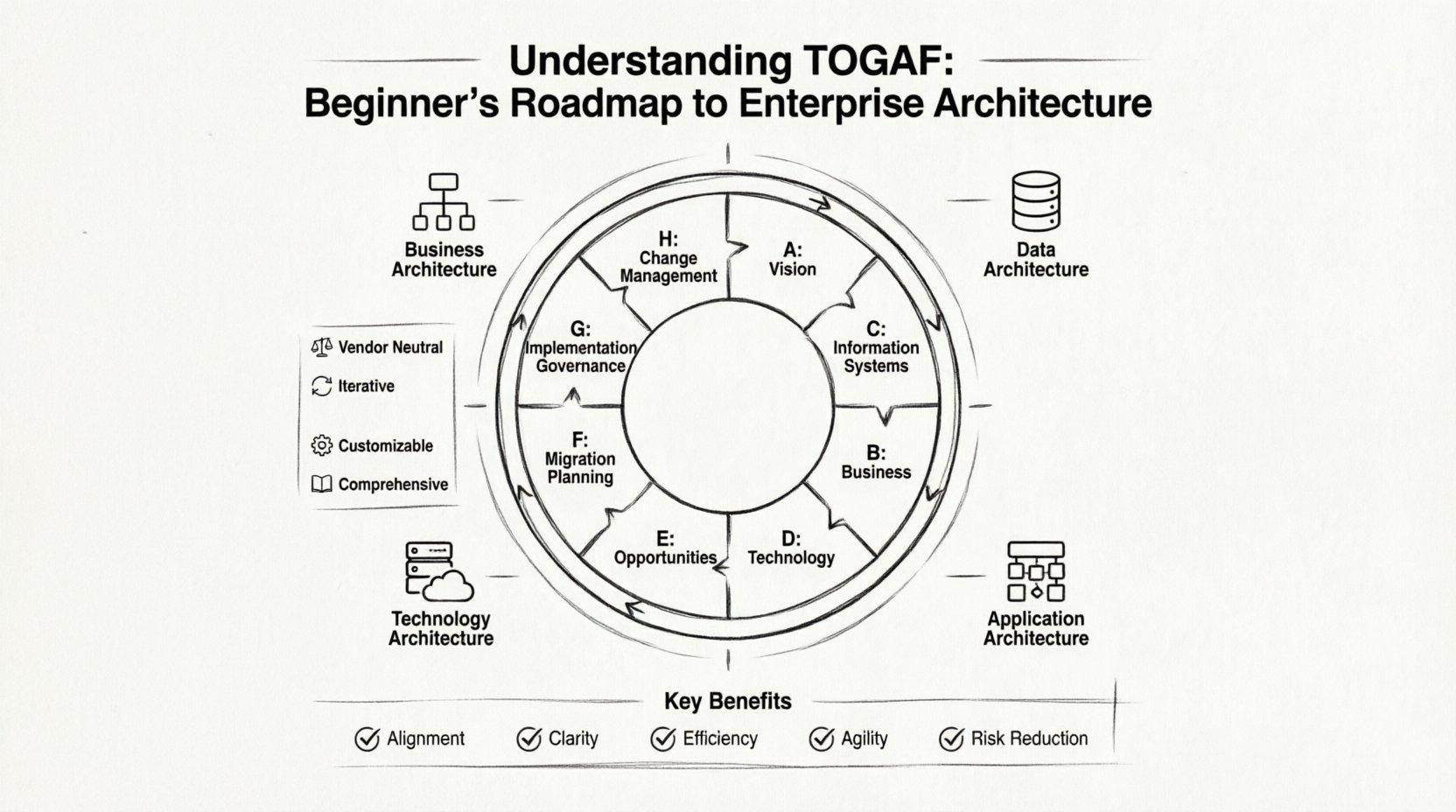
- Vendor Neutral: It does not rely on specific software products or hardware vendors.
- Iterative: It supports continuous improvement rather than a one-time project.
- Customizable: Organizations can adapt the framework to fit their size and industry.
- Comprehensive: It covers business, data, application, and technology architectures.
The primary goal is to improve the efficiency of IT investments and reduce the risk of project failure. By using a common vocabulary and set of practices, stakeholders can communicate more effectively.
🔑 Core Components of the Framework
TOGAF is not just a single document but a collection of tools and guidelines. Understanding the core components helps in navigating the framework effectively.
1. The Architecture Development Method (ADM)
The ADM is the heart of the framework. It is a step-by-step approach for developing an enterprise architecture. It ensures that architecture is developed systematically and meets the requirements of the organization. The ADM is cyclical, meaning it can be repeated to refine the architecture over time.
2. The Architecture Content Framework
This component defines what artifacts are created during the ADM process. It includes models, diagrams, and documentation standards. It ensures consistency in how architecture is represented across the organization.
3. The Enterprise Continuum
The Enterprise Continuum is a repository of reusable assets. It helps architects find existing solutions rather than building from scratch. It includes:
- Architecture Continuum: Generic to specific architectures.
- Solutions Continuum: Generic to specific solutions.
4. The TOGAF Content Metamodel
This provides a standardized structure for defining architecture content. It ensures that all architects are using the same definitions and relationships when creating models.
🔄 The Architecture Development Method (ADM) Cycle
The ADM is a cycle of phases that guide the development of architecture. Each phase has specific objectives, inputs, and outputs. Below is a detailed breakdown of the phases.
Phase A: Architecture Vision
This phase sets the stage. It defines the scope, constraints, and stakeholders. The goal is to create a high-level vision that aligns with business strategy. Key activities include:
- Identifying stakeholders and their concerns.
- Defining the scope of the architecture.
- Creating the Architecture Vision document.
- Securing approval to proceed.
Phase B: Business Architecture
This phase focuses on the business domain. It defines the business strategy, governance, organization, and key business processes. The output includes:
- Business capability maps.
- Business process models.
- Organizational charts.
- Stakeholder maps.
Phase C: Information Systems Architectures
This phase is divided into two parts: Data and Application.
- Data Architecture: Defines the logical and physical data assets and data management resources.
- Application Architecture: Provides a blueprint for individual application systems, their interactions, and their relationships to the core business processes.
Phase D: Technology Architecture
This phase defines the hardware and software infrastructure required to support the business and data architectures. It includes:
- Network infrastructure.
- Hardware specifications.
- Software platforms.
- Security standards.
Phase E: Opportunities and Solutions
Here, the focus shifts to implementation. It involves identifying building blocks and determining the best approach to achieve the target architecture. Activities include:
- Identifying major projects.
- Assessing risks and impacts.
- Developing a migration plan.
Phase F: Migration Planning
This phase creates a detailed implementation and migration plan. It prioritizes projects and creates a schedule. Key outputs include:
- Implementation projects.
- Migration schedules.
- Budget estimates.
- Risk management plans.
Phase G: Implementation Governance
This phase ensures that the architecture is implemented correctly. It involves oversight of the projects to ensure they align with the architecture. It includes:
- Architecture compliance reviews.
- Managing changes to the architecture.
- Ensuring deliverables meet requirements.
Phase H: Architecture Change Management
The final phase ensures that the architecture remains relevant. As the business changes, the architecture must adapt. This phase handles:
- Monitoring the architecture over time.
- Managing change requests.
- Initiating new ADM cycles if necessary.
Table: Summary of ADM Phases
| Phase | Focus Area | Key Output |
|---|---|---|
| Phase A | Vision | Architecture Vision |
| Phase B | Business | Business Architecture |
| Phase C | Data & Apps | Information Systems Architecture |
| Phase D | Technology | Technology Architecture |
| Phase E | Opportunities | Migration Plan Options |
| Phase F | Planning | Implementation Plan |
| Phase G | Governance | Implementation Governance |
| Phase H | Change | Change Management |
🧩 The Four Architecture Domains
TOGAF organizes architecture into four distinct domains. Understanding these domains is essential for a holistic view of the enterprise.
1. Business Architecture
This domain describes the business strategy, governance, organization, and key business processes. It answers the question: “How does the business operate?” It connects business goals to the capabilities required to achieve them.
2. Data Architecture
This domain describes the structure of an organization’s logical and physical data assets and data management resources. It ensures data is available to the right people at the right time. Key aspects include:
- Data models.
- Data flow diagrams.
- Data standards.
3. Application Architecture
This domain provides a blueprint for individual application systems, their interactions, and their relationships to the core business processes. It focuses on software capabilities. It helps in identifying which applications support which business processes.
4. Technology Architecture
This domain describes the hardware and software infrastructure required to support the business and data architectures. It includes network infrastructure, computing hardware, and security mechanisms. It ensures the technical foundation is robust and scalable.
⚖️ Benefits and Realities of Adoption
Implementing a structured framework like TOGAF brings significant advantages. However, it also requires commitment and resources. It is important to understand both sides.
Key Benefits
- Alignment: Ensures IT investments support business goals.
- Clarity: Provides a common language for stakeholders.
- Efficiency: Reduces redundancy and improves resource utilization.
- Agility: Enables faster response to market changes through better planning.
- Risk Reduction: Identifies potential issues before implementation.
Common Challenges
- Complexity: The framework can be overwhelming for small teams.
- Adoption: Getting stakeholders to follow the process requires discipline.
- Cost: Training and initial setup take time and budget.
- Maintenance: Keeping the architecture up to date requires ongoing effort.
🚀 Getting Started with TOGAF
For organizations new to Enterprise Architecture, a phased approach is recommended. Do not attempt to implement every aspect immediately.
Step 1: Assess Readiness
Evaluate the current state of the organization. Determine if there is a need for EA. Check if leadership supports the initiative.
Step 2: Define Scope
Decide which parts of the framework to use. Start with the ADM cycle and the core architecture domains. Avoid trying to cover everything at once.
Step 3: Train the Team
Ensure that key personnel understand the concepts. Consider certification for senior architects to ensure they have a deep understanding of the framework.
Step 4: Execute a Pilot
Run a small project using the ADM cycle. This allows the team to learn the process without risking critical operations.
Step 5: Review and Adapt
After the pilot, review what worked and what did not. Adjust the framework to fit the organizational culture better.
🎓 Certification and Professional Development
The Open Group offers a certification program for TOGAF. This validates the knowledge and skills of individuals working with the framework.
- TOGAF Foundation: Tests basic understanding of the concepts and terminology.
- TOGAF Practitioner: Tests the ability to apply the framework in real-world scenarios.
Having certified professionals on a team can increase the credibility of the architecture function. It ensures that the team speaks the same language and follows best practices.
🛠️ Tools and Methods
While TOGAF does not mandate specific tools, it defines the methods for creating and managing architecture. Organizations often use modeling tools to create diagrams and manage artifacts.
When selecting tools, consider the following criteria:
- Compatibility: Can the tool support the required models?
- Collaboration: Does it allow multiple users to work together?
- Reporting: Can it generate the reports needed by stakeholders?
- Integration: Can it connect with other systems like project management tools?
It is crucial to remember that the tool is secondary to the process. The framework defines the logic, not the software.
📈 Measuring Success
How do you know if the architecture effort is successful? Metrics are essential for demonstrating value.
- Project Success Rate: Percentage of projects delivered on time and within budget.
- System Availability: Uptime and reliability of critical systems.
- Cost Savings: Reduction in duplicate systems or maintenance costs.
- Time to Market: Speed at which new capabilities are deployed.
Tracking these metrics helps in justifying the continued investment in Enterprise Architecture.
🌐 The Future of Enterprise Architecture
The landscape of technology is constantly changing. Cloud computing, artificial intelligence, and the Internet of Things are reshaping how organizations operate. TOGAF remains relevant because it is adaptable.
Architects must stay updated on emerging trends. The framework provides a stable foundation upon which new technologies can be integrated. The focus is shifting towards agile architecture, where flexibility is as important as planning.
🤝 Building a Strong Architecture Team
A successful EA practice relies on people. Building a team with the right skills is vital.
- Leadership: Senior architects who can guide strategy.
- Analysts: Individuals who can gather requirements and model processes.
- Engineers: Technical experts who understand the implementation details.
- Stakeholders: Business leaders who provide direction and funding.
Communication is the glue that holds the team together. Regular meetings and clear documentation ensure everyone is aligned.
📝 Final Thoughts
TOGAF provides a robust structure for managing enterprise architecture. It is not a magic solution, but a disciplined approach to solving complex problems. By following the ADM cycle and focusing on the four domains, organizations can achieve better alignment between business and technology.
Success requires patience and persistence. It is a journey of continuous improvement. Start small, learn from the process, and expand gradually. With the right team and approach, the framework can drive significant value for the organization.
Remember that the goal is not to create perfect documents, but to enable better decision-making. Use the framework to clarify thinking and reduce uncertainty. This practical approach ensures that the architecture serves the business, not the other way around.
As you move forward, keep the core principles in mind. Focus on value, alignment, and agility. These principles will guide you through the complexities of modern enterprise architecture.