


Enterprise architecture is not merely about drawing diagrams. It is about establishing a clear path for an organization to navigate change, manage complexity, and ensure alignment between business strategy and IT capabilities. At the heart of this alignment lies the Architecture Principle. These principles act as the foundational rules that guide decision-making, ensuring that every investment, project, and system supports the broader organizational goals.
However, defining these principles is only the first step. The real challenge lies in modeling them effectively so they can be traced, analyzed, and enforced throughout the enterprise. This is where the ArchiMate Motivation Extension becomes essential. By integrating motivation elements into the architecture model, architects can create a living documentation of why certain structures exist, not just what those structures are.
This guide explores the mechanics of defining architecture principles using the ArchiMate framework. We will examine the specific elements involved, the relationships that bind them, and best practices for integrating these principles into your enterprise architecture practice.
📚 Understanding the Motivation Extension
The ArchiMate framework is structured into layers (Business, Application, Technology, etc.) and cross-cutting concerns. The Motivation Extension is one of these cross-cutting concerns. It provides a standardized way to describe the motivations behind the architecture.
Without motivation, an architecture model is static. It shows the current state but fails to explain the driving forces. The motivation layer introduces several key constructs:
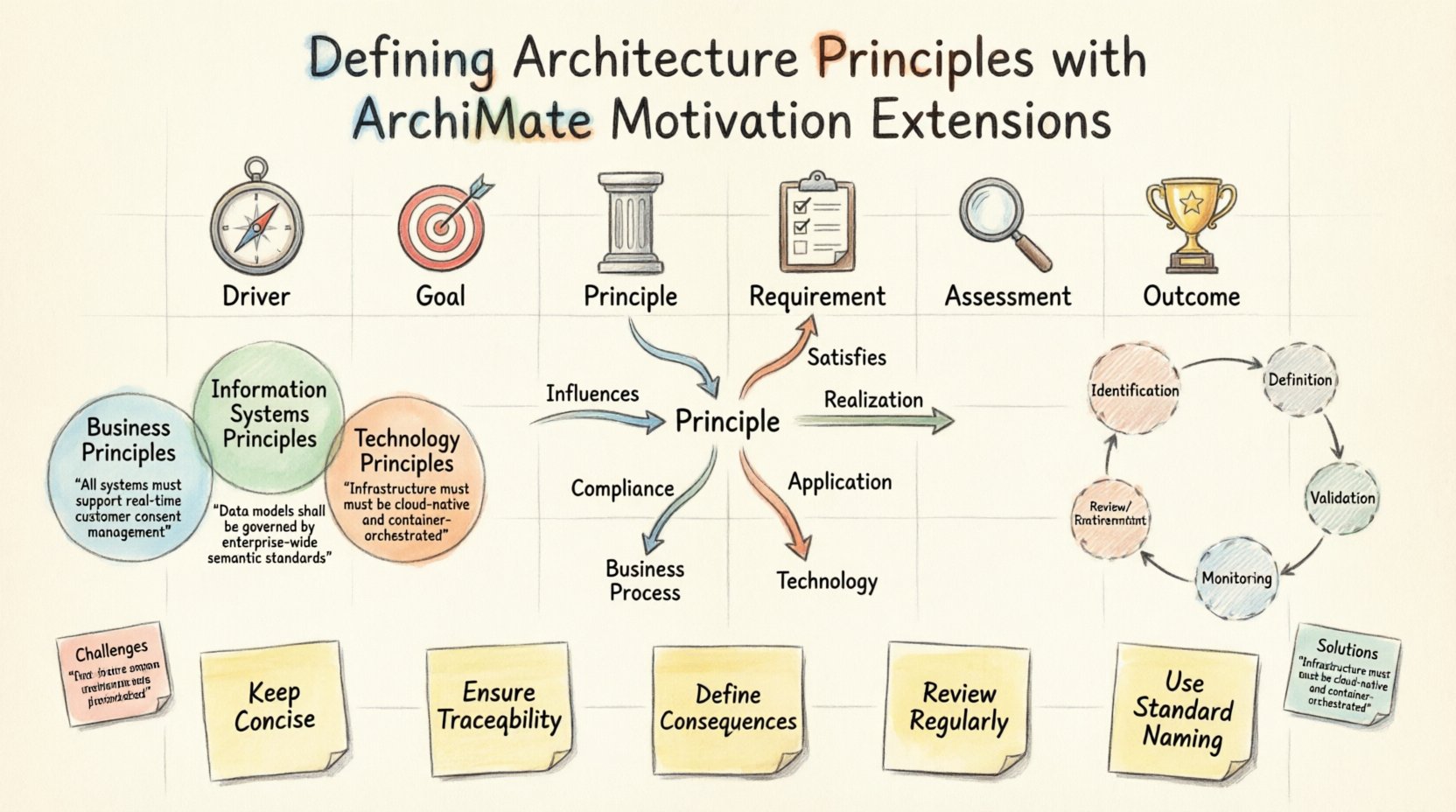
- Driver: A factor that influences the motivation of an organization. This could be a regulation, a market trend, or a technological shift.
- Goal: Something that an organization wants to achieve.
- Principle: A fundamental truth or rule that serves as a foundation for a system of belief or behavior or for a system of interpretation.
- Requirement: A condition or capability that must be met or possessed by a system or system component.
- Assessment: A judgment of the value of something.
- Outcome: The result of an activity or process.
When focusing on architecture principles, it is crucial to understand how they interact with these other elements. A principle is not created in a vacuum. It is usually derived from a Driver or a Goal, and it is enforced to satisfy Requirements.
🎯 What Are Architecture Principles?
In the context of enterprise architecture, a principle is more than a suggestion. It is a directive that constrains behavior. Principles define the boundaries within which the enterprise operates. They are often categorized into three types:
- Business Principles: High-level rules that govern business operations. Examples include “Customer data must be protected” or “Systems must be interoperable.”
- Information Systems Principles: Rules regarding the management of data and systems. Examples include “Data is an asset” or “Systems must be reusable.”
- Technology Principles: Rules regarding the infrastructure. Examples include “Use standard interfaces” or “Minimize vendor lock-in.”
Defining these principles clearly is vital. Vague principles lead to inconsistent implementations. Clear principles lead to predictable outcomes. The ArchiMate Motivation Extension allows architects to model these principles formally, linking them to the business drivers that necessitate them.
🛠️ Modeling Principles in ArchiMate
To effectively model architecture principles, you must use the specific constructs provided by the Motivation Extension. This involves creating instances of the Principle construct and linking them to other elements in the model.
1. Identifying the Source
A principle should rarely exist without a source. In ArchiMate, you typically link a Principle to a Driver or a Goal.
- Driver: If a new regulation requires data privacy, this is the Driver. The principle “All data must be encrypted” is the response.
- Goal: If the organization aims for “Operational Excellence,” the principle “Standardize processes where possible” supports that goal.
This linkage ensures that principles are not arbitrary. They are traceable back to the strategic intent of the organization. When a principle is questioned, you can refer to the driver or goal that justified its creation.
2. Defining the Scope
Principles apply to different areas of the enterprise. ArchiMate allows you to associate principles with specific Application Services, Business Processes, or Business Objects. This is done through relationships like Compliance.
For example, a principle stating “No redundant systems” can be applied to the Application Portfolio. If a new project proposes a duplicate system, the architecture review checks the principle. If the application violates the principle, it is marked as non-compliant.
3. The Relationship Matrix
Understanding the relationships between motivation elements is critical for a coherent model. The following table outlines the primary relationships relevant to principles:
| Relationship Type | Source Element | Target Element | Meaning |
|---|---|---|---|
| Compliance | Element (e.g., Process) | Principle | The element adheres to the rule defined by the principle. |
| Satisfies | Goal | Principle | The principle helps achieve the goal (often bidirectional). |
| Influences | Driver | Principle | The external or internal factor prompts the creation of the principle. |
| Realization | Requirement | Principle | The principle helps fulfill a specific requirement. |
Using these relationships correctly prevents a “spaghetti model” where connections are arbitrary. It creates a logical flow from motivation to implementation.
📝 Best Practices for Definition
Creating a robust set of architecture principles requires discipline. It is not enough to list them in a document; they must be modeled. Here are key practices to ensure your principles are effective within the ArchiMate framework.
- Keep them Concise: A principle should be a single, clear statement. Avoid compound sentences that introduce ambiguity. For example, “Systems should be secure and fast” is better split into “Systems must be secure” and “Systems must be performant.”
- Ensure Traceability: Every principle must link back to a Driver or Goal. If a principle cannot be traced to a business need, it risks becoming obsolete or irrelevant.
- Define Consequences: What happens if a principle is violated? The model should support the ability to flag non-compliance. While ArchiMate models the rules, the governance process enforces them.
- Review Regularly: Principles are not set in stone. As the market changes, drivers change. Principles must be reviewed periodically to ensure they still align with the organization’s direction.
- Use Standard Naming: Adopt a consistent naming convention for principles. This aids in searching and reporting. For example, use prefixes like
PRP-BUS-01for Business Principles.
🔗 Integration with Other Layers
One of the strengths of ArchiMate is its layered approach. The Motivation Extension does not exist in isolation. It connects deeply with the Business, Application, and Technology layers.
1. Business Layer Impact
Principles often start at the Business layer. A principle like “Customer First” dictates how business processes are designed. In the model, a Business Process can be linked to a Business Principle via a Compliance relationship. This means that if the process is redesigned, the principle must still be satisfied.
2. Application Layer Impact
Principles guide software selection and development. A principle such as “Buy before Build” influences the Application Portfolio. When a new application is proposed, the architecture review checks if it aligns with this principle. In the model, the Application Function or Application Component can be shown as compliant with the principle.
3. Technology Layer Impact
Infrastructure principles affect hardware and network choices. A principle like “Cloud First” directs the Technology Interface or Technology Service selection. Modeling this ensures that the physical and virtual infrastructure supports the strategic direction.
⚠️ Common Challenges and Solutions
Implementing architecture principles using the Motivation Extension is not without challenges. Architects often face specific hurdles when defining and modeling these rules.
Challenge 1: Principle Proliferation
Over time, organizations accumulate hundreds of principles. This leads to confusion and decision paralysis.
- Solution: Implement a hierarchy. Distinguish between Core Principles (high-level, stable) and Derived Principles (specific to domains). Use the Goal element to group principles under strategic themes.
Challenge 2: Lack of Enforcement
A model is useless if no one checks it. Principles exist on paper but are ignored during project delivery.
- Solution: Integrate the model into the governance process. Use the Assessment element to record the status of compliance for specific projects. Link projects to the principles they must satisfy.
Challenge 3: Ambiguous Relationships
Using the wrong relationship type (e.g., using Influences instead of Complies With) makes the model hard to analyze.
- Solution: Train the architecture team on the semantics of the framework. Ensure that Compliance is reserved for adherence, and Realization is reserved for fulfillment.
🔄 The Lifecycle of a Principle
Principles are dynamic. They have a lifecycle that mirrors the lifecycle of the enterprise itself. Modeling this lifecycle helps maintain the integrity of the architecture.
- Identification: A Driver (e.g., new GDPR regulation) identifies the need for a rule.
- Definition: The principle is drafted (e.g., “Personal data must be encrypted at rest”).
- Validation: Stakeholders review the principle. It is linked to the Goal of “Regulatory Compliance”.
- Implementation: Projects and systems are designed to comply. This is modeled via Compliance relationships.
- Monitoring: Assessments are conducted to check adherence.
- Review/Retirement: If the driver changes (e.g., regulation is repealed), the principle is retired or updated.
By modeling each step, architects can see the history and evolution of their principles. This transparency builds trust among stakeholders.
📊 Analyzing the Model
Once the principles are modeled, the real value comes from analysis. ArchiMate models allow for various types of impact analysis.
Impact Analysis
If a Driver changes, which Principles are affected? By tracing the Influences relationship, you can identify the downstream effects. This helps in change management.
Gap Analysis
Are there Requirements that are not satisfied by any Principle? Or are there Principles that have no Requirements supporting them? This analysis helps clean up the architecture.
Compliance Reporting
You can generate reports showing the compliance status of business processes against principles. This is often a requirement for internal audits or external regulatory bodies.
🤝 Collaboration and Governance
Architecture principles are not the sole domain of the architecture team. They require collaboration across the organization. The Motivation Extension supports this by making the rationale visible.
- Business Stakeholders: They define the Drivers and Goals. They ensure principles align with business strategy.
- IT Stakeholders: They define the Requirements. They ensure principles are technically feasible.
- Security & Compliance: They define specific constraints that become Principles.
When everyone understands the why behind the rules, adoption increases. The model serves as a single source of truth for these collaborative agreements.
🚀 Moving Forward
The integration of Architecture Principles into the ArchiMate Motivation Extension is a powerful capability. It moves enterprise architecture from a static documentation exercise to a dynamic governance tool. By clearly defining how principles relate to drivers, goals, and requirements, organizations can ensure that their investments align with their strategic intent.
Success in this area depends on consistency, clarity, and discipline. The tools and frameworks provide the structure, but the people provide the insight. Regularly reviewing your model, ensuring traceability, and fostering a culture of compliance will maximize the value of your architecture practice.
Start by auditing your current principles. Do they have a source? Can they be traced to a business goal? If not, use the ArchiMate Motivation Extension to build that connection. A well-modeled architecture is the foundation of a resilient enterprise.