

Enterprise architecture modeling is inherently complex. When teams are geographically dispersed, working on different parts of the same organizational landscape, maintaining a unified vision becomes a significant challenge. ArchiMate provides a structured language for describing, analyzing, and visualizing enterprise architectures. However, the value of this language depends entirely on the consistency of its application. Without strict adherence to modeling standards, distributed diagrams risk becoming isolated islands of information rather than components of a cohesive whole.
This guide explores the practical methods for ensuring consistency across distributed ArchiMate diagrams. We will examine naming conventions, layer alignment, relationship management, and governance processes that support collaboration without relying on specific commercial tools. The goal is to create an environment where diagrams communicate clearly, regardless of who created them or where they reside.
Understanding the Challenge of Distributed Modeling 🌍
In a centralized environment, a single architect or a tightly knit team can enforce standards informally. In a distributed setup, communication gaps lead to divergent interpretations of the framework. One team might model a business process using a specific granularity, while another uses a higher level of abstraction. This fragmentation creates technical debt in the architecture documentation itself.
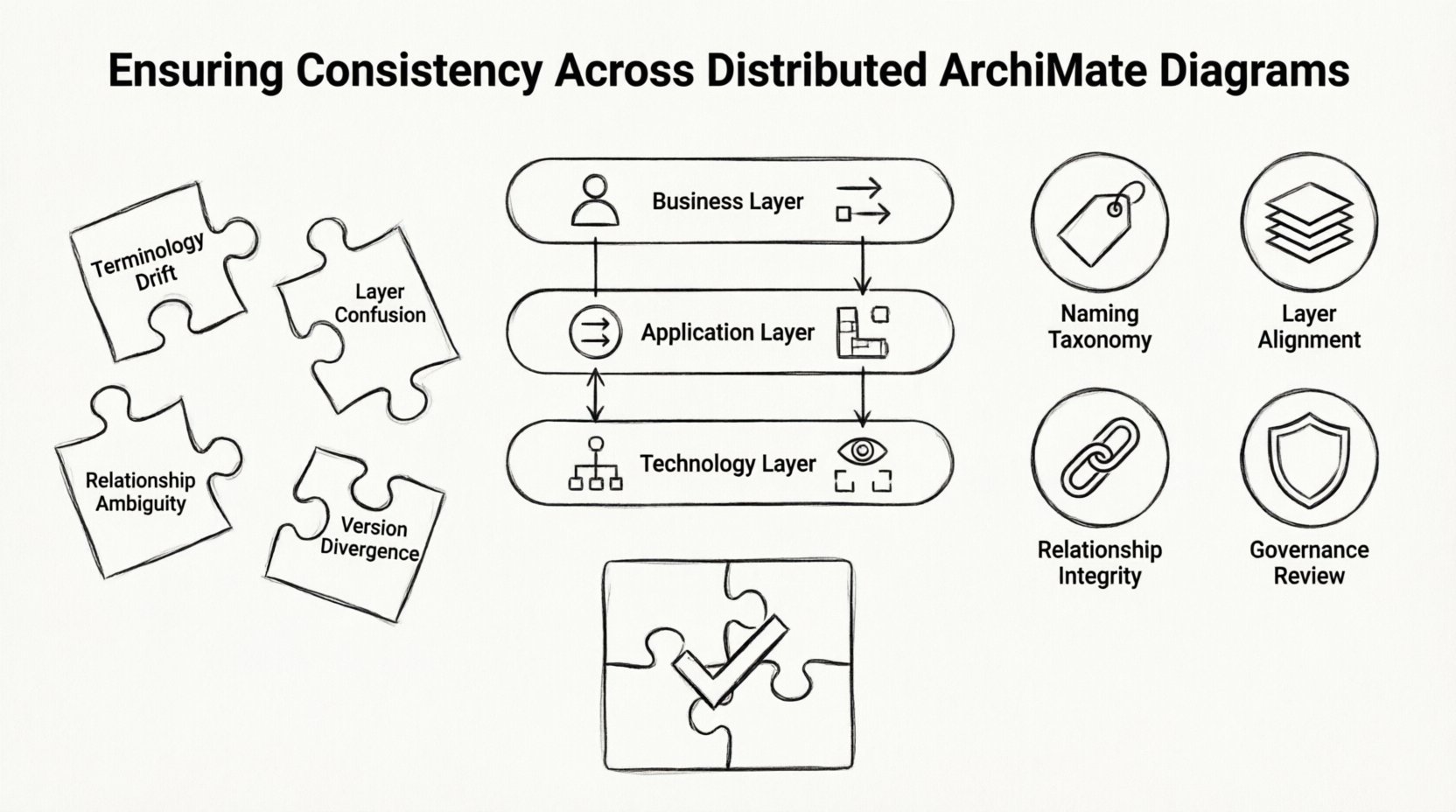
Consistency is not merely about visual uniformity; it is about semantic alignment. When diagrams are integrated or compared, the underlying data must correspond logically. Key areas of risk include:
- Terminology Drift: Different names for the same concept.
- Layer Confusion: Placing business functions in the application layer.
- Relationship Ambiguity: Unclear flows between domains.
- Version Divergence: Models updating at different rates.
Addressing these issues requires a proactive approach to standards and a culture of quality assurance within the architecture function.
Standardizing Core Elements and Naming Conventions 🏷️
The foundation of consistency lies in how elements are named and identified. ArchiMate defines specific types of elements, such as Business Actor, Application Service, or Technology Node. Each type carries specific responsibilities within the framework. When teams work independently, the tendency to use colloquial terms can undermine the rigor of the model.
1. Establishing a Naming Taxonomy
A standardized naming convention reduces ambiguity significantly. This should be documented in an architecture style guide accessible to all contributors. Key principles for naming include:
- Precision: Avoid generic terms like “System” or “Process.” Instead, use “Order Management System” or “Invoice Processing.”
- Consistency: Ensure singular and plural forms match across diagrams. If one diagram uses “Service,” others should not use “Services.”
- Contextual Clarity: If a name is ambiguous, include the domain in the identifier, such as “HR-Leave-Request.”
- Case Sensitivity: Decide on CamelCase, snake_case, or Title Case and enforce it strictly.
Consider the impact of a mismatch. If a Business Process is named “Approve Loan” in the business layer, but the Application Function supporting it is labeled “Loan Approval Workflow,” a reviewer must mentally map the two. Standardizing to “Approve Loan” across both layers eliminates this cognitive load.
2. Unique Identification
Beyond names, unique identifiers (IDs) are crucial for managing relationships in a distributed environment. While human-readable names are important for communication, machine-readable IDs allow for the merging of models without collision. Every element should have a unique reference that does not change, even if the name evolves.
Teams should agree on an ID structure. For example, using prefixes to denote layers:
BP-for Business ProcessAS-for Application ServiceTN-for Technology Node
This prevents scenarios where two different teams create elements with the same ID in a shared repository, causing data corruption upon integration.
Layer Alignment and Motivation 🧱
ArchiMate is structured around distinct layers, primarily the Business, Application, and Technology layers, underpinned by the Motivation layer. A common source of inconsistency is the misplacement of elements across these layers. This often happens when teams focus on their specific domain without understanding the cross-domain dependencies.
1. The Motivation Layer
The Motivation layer (Requirements, Goals, Principles, Assessments) often gets overlooked in distributed modeling. If one team defines a Principle as “Security is paramount” and another defines it as “Data Privacy is priority,” these principles may conflict when aggregated. Consistency in this layer ensures that the driving forces behind the architecture are unified.
Practices for alignment include:
- Centralizing the definition of Principles and Goals.
- Linking specific Business Drivers to specific Architecture Changes.
- Ensuring Assessment results are standardized in format.
2. Layer Boundaries
Elements should remain within their intended layers unless a specific relationship justifies movement. For instance, a Business Function should not be modeled as an Application Component. While it is tempting to simplify diagrams by merging layers, doing so obscures the actual technology stack and operational reality.
A clear boundary ensures that:
- Business Architects focus on value streams and capabilities.
- Application Architects focus on services and logical functions.
- Technology Architects focus on infrastructure and nodes.
When these roles collaborate, the handover points must be clear. Consistency is maintained by validating that every element in a diagram belongs to the correct layer according to the agreed-upon definitions.
Managing Relationship Integrity 🔗
Relationships are the glue that holds the ArchiMate model together. They define how elements interact, specialize, or depend on one another. In distributed modeling, broken relationships are a frequent failure point. This occurs when a team references an element that does not exist in their local view or uses a relationship type that is not defined in the standard.
1. Relationship Types
ArchiMate defines specific relationship types, such as Association, Specialization, Aggregation, and Realization. Using the wrong relationship can change the meaning of the model entirely.
For example:
- Realization: An artifact realizes a goal.
- Assignment: An actor is assigned to a process.
- Serving: A service serves a business function.
Teams must agree on a relationship dictionary. If Team A uses “Serving” to connect a Business Process to an Application Service, Team B must use the same relationship type for the same interaction. Mixing “Serving” and “Access” for the same interaction creates confusion during analysis.
2. Cross-Layer Connectivity
Distributed diagrams often struggle with cross-layer connections. The flow of data or control from the Business layer to the Application layer must be explicit. Consistency here ensures that the impact of a business change can be traced down to the technology infrastructure.
To maintain this:
- Define standard flow patterns for cross-layer interactions.
- Ensure all interfaces between layers are named consistently.
- Validate that every business function has a supporting application service defined in the model.
When diagrams are merged, orphaned relationships often appear. This happens when a source element exists in one diagram but the target element exists in another, and the relationship is not updated. Regular synchronization of element lists helps prevent this.
Views, Viewpoints, and Abstraction 🕵️
Not everyone needs to see the same level of detail. ArchiMate supports Views and Viewpoints to cater to different stakeholders. However, inconsistency in abstraction levels can lead to misinterpretation. A Viewpoint for a CTO might require high-level strategic alignment, while a Viewpoint for a Developer requires technical specifics.
1. Defining Viewpoint Standards
Teams should define Viewpoints based on the audience. A standard Viewpoint specification should include:
- Intended Audience: Who reads this view?
- Abstraction Level: What details are included or excluded?
- Focus Area: Which layers are prioritized?
If one team produces a “High Level” view that omits the Technology layer, and another produces a “High Level” view that includes it, comparing them becomes difficult. Consistency requires agreeing on what “High Level” means.
2. View Consistency
When generating views from the same model, the presentation should remain consistent. This includes the use of colors, shapes, and layout conventions. While layout is less critical than semantics, visual consistency aids in recognition and reduces the learning curve for new stakeholders.
Key aspects to standardize include:
- Color coding for layers (e.g., Blue for Business, Green for Application).
- Shape usage for specific element types.
- Label placement and font sizes.
While specific styling tools vary, the logic behind the visual representation should remain constant. This ensures that a red box always signifies an issue, regardless of which diagram is being viewed.
Governance and Review Processes 🛡️
Standards alone are not enough. A governance framework is required to enforce them. This involves establishing review cycles and accountability mechanisms. Without oversight, deviations from the standard accumulate over time.
1. The Architecture Review Board
An Architecture Review Board (ARB) or a similar governance body should evaluate models before they are promoted to the enterprise baseline. The ARB does not need to be a large group; it requires representatives from each domain (Business, IT, Security).
Review criteria should include:
- Adherence to naming conventions.
- Correctness of relationship types.
- Completeness of cross-layer links.
- Consistency with existing enterprise principles.
2. Version Control and Baselining
Distributed teams require a mechanism to manage changes over time. Version control is essential to track who changed what and when. This allows for the identification of drift between diagrams.
Key practices include:
- Baseline Creation: Lock a version of the model at specific milestones.
- Change Logging: Document every modification to an element.
- Integration Testing: Regularly merge local models to check for conflicts.
When a conflict arises, it is usually due to inconsistent definitions. A formal process for resolving these conflicts ensures that the final merged model reflects the agreed-upon standard.
Common Pitfalls and How to Avoid Them ⚠️
Even with the best intentions, teams often fall into predictable traps. Recognizing these pitfalls early can save significant effort in remediation later.
The following table outlines common issues and their preventative measures:
| Pitfall | Impact | Mitigation Strategy |
|---|---|---|
| Naming Inconsistency | Confusion during integration; duplicate elements. | Implement a central registry for all element names. |
| Layer Mixing | Loss of architectural clarity; technical debt. | Enforce layer rules during the review process. |
| Broken Relationships | Incorrect dependency mapping; analysis errors. | Validate all links before finalizing diagrams. |
| Outdated Principles | Architecture conflicts with current business strategy. | Review principles quarterly against business goals. |
| Version Drift | Working on obsolete models. | Establish clear baselines and notification protocols. |
By proactively addressing these areas, teams can maintain a high level of data integrity across the enterprise architecture repository.
Conclusion and Continuous Improvement 🚀
Maintaining consistency across distributed ArchiMate diagrams is an ongoing discipline rather than a one-time setup. It requires a combination of clear standards, robust governance, and a collaborative culture. As the enterprise evolves, the models must evolve with it, but the rules of the game should remain stable.
Success in this area is measured by the ability to integrate models seamlessly and derive accurate insights from the combined data. When teams trust that the diagrams they receive are consistent with their own work, the entire architecture practice becomes more effective. This reliability supports better decision-making, faster implementation of changes, and a clearer understanding of the organization’s digital landscape.
Regularly revisiting the standards and adapting them to new challenges ensures that the architecture function remains relevant. The investment in consistency pays dividends in the form of reduced rework and improved stakeholder confidence. By focusing on these core principles, organizations can build a robust architecture framework that withstands the complexities of distributed work.
The journey toward consistency is continuous. It demands vigilance and a commitment to quality. However, the result is a unified view of the enterprise that empowers teams to align their efforts effectively. Through disciplined modeling and shared standards, the complexity of distributed architecture becomes manageable, turning potential chaos into a structured foundation for digital transformation.