

Enterprise Architecture serves as the blueprint for organizational strategy and execution. Without a standardized approach, models become fragmented, communication breaks down, and governance becomes unmanageable. ArchiMate provides a robust language for describing, analyzing, and visualizing enterprise architecture. However, the framework itself requires a set of internal rules to function effectively within a specific organization. Establishing ArchiMate modeling standards ensures that all stakeholders interpret diagrams and models consistently.
This guide outlines the essential components for defining, implementing, and maintaining modeling standards. It focuses on structure, clarity, and alignment with business objectives without relying on specific software vendors.
🎯 The Importance of Standardization
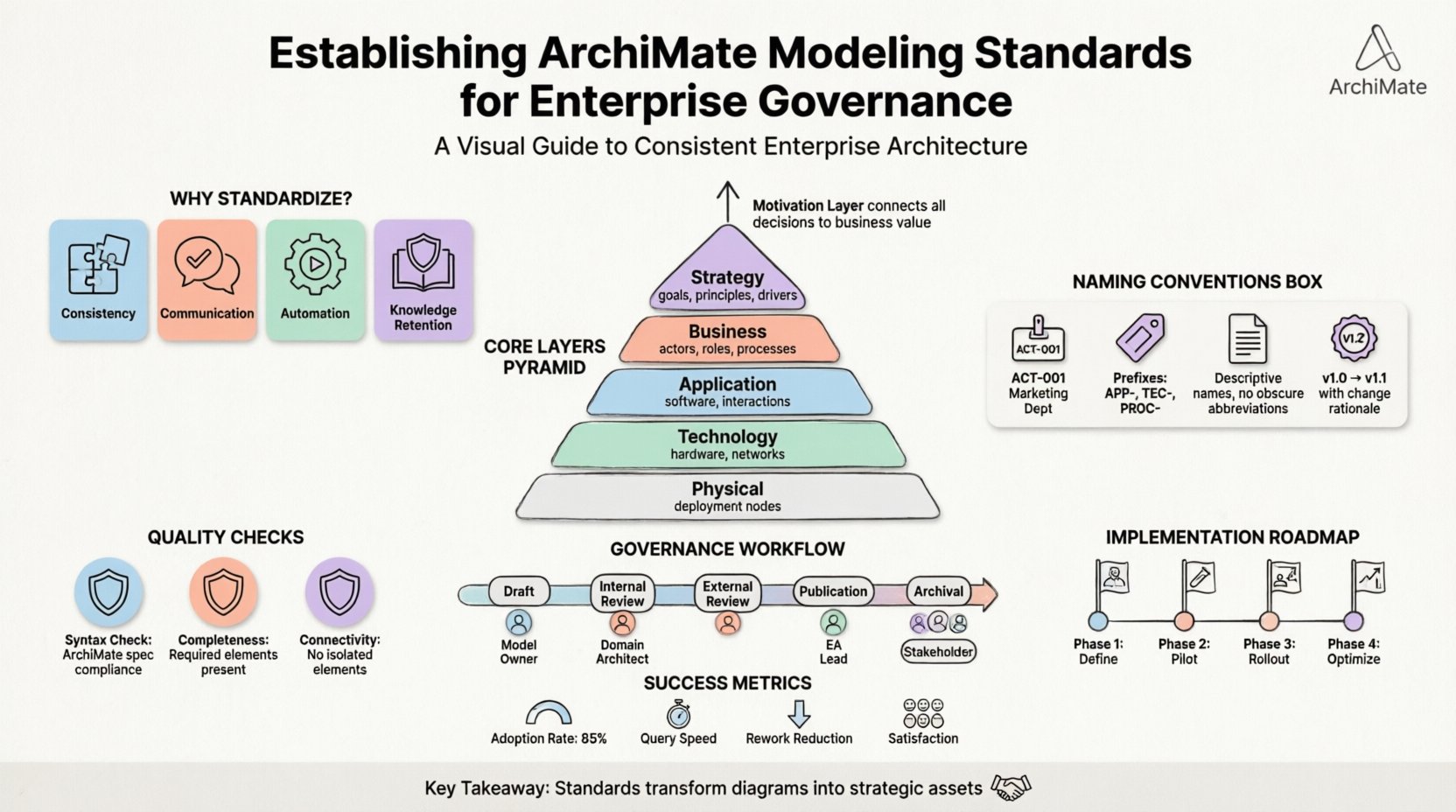
Adopting a formal set of modeling standards is not merely about aesthetics; it is about governance and clarity. When architects across different domains use different conventions, the resulting architecture repository becomes difficult to query and analyze.
- Consistency: Standardization ensures that a “Business Process” looks the same whether it is modeled by the Finance team or the Operations team.
- Communication: Stakeholders can understand diagrams without needing a translator or extensive legend.
- Automation: Consistent structures allow for automated validation and reporting.
- Knowledge Retention: Standards reduce reliance on individual tribal knowledge, making the architecture resilient to personnel changes.
🧱 Core Modeling Principles
The foundation of any standard lies in the core principles of the framework. These principles define how elements are categorized and related.
1. Layer Adherence
Models must strictly adhere to the defined layers to maintain separation of concerns. Mixing layers without explicit justification leads to confusion.
- Strategy Layer: Defines goals, principles, and drivers.
- Business Layer: Describes business actors, roles, and processes.
- Application Layer: Details software applications and their interactions.
- Technology Layer: Specifies hardware, networks, and physical infrastructure.
- Physical Layer: Represents the deployment nodes.
2. Motivation Layer Integration
Every technical decision should trace back to a business motivation. Standards should mandate the use of the Motivation Layer elements (Goal, Principle, Requirement, Assessment, Driver, Outcome) to link architectural decisions to business value.
🏷️ Naming Conventions and Identification
Naming conventions are the most visible aspect of a standard. They provide immediate context and hierarchy.
- Unique Identifiers: Every element must have a unique ID (e.g.,
BUS-001for a Business Actor). - Prefixes: Use prefixes to denote layers (e.g.,
APPfor Application,TECfor Technology). - Descriptive Names: Avoid abbreviations that are not universally understood. Use full business terms where possible.
- Versioning: Names should not change frequently. If a name changes, a new version should be created rather than overwriting the old one.
Example of a compliant naming structure:
ACT-001Marketing DepartmentPROC-045Process Customer OnboardingAPP-102Customer Relationship Management System
👁️ Managing Views and Viewpoints
A single model cannot serve all audiences. Standards must define which views are required for specific governance contexts.
Viewpoint Definitions
Define standard viewpoints for key stakeholder groups:
- Executive View: Focus on Strategy, Drivers, and high-level Business Processes.
- Architect View: Focus on Application Interactions and Technology Dependencies.
- Implementation View: Focus on Deployment Nodes and Component Interfaces.
View Composition Rules
- Limit the number of layers visible in a single diagram to prevent clutter.
- Use consistent color coding for different element types across all views.
- Ensure all relationships are fully labeled with their specific ArchiMate semantics.
📋 Governance and Approval Processes
Standards are useless without enforcement. Governance processes define who approves changes and when.
| Role | Responsibility | Approval Authority |
|---|---|---|
| Model Owner | Creates and updates the model | None (Draft) |
| Domain Architect | Reviews technical accuracy | Domain Approval |
| EA Lead | Reviews alignment with enterprise standards | Enterprise Approval |
| Stakeholder | Confirms business relevance | Business Sign-off |
Workflow Stages
- Drafting: Architect creates the model based on requirements.
- Internal Review: Domain Architect checks for layer compliance and naming.
- External Review: Stakeholders validate business logic.
- Publication: Model is promoted to the repository.
- Archival: Obsolete models are marked as retired but kept for history.
✅ Quality Assurance and Compliance Checks
Quality gates ensure that models entering the repository meet the defined standards. These checks should be automated where possible.
Validation Rules
- Syntax Check: Ensure all relationships are valid according to the ArchiMate specification.
- Completeness Check: Ensure required elements (e.g., Drivers for Goals) are present.
- Connectivity Check: Ensure no isolated elements exist without a logical connection.
- Redundancy Check: Prevent duplicate definitions of the same Business Process or Application.
| Check Type | Frequency | Tool Support |
|---|---|---|
| Syntax Validation | On Save | Automatic |
| Standards Compliance | Before Publication | Semi-Automatic |
| Business Alignment | Quarterly | Manual Review |
🔄 Lifecycle Management
Architecture is dynamic. Standards must address how models evolve over time.
Version Control
- Every significant change to a model element should trigger a version increment.
- Version history must be retained to track the evolution of decisions.
- Changes should be documented with a rationale (e.g., “Why was this process modified?”).
Decommissioning
- Establish a clear process for retiring models that are no longer relevant.
- Do not delete old models; archive them to preserve audit trails.
- Link retired models to new models to show the migration path.
🛣️ Implementation Roadmap
Rolling out these standards requires a phased approach to ensure adoption and minimize disruption.
Phase 1: Definition
- Form a standards working group.
- Draft the initial naming conventions and layer rules.
- Define the quality checklist.
Phase 2: Pilot
- Select a low-risk domain for the pilot.
- Apply the standards to a specific project.
- Gather feedback on friction points.
Phase 3: Rollout
- Train architects on the new standards.
- Enforce quality gates in the repository.
- Migrate existing legacy models to the new format.
Phase 4: Optimization
- Review metrics regularly.
- Update standards based on feedback.
- Automate more validation checks.
📊 Measuring Success
To ensure the standards are working, you must measure their impact.
- Adoption Rate: Percentage of models compliant with standards.
- Query Response Time: Speed at which stakeholders can find relevant information.
- Change Request Volume: Reduction in ambiguity-related rework.
- Stakeholder Satisfaction: Feedback from business leaders on clarity.
Key Performance Indicators
Track the following metrics monthly:
- Number of models published per quarter.
- Percentage of models passing automated validation.
- Average time from draft to approved publication.
- Number of duplicate element definitions found and resolved.
🛡️ Risk Management
Implementing standards introduces risks that must be managed.
- Over-Engineering: Standards should not be so rigid that they stifle innovation. Allow flexibility for unique contexts.
- Adoption Resistance: Architects may prefer their own methods. Provide training and highlight benefits.
- Maintenance Overhead: Standards require upkeep. Assign ownership for the standards document itself.
🤝 Collaboration and Culture
Technical standards succeed only when supported by culture. Governance is not just about rules; it is about shared understanding.
- Encourage peer reviews as a learning opportunity.
- Create a central repository for standard templates.
- Recognize and reward high-quality modeling contributions.
- Regularly host workshops to discuss edge cases and updates.
📝 Summary of Standards Requirements
For a comprehensive governance framework, the following requirements must be met:
- Layer Separation: Strict adherence to Business, Application, and Technology layers.
- Naming: Unique IDs and descriptive prefixes.
- Relationships: Correct use of dependency and flow relationships.
- Views: Defined viewpoints for specific stakeholder needs.
- Approval: Multi-stage review process before publication.
- Versioning: Historical tracking of all changes.
By adhering to these guidelines, organizations can transform their architecture practice from a collection of diagrams into a strategic asset. The goal is clarity, alignment, and the ability to drive business value through informed architectural decisions.