

Enterprise architecture is rarely a static discipline. It is a dynamic landscape where business strategies evolve, technologies shift, and organizational structures transform. To navigate this complexity, organizations require a structured approach to planning change. This is where the ArchiMate framework proves invaluable. By providing a standardized language for modeling and analyzing enterprise architectures, ArchiMate enables teams to visualize the transition from a current state to a future state. This guide details how to construct robust enterprise roadmaps using ArchiMate migration concepts, ensuring alignment between strategy and execution.
Creating a roadmap is not merely about drawing a timeline. It involves understanding the dependencies between business capabilities, application services, and technology infrastructure. Through the Implementation and Migration Layer of ArchiMate, architects can define the steps required to bridge the gap between the as-is and to-be states. This document explores the methodologies, patterns, and best practices for building these roadmaps without relying on specific vendor tools, focusing instead on the core conceptual framework.
🧩 Understanding the ArchiMate Layers
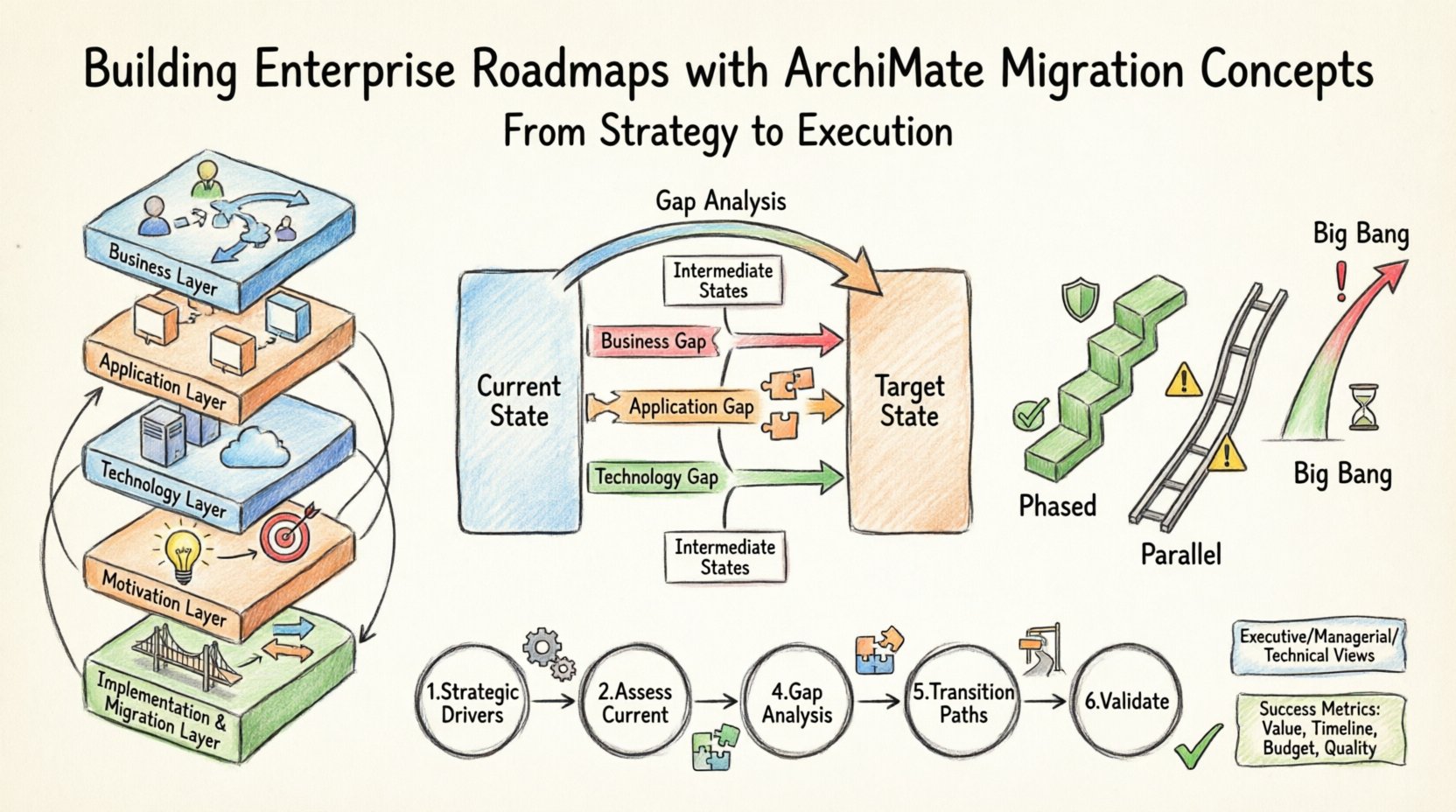
Before constructing a roadmap, it is essential to grasp the foundational layers that ArchiMate defines. These layers provide the context for migration activities. A clear understanding of the relationships between these layers ensures that changes in one area are properly reflected in others.
- Business Layer: Focuses on the business processes, organization, and functions. This layer defines what the enterprise does.
- Application Layer: Represents the software systems that support the business processes. This includes application components and services.
- Technology Layer: Describes the physical infrastructure, such as servers, networks, and storage, that hosts the applications.
- Motivation Layer: Captures the drivers, goals, and principles that influence the architecture. This is crucial for justifying roadmap investments.
- Implementation & Migration Layer: Defines the projects and transition states required to move from one architecture to another.
When building a roadmap, the focus often centers on the Implementation & Migration Layer, but it cannot exist in isolation. Changes in the Technology Layer will inevitably impact the Application Layer, which in turn affects the Business Layer. A successful roadmap accounts for these interdependencies.
🔄 The Implementation and Migration Layer
This layer is the engine of change within the ArchiMate framework. It provides the constructs necessary to describe how an enterprise moves from its current state to a target state. The primary constructs used here are Gap Analysis, State Transitions, and Path Definitions.
1. Gap Analysis
A gap analysis identifies the differences between the current architecture and the target architecture. This is the first step in roadmap planning. It involves comparing the existing capabilities against the desired future capabilities.
- Business Gap: Missing business capabilities or processes required to meet new strategic goals.
- Application Gap: Software functionality that does not support the required business processes.
- Technology Gap: Infrastructure limitations that prevent the deployment of new applications.
Documenting these gaps explicitly allows stakeholders to understand the scope of work required. It prevents scope creep by clearly defining what is and is not part of the transformation.
2. State Transitions
A roadmap is essentially a sequence of states. ArchiMate models these as transitions from one architecture state to another. Each state represents a stable point in time where specific capabilities are available.
- Current State: The architecture as it exists today.
- Intermediate States: Temporary architectures achieved during the transition.
- Target State: The final desired architecture.
Defining intermediate states is critical for large-scale transformations. It allows the organization to realize value incrementally rather than waiting for a single “big bang” delivery.
3. Path Definitions
A path defines the sequence of transitions. It outlines the logical flow of the migration. A path can include multiple parallel transitions if different parts of the enterprise are changing independently.
| Construct | Function | Example |
|---|---|---|
| Gap | Identifies missing elements | Missing Customer Portal |
| Transition | Describes the change | Develop and Deploy Portal |
| Path | Sequences transitions | Q1: Portal, Q2: Analytics |
📅 Constructing the Roadmap
Building the roadmap requires a systematic approach. It is not enough to list tasks; the tasks must be linked to architectural elements. This ensures that every activity on the roadmap contributes to a specific architectural change.
Step 1: Define Strategic Drivers
Every roadmap begins with the Motivation Layer. What is driving the change? Is it regulatory compliance, cost reduction, or market expansion? Documenting these drivers ensures the roadmap remains aligned with business objectives.
- Identify key business goals.
- Map goals to specific architectural requirements.
- Establish principles that govern the change.
Step 2: Assess Current Capabilities
Conduct a thorough assessment of the existing architecture. This involves inventorying business processes, applications, and infrastructure. The goal is to create a baseline model.
- Document current business processes.
- Map applications to processes.
- Identify technical constraints.
Step 3: Define Target Architecture
Design the future state. This model should address the gaps identified in the current state. It should be modular and flexible to accommodate future changes.
- Define new business capabilities.
- Specify application requirements.
- Outline infrastructure needs.
Step 4: Perform Gap Analysis
Compare the current and target architectures. Identify the specific elements that need to be added, modified, or removed. This analysis forms the backbone of the roadmap.
- List missing capabilities.
- Identify obsolete systems.
- Categorize gaps by priority.
Step 5: Develop Transition Paths
Organize the gaps into logical sequences. Group related changes together to minimize disruption. Define the milestones for each phase of the transition.
- Sequence the transitions.
- Set timelines for each phase.
- Assign resources to specific tasks.
Step 6: Validate and Refine
Review the roadmap with stakeholders. Ensure that the proposed changes are feasible and align with budget and resource constraints. Refine the plan based on feedback.
- Conduct stakeholder reviews.
- Validate resource availability.
- Adjust timelines as necessary.
🛠️ Migration Patterns and Scenarios
There is no single way to move from one state to another. Different scenarios require different migration patterns. ArchiMate supports the modeling of various patterns to suit the specific needs of the enterprise.
1. Phased Migration
This approach involves breaking the transition into distinct phases. Each phase delivers a set of capabilities that provides value before the next phase begins. This reduces risk and allows for learning and adjustment.
- Benefit: Lower risk, incremental value delivery.
- Challenge: Requires managing multiple states simultaneously.
- Best For: Large, complex transformations.
2. Parallel Migration
In this pattern, the new system operates alongside the old system for a period. This allows users to verify the new system before the old one is retired.
- Benefit: Safety net for failures, continuous operation.
- Challenge: Higher initial cost, increased complexity.
- Best For: Critical systems where downtime is unacceptable.
3. Big Bang Migration
This approach replaces the old system with the new system at a specific point in time. It is a single transition event.
- Benefit: Fastest completion, lower long-term maintenance costs.
- Challenge: High risk, potential for significant disruption.
- Best For: Small, well-defined changes or non-critical systems.
| Pattern | Risk Level | Cost Impact | Duration |
|---|---|---|---|
| Phased | Low | Medium | Long |
| Parallel | Low | High | Medium |
| Big Bang | High | Low | Short |
👁️ Visualization and Views
A roadmap is only useful if it is understood by its audience. ArchiMate supports the creation of different views to communicate the roadmap to various stakeholders.
- Executive View: Focuses on business value, costs, and high-level milestones. It avoids technical details.
- Managerial View: Details resource allocation, timelines, and dependencies between projects.
- Technical View: Provides deep dives into specific technology stacks, integration points, and data flows.
Using a consistent set of views ensures that everyone is working from the same understanding of the plan. It prevents miscommunication between business leaders and technical teams.
⚖️ Governance and Alignment
Building the roadmap is just the beginning. Maintaining alignment throughout the execution phase is critical. Governance structures must be established to monitor progress and manage deviations.
1. Architecture Review Boards
Establish a board to review proposed changes. This ensures that all activities adhere to architectural principles and standards. It prevents fragmentation and technical debt.
- Review project proposals.
- Ensure compliance with standards.
- Manage exceptions to principles.
2. Continuous Monitoring
The roadmap is a living document. It must be updated as conditions change. Regular reviews help identify delays, budget overruns, or shifts in business strategy.
- Track progress against milestones.
- Update gap analyses.
- Adjust transition paths as needed.
3. Stakeholder Engagement
Keep stakeholders informed throughout the process. Regular communication builds trust and ensures that the roadmap remains relevant to business needs.
- Schedule regular status meetings.
- Distribute progress reports.
- Facilitate feedback sessions.
⚠️ Common Challenges and Mitigation
Even with a solid plan, challenges arise. Understanding common pitfalls helps in preparing mitigation strategies.
- Scope Creep: Adding new requirements mid-project. Mitigation: Strict change control processes.
- Resource Constraints: Lack of skilled personnel. Mitigation: Early resource planning and training.
- Resistance to Change: Users reluctant to adopt new systems. Mitigation: Strong change management and training programs.
- Technical Debt: Accumulation of legacy issues. Mitigation: Dedicated refactoring time in the roadmap.
📈 Measuring Success
How do you know the roadmap is successful? Define clear metrics and key performance indicators (KPIs) at the outset.
- Business Value: Did the changes achieve the strategic goals?
- Timeline Adherence: Were milestones met on schedule?
- Budget Compliance: Did the project stay within financial limits?
- Quality Metrics: Are the new systems stable and performant?
Regularly measuring these metrics provides objective data on the health of the transformation. It allows for data-driven decisions when adjustments are needed.
🚀 Conclusion
Building enterprise roadmaps using ArchiMate migration concepts offers a structured, transparent way to manage change. By leveraging the framework’s layers and constructs, organizations can ensure that their technical investments align with their business strategies. The key lies in thorough gap analysis, clear state transitions, and effective communication through tailored views. While challenges are inevitable, a well-governed roadmap provides the stability needed to navigate complex transformations. This approach fosters a culture of continuous improvement and adaptability, essential for long-term success in a dynamic business environment.
As you embark on your architecture journey, remember that the roadmap is a tool for guidance, not a rigid contract. It should evolve as your understanding of the enterprise deepens. By focusing on the fundamental concepts of ArchiMate, you build a foundation that supports sustainable growth and effective decision-making.