


In the modern enterprise landscape, technology exists to serve strategy, not the other way around. Yet, a persistent challenge remains: how do we prove that a specific server, application, or database directly contributes to a high-level corporate objective? This gap between ambition and execution often leads to wasted resources, shadow IT, and strategic drift. To bridge this divide, organizations require a structured method for alignment. This is where the ArchiMate modeling language proves indispensable.
ArchiMate provides a standardized framework for describing, analyzing, and visualizing enterprise architecture. It allows architects to map the flow of value from the motivation layer, through business and application layers, down to the technology infrastructure. By utilizing specific relationships defined within the standard, we can create a verifiable chain of evidence linking a board-level goal to a specific piece of hardware. This process ensures transparency, accountability, and optimized investment.
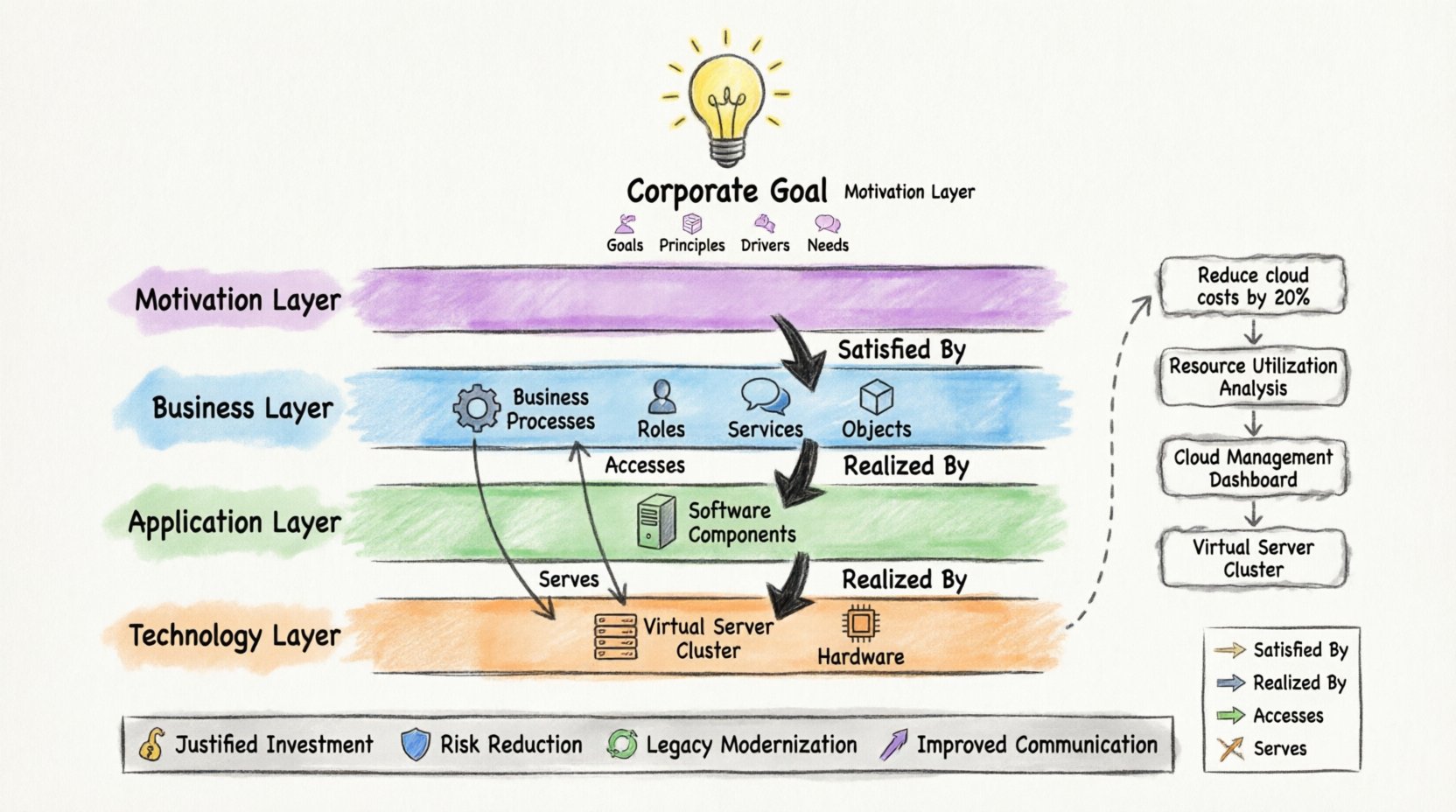
🧩 Understanding the ArchiMate Layers
To trace goals effectively, one must first understand the structural components of the framework. ArchiMate divides the enterprise into distinct layers, each representing a specific perspective of the organization. These layers act as the rungs of a ladder, allowing us to climb from abstract intent to concrete implementation.
1. The Motivation Layer
This layer captures the reasons behind the architecture. It answers the why. Elements here include:
- Goals: What the organization wants to achieve.
- Principles: Rules that guide decision-making.
- Needs: Requirements or desires driving the change.
- Drivers: Internal or external forces necessitating action.
2. The Business Layer
Here, we define the business capabilities and processes. This is the what the organization does. Key elements include:
- Business Objects: Information or physical objects used in business processes.
- Business Processes: Logical sequences of activities.
- Business Roles: People or groups performing activities.
- Business Services: Functional units exposed to the outside world.
3. The Application Layer
This layer describes the software systems supporting the business. It represents the how of automation. Elements include:
- Application Functions: Logical software functions.
- Application Services: Functional units exposed to the business layer.
- Application Components: Physical implementation of functions.
4. The Technology Layer
The foundation of the architecture. This is the infrastructure that runs the applications. Elements include:
- Networks: Communication infrastructure.
- Hardware: Physical devices like servers and storage.
- System Software: Operating systems and middleware.
- Artifacts: Information used by a technology layer element.
🔗 Key Relationships for Tracing
The true power of ArchiMate lies in the relationships that connect these elements. These relationships define the direction and nature of the influence. To trace a corporate goal to an IT asset, we must select the correct relationship types at each transition.
Relationships Within the Motivation Layer
Before connecting to business, we must structure the motivation.
- Satisfied By: Links a Goal to a Business Object or Process that satisfies it.
- Associated With: General association between elements.
- Triggered By: Indicates a cause-and-effect relationship between Drivers and Goals.
Connecting Motivation to Business
This is the critical first step in tracing. We need to know which business activity fulfills the goal.
- Satisfied By: A Business Process satisfies a Goal.
- Realized By: A Business Object realizes a Goal.
Connecting Business to Application
How does software support the business process? We use the following relationships:
- Accesses: An Application Function accesses a Business Object.
- Realized By: An Application Component realizes a Business Process.
- Assignment: A Business Role is assigned to an Application Service.
- Serves: An Application Service serves a Business Service.
Connecting Application to Technology
Finally, we map the software to the infrastructure. This is where IT assets are identified.
- Realized By: An Application Component is realized by a Technology Component.
- Accesses: An Application Function accesses a Technology Object.
- Assigns: A Technology Component assigns a value to an Application Component.
📊 Mapping Strategy to Infrastructure: A Visual Guide
Understanding the relationship types is one thing; applying them is another. The following table outlines the standard flow of tracing from high-level strategy down to physical hardware.
| Source Layer | Target Layer | Relationship Type | Meaning |
|---|---|---|---|
| Motivation | Business | Satisfied By | The business activity achieves the strategic goal. |
| Business | Application | Realized By | The software function implements the business process. |
| Application | Technology | Realized By | The hardware infrastructure hosts the software component. |
| Business | Technology | Accesses | Business objects are stored or accessed by technology. |
| Motivation | Technology | Realized By | Direct link (rare, but possible) for specific infrastructure needs. |
🚀 Step-by-Step Tracing Process
Executing a trace requires a disciplined approach. There is no magic button; it is a modeling exercise that demands attention to detail. Follow these steps to establish a clear lineage.
Step 1: Define the Corporate Goal
Start at the top. Identify the specific objective. Avoid vague statements like “improve efficiency.” Instead, use measurable targets such as “Reduce cloud infrastructure costs by 20%” or “Achieve 99.9% system availability.” In the motivation layer, create a Goal element representing this target.
Step 2: Identify Enabling Business Capabilities
Ask which business processes enable this goal. If the goal is cost reduction, the process might be “Resource Utilization Analysis.” Link the Goal to this Process using the Satisfied By relationship. This establishes the business justification.
Step 3: Map Processes to Applications
Which software systems support the identified processes? If the process is “Resource Utilization Analysis,” the Application Service might be “Cloud Management Dashboard.” Use the Realized By relationship to link the Business Process to the Application Service. This shows where automation occurs.
Step 4: Locate the Technical Components
Now, drill down into the infrastructure. The Cloud Management Dashboard runs on specific servers. Identify the Application Components and link them to the Application Service. Then, link the Application Components to the Technology Components using Realized By. This identifies the physical or virtual assets.
Step 5: Validate the Chain
Review the entire path. Does the Technology Component actually support the Application Component? Does the Application Component perform the Business Process? Does the Business Process achieve the Corporate Goal? Breaks in this chain indicate gaps in strategy execution.
💡 Benefits of Architecture Alignment
Why invest time in this detailed mapping? The advantages extend far beyond documentation. They impact financial planning, risk management, and operational stability.
1. Justified Investment
When requesting budget for a new server or license, you can point to the specific corporate goal it supports. This shifts the conversation from “cost” to “investment.” Stakeholders are more likely to approve funding when they see a direct line to strategic value.
2. Risk Reduction
Understanding dependencies allows for better risk assessment. If a specific server is critical for a high-priority goal, it requires higher availability standards. If a goal is low priority, the underlying technology can be decommissioned or standardized without fear of impacting critical business outcomes.
3. Legacy Modernization
During migration projects, knowing which assets are tied to active goals helps prioritize work. You can retire assets that support obsolete processes while ensuring new goals have robust support. This prevents “lift and shift” of useless systems.
4. Improved Communication
Visual models bridge the gap between technical teams and business leaders. A diagram showing a goal connected to a technology stack is easier to understand than a spreadsheet of inventory. It creates a shared language for enterprise architecture.
⚠️ Common Challenges and Pitfalls
While the methodology is sound, execution often encounters friction. Awareness of these common issues helps mitigate them.
Complexity Creep
Architects often create overly detailed models. If every single database table is linked to a goal, the model becomes unmanageable. Focus on the critical path. Aggregate lower-level details unless they are specific risk points.
Stale Data
Architecture models decay quickly. If the model is not updated during project lifecycles, it becomes a fiction. Establish a governance process where changes to applications or business processes trigger a review of the architectural model.
Over-Linking
Using the Realized By relationship too loosely weakens its meaning. Ensure that the link represents a true implementation dependency. If an application only touches a business object but does not realize the process, use Accesses instead.
Lack of Context
Tracing is not just about technical connections; it is about business context. A server might host multiple applications. Without clear labeling, it is impossible to know which goal is being served. Contextual tags or notes are essential.
🛠️ Best Practices for Maintenance
To keep the tracing effective, adopt a routine for maintenance.
- Regular Reviews: Schedule quarterly reviews of the motivation layer. Goals change, and the architecture must follow.
- Version Control: Treat architecture models like code. Use versioning to track changes over time.
- Tooling Agnosticism: Focus on the concepts, not the tool. While modeling tools exist, the value lies in the relationships, not the vendor interface.
- Stakeholder Engagement: Involve business owners in the modeling process. They verify that the goals and processes are accurate.
- Automated Reporting: Where possible, generate reports from the model to show current status. This keeps the architecture visible to the organization.
🌐 Long-Term Strategic Value
The effort to trace corporate goals to IT assets creates a living record of the organization’s intent. It transforms IT from a cost center into a strategic partner. When a new initiative is proposed, the architecture team can immediately assess the impact on existing goals. This agility is crucial in volatile markets.
Furthermore, this approach supports regulatory compliance. Many industries require proof of data handling and system availability. A well-maintained ArchiMate model provides the audit trail needed to demonstrate compliance with minimal friction. It proves that the technology is not just running, but running for a purpose.
🔍 Detailed Relationship Semantics
To ensure accuracy, it is vital to distinguish between similar relationship types. Confusion here leads to incorrect traces.
Realization vs. Assignment
Realization implies that the target is the implementation of the source. A Process is realized by a Component. Assignment implies that a role is linked to a service or object. A Role is assigned to a Process. Do not mix these; they serve different semantic purposes.
Access vs. Uses
In the application layer, Accesses is the standard relationship. It indicates that one function reads or writes data managed by another. Uses is less common and implies dependency. Stick to Accesses for data flow and Realized By for implementation.
Triggering vs. Serving
Triggering is a time-based relationship. Event A triggers Event B. Serving is a functional dependency. Service A provides functionality to Service B. In goal tracing, Serving is often more relevant as it shows functional support rather than temporal sequence.
📈 Measuring Success
How do you know the tracing is working? Look for these indicators.
- Reduced Shadow IT: When IT assets are tied to goals, business units are less likely to buy their own solutions.
- Faster Decision Making: When evaluating a project, the impact on goals is immediately visible.
- Clearer Budgets: IT spending is allocated based on strategic priority rather than historical precedent.
- Better Vendor Management: Contracts can be aligned with specific architectural goals.
🔄 Continuous Improvement
Enterprise architecture is not a one-time project. It is a discipline of continuous improvement. As the market changes, goals shift, and technology evolves. The relationships you define today must be revisited tomorrow. Treat the model as a living document.
When a new goal is set, trace it immediately. When an application is retired, remove the relationships. This keeps the architecture relevant. By maintaining this discipline, the organization ensures that every dollar spent on technology contributes to the overarching mission.
🏁 Final Thoughts on Alignment
The journey from corporate ambition to IT reality is complex, but not impossible. ArchiMate provides the vocabulary and the grammar to describe this journey clearly. By focusing on relationships rather than just elements, we create a dynamic map of value. This map guides investment, reduces risk, and clarifies responsibility.
Start small. Pick one strategic goal and trace it down to the infrastructure. Validate the path. Expand from there. Over time, the organization will gain a level of insight that allows it to navigate change with confidence. The technology will no longer be a mystery; it will be the engine of the strategy.