

Enterprise architecture serves as the blueprint for organizational strategy. However, a blueprint is only useful if it addresses the specific needs of those who will use or build upon it. This process begins with understanding stakeholder concerns. In complex environments, aligning these concerns with formal modeling standards like the TOGAF Architecture Development Method (ADM) and the ArchiMate modeling language is essential. This guide explores how to bridge the gap between human intent and technical specification without relying on specific software tools.
Why Alignment Matters 🤝
Architecture projects often fail not because of technical debt, but because of misalignment. When stakeholders express a need for improved agility, that need must translate into concrete architectural changes. If the link between the concern and the artifact is broken, the resulting architecture may look correct on paper but fail to solve the actual business problem. Mapping ensures traceability. It allows architects to demonstrate how a specific business driver influences a technology component.
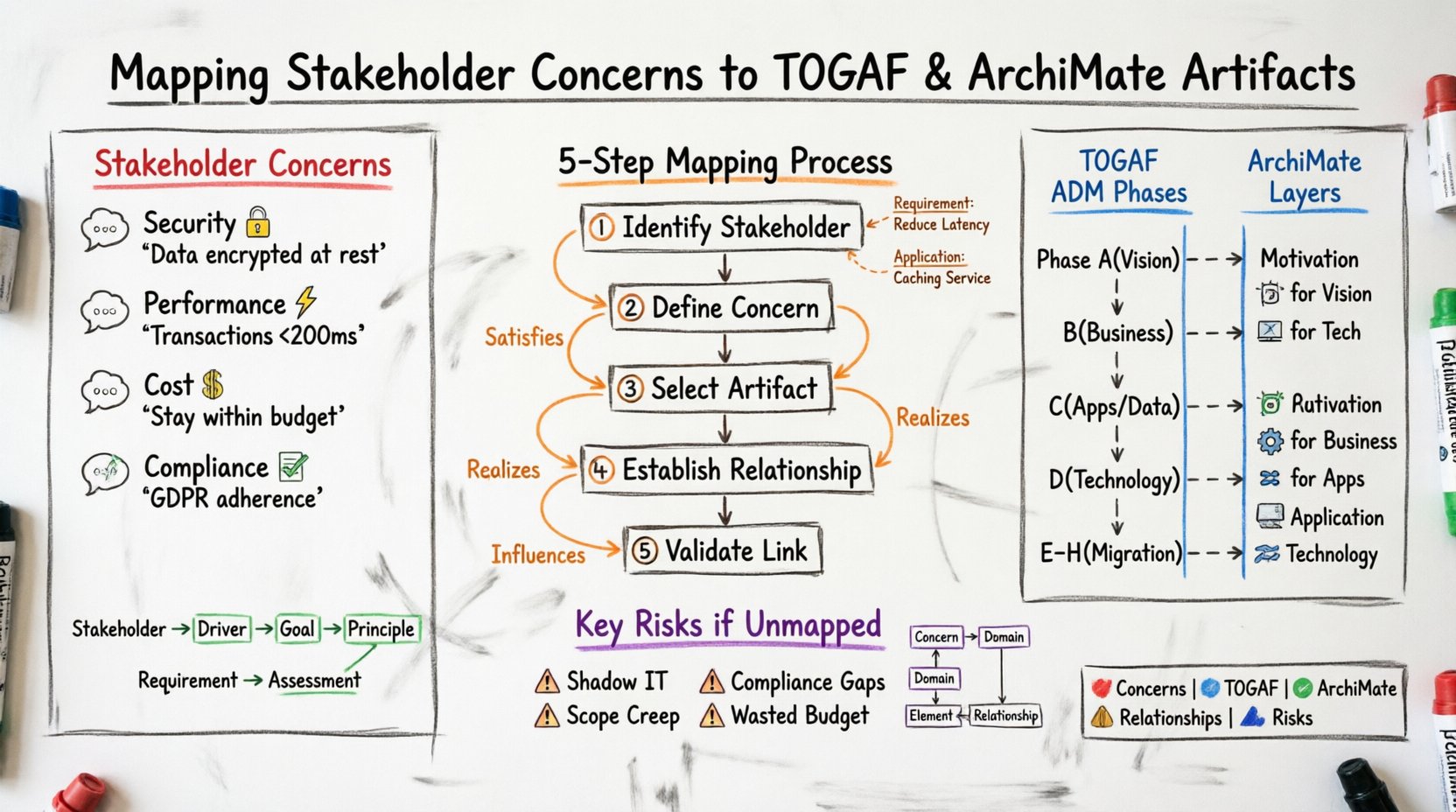
Without this mapping, several risks emerge:
- Shadow IT: Departments build solutions that do not adhere to enterprise standards because the official architecture does not address their concerns.
- Scope Creep: Features are added to the architecture without understanding their origin, leading to bloated systems.
- Compliance Gaps: Regulatory requirements may be overlooked if they are not explicitly linked to design decisions.
- Inefficient Resource Allocation: Budget is spent on areas that do not drive the primary business goals.
Core Concepts Defined 🧠
Before diving into the mapping process, it is necessary to clarify the terminology used in enterprise architecture.
Stakeholder Concerns
A concern is a set of interests that a stakeholder has in a system. It is not merely a wish; it is a specific requirement or constraint. Examples include:
- Security: Data must be encrypted at rest.
- Performance: Transactions must complete within 200 milliseconds.
- Cost: Infrastructure costs cannot exceed the current budget.
- Compliance: The system must adhere to GDPR regulations.
TOGAF Architecture Domains
The TOGAF framework organizes architecture into four domains:
- Business: Strategy, governance, organization, and key business processes.
- Data: Logical and physical data assets and data management resources.
- Application: The application landscape, interactions, and the logical software components.
- Technology: The hardware, network, and physical infrastructure required.
ArchiMate Layers
ArchiMate provides a visual language to model these domains using layers:
- Business Layer: Processes, roles, and products.
- Application Layer: Services and components.
- Technology Layer: Hardware and software infrastructure.
- Motivation Layer: Goals, drivers, and requirements.
The TOGAF Architecture Development Method Context 🔄
TOGAF structures the creation of architecture into phases. Stakeholder concerns are not addressed in a single step; they are refined throughout the lifecycle. Understanding where these concerns fit into the ADM phases is critical.
Phase A: Architecture Vision
This phase defines the scope and identifies the stakeholders. The primary output is the Architecture Vision document. Here, high-level concerns are captured. Architects must determine who the key stakeholders are and what their high-level expectations are.
Phase B: Business Architecture
Business capabilities and processes are defined. Stakeholder concerns regarding business efficiency or market responsiveness are translated into business architecture artifacts. For example, a concern about “faster time to market” might map to a new business process model.
Phase C: Information Systems Architectures
This covers Data and Application architectures. Concerns about data integrity, availability, or application interoperability are addressed here. The mapping becomes more granular, linking business processes to specific applications.
Phase D: Technology Architecture
Infrastructure concerns are mapped here. Issues regarding latency, capacity, or physical security are addressed in the technology architecture models.
Phases E through H: Migration and Implementation
During migration, the concerns are validated against the actual implementation. If a concern cannot be met by the planned solution, the architecture must be adjusted. This is where traceability becomes a management tool.
ArchiMate Modeling Language 🎨
ArchiMate is the language used to visualize the architecture. It is not just a drawing tool; it is a semantic language that enforces relationships between concepts. Using ArchiMate correctly ensures that the mapping to stakeholder concerns is logical and consistent.
The Motivation Extension
The most direct way to handle stakeholder concerns in ArchiMate is through the Motivation Extension. This extension includes specific elements designed to capture intent:
- Stakeholder: The person or group with the concern.
- Driver: Something that motivates the change (e.g., a new law).
- Goal: A state to be achieved.
- Principle: A rule guiding behavior.
- Requirement: A condition that must be met.
- Assessment: A measure of how well the architecture meets the concern.
By using these elements, architects can create a model where a specific Requirement is directly linked to a Stakeholder. This creates a clear line of sight from the human need to the technical model.
The Mapping Process Step-by-Step 🔗
Mapping concerns to artifacts is a systematic exercise. It requires discipline to ensure that every concern has a corresponding element in the architecture model.
Step 1: Identify the Stakeholder
Begin by listing all relevant stakeholders. This includes internal groups (e.g., CIO, CFO, End Users) and external groups (e.g., Regulators, Partners). Each stakeholder brings a unique perspective.
Step 2: Define the Concern
For each stakeholder, list their specific concerns. Use the Motivation Extension in ArchiMate to formalize these. A concern should be written as a clear statement, such as “Reduce latency in customer transactions.”
Step 3: Select the Artifact
Determine which architectural artifact addresses the concern. This could be a business process diagram, a data flow chart, or a technology infrastructure map. The artifact must provide a solution or a constraint that satisfies the concern.
Step 4: Establish the Relationship
Connect the concern to the artifact. In ArchiMate, this is done using relationships like “Satisfies,” “Realizes,” or “Influences.” For example, a Requirement “Reduce Latency” might be satisfied by an Application Component “Caching Service.”
Step 5: Validate the Link
Review the link to ensure it makes sense. Does the artifact actually solve the concern? Is the concern too vague to be addressed by the artifact? If the link is weak, the concern needs refinement.
Detailed Mapping Matrix 📊
The following table illustrates how specific stakeholder concerns map to TOGAF domains and ArchiMate elements. This serves as a reference for architects during the modeling process.
| Stakeholder Concern | TOGAF Domain | ArchiMate Layer | ArchiMate Element | Mapping Relationship |
|---|---|---|---|---|
| Ensure data privacy compliance | Data / Business | Business / Data | Requirement / Data Object | Satisfies |
| Reduce operational costs | Technology | Technology | Goal / Infrastructure Node | Realizes |
| Improve customer response time | Application | Business / Application | Process / Application Service | Serves |
| Maintain system availability | Technology | Technology | Principle / System Software | Complies With |
| Enable remote work capabilities | Application / Technology | Application / Technology | Capability / Network | Enables |
Traceability and Governance 🛡️
Once the mapping is established, it must be maintained. Architecture is not static; it evolves as business needs change. Without governance, the links between concerns and artifacts will rot.
Change Management
When a change request is submitted, it often originates from a stakeholder concern. The change management process should check the architecture model to see which artifacts are affected. If a new regulation is introduced, the model should flag all Requirements related to compliance for review.
Impact Analysis
Before approving a change, architects must analyze the impact on existing concerns. If a new technology is selected, does it satisfy the security concerns? Does it violate the cost constraints? Traceability allows for this analysis to be performed efficiently.
Audit and Reporting
Stakeholders need to see how their concerns are being addressed. Reports generated from the architecture model can show the status of each requirement. This builds trust and ensures accountability.
Common Challenges and Solutions ⚠️
Implementing this mapping strategy is not without difficulties. Recognizing these challenges early helps in planning mitigation strategies.
Challenge 1: Vague Concerns
Stakeholders often express concerns in vague terms like “make it better.” This makes mapping difficult. Solution: Use the TOGAF stakeholder analysis technique to drill down. Ask “better in what way?” until the concern is specific enough to be modeled.
Challenge 2: Over-Modeling
Architects sometimes create too many relationships, making the model complex and hard to read. Solution: Focus on the critical paths. Not every concern needs a direct line to a technology component. High-level concerns can map to business capabilities, which then map down to technology.
Challenge 3: Dynamic Environments
In agile environments, concerns change frequently. Maintaining the map becomes a burden. Solution: Use lightweight documentation. Focus on the current iteration’s concerns rather than maintaining a perfect historical record of every past change.
Challenge 4: Siloed Architectures
Business architects and technology architects often work in isolation. The business concern gets mapped to business artifacts, but the technology artifact is ignored. Solution: Establish a cross-functional architecture board. Ensure that stakeholders from different domains review the mapping together.
Practical Scenario: Cloud Migration 🌥️
Consider a scenario where a company decides to migrate from on-premise servers to a cloud environment. The stakeholder concerns are diverse.
- Cost Manager: Concern is to reduce monthly infrastructure spend.
- Security Officer: Concern is to ensure data sovereignty.
- Development Team: Concern is to improve deployment speed.
Mapping these concerns involves:
- Cost Manager: The concern “Reduce Spend” becomes a Goal in the Motivation layer. This Goal is satisfied by a Technology Architecture decision to use a “Pay-as-you-go” model (Infrastructure Node).
- Security Officer: The concern “Data Sovereignty” becomes a Requirement. This Requirement is satisfied by a Principle in the Technology layer specifying “Data must reside in Region X.”
- Development Team: The concern “Deployment Speed” becomes a Goal. This Goal is realized by an Application Architecture change to use “Containerized Services” (Application Component).
This scenario demonstrates how a single project involves multiple concerns mapped to different layers and domains. Without this mapping, the migration might save money but violate security, or improve speed but increase costs.
Conclusion 🏁
Mapping stakeholder concerns to TOGAF and ArchiMate artifacts is a fundamental practice for effective enterprise architecture. It transforms abstract needs into concrete models. By using the TOGAF ADM phases and the ArchiMate Motivation Extension, architects can create a transparent link between business intent and technical implementation.
This process requires discipline and regular maintenance. It is not a one-time activity but a continuous cycle of alignment. When done correctly, it ensures that the architecture delivers value. It prevents wasted effort on features that do not matter and highlights areas where investment is truly needed. The result is an organization that is resilient, compliant, and ready to adapt to change.
Architects should view this mapping as a communication tool. It speaks the language of the business while remaining grounded in technical reality. As the organization evolves, the map must evolve with it. Keeping these connections alive is the key to long-term architectural success.