

Enterprise architecture functions as the backbone of organizational strategy, requiring a unified approach to modeling and governance. The TOGAF framework provides a structured methodology for developing architecture, while ArchiMate offers a standard modeling language to visualize that structure. Aligning these two standards ensures that architectural assets remain consistent, reusable, and actionable. This guide details the process of mapping ArchiMate deliverables to the TOGAF Content Framework, ensuring a robust architecture repository.
Understanding the Core Frameworks 🌍
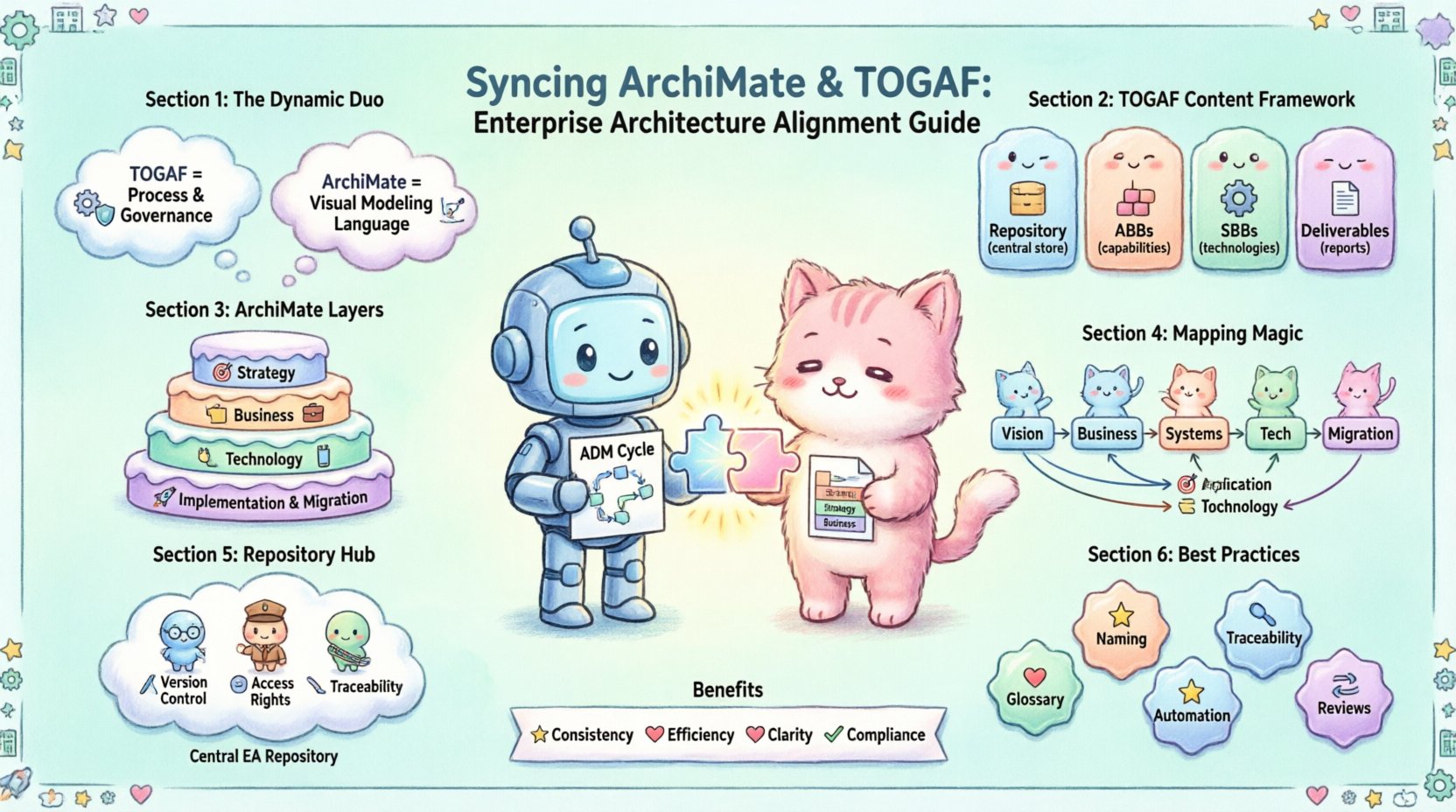
When building enterprise architecture, professionals often navigate multiple standards. TOGAF defines the process and the content metamodel. ArchiMate defines the notation and the conceptual model. Without synchronization, discrepancies arise between the documented strategy and the actual implementation. The goal is to create a coherent view where the content produced by the architecture development method aligns perfectly with the visual models.
- TOGAF Content Framework: Defines the structure of the repository, including building blocks, architecture building blocks, and deliverables.
- ArchiMate: Defines the visual elements (actors, processes, services) and their relationships.
- Alignment: The act of ensuring that every TOGAF deliverable has a corresponding ArchiMate representation or vice versa.
This synchronization reduces redundancy. It allows stakeholders to view high-level strategy in TOGAF terms while drilling down into specific technical relationships using ArchiMate notation. It creates a single source of truth for the enterprise.
The TOGAF Content Framework Explained 📂
The TOGAF Content Framework organizes architectural knowledge into a logical structure. It is designed to store information in a way that supports reuse and consistency. The framework consists of several key components that must be mapped to modeling efforts.
1. The Architecture Repository
This is the central store for all architectural artifacts. It holds the actual models, reports, and specifications. When integrating ArchiMate, the repository must support the specific data types required by the modeling language. Metadata, such as version numbers, ownership, and lifecycle status, must be preserved.
2. Architecture Building Blocks (ABBs)
ABBs are the building blocks of the architecture itself. They define the capabilities and services required to achieve business goals. In a synchronized environment, an ABB should correspond to a specific ArchiMate concept. For example, a business capability in TOGAF maps to a Business Function or Business Service in ArchiMate.
3. Solution Building Blocks (SBBs)
SBBs represent the specific products or technologies used to implement the architecture. These often appear in technical layers of the ArchiMate model. Synchronization here ensures that the technical specifications match the architectural intent defined in the framework.
4. Deliverables
Deliverables are the tangible outputs of the architecture process. They include reports, diagrams, and matrices. In the context of ArchiMate, many deliverables are visualizations of the model. However, some deliverables are text-based. The mapping process must ensure that text-based TOGAF artifacts are linked to the underlying ArchiMate models for traceability.
ArchiMate Modeling Standards 🧱
ArchiMate provides a layered approach to modeling enterprise architecture. To sync effectively with TOGAF, one must understand how these layers interact with the ADM phases.
- Business Layer: Focuses on business strategy, governance, organization, and key business processes.
- Application Layer: Focuses on the software components that support business processes.
- Technology Layer: Focuses on the physical infrastructure and hardware supporting the applications.
- Strategy Layer: Focuses on the motivation behind the architecture, linking to TOGAF’s Motivation Viewpoint.
- Implementation & Migration Layer: Focuses on projects and transitions.
Each layer corresponds to specific TOGAF deliverables. For instance, the Business Layer often aligns with the Business Architecture deliverables, while the Technology Layer aligns with the Technology Architecture deliverables.
Mapping Strategies: From Framework to Model 🔄
The core of synchronization lies in the mapping strategy. This involves taking the requirements from the TOGAF Content Framework and representing them within the ArchiMate model. It is not merely a translation exercise; it is a structural alignment.
Phase 1: Architecture Vision
This phase defines the scope and constraints. In ArchiMate, this is represented by the Context Diagram and Strategic View. The TOGAF deliverable, the Architecture Vision, maps to the motivation elements in ArchiMate, such as Goals and Drivers.
Phase 2: Business Architecture
This phase defines the target business architecture. TOGAF deliverables here include the Business Process Model and the Business Organization Model. ArchiMate maps these directly to the Business Layer. The Business Process concept in ArchiMate aligns with TOGAF Business Processes. The Role concept aligns with TOGAF Business Roles.
Phase 3: Information Systems Architecture
This phase covers both Data and Application architectures. TOGAF deliverables include the Application Portfolio and Data Entity specifications. In ArchiMate, the Application Layer contains Application Components and Data Objects. The mapping ensures that every Application Component in the model traces back to a requirement in the TOGAF repository.
Phase 4: Technology Architecture
This phase defines the infrastructure. TOGAF deliverables include the Technology Portfolio and Infrastructure specifications. ArchiMate maps these to the Node and Device concepts in the Technology Layer. Synchronization here prevents the creation of technology models that contradict the business requirements defined earlier.
Phase 5 to 8: Opportunities, Planning, Migration, and Implementation
These phases focus on transition. TOGAF deliverables here are the Implementation and Migration Plan. ArchiMate supports this through the Implementation and Migration layer, utilizing Assessment and Gap concepts. The mapping ensures that the transition projects are traceable to specific architectural changes.
| TOGAF Deliverable | ArchiMate Concept | Layer |
|---|---|---|
| Business Capability Map | Business Capability | Business |
| Application Portfolio | Application Component | Application |
| Infrastructure Diagram | Node / Device | Technology |
| Regulation Analysis | Constraint / Driver | Strategy |
| Gap Analysis Report | Gap / Assessment | Implementation |
Managing the Architecture Repository 🗄️
Once the mapping is established, the repository becomes the central hub. It must handle the complexity of linking TOGAF metadata to ArchiMate graphics. Effective management involves version control, access rights, and lifecycle management.
- Version Control: Every change to a model must be recorded. If a Business Process changes in the model, the corresponding TOGAF Business Architecture document must be updated. The repository tracks these dependencies.
- Access Rights: Not all stakeholders need access to all models. Sensitive technology details might be restricted, while business strategy is open. The repository must enforce these permissions.
- Traceability: This is the most critical function. Every element in the ArchiMate model should be traceable to a requirement in the TOGAF Content Framework. This allows impact analysis when changes occur.
When managing the repository, ensure that the metadata fields match. TOGAF often requires specific attributes for deliverables (e.g., Author, Status, Review Date). The ArchiMate model must store these attributes as metadata on the model elements or in a linked database table.
Governance and Compliance ✅
Alignment is not a one-time task; it requires ongoing governance. Without governance, models drift away from the framework over time. Compliance checks ensure that the architecture remains valid.
Quality Assurance Checks
Regular audits should verify that the ArchiMate models adhere to the TOGAF Content Framework rules. This includes checking for orphaned elements, inconsistent naming conventions, and missing links. Automated tools can assist in these checks, but human oversight is essential.
Change Management
When the business changes, the architecture must change. A change request in the TOGAF process should trigger a review of the ArchiMate models. If a new application is added, the Business Layer must be reviewed to see if processes need updating. This closed-loop process ensures consistency.
Stakeholder Engagement
Governance is also about people. Stakeholders must understand how to use the framework and the language. Training programs should cover both TOGAF processes and ArchiMate modeling techniques. This reduces the risk of misinterpretation.
Common Implementation Challenges ⚠️
While the goal is clear, the path often presents obstacles. Understanding these challenges helps in planning a successful implementation.
- Complexity Overload: Attempting to map every single TOGAF deliverable to a granular ArchiMate element can lead to excessive model complexity. It is better to map high-level concepts and drill down only when necessary.
- Terminology Differences: TOGAF and ArchiMate use similar but distinct terms. For example, “Service” in TOGAF might refer to a business service, while in ArchiMate it is a specific interface. Clear definitions are required to avoid confusion.
- Tool Limitations: Some modeling tools do not fully support the depth of the TOGAF Content Framework. Workarounds may be needed to store metadata that the tool does not natively support.
- Resource Constraints: Maintaining a fully synchronized repository requires time and effort. Organizations must prioritize which deliverables are critical for alignment and focus resources there.
Strategic Best Practices 💡
To overcome challenges and ensure success, follow these established practices. They are designed to streamline the process and maintain high quality.
1. Define a Common Glossary
Establish a glossary that maps terms from TOGAF to terms from ArchiMate. This document serves as the reference for all architects. It clarifies that a “Business Process” in TOGAF is synonymous with a “Business Process” in ArchiMate for the purposes of the organization.
2. Standardize Naming Conventions
Consistent naming is vital for searchability and traceability. Use a standardized format for all elements, such as [Domain]-[Function]-[ID]. This helps in generating reports from the repository.
3. Prioritize Traceability
Focus on traceability between the most critical elements. You do not need to link every single relationship. Focus on the links that drive decision-making, such as the link between a Business Goal and the Application supporting it.
4. Automate Where Possible
Use scripting or built-in features to automate the generation of TOGAF deliverables from ArchiMate models. For example, generate a Business Capability report automatically from the model rather than maintaining a separate document.
5. Regular Reviews
Schedule periodic reviews of the architecture repository. Check for outdated models, broken links, and elements that no longer reflect the current state of the enterprise. This keeps the framework relevant.
The Value of Synchronization 📈
Syncing these frameworks delivers tangible benefits. It reduces the time spent creating duplicate documentation. It improves communication between business and IT stakeholders. It ensures that technical decisions are grounded in business strategy.
- Consistency: All stakeholders see the same information in different views.
- Efficiency: Less time is spent manually updating documents because models generate the content.
- Clarity: Complex relationships are visualized clearly, making them easier to understand.
- Compliance: It becomes easier to demonstrate adherence to internal and external standards.
The integration of the TOGAF Content Framework with ArchiMate modeling creates a robust foundation for enterprise architecture. It bridges the gap between the process of building architecture and the language used to describe it. By following the strategies outlined in this guide, organizations can build a sustainable architecture practice.
Conclusion on Framework Alignment
The alignment of ArchiMate deliverables with the TOGAF Content Framework is a strategic necessity for mature enterprise architecture practices. It requires careful planning, clear definitions, and ongoing governance. By treating the repository as a living system rather than a static archive, organizations can maintain the integrity of their architecture over time. The effort invested in this synchronization pays dividends in clarity, efficiency, and strategic alignment.
Architects should focus on practical application rather than theoretical perfection. Start with the core layers, establish the glossary, and expand the scope as the practice matures. This approach ensures that the architecture remains a useful tool for decision-making rather than a bureaucratic exercise.
Ultimately, the goal is to create an environment where the architecture supports the business effectively. The tools and frameworks are means to that end. By mastering the relationship between TOGAF and ArchiMate, architects can deliver value that is visible, measurable, and actionable.