
Mastering Parallel Gateways in BPMN: A Visual Paradigm Tutorial
In the world of Business Process Model and Notation (BPMN), managing the flow of activities is critical for accurate process representation. One of the most powerful constructs for controlling concurrency is the Parallel Gateway. This tutorial explores the architecture and modeling logic of parallel flows using Visual Paradigm, focusing on how to model processes where multiple tasks must occur simultaneously.
Understanding the Parallel Gateway
A Parallel Gateway is a synchronization point in a process flow. Unlike Exclusive Gateways, which choose one path based on a condition, a Parallel Gateway has no decision logic. Its sole purpose is to split or join the flow of control.
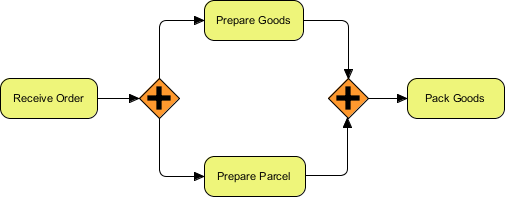
When used as a splitter, it takes a single incoming sequence flow and creates multiple outgoing flows that are executed simultaneously. When used as a joiner, it waits for all incoming flows to complete before proceeding to the next task. In the diagram provided, we see this construct represented by an orange diamond containing a plus sign (+).
Step-by-Step Modeling: The Order Fulfillment Example
Let’s break down the specific workflow illustrated in the image, which represents an Order Fulfillment process. This scenario demonstrates how to model independent tasks that happen in parallel to increase efficiency.
1. The Entry Point
The process begins with a standard task labeled Receive Order. This represents the initial trigger where a customer’s request is logged into the system. Once this task is complete, the process moves to the gateway.
2. The Parallel Split
The process encounters the first Parallel Gateway (the splitter). In Visual Paradigm, this is the diamond with the plus sign. The logic here is simple:
- No Condition Checks: The tool does not ask “If X, then go to Y.” It assumes all paths are valid.
- Simultaneous Execution: The flow immediately branches into two distinct paths.
This split allows the system to start preparing the physical goods and preparing the shipping logistics at the exact same moment, rather than waiting for one to finish before starting the other.
3. Parallel Activities
Following the split, two independent tasks run concurrently:
- Prepare Goods: This activity involves picking the items from the warehouse inventory and packing them into a box.
- Prepare Parcel: This activity involves generating the shipping label, calculating the shipping cost, and arranging the courier pickup.
In a real-world system, these two threads of execution would likely run on different threads or even different systems (e.g., Warehouse Management System vs. Shipping Carrier API).
4. The Parallel Join
After both activities are complete, the process reaches the second Parallel Gateway (the joiner). This gateway acts as a barrier. The process cannot proceed to the Pack Goods task until both “Prepare Goods” and “Prepare Parcel” have successfully finished.
If you were to model this with an Exclusive Gateway, the process would likely hang or behave incorrectly because it would wait for a specific condition to be met rather than the completion of independent tasks.
Why Use Parallel Gateways?
Using Parallel Gateways is essential for modeling real-world efficiency. By allowing tasks to run in parallel, you reduce the overall cycle time of the process. In our example, the total time to fulfill the order is the time of the longer of the two parallel tasks, rather than the sum of both. This distinction is vital for accurate process simulation and performance analysis in Visual Paradigm.
Summary
The Parallel Gateway is a fundamental building block for complex workflows. By understanding that it forces simultaneous execution and synchronization, you can create robust, realistic models that accurately reflect the speed and complexity of modern business operations.