


Business Process Model and Notation (BPMN) 2.0 is often mistakenly viewed as a relic of traditional, waterfall-style business analysis. However, in the context of complex systems and modern Agile delivery, BPMN has evolved into a critical ubiquitous language. It bridges the gap between product owners, developers, and operations teams by providing a visual specification that is both human-readable and machine-executable.
This guide moves beyond basic flowcharts to address modeling for complexity, integrating Agile principles, and leveraging modern AI-assisted tooling.
1. BPMN Key Concepts for Complex Systems
When modeling complex systems (e.g., microservices orchestration, multi-tenant SaaS platforms, or regulatory compliance workflows), standard happy-path modeling is insufficient. You must master these advanced concepts:
The Four Pillars of Complexity
| Concept | Definition | Use Case in Complex Systems |
|---|---|---|
| Sub-Processes | Encapsulating logic into reusable units. | Breaking down monolithic models; defining bounded contexts in DDD. |
| Events & Messages | Triggers (Start), Intermediate states, and End signals. | Modeling asynchronous communication between microservices or external APIs. |
| Gateways | Decision points (XOR, AND, OR, Event-based). | Handling conditional routing, parallel processing, and race conditions. |
| Data Objects | Artifacts flowing through the process. | Mapping state transitions and payload requirements without cluttering control flow. |
Collaboration vs. Orchestration
-
Orchestration: Models the internal workflow of a single system or team. Focuses on sequence.

-
Collaboration: Models interactions between multiple participants (pools/lanes). Focuses on message exchange.

Agile Tip: In complex systems, always start with Collaboration diagrams to define API contracts and integration points before diving into internal Orchestration details.
Exception Handling as First-Class Citizens
Complexity lives in the edges. Do not model exceptions as afterthoughts. Use Boundary Events (Error, Timer, Escalation, Compensation) attached directly to tasks. This makes failure paths visible and testable during sprint planning.
2. Techniques for Agile Teams
Agile teams should treat BPMN models as living artifacts, not static documentation.
1. Just-In-Time (JIT) Modeling
Do not model the entire end-to-end process before development. Model only the upcoming sprint’s scope at a detailed level. Keep upstream/downstream processes as high-level “Black Box” sub-processes until they enter the backlog.
2. Executable BPMN / DMN Separation
Separate decision logic from process flow. Use DMN (Decision Model and Notation) tables for business rules (e.g., pricing tiers, eligibility checks). Link DMN decisions to BPMN Business Rule Tasks. This allows product owners to update rules without touching process code.
3. Behavior-Driven Development (BDD) Alignment
Map BPMN elements directly to Gherkin syntax:
-
Start Event →
Given -
Task →
When -
End Event / Gateway Outcome →
Then
This ensures your model serves as your acceptance criteria.
4. Token Simulation
Before writing code, run token simulations. If a token gets stuck, splits unexpectedly, or deadlocks in the simulator, it will do so in production. This is the cheapest form of testing.
3. Practical Examples
Example A: E-Commerce Order Fulfillment (Microservices)
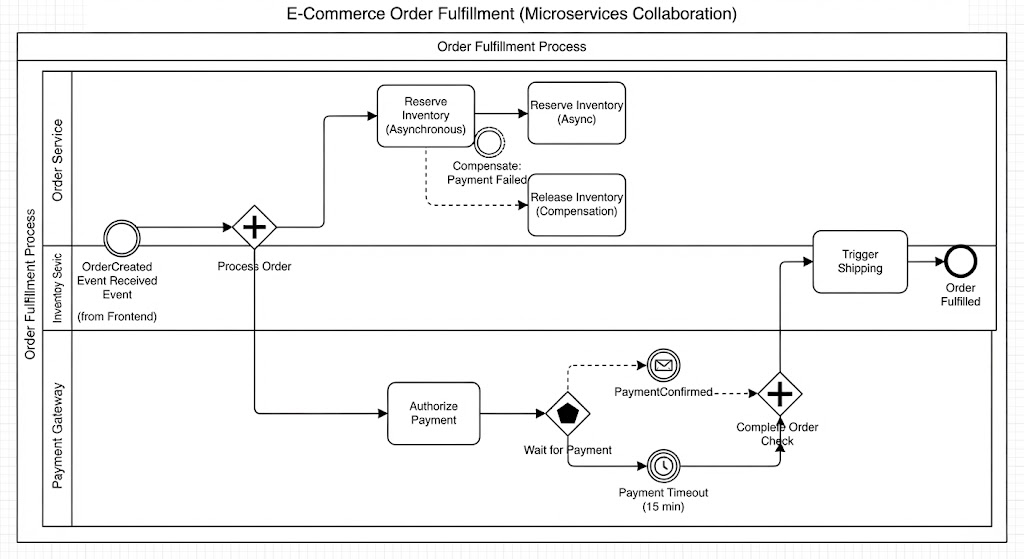
Scenario: An order is placed, inventory is checked asynchronously, payment is processed, and shipping is triggered.
Modeling Highlights:
-
Message Start Event: Triggered by
OrderCreatedevent from the frontend. -
Parallel Gateway (AND): Splits flow to “Reserve Inventory” and “Authorize Payment” simultaneously.
-
Event-Based Gateway: After payment auth, wait for either
PaymentConfirmedmessage ORPaymentTimeouttimer. -
Compensation Boundary Event: Attached to “Reserve Inventory.” If payment fails later, trigger “Release Inventory” compensation task.
-
Lane Structure: Lanes represent services (
OrderService,InventoryService,PaymentGateway) rather than human roles.
Example B: User Onboarding with Regulatory Compliance
Scenario: New user signup requiring KYC verification, document upload, and automated risk scoring.
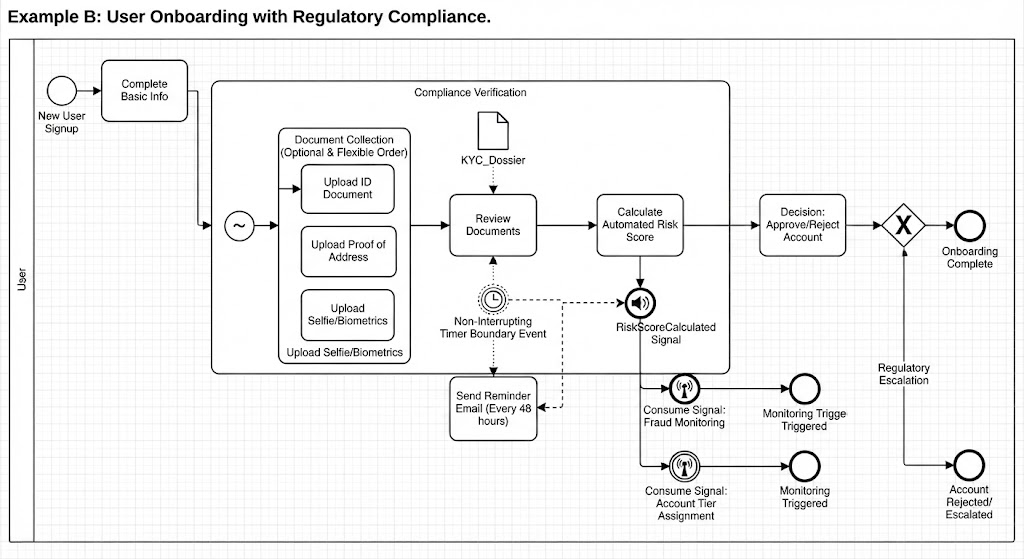
Modeling Highlights:
-
Ad-Hoc Sub-Process: For document collection where users may upload files in any order or skip optional ones. Rigid sequencing fails here.
-
User Task + Form Data Object: Explicitly link the “Review Documents” task to a
KYC_Dossierdata object. -
Signal Intermediate Event: Broadcast
RiskScoreCalculatedsignal consumed by multiple downstream processes (fraud monitoring, account tier assignment). -
Timer Boundary Event (Non-Interrupting): Send reminder email every 48 hours if documents aren’t uploaded, without stopping the main verification flow.
Example C: CI/CD Pipeline Approval Workflow
Scenario: Automated deployment requires dynamic approval based on change risk level.
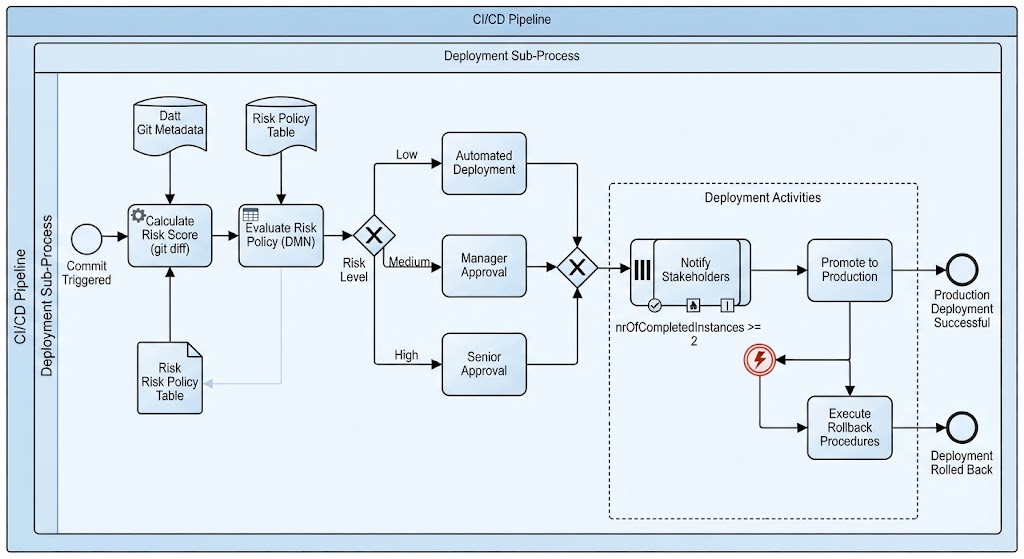
Modeling Highlights:
-
Script Task: Calculate risk score using git diff metadata.
-
DMN Integration: Business Rule Task evaluates risk score against policy table to determine approval path.
-
Multi-Instance Task: “Notify Stakeholders” configured as parallel multi-instance with completion condition:
nrOfCompletedInstances >= 2. -
Error Boundary Event: Catch
DeploymentFailederror and route to rollback sub-process.
4. Common Pitfalls in Complex Modeling
-
Spaghetti Diagrams: If a model has >15 elements in one view, decompose it. Use collapsed sub-processes.
-
Mixing Levels of Abstraction: Don’t put “Send Email” and “Update Database Schema” in the same diagram. Keep granularity consistent.
-
Ignoring Correlation: In async systems, always define correlation keys (e.g., OrderID) on message events. Without this, your model is theoretically correct but practically broken.
-
Over-Modeling UI: BPMN describes backend/business logic, not screen navigation. Leave UI flows to wireframes or user journey maps.
5. Conclusion: Modern Tooling for Agile Excellence
The success of BPMN in Agile environments depends entirely on reducing friction between modeling and implementation. Traditional drag-and-drop tools create a “model-code gap” that kills agility. Modern teams require an integrated ecosystem.
Recommended Stack: Visual Paradigm + AI Chatbot + VPascode
For Agile teams tackling complex systems, this combination offers distinct advantages:
Why Visual Paradigm?
-
Standards Compliance: Full BPMN 2.0, DMN, and UML support ensures models are portable and unambiguous.
-
Agile Integration: Built-in Scrum/Kanban boards and user story mapping allow you to link process models directly to backlog items and sprint tasks.
-
Team Collaboration: Cloud workspace enables real-time co-editing and stakeholder commenting, essential for JIT modeling sessions.
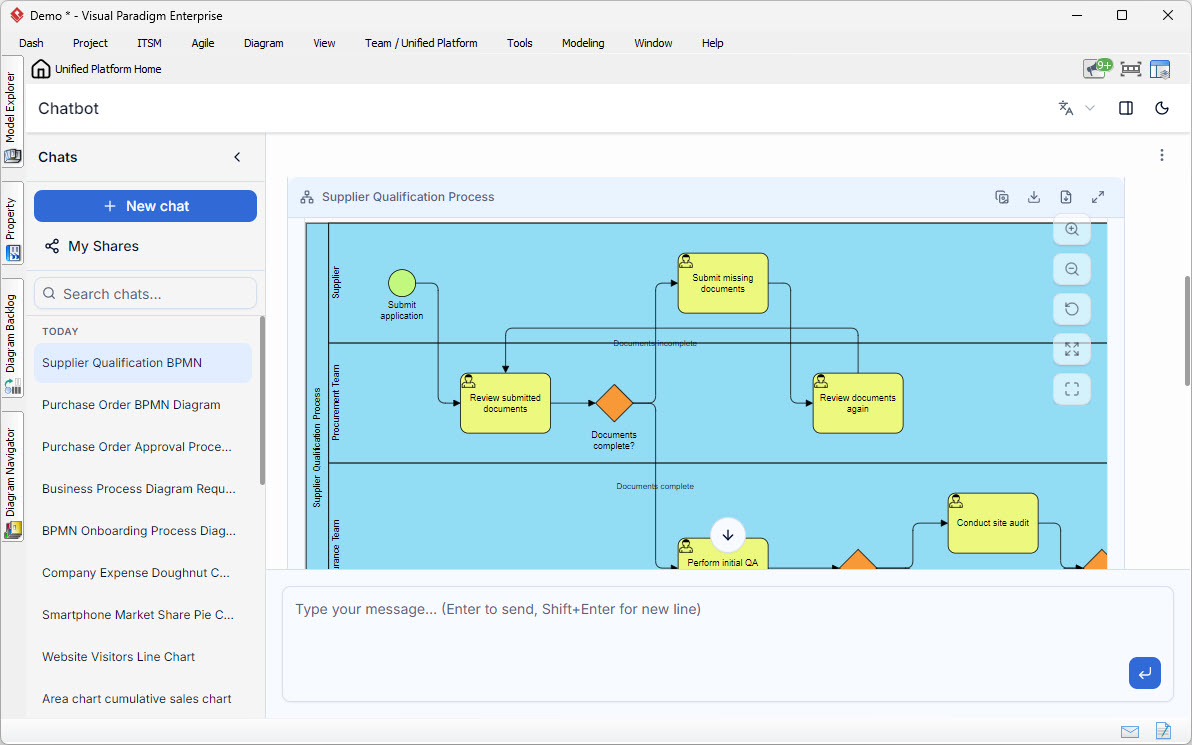
Why AI Chatbot Integration?
-
Accelerated Modeling: Describe complex flows in natural language (“Create an order fulfillment process with async payment and inventory check”) and let AI generate the initial BPMN skeleton.
-
Model Validation: Ask the AI to review your diagram for anti-patterns, missing exception handlers, or gateway mismatches before peer review.
-
Documentation Generation: Automatically generate user stories, test cases, and API specs from the visual model, keeping documentation synchronized with zero extra effort.
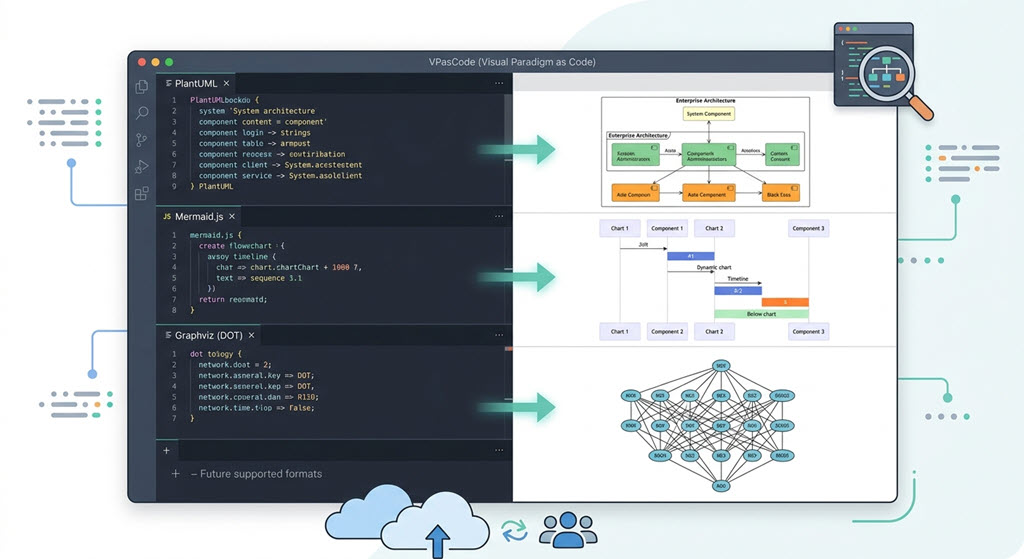
Why VPascode?
-
Model-as-Code Philosophy: VPascode allows you to define and version-control BPMN models programmatically alongside your application code. This eliminates binary file conflicts in Git.
-
CI/CD Integration: Validate models, generate code stubs, and deploy process definitions automatically in your pipeline. The model is the source of truth.
-
Developer Experience: Agile developers can work in their preferred IDE/text editor while maintaining full BPMN compliance. No context switching between modeling tools and coding environments.
Bottom Line for Agile Teams: This stack transforms BPMN from a documentation exercise into an engineering discipline. Visual Paradigm provides the visual clarity stakeholders need, AI accelerates creation and validation, and VPascode ensures the model lives and breathes with your codebase. Together, they enable true executable modeling at the speed of Agile.
Conclusion: Bridging the Gap with Modern Tooling
Mastering BPMN for complex systems requires more than just understanding notation; it demands a workflow that keeps pace with Agile delivery. Traditional modeling often fails in modern environments because it creates a disconnect between visual design and executable code, turning process models into stale documentation rather than living specifications. To truly leverage BPMN in an Agile context, teams must adopt tooling that integrates seamlessly into the development lifecycle.
For Agile teams navigating complexity, the combination of Visual Paradigm, AI Chatbot, and VPascode represents the ideal modern stack:
-
Visual Paradigm serves as the collaborative source of truth, offering full BPMN 2.0/DMN compliance and direct integration with Agile project management to keep models aligned with sprint backlogs and user stories.
-
AI Chatbot Integration dramatically reduces modeling friction by generating initial diagrams from natural language prompts, validating designs for anti-patterns, and auto-generating test cases or documentation, allowing teams to focus on logic rather than layout.
-
VPascode closes the final gap by enabling Model-as-Code. It allows developers to version-control, validate, and deploy process definitions programmatically within CI/CD pipelines, ensuring the model evolves in lockstep with the application.
Ultimately, this integrated approach transforms BPMN from a static analysis artifact into a dynamic engineering asset. By combining visual clarity, AI-assisted acceleration, and code-native execution, Agile teams can model complex systems with confidence, ensuring that business intent is accurately translated into working software at the speed of iteration.
Reference List: Visual Paradigm BPMN, AI Chatbot & VPasCode
BPMN Modeling with Visual Paradigm
-
Visual Paradigm BPMN Tutorial: Create Your First Diagram: Step-by-step guide covering tasks, sequence flows, gateways, and swimlanes for beginners .
-
Visual Paradigm BPMN Process Diagram Tutorial: Walkthrough of creating process diagrams with pools, lanes, validation, and layout best practices .
-
BPMN with Visual Paradigm AI: Comprehensive Guide: Covers BPMN fundamentals (events, gateways, swimlanes) and AI-assisted diagram generation .
-
Using Validation and Collaboration Features for CX Modeling: Guide on validation engine, comments, and review workflows for stakeholder collaboration .
-
Using BPMN to Model PMBOK Process Workflows: Practical guide for mapping PMBOK process groups using BPMN with swimlanes and decision logic .
AI Chatbot & Generative Modeling
-
BPMN Tutorial: Visual Paradigm Tooling, AI Chatbot & Ecosystem: Comprehensive overview of AI chatbot capabilities including text-to-BPMN generation and conversational refinement.
-
Comprehensive Guide to BPMN, Visual Paradigm Tooling, AI, and Ecosystem: Detailed explanation of the four-pillar AI ecosystem with practical BPMN generation examples .
-
AI Chatbot: Comprehensive Guide to Visual Modeling: Guide covering instant diagram generation, conversational refinement, and intelligent model analysis across multiple diagram types .
-
How AI is Transforming Business Process Modeling: Overview of AI-driven BPM transformation, rapid prototyping, and integration with enterprise modeling ecosystems .
VPasCode (Diagram-as-Code)
-
Seamlessly Connect As-Code Diagrams to Documentation with OpenDocs: Guide on integrating VPasCode with OpenDocs Pipeline for living documentation workflows .
-
What’s New in VPasCode – Launch Feature Roundup: Overview of multi-syntax support (PlantUML, Mermaid, Graphviz), AI code error fixing, and translation features .
-
Visual Paradigm 18.1: Unified Ecosystems and AI-Driven Innovation: Highlights VPasCode capabilities including AI error fixing and language translation for global teams .