Enterprise Architecture often focuses heavily on the structural layers of an organization. While business capabilities, applications, and technology infrastructure are critical, they exist to serve a higher purpose. That purpose is defined in the motivation layer. Without a clear understanding of why an architecture exists, the resulting structures are merely expensive artifacts. This guide explores how to effectively visualize business strategy using the motivation elements of the ArchiMate framework.
🧠 Why the Motivation Layer Matters
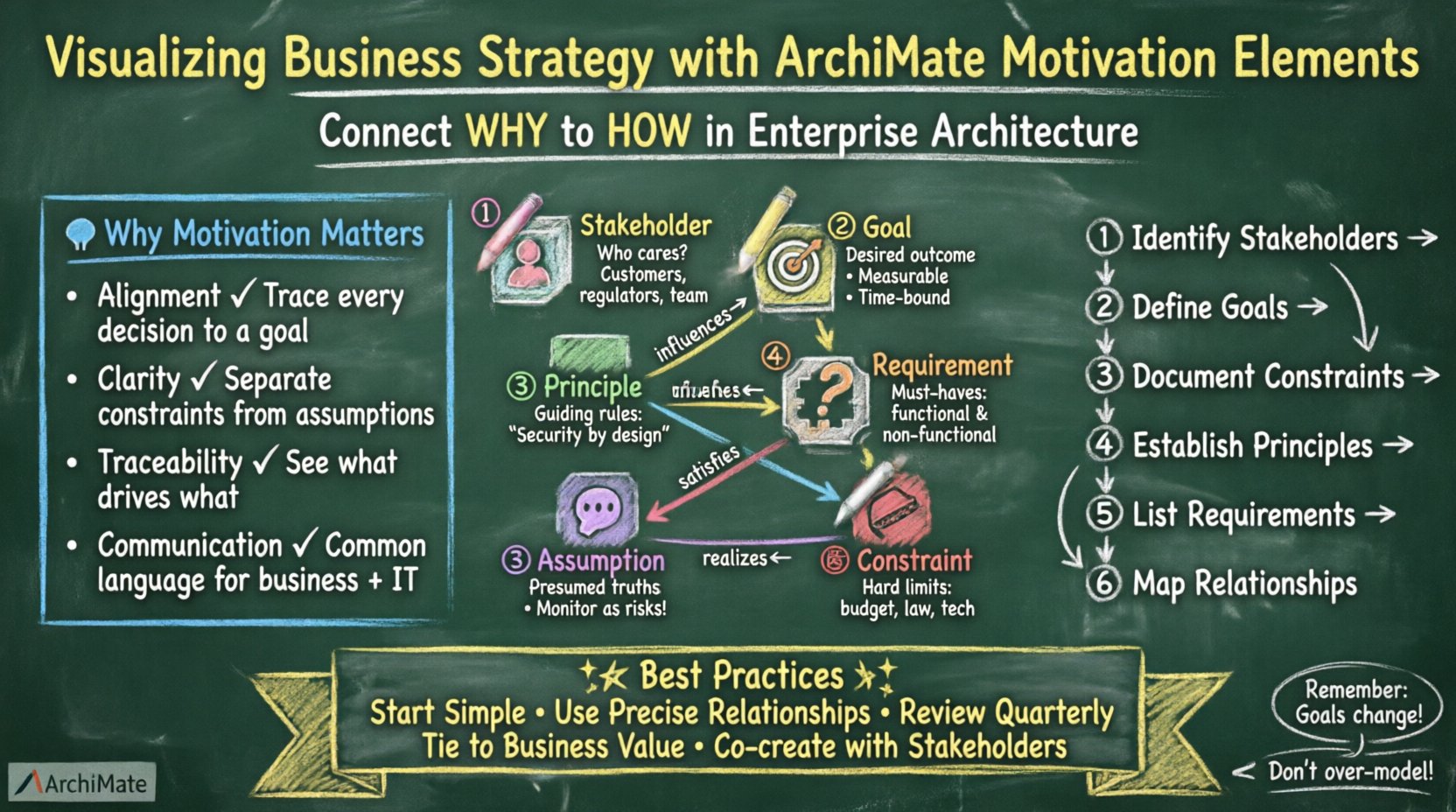
Strategy is frequently misunderstood as a document that sits on a shelf. In reality, strategy is a dynamic set of decisions and drivers that guide an organization. The motivation layer provides the semantic vocabulary to express these drivers. It connects the abstract desires of stakeholders to the concrete implementations of the business, application, and technology layers.
Using this layer offers several distinct advantages:
- Alignment: It ensures every technical decision can be traced back to a business goal.
- Clarity: It distinguishes between a hard constraint and a soft assumption.
- Traceability: It allows architects to see which requirements drive which capabilities.
- Communication: It provides a common language for business leaders and IT professionals to discuss direction.
When you model motivation, you are not just drawing boxes. You are defining the logic of the organization’s existence. This is not about hype or quick fixes. It is about establishing a robust foundation for decision-making.
🧱 The Six Core Motivation Elements
The motivation layer consists of six specific element types. Each serves a unique function in the strategic narrative. Understanding the nuance between them is essential for accurate modeling.
1. Stakeholder 👤
A stakeholder is an individual, group, or organization that is active in or affected by the enterprise. In the context of strategy, stakeholders are the source of intent. They do not build the system, but they define the value.
- Internal Stakeholders: Employees, managers, shareholders.
- External Stakeholders: Customers, regulators, partners, suppliers.
Modeling stakeholders allows you to map who is interested in what. For example, a regulator may have a specific requirement regarding data privacy. A customer may have a goal regarding service speed.
2. Goal 🎯
A goal is a state that the enterprise wishes to achieve. It represents the desired outcome. Goals are hierarchical. A high-level strategic goal might be “Increase Market Share,” which breaks down into “Improve Customer Retention,” which further breaks down into “Reduce Churn by 5%.”
Key characteristics of a goal include:
- Measurability: It should be possible to determine if the goal has been met.
- Time-bound: It usually has a target date or duration.
- Value-driven: It contributes to the overall success of the organization.
3. Principle 📜
A principle is a fundamental truth or proposition that serves as the foundation for a system of belief or behavior. In architecture, principles guide decision-making. They are rules that should not be violated.
Common examples include:
- “Data is an asset”: Data should be managed with care and integrity.
- “Buy before build”: Avoid developing custom software if a commercial solution exists.
- “Security by design”: Security must be integrated from the start, not added later.
Principles are often used to evaluate whether a solution aligns with the organization’s values.
4. Requirement 📋
A requirement is a condition or capability that must be met or possessed by a system or system component to satisfy a contract, standard, or specification. Unlike a goal, which is a desired state, a requirement is a specific need.
- Functional Requirement: What the system must do (e.g., “The system must calculate tax.”).
- Non-functional Requirement: How the system must perform (e.g., “The system must respond in under 2 seconds.”).
Requirements bridge the gap between high-level goals and specific technical solutions.
5. Assumption 🤔
An assumption is a fact or condition that is presumed to be true. Assumptions are risks. If an assumption proves false, the strategy may fail. Identifying assumptions is crucial for risk management.
Examples include:
- Market Assumption: “We assume demand will grow by 10% next year.”
- Technical Assumption: “We assume the new API will be compatible with legacy systems.”
6. Constraint 🚧
A constraint is a restriction that limits the options available. Constraints are hard boundaries. They cannot be changed without altering the nature of the problem.
- Financial: “Budget cannot exceed $1 million.”
- Regulatory: “Must comply with GDPR.”
- Technical: “Must run on Windows Server 2019.”
Unlike assumptions, constraints are facts that limit the design space. Unlike goals, constraints are not targets to be achieved but boundaries to be respected.
🔗 Understanding Relationships
Elements alone do not tell a story. Relationships connect the elements to form a coherent strategy map. The semantics of these relationships are vital. Using the wrong relationship type can lead to architectural drift.
Table: Common ArchiMate Relationships
| Relationship | Direction | Semantics | Example |
|---|---|---|---|
| Satisfies | ← | Element A meets the needs of Element B | Requirement satisfied by Capability |
| Influences | → | Element A affects Element B | Stakeholder influences Goal |
| Aggregates | → | Element A is composed of Element B | Goal aggregates into Sub-goals |
| Realizes | ← | Element A provides the solution for Element B | Business Process realizes Goal |
| Assigns | → | Element A is responsible for Element B | Actor assigned to Requirement |
| Accesses | → | Element A uses Element B | Application accesses Data |
Satisfies: This is the most critical relationship in strategy modeling. It links the “What” to the “How.” A requirement is satisfied by a capability. A goal is satisfied by a process. This creates a traceability chain.
Influences: This relationship is often used to show political or social dynamics. A stakeholder influences a goal. A principle influences a requirement. It does not mean the element creates the other, but that it has an impact.
Aggregates: This is used for decomposition. A high-level goal aggregates into more specific sub-goals. This helps in breaking down complex strategies into manageable chunks.
Realizes: This relationship connects the motivation layer to the business layer. It shows that a business process or function actually delivers the value promised by the motivation element.
🚀 Modeling Strategy: A Practical Approach
Creating a motivation model is a process of abstraction. It requires stepping back from the details to see the big picture. Here is a logical flow for constructing a strategy model.
- Step 1: Identify Stakeholders. Start by listing who matters. Who are the customers? Who are the regulators? Who are the internal managers?
- Step 2: Define Goals. Ask what these stakeholders want. What is the mission? What are the strategic objectives? Group these into a hierarchy.
- Step 3: Document Constraints. What cannot be changed? What is the budget? What are the legal limits? List these early to set boundaries.
- Step 4: Establish Principles. What rules must be followed to achieve the goals? Write down the guiding principles.
- Step 5: List Requirements. What specific capabilities are needed to reach the goals? Translate goals into tangible requirements.
- Step 6: Map Relationships. Connect the elements. Ensure every requirement links to a goal. Ensure every stakeholder is linked to their interests.
This process ensures that no element exists in a vacuum. Every box in your diagram should have a reason for being there.
🏢 Connecting Motivation to Business
The motivation layer does not operate in isolation. It drives the rest of the architecture. The Business Layer contains the capabilities, processes, and roles that execute the strategy.
Goal to Capability: A goal is realized by a business capability. For example, the goal “Provide 24/7 Support” is realized by the capability “Customer Service Operations.”
Requirement to Process: A requirement is satisfied by a business process. If a requirement states “Verify Identity,” the process “Login Workflow” satisfies it.
Principle to Application: Principles guide the selection of applications. If a principle states “Use Cloud Native,” the architecture team will select cloud-based applications rather than on-premise servers.
This integration is where the value is realized. It prevents the creation of systems that look good on paper but do not support the business strategy.
⚠️ Common Pitfalls and Anti-Patterns
Even with a solid framework, modeling efforts can go astray. Awareness of common mistakes helps maintain model quality.
1. Over-modeling
Creating a diagram with hundreds of elements makes the strategy unreadable. Focus on the critical drivers. If an element does not influence a decision, it may not need to be modeled.
2. Mixing Layers
Do not mix motivation elements with business elements in the same visual cluster without clear distinction. Keep the motivation layer distinct to maintain semantic clarity.
3. Static Goals
Goals change. A model that is never updated becomes a liability. Establish a review cycle for the motivation layer. If the strategy shifts, the model must shift with it.
4. Vague Relationships
Avoid using generic lines without specific relationship semantics. A line labeled “connects” tells the reader nothing. Use “satisfies,” “influences,” or “realizes” to convey meaning.
5. Ignoring Assumptions
Assumptions are often forgotten until they become risks. Document them explicitly. Assign an owner to each assumption to monitor its validity over time.
🔄 Maintenance and Evolution
Once the model is created, it becomes a living artifact. It must evolve as the business evolves. This requires a governance process.
- Change Management: When a new requirement is introduced, trace it back to the goal. If the goal changes, does the requirement still make sense?
- Impact Analysis: If a constraint is removed, what new capabilities can be considered? If a principle is strengthened, which existing projects need to be re-evaluated?
- Versioning: Keep historical versions of the model. This provides an audit trail of strategic decisions.
Regular reviews ensure that the architecture remains aligned with the market. It prevents technical debt from accumulating because the underlying strategy was ignored.
📊 Case Scenario: Digital Transformation
Consider a scenario where a traditional retailer wants to move to an e-commerce model.
- Stakeholder: The Board of Directors and the Customer Base.
- Goal: “Achieve 30% revenue from online channels within 2 years.”
- Principle: “Customer Experience is the top priority.”
- Requirement: “The website must handle 10,000 concurrent users.”
- Assumption: “Internet connectivity in target regions will remain stable.”
- Constraint: “Budget is limited to $500,000 for the initial phase.”
In this scenario, the goal drives the requirement. The principle guides the design of the user interface. The constraint limits the technology choices. The assumption defines the risk profile. The stakeholder defines the value. All elements are interlinked.
🔍 Strategic Alignment
The ultimate test of a motivation model is strategic alignment. Does the architecture support the goals? This requires a continuous check.
Vertical Alignment: Does the technology layer support the business layer, which supports the motivation layer? If there is a break in the chain, the strategy is not being executed.
Horizontal Alignment: Do different parts of the organization share the same goals? If the marketing department has a goal that conflicts with the finance department, the motivation layer must highlight this tension.
Alignment is not a one-time event. It is a continuous state of being. The model serves as the reference point for this alignment.
📝 Summary of Best Practices
To ensure success in modeling motivation, adhere to these guidelines:
- Start Simple: Begin with high-level goals and stakeholders. Add detail only as needed.
- Use Semantics: Choose relationship types that accurately describe the interaction.
- Keep it Current: Review the model quarterly or when major strategic shifts occur.
- Focus on Value: Ensure every element can be tied to business value.
- Involve Stakeholders: Do not model in a vacuum. Validate the goals and requirements with the people who care about them.
By following these practices, organizations can create a clear, actionable map of their strategy. This map guides investment, development, and change. It turns abstract vision into concrete architecture.
🌟 Final Thoughts
Enterprise Architecture is about more than diagrams. It is about understanding the logic of the organization. The motivation layer is the brain of the architecture. It defines the intent. Without it, the body of the architecture has no direction.
Visualizing business strategy requires discipline. It requires a commitment to clarity and traceability. It requires the courage to define what the organization wants and the honesty to define what it cannot do.
When done correctly, the motivation layer becomes a powerful tool for leadership. It clarifies the path forward. It highlights the risks. It ensures that resources are spent on what matters. It transforms strategy from a document into a living system.
Invest time in understanding these elements. Practice modeling them. Refine your relationships. Over time, this effort will pay dividends in the form of better decisions and more resilient systems. The goal is not perfection. The goal is alignment.