
Enterprise architecture is rarely static. It is a living ecosystem that evolves alongside business strategy, technology trends, and regulatory requirements. Understanding this evolution requires more than a simple snapshot of the current state. It demands a structured approach to capture the journey from where an organization stands today to where it intends to be tomorrow. This is where the concept of ArchiMate plateaus becomes essential.
For architects tasked with managing complex transformations, the ability to model states clearly is the difference between a chaotic migration and a controlled evolution. By utilizing plateaus, teams can define distinct versions of their architecture, visualize the gaps between them, and map the specific steps required to bridge those gaps. This guide explores the mechanics of tracking architecture change through plateaus without relying on specific vendor tools, focusing instead on the underlying modeling principles.
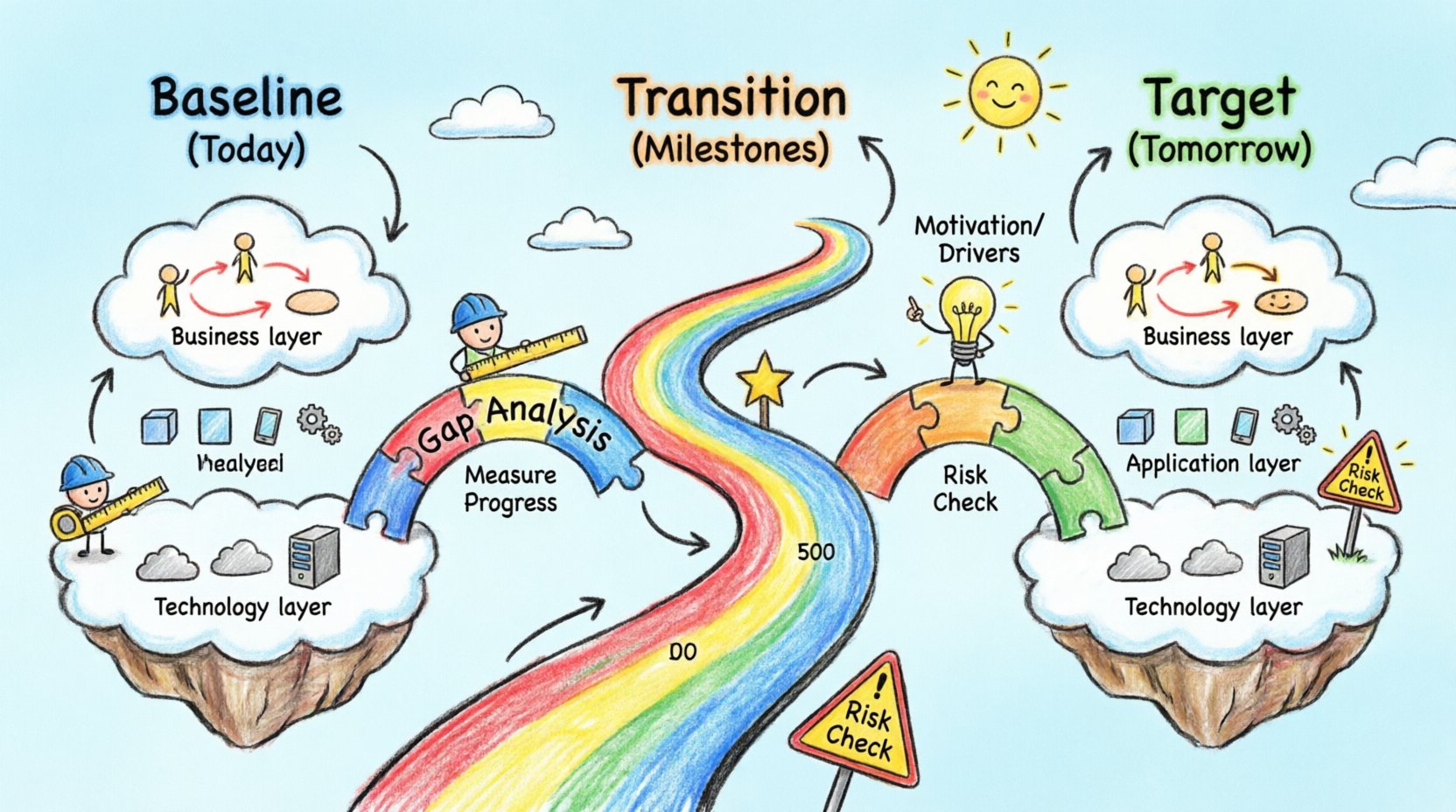
Understanding ArchiMate Plateaus 📊
In the context of enterprise architecture modeling, a plateau represents a specific point in time or a stable state of the architecture. It is a container for the elements that exist within a particular scope, often defined by a specific baseline or target condition. When tracking change, you are essentially comparing one plateau against another to identify what must be added, removed, or modified.
Think of a plateau as a frozen frame in a movie. It captures the actors, the set design, and the lighting at a specific moment. To understand the plot (the change), you must compare multiple frames. ArchiMate provides the syntax to link these frames, ensuring that the narrative of the architecture remains coherent across time.
Key Characteristics of a Plateau
- Temporal Stability: A plateau implies a period where the architecture is relatively stable, allowing for governance and assessment.
- Scope Definition: Each plateau should have a defined scope, whether it covers the entire enterprise or a specific business unit.
- Versioning: Plateaus act as version control for the architecture model, allowing historians to trace lineage.
The Lifecycle of an Architecture Plateau 🔄
Tracking change is not a linear event; it is a lifecycle. A typical architectural evolution moves through several phases, each represented by a distinct plateau. Understanding these phases helps in assigning the correct modeling constructs to each state.
1. Baseline Plateau
The baseline plateau represents the current state of the enterprise. It is the “as-is” model. This is the foundation upon which all change is measured. Accuracy here is critical. If the baseline does not reflect reality, any gap analysis performed against a target state will be flawed.
- Focus: Documentation of existing capabilities, applications, and infrastructure.
- Validation: Requires stakeholder sign-off to ensure the model matches operational reality.
- Constraint: Must reflect legacy constraints that cannot be immediately altered.
2. Target Plateau
The target plateau represents the desired future state. It is the “to-be” model. This state is often aspirational but must be grounded in feasibility. The target plateau defines the destination, outlining the capabilities required to support future business strategies.
- Focus: Future capabilities, modernized infrastructure, and optimized processes.
- Validation: Must align with strategic goals and budgetary constraints.
- Constraint: Must be achievable within the defined timeline.
3. Transition Plateaus
Between the baseline and the target, there are intermediate states known as transition plateaus. These represent milestones in the journey. Large transformations are rarely achieved in a single leap; they require stepping stones. Transition plateaus allow architects to manage risk by breaking the change into manageable chunks.
- Focus: Interim capabilities and phased delivery.
- Validation: Each transition must be viable as a standalone state.
- Constraint: Must maintain business continuity during the shift.
Mapping Change Across Layers 🧩
Architecture is multi-layered. Change rarely happens in isolation. A shift in business strategy triggers changes in processes, which require new applications, which run on new infrastructure. ArchiMate plateaus allow you to track these correlations across the Business, Application, and Technology layers simultaneously.
When defining a transition, you must ensure that the dependencies between layers are preserved or explicitly documented. The following table illustrates how different layers interact during a plateau transition.
| Layer | Baseline State | Target State | Change Type |
|---|---|---|---|
| Business | Manual Order Processing | Automated Order Processing | Process Reengineering |
| Application | Legacy ERP System | Cloud-Native Order Service | System Replacement |
| Technology | On-Premise Servers | Virtualized Cloud Environment | Infrastructure Migration |
This structured mapping ensures that when the technology layer changes, the application layer is aware of the new constraints, and the business layer understands the new capabilities. Without plateaus, these changes might be modeled as a single event, obscuring the dependencies.
Practical Steps for Implementation 🛠️
Implementing a plateau-based tracking system requires discipline. It is not enough to simply draw two models side by side. There is a process to follow to ensure the data is usable for analysis.
Step 1: Define the Scope
Before creating any plateaus, define the boundaries. Are you modeling the entire enterprise or a specific domain? A broad scope can lead to model bloat. Narrowing the scope allows for more granular tracking of change.
Step 2: Establish Naming Conventions
Consistency is key. Use clear naming conventions for your plateaus. For example, use versioning (v1.0, v2.0) or temporal markers (2023_Baseline, 2024_Target). This helps in sorting and querying the architecture repository later.
Step 3: Link Elements
Use the relationship constructs provided by the architecture method to link elements across plateaus. These links are the evidence of change. They show that an element in the target plateau is a replacement for an element in the baseline plateau.
- Realization: Shows how a business service is realized by an application.
- Assignment: Shows which actor is assigned to a role.
- Access: Shows which application accesses data.
Step 4: Document the Rationale
Every change needs a reason. Use the Motivation layer to document the drivers behind the transition. Is the change driven by a cost reduction requirement? A compliance mandate? Linking the Motivation layer to the plateaus provides context for why the architecture is shifting.
Managing Dependencies and Risks ⚠️
Change introduces risk. In a plateau model, you can visualize these risks by analyzing the connectivity between elements. If a critical business capability in the target plateau relies on a technology component that is still in the baseline plateau, you have identified a dependency risk.
Dependency Analysis
Perform a dependency analysis for each transition plateau. This involves tracing the paths from business goals down to the technical infrastructure.
- Identify Single Points of Failure: Are there any critical elements in the target state that depend on a single legacy system?
- Assess Migration Complexity: Does the transition plateau require a “big bang” cutover or a phased approach?
- Verify Data Integrity: Ensure that data flows remain consistent across the change boundary.
Risk Mitigation Strategies
Once risks are identified, the transition plateaus serve as a planning tool for mitigation. You can introduce additional transition stages to isolate risks. For example, if a new technology is high risk, create a pilot plateau where the new technology coexists with the old one. This allows for testing without full commitment.
Measuring Stability and Evolution 📈
One of the primary benefits of using plateaus is the ability to measure stability. By comparing the number of elements and relationships between plateaus, you can quantify the volatility of the architecture.
Stability Metrics
Track specific metrics to evaluate the health of the architecture over time.
- Element Count: The number of unique objects (business processes, applications) in each plateau.
- Relationship Density: The number of connections per element. High density can indicate complexity.
- Change Frequency: How often the model is updated between plateaus.
If the architecture changes too frequently between plateaus, it may indicate a lack of strategic direction. If the changes are too infrequent, the architecture may be becoming obsolete. Plateaus provide the data points to find the balance.
Common Pitfalls in Plateau Modeling 🚫
While powerful, plateau modeling has common traps that can undermine its effectiveness. Avoiding these pitfalls is crucial for maintaining the integrity of the architecture model.
Pitfall 1: Over-Modeling
Do not try to model every detail in every plateau. This creates noise and makes comparison difficult. Focus on the elements that are changing or are critical to the specific change initiative. Use abstraction where possible.
Pitfall 2: Ignoring the Motivation Layer
A model without context is just a diagram. If you do not link the plateaus to the business motivations (drivers, goals, principles), the model loses its strategic value. Stakeholders need to understand why the change is happening, not just what is changing.
Pitfall 3: Lack of Governance
Without a governance process, plateaus can drift. Who approves a new plateau? Who validates the baseline? Establish a review board that meets periodically to approve the transitions between states. This ensures that the model remains the single source of truth.
Pitfall 4: Disconnecting Layers
Do not model the layers in isolation. A technology change without a corresponding business process change is a failure. Ensure that the relationships between layers are maintained across all plateaus to reflect the true impact of the transformation.
Conclusion: The Value of State Modeling 🌟
Tracking architecture change is not about predicting the future with certainty; it is about managing the uncertainty of the present. ArchiMate plateaus provide the structural framework needed to do this effectively. They turn abstract change into concrete, modelable states that can be analyzed, communicated, and governed.
By adhering to the principles of baseline, target, and transition plateaus, organizations can navigate complex transformations with clarity. The result is an architecture that is resilient, adaptable, and aligned with business value. The journey of architecture is continuous, and plateaus are the signposts that ensure the path remains clear.