Enterprise architecture is a complex discipline that requires structure, clarity, and a standardized approach. For professionals entering this field, the The Open Group Architecture Framework (TOGAF) serves as the foundational guide. This tutorial provides a detailed pathway for understanding the framework, its core components, and how to apply its methodologies in real-world scenarios. Whether you are preparing for certification or seeking to improve organizational alignment, this resource offers a structured path forward.
Learning TOGAF is not about memorizing diagrams; it is about understanding the logic behind business transformation. This guide breaks down the process into manageable steps, ensuring you build a solid foundation before moving to advanced concepts.
🔍 Understanding the TOGAF Framework
TOGAF is a framework for developing an enterprise architecture. It provides a comprehensive approach to designing, planning, implementing, and governing an enterprise information architecture. The framework is vendor-neutral and industry-agnostic, making it applicable across various sectors.
- Focus: It centers on the Architecture Development Method (ADM) to guide the creation of architecture.
- Scope: It covers business, data, application, and technology domains.
- Flexibility: Organizations can adapt the framework to fit their specific needs without losing core principles.
The core of TOGAF lies in its content and the iterative nature of its development method. By following the established guidelines, practitioners can ensure consistency and quality in their architectural outputs.
🔄 The Architecture Development Method (ADM)
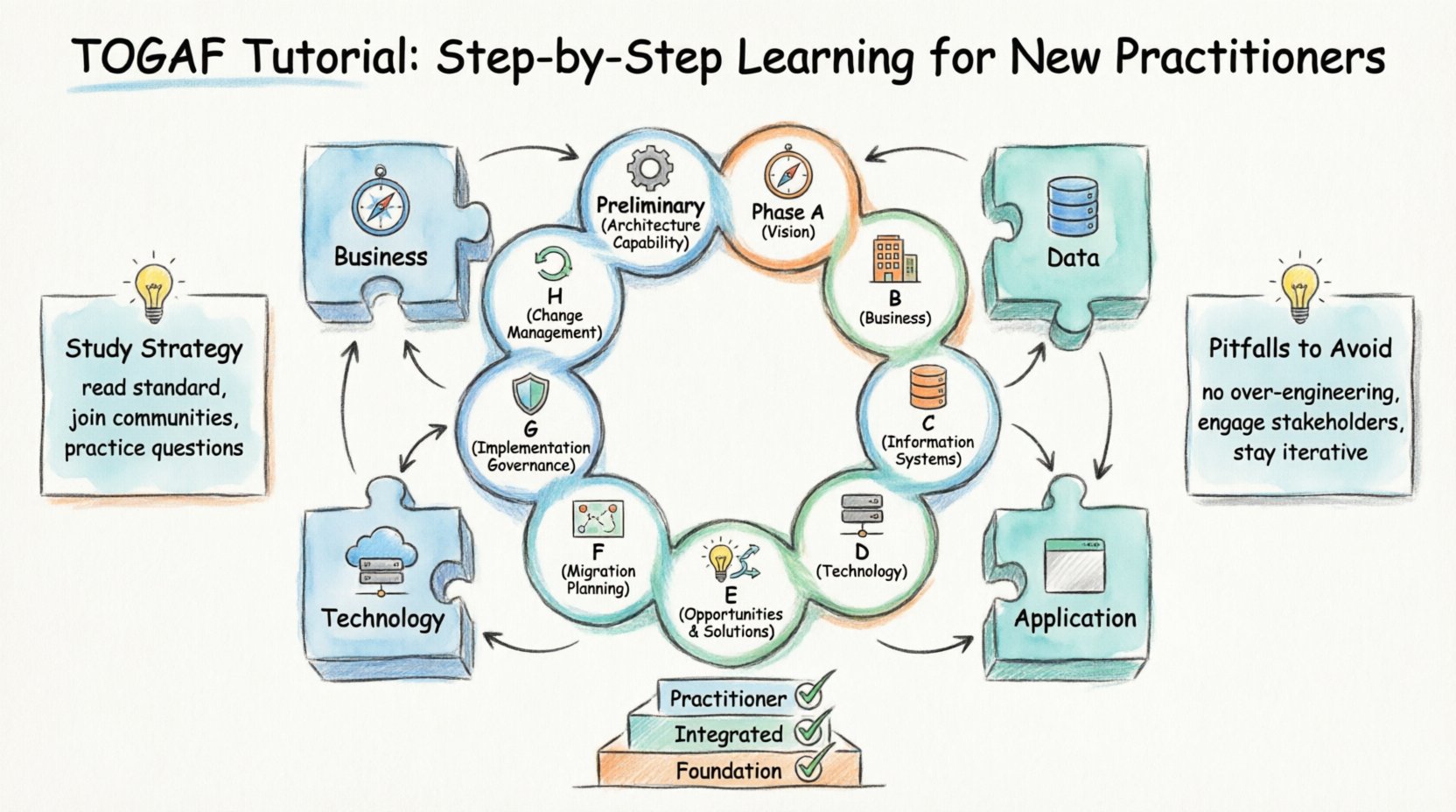
The ADM is the engine of the TOGAF framework. It is a cycle that guides the architect through the creation of an architecture. The process is iterative, meaning phases can be revisited as requirements evolve or new information becomes available. Understanding the phases is critical for any practitioner.
Below is a structured overview of the ADM cycle, detailing the focus and outputs for each stage.
| Phase | Name | Primary Focus | Key Output |
|---|---|---|---|
| Preliminary | Architecture Capability | Preparing the organization | Architecture Principles |
| A | Architecture Vision | Defining scope and stakeholders | Statement of Architecture Work |
| B | Business Architecture | Business strategy and processes | Business Capability Map |
| C | Information Systems Architecture | Data and Application needs | Application Portfolio |
| D | Technology Architecture | Hardware and software platforms | Technology Standards Matrix |
| E | Opportunities & Solutions | Implementation planning | Implementation Plan |
| F | Migration Planning | Transition architectures | Migration Plan |
| G | Implementation Governance | Ensuring compliance | Architecture Compliance Report |
| H | Architecture Change Management | Managing changes post-implementation | Change Request |
🛠 Detailed Breakdown of the ADM Phases
To truly grasp the framework, one must look deeper into the specific activities within each phase.
🏗 Phase A: Architecture Vision
This phase sets the stage. It involves identifying the scope, constraints, and stakeholders. The goal is to create a high-level vision that aligns with business goals. Key activities include defining the initial architecture repository and obtaining approval to proceed.
🏢 Phase B: Business Architecture
Here, the focus shifts to the business itself. This involves analyzing business strategy, governance, organization, and key business processes. The output defines the business capabilities and the business processes required to support the strategy.
💾 Phase C: Information Systems Architectures
This phase is divided into two parts: Data and Application. It defines the logical data assets and the software applications that will be used to store and manipulate this data. The goal is to ensure data integrity and application interoperability.
🔌 Phase D: Technology Architecture
This phase describes the hardware and software infrastructure required to support the applications. It includes network infrastructure, computing hardware, and system software. The focus is on performance, security, and reliability.
🚀 Phase E: Opportunities & Solutions
Once the baseline and target architectures are defined, this phase looks at the gaps. It identifies the major projects and work packages required to move from the current state to the target state. It also considers the risks and dependencies involved.
🗺 Phase F: Migration Planning
This phase creates a detailed implementation and migration plan. It sequences the projects and defines the transition architectures. The plan ensures that the organization can move forward without disrupting critical operations.
🛡 Phase G: Implementation Governance
During the actual implementation, this phase ensures that the solution aligns with the architecture. It involves monitoring the projects and managing any deviations from the plan. Governance ensures that the delivered value matches the architectural intent.
🔄 Phase H: Architecture Change Management
After implementation, the architecture must be maintained. This phase handles changes to the architecture as the business environment evolves. It ensures the architecture remains relevant and supports ongoing business needs.
🌐 The Four Architecture Domains
TOGAF organizes the architecture into four distinct domains. Understanding the relationship between these domains is essential for creating a cohesive plan.
- Business Architecture: Defines the business strategy, governance, organization, and key business processes.
- Data Architecture: Describes the logical and physical data assets and data management resources.
- Application Architecture: Provides a blueprint for the individual application systems, their interactions, and their relationships to the core business processes.
- Technology Architecture: Describes the logical software and hardware capabilities required to support the deployment of business, data, and application services.
These domains are not isolated. Changes in one domain often impact the others. For example, a new business process (Business Architecture) may require new software (Application Architecture) and increased server capacity (Technology Architecture).
🎓 Certification Pathways
For those seeking formal recognition of their knowledge, the certification program offers a structured path. It validates competence in both the theoretical understanding and practical application of the framework.
Level 1: Foundation
This exam tests knowledge of the TOGAF standard. It covers the terminology, structure, and basic concepts. The focus is on understanding the vocabulary and the high-level flow of the ADM.
Level 2: Integrated
This level requires a deeper understanding of how the components work together. It involves case studies and scenario-based questions that test the ability to apply the framework to specific business situations.
Level 3: Practitioner
While not always a standard exam in all regions, this level focuses on the practical application of TOGAF within an organization. It demonstrates the ability to tailor the framework to specific contexts.
📚 Developing a Study Strategy
Success in learning TOGAF requires a disciplined approach. Rushing through the material often leads to gaps in understanding. The following steps provide a roadmap for effective learning.
- Read the Standard: Start with the official documentation. It is the primary source of truth for all concepts and definitions.
- Join Communities: Engage with forums and professional groups. Discussing concepts with peers helps clarify complex topics.
- Practice Questions: Use sample questions to test your knowledge. This helps identify areas that require further review.
- Apply Concepts: Try to map the framework to a project you are currently working on. Practical application reinforces theoretical knowledge.
- Review Artifacts: Study the templates and examples of architecture artifacts provided in the framework.
⚠️ Common Pitfalls to Avoid
Even experienced practitioners can make mistakes when implementing this framework. Being aware of common errors can save time and resources.
- Over-Engineering: Do not create more documentation than is necessary. The goal is to support the business, not to create bureaucracy.
- Ignoring Stakeholders: Architecture must be accepted by those who will use it. Engage stakeholders early and often.
- Static Thinking: Treat the architecture as a living document. Requirements change, and the architecture must adapt.
- Skipping the Preliminary Phase: Do not jump straight into the ADM. Establish the context and principles first.
💼 Career Impact and Benefits
Proficiency in this framework opens doors to various roles within the technology and business sectors. It demonstrates a structured approach to problem-solving and strategic planning.
- Increased Visibility: Architects are often seen as strategic partners rather than just technical staff.
- Better Alignment: Projects are more likely to succeed when they align with the overall business strategy.
- Cost Reduction: By identifying redundancies and standardizing processes, organizations can reduce costs.
- Risk Management: A clear architecture helps identify risks before they become critical issues.
🛠 Practical Application Tips
Applying the framework in a real environment requires adaptation. There is no single “right” way to do it, but there are best practices to follow.
Start Small
Do not attempt to document the entire enterprise architecture at once. Begin with a specific domain or a specific project. Gain momentum and refine the process before expanding.
Define Principles Early
Architecture principles act as rules for decision-making. Establish these early to guide the design process. They provide a consistent basis for evaluating options.
Use Visuals
Diagrams and models communicate complex information more effectively than text alone. Use standard notation to ensure everyone understands the visuals.
Iterate Frequently
Architecture is not a one-time event. Regularly review the architecture to ensure it still meets the business needs. Update the models as the environment changes.
🔗 Resources for Further Learning
There are many resources available to support your journey. While specific tools exist, the core knowledge comes from the standard itself.
- Official Documentation: The primary source for definitions and processes.
- Case Studies: Look for published examples of how organizations have used the framework.
- Workshops: Participate in training sessions to gain hands-on experience.
- Mentorship: Find a mentor who has practical experience with the framework.
🏁 Final Thoughts
Navigating the landscape of enterprise architecture can seem daunting. However, with the right guidance and a structured approach, it becomes a manageable and rewarding discipline. TOGAF provides the structure needed to bring order to complexity.
By following the steps outlined in this guide, you build the competence required to drive meaningful change. Remember that the framework is a tool to serve the business, not an end in itself. Focus on delivering value and solving problems.
Continuous learning is essential in this field. As technology and business needs evolve, so must your knowledge. Stay engaged with the community and keep refining your skills.