The shift from traditional on-premises infrastructure to cloud-native environments has fundamentally altered how organizations design, deploy, and manage their technology landscapes. Enterprise Architecture (EA) frameworks, specifically The Open Group Architecture Framework (TOGAF), were originally designed with a focus on stable, long-lifecycle systems. Today, the dynamism of cloud computing demands a re-evaluation of these established practices. This guide explores how TOGAF principles can be effectively adapted to support modern cloud strategies, ensuring alignment between business goals and technical execution without sacrificing governance or stability.
🔄 The Evolution of Enterprise Architecture
Historically, enterprise architecture focused on rigid structures, heavy documentation, and predictable lifecycles. The goal was often to minimize change and maximize control over hardware and software assets. However, the rise of cloud computing introduced elasticity, rapid iteration, and service-oriented models that challenge these traditional assumptions.
Organizations now operate in environments where:
Infrastructure is ephemeral: Servers are spun up and down in minutes.
Services are consumed: Functionality is acquired via APIs rather than built from scratch.
Costs are variable: Spending scales with usage, requiring continuous financial oversight.
Security is shared: Responsibility is distributed between the organization and the provider.
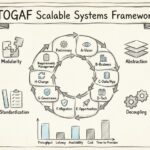
Adapting TOGAF to this context does not mean discarding the framework. Instead, it requires tuning the Architecture Development Method (ADM) to be more iterative and responsive. The core value of TOGAF lies in its structured approach to decision-making, which remains vital even in volatile cloud environments.
🛠️ Adapting the Architecture Development Method (ADM)
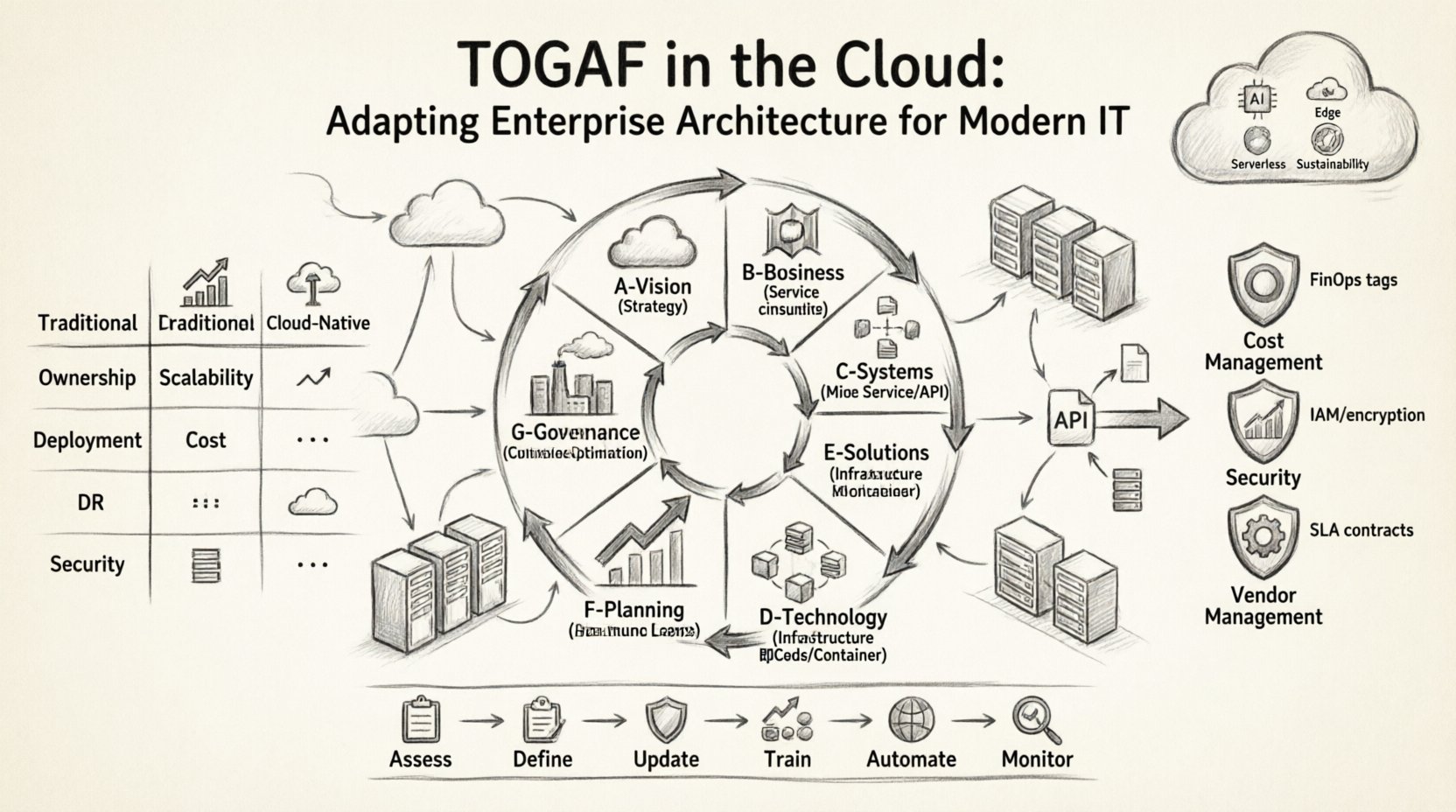
The ADM is the heart of TOGAF. In a cloud context, the phases need to be interpreted with flexibility. Below is a breakdown of how each phase transforms when applied to cloud initiatives.
Phase A: Architecture Vision
In traditional settings, this phase defines the scope and constraints. In the cloud, the vision must include:
Multi-cloud strategy: Avoiding single-vendor dependency.
Compliance requirements: Data sovereignty and regulatory adherence across regions.
Business agility: Defining how quickly new services can be delivered.
Phase B: Business Architecture
This phase aligns business strategy with IT capabilities. Cloud adoption changes the business model significantly.
Service Consumption: The business buys capabilities rather than owning assets.
Operational Models: Shift from CapEx to OpEx requires new financial governance.
Customer Experience: Cloud enables faster deployment of user-facing features.
Phase C: Information Systems Architectures
Data and application architectures must shift towards modularity.
Microservices: Breaking monolithic applications into smaller, deployable units.
API-First Design: Ensuring systems communicate through standardized interfaces.
Data Residency: Managing where data resides to satisfy legal requirements.
Phase D: Technology Architecture
This is where the physical and logical infrastructure is defined.
Infrastructure as Code (IaC): Defining infrastructure through scripts rather than manual configuration.
Containerization: Using containers to ensure consistency across environments.
Serverless Computing: Leveraging managed functions to reduce operational overhead.
Phase E: Opportunities and Solutions
Identifying how to migrate or integrate cloud services.
Migration Waves: Grouping applications by complexity and risk.
Integration Patterns: Using middleware or event-driven architectures.
Build vs. Buy: Deciding between custom development and SaaS solutions.
Phase F: Migration Planning
Creating the roadmap for implementation.
Phased Rollouts: Moving non-critical systems first.
Parallel Running: Maintaining legacy systems alongside new cloud versions.
Training: Preparing staff for new tools and processes.
Phase G: Implementation Governance
Monitoring the transition to ensure compliance with the architecture.
Automated Compliance: Using tools to check infrastructure against policies.
Change Management: Controlling modifications to live environments.
Security Audits: Regular reviews of access controls and configurations.
Phase H: Architecture Change Management
Managing the ongoing evolution of the architecture.
Continuous Optimization: Tuning resources for cost and performance.
Feedback Loops: Incorporating lessons learned from operations.
Version Control: Tracking changes to architectural blueprints.
📊 Traditional vs. Cloud Architecture Comparison
To visualize the differences clearly, consider the following comparison of architectural characteristics.
Characteristic | Traditional On-Premises | Cloud-Native Architecture |
|---|---|---|
Infrastructure Ownership | Full ownership and maintenance | Shared responsibility model |
Scalability | Vertical (hardware upgrades) | Horizontal (adding instances) |
Deployment Frequency | Quarterly or annually | Multiple times per day |
Cost Model | Capital Expenditure (CapEx) | Operating Expenditure (OpEx) |
Disaster Recovery | Secondary data center | Multi-region replication |
Security Focus | Perimeter defense | Zero Trust and Identity |
🛡️ Governance and Security in the Cloud
Governance in the cloud requires a shift from manual checks to automated enforcement. The Architecture Capability Framework within TOGAF provides the structure, but the implementation must be technical.
1. Cost Management (FinOps)
Without strict governance, cloud costs can spiral. Enterprise Architecture must define policies for resource tagging, budgeting, and rightsizing.
Tagging Standards: Every resource must be tagged for cost allocation.
Budget Alerts: Automated notifications when spending thresholds are reached.
Resource Lifecycle: Rules for decommissioning unused resources.
2. Security and Compliance
Security moves from network perimeter to identity and data.
Identity and Access Management (IAM): Least privilege access principles.
Data Encryption: Encrypting data at rest and in transit.
Logging and Monitoring: Centralized logging for audit trails.
3. Vendor Management
Reliance on external providers introduces risk.
Service Level Agreements (SLAs): Defining uptime and performance guarantees.
Exit Strategies: Ensuring data can be migrated if the relationship ends.
Integration Contracts: Defining how data flows between vendors.
🧩 Integration Patterns and Interoperability
Modern enterprises rarely use a single cloud provider or a single application type. Integration becomes a critical architectural concern.
API Gateways: Managing traffic, security, and rate limiting for services.
Event-Driven Architecture: Using messages to trigger actions across systems.
Data Lakes: Consolidating data from various sources for analytics.
Hybrid Connectivity: Secure connections between on-premises data centers and cloud networks.
Architecture diagrams must reflect these connections clearly. The TOGAF Content Metamodel provides standard building blocks, but cloud-specific extensions may be necessary to capture serverless functions or container clusters.
👥 Skills and Organizational Culture
Technology is only half the challenge. The people and processes must align with the cloud strategy.
1. DevOps and Agile
Cloud architecture supports DevOps methodologies. Architects must work closely with development and operations teams.
CI/CD Pipelines: Automated testing and deployment.
Infrastructure as Code: Treating infrastructure configuration like software code.
Collaboration: Breaking down silos between teams.
2. The Role of the Architect
The architect’s role shifts from gatekeeper to enabler.
Enabling Innovation: Providing guardrails rather than roadblocks.
Technical Guidance: Helping teams choose the right patterns.
Continuous Learning: Staying updated on new cloud services and features.
3. Shadow IT
When developers can provision resources instantly, shadow IT emerges. Architecture must address this by providing approved tools and clear guidelines.
Self-Service Portals: Pre-approved resources for developers.
Education: Training teams on governance requirements.
Discovery Tools: Identifying unmanaged resources.
⚠️ Common Pitfalls in Cloud Architecture
Even with a solid framework, mistakes happen. Understanding common pitfalls helps avoid them.
Ignoring Data Gravity: Moving data is expensive and slow. Design applications where data lives.
Over-Optimizing: Spending too much time on perfection instead of shipping value.
Underestimating Complexity: Cloud introduces new dependencies that must be managed.
Lack of Observability: If you cannot see it, you cannot manage it.
🔮 Future Trends and Considerations
The landscape continues to evolve. Enterprise Architects must anticipate these shifts.
Artificial Intelligence: Using AI to optimize costs and detect anomalies.
Edge Computing: Processing data closer to the source for latency reduction.
Serverless Dominance: Increasing reliance on managed code execution.
Sustainability: Monitoring the carbon footprint of cloud usage.
🔗 Summary of Implementation Steps
To successfully implement TOGAF in a cloud environment, follow these structured steps:
Assess Current State: Understand existing architecture and cloud readiness.
Define Principles: Establish cloud-specific principles (e.g., “Buy before Build”).
Update Artifacts: Revise architecture diagrams and documentation.
Train Teams: Ensure stakeholders understand the new processes.
Automate Governance: Implement policy-as-code.
Monitor and Iterate: Continuously review and refine the architecture.
By adapting TOGAF to the cloud, organizations can maintain strategic alignment while embracing the agility required for modern IT. The framework provides the discipline needed to navigate complexity, ensuring that speed does not come at the cost of stability or security.
The journey is ongoing. As cloud technologies mature, so too must the architectural practices that guide them. A flexible, principle-driven approach ensures resilience in an ever-changing digital landscape.