Building a technology stack from scratch is an exhilarating process. It involves creativity, speed, and the thrill of turning ideas into reality. However, as a startup grows, the initial structure often becomes a bottleneck. This is where frameworks designed for enterprise environments, such as TOGAF (The Open Group Architecture Framework), come into question. Many founders assume this methodology belongs solely to large corporations. The reality is quite different. A tailored application of TOGAF principles can provide the stability needed for sustainable growth without sacrificing agility.
This guide explores how to apply architectural rigor to a startup environment. We will discuss adapting the Architecture Development Method (ADM), defining critical domains, and establishing governance that supports rather than hinders progress. The goal is not to create bureaucracy, but to build a foundation that can withstand scaling pressures.
Why Consider TOGAF in a High-Growth Environment? 🤔
The primary hesitation startups face regarding TOGAF is the perception of heaviness. Enterprise software often moves slowly, bound by complex approval processes. Startups thrive on speed. However, there is a critical distinction between the framework itself and its implementation. When applied correctly, the core concepts offer significant advantages:
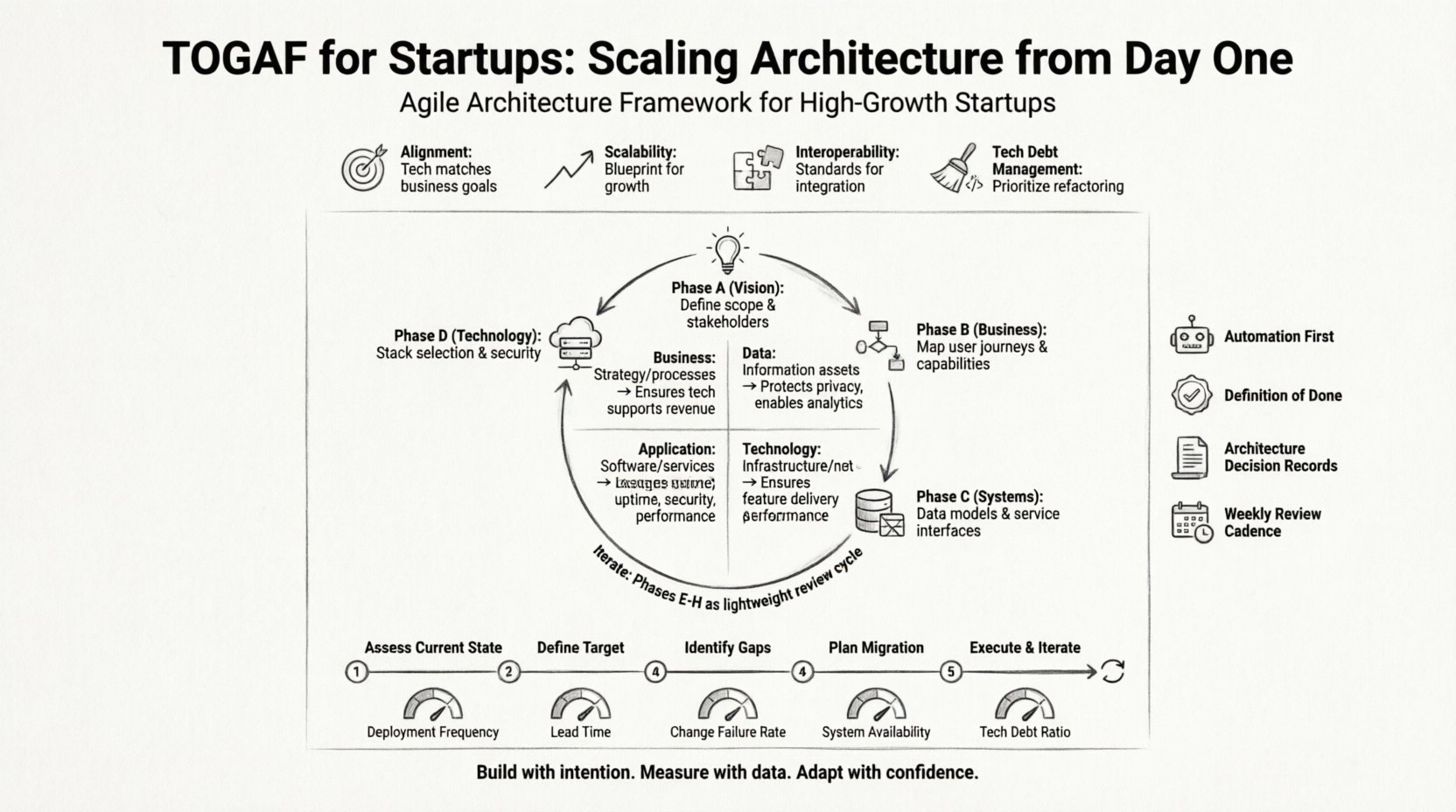
- Alignment: Ensures technology decisions match business goals. This prevents building features that do not serve the core value proposition.
- Scalability: Provides a blueprint for how systems interact as user bases expand.
- Interoperability: Defines standards so that different components can communicate effectively.
- Technical Debt Management: Helps identify and prioritize refactoring before it becomes unmanageable.
Without a structured approach, startups often fall into the trap of “spaghetti architecture.” Individual teams build isolated solutions that work for them but create friction when integration is required. TOGAF offers a common language and set of artifacts that facilitate communication across different departments. This shared understanding reduces the risk of silos forming early in the lifecycle.
The Core Framework: ADM Simplified 🔧
The Architecture Development Method (ADM) is the heart of TOGAF. It is a cyclical process that guides the development of architecture. For a startup, following every phase in its entirety is impractical. The strategy involves selecting the relevant iterations and compressing the timeline. Below is an adaptation of the standard phases for a high-velocity environment.
Phase A: Architecture Vision 🎯
In the startup context, this phase is about defining the scope of the architecture relative to the business plan. It answers the question: What are we building and why? This is not a document written by a committee. It is a strategic outline agreed upon by the founding team.
- Identify key stakeholders (investors, customers, engineering leads).
- Define the business drivers (revenue targets, user acquisition goals).
- Establish high-level constraints (budget, timeline, compliance).
Phase B: Business Architecture 🏢
This phase maps the business processes to the technology. For a startup, this means understanding the workflow required to deliver value. If you are a fintech startup, the architecture must support transaction integrity. If you are a social platform, it must support high concurrency.
- Map out user journeys.
- Define the capabilities required to support these journeys.
- Identify gaps between current state (MVP) and future state (Scale).
Phase C: Information Systems Architectures 🗄️
This covers both data and applications. In a lean startup, this often happens simultaneously with development. The focus here is on data models and application interfaces.
- Data Architecture: How is customer data stored? Is it normalized for analytics or denormalized for speed? What are the retention policies?
- Application Architecture: How do services interact? Are we using microservices or a monolith? This decision impacts deployment frequency.
Phase D: Technology Architecture 💻
This defines the hardware, software, and network capabilities. Startups often rely on third-party infrastructure providers. The architectural decision here is about selecting the right stack that supports growth without vendor lock-in.
- Selection of cloud infrastructure.
- Network topology and security boundaries.
- Integration with external APIs.
Phases E through H: Migration, Implementation, and Governance 🔄
Traditional models treat these as separate long-term phases. In a startup, this is an iterative cycle. After every sprint or major release, the architecture is reviewed. Governance is lightweight. It focuses on change control rather than rigid approval chains.
Building a Lightweight Governance Model ⚖️
One of the biggest fears is that adding structure will slow down delivery. Governance is necessary to maintain quality, but it does not have to be heavy. The key is to embed governance into the development workflow rather than placing it outside of it.
Consider the following principles for a lightweight model:
- Automation First: Use automated testing and linting to enforce standards. This removes the need for manual code reviews for style issues.
- Definition of Done: Include architectural criteria in the “Done” definition. If a feature violates security or scalability standards, it cannot be merged.
- Architecture Decision Records (ADRs): Keep a log of significant decisions. This creates a history of why choices were made, aiding future developers.
- Review Cadence: Hold a brief architectural review once a week. This keeps the team aligned without requiring a full meeting every time.
The Four Architecture Domains Explained 📊
TOGAF divides architecture into four domains. Understanding how these apply to a startup is crucial for holistic planning. A startup cannot ignore one domain to focus on another without consequences.
| Domain | Focus Area | Startup Application |
|---|---|---|
| Business | Strategy, Goals, Processes | Ensures tech builds support revenue models. |
| Data | Information, Knowledge Assets | Protects user privacy and enables analytics. |
| Application | Software, Services, Interactions | Manages feature delivery and system integration. |
| Technology | Infrastructure, Networks | Ensures uptime, security, and performance. |
Business Architecture: This is often the most neglected area in early-stage startups. Founders focus on the code, but the code must serve a business process. If the business model changes, the architecture must adapt. Regular reviews of the business architecture ensure the technology remains aligned.
Data Architecture: Data is a startup’s most valuable asset. Poor data architecture leads to corrupted analytics and privacy violations. Establishing data lineage early ensures that you know where every piece of information comes from and how it is used. This is critical for compliance and for building machine learning models later.
Application Architecture: This is where most engineering effort lies. The challenge is balancing modularity with speed. A monolithic approach is often faster initially, but a modular approach is safer for long-term growth. The architecture should allow for services to be swapped or scaled independently.
Technology Architecture: This involves the underlying hardware and software. In modern startups, this is often abstracted by cloud platforms. However, understanding the underlying technology stack is vital for cost management and security. Knowing how load balancers work or how databases replicate helps in troubleshooting performance issues.
Pitfalls to Avoid ⚠️
Adopting a framework like TOGAF introduces risks if not managed carefully. Startups have a unique set of vulnerabilities. The following pitfalls are common when bringing enterprise concepts into a high-growth environment.
- Over-Engineering: Building systems that are too complex for the current stage. This wastes resources and slows down feature delivery.
- Documentation Overload: Creating documents that are never read. Documentation should be living and accessible, not static files in a repository.
- Rigidity: Refusing to pivot because the architecture does not support the new direction. Architecture should be flexible enough to accommodate business pivots.
- Lack of Buy-in: If the engineering team does not understand the value, they will bypass the process. Training and communication are essential.
Implementation Roadmap 🗺️
Implementing these principles does not require a massive overhaul. It can be done incrementally. Here is a step-by-step approach to integrating architectural thinking into your workflow.
Step 1: Assess the Current State 📝
Before building, you must know where you stand. Conduct an audit of your current systems. Identify technical debt, security vulnerabilities, and performance bottlenecks. Document the existing topology and data flows.
Step 2: Define the Target State 🎨
Visualize where the system needs to be in six to twelve months. What features are coming? What is the expected user load? Create a high-level diagram of the desired architecture. This serves as the North Star for development.
Step 3: Identify Gaps 🔍
Compare the current state with the target state. What is missing? Is it a lack of caching? Is it a missing authentication layer? Prioritize these gaps based on risk and business value.
Step 4: Plan the Migration 🚀
Create a roadmap for addressing the gaps. This should align with your product release schedule. Some architectural changes can be done in the background, while others require downtime or significant effort. Plan accordingly.
Step 5: Execute and Iterate 🔄
Begin implementing the changes. Monitor the results closely. Did the performance improve? Did the deployment frequency increase? Adjust the plan based on feedback. Architecture is not a one-time project; it is a continuous process.
Measuring Architectural Health 📈
How do you know if the architecture is working? You need metrics. Just as you track revenue and user growth, you must track architectural health. These metrics help justify the investment in structure.
- Deployment Frequency: How often do you release code? A healthy architecture supports frequent, small releases.
- Lead Time for Changes: How long does it take from code commit to production? Shorter times indicate better automation and integration.
- Change Failure Rate: What percentage of deployments cause an outage or require a rollback? Lower rates suggest robust testing and design.
- System Availability: Is the system up and running when users need it? High availability is a direct result of sound technology architecture.
- Technical Debt Ratio: Estimate the time spent fixing issues versus building new features. A lower ratio indicates a healthier codebase.
Tracking these metrics provides objective evidence that the architectural framework is adding value. It shifts the conversation from “we need more process” to “this process improves our velocity.”
Final Thoughts on Scaling with Structure 🚀
Applying TOGAF principles to a startup is not about copying a large corporation. It is about importing the discipline of structured thinking into a creative environment. The framework provides a vocabulary and a set of tools to manage complexity as it inevitably arises.
Startups face unique challenges: limited resources, high uncertainty, and the need for speed. A well-designed architecture acts as a force multiplier. It allows the team to focus on innovation rather than firefighting infrastructure problems. By adopting a lightweight version of these principles, you build a system that can grow with your business.
The journey from day one to scale is long. The decisions made early on will define the limits of your growth. Investing in architecture is investing in the longevity of the company. It ensures that when the market opportunity arrives, the technology is ready to seize it. The goal is not perfection, but resilience. Build with intention, measure with data, and adapt with confidence.