Enterprise Architecture serves as the backbone for organizational strategy and IT alignment. Within this discipline, The Open Group Architecture Framework (TOGAF) stands out as a widely adopted standard. At the core of TOGAF lies the concept of Architecture Principles. These principles act as the guiding rules that govern decision-making across the enterprise. Without them, architectural efforts can become disjointed, leading to redundancy and inefficiency. This article provides a detailed look at how these principles function, how to develop them, and how to ensure they drive tangible value. We will explore the lifecycle, the categorization, and the practical application of these foundational rules. 📝
Understanding the Foundation of Architecture Principles 🧱
Architecture Principles are high-level statements that define the boundaries and rules of an organization’s architecture. They are not technical specifications; rather, they are the intent and direction that inform those specifications. A principle is timeless, fundamental, and general. It applies regardless of the specific technology or business process involved. Think of them as the constitution of your architectural landscape.
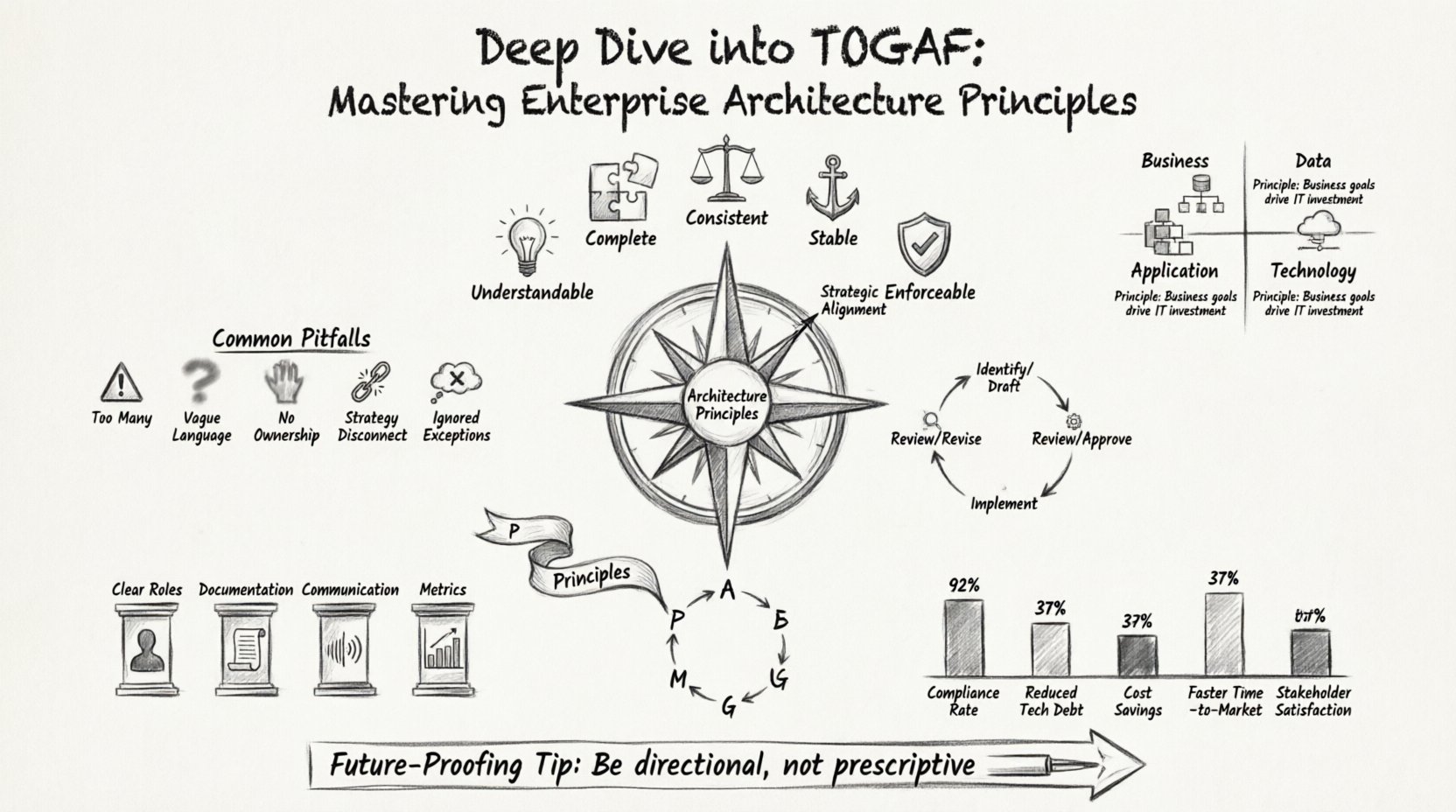
Effective principles share specific characteristics. They must be:
- Understandable: Stakeholders must be able to grasp the meaning without ambiguity.
- Complete: They should cover the scope of the enterprise without leaving critical gaps.
- Consistent: Principles should not contradict one another.
- Stable: While not immutable, they should not change frequently.
- Enforceable: There must be a mechanism to verify compliance.
When an organization defines these principles, it creates a shared language. This language allows architects, business leaders, and technical teams to communicate effectively. It reduces friction during project initiation and ensures that investments align with long-term goals. 🎯
Categories of Architecture Principles 📊
TOGAF suggests categorizing principles to ensure comprehensive coverage of the enterprise. These categories align with the domains defined in the framework. By segmenting principles, organizations can address specific concerns within each domain while maintaining a cohesive overall strategy.
The primary categories include:
- Business Principles: Focus on the organizational structure, processes, and goals. They dictate how the business operates and competes.
- Data Principles: Govern the management, quality, and security of information assets. They ensure data is treated as a strategic resource.
- Application Principles: Define standards for software systems, their integration, and lifecycle management.
- Technology Principles: Cover the underlying infrastructure, platforms, and hardware standards.
The following table illustrates the distinction between these categories and their typical focus areas.
| Category | Focus Area | Example Principle |
|---|---|---|
| Business | Organizational Strategy & Operations | Customer data should be unified across all business units. |
| Data | Information Management & Security | Data must be owned by the business, not the IT department. |
| Application | System Functionality & Integration | Applications should be modular to allow for independent updates. |
| Technology | Infrastructure & Platforms | Infrastructure should be scalable to handle peak loads. |
The Lifecycle of Architecture Principles 🔄
Defining a principle is not a one-time event. It is a continuous process that requires maintenance and governance. The lifecycle of an architecture principle involves several distinct stages. Understanding these stages ensures that principles remain relevant and effective over time.
1. Identification and Drafting
The process begins with identifying the need for a principle. This often stems from recurring issues, strategic shifts, or regulatory requirements. Stakeholders draft the principle statement. During this phase, it is crucial to define the implication of the principle. What does it mean for the organization if this rule is followed? What happens if it is not?
2. Review and Approval
Once drafted, the principle undergoes review. This involves checking for conflicts with existing principles or business goals. Senior leadership or the Architecture Board provides formal approval. Without this endorsement, the principle lacks the authority needed for enforcement. Approval signifies that the organization is committed to the direction the principle sets. 📜
3. Implementation
Approved principles must be integrated into daily operations. This involves updating standards, guidelines, and processes. Architects reference these principles during project assessments. Procurement teams use them to evaluate vendors. Implementation ensures the principle moves from theory to practice.
4. Compliance and Enforcement
Compliance mechanisms verify adherence to the principles. This can take the form of architecture reviews, audits, or automated checks. If a project violates a principle, it must be flagged. The Architecture Board then decides on an exception. Exceptions should be rare and well-documented. Frequent exceptions indicate that the principle may be flawed or unrealistic.
5. Review and Revision
The business environment changes. Technology evolves. Principles that were once valid may become obsolete. Regular reviews ensure the principle set remains current. If a principle no longer serves a purpose, it should be retired. If a new need arises, a new principle can be added. This keeps the architecture agile. 🚀
Integrating Principles into the ADM Cycle 📅
The TOGAF Architecture Development Method (ADM) provides the process for developing architecture. Architecture Principles play a critical role throughout the ADM cycle. They are not isolated to a single phase but influence decisions from start to finish.
Phase A: Architecture Vision
In this initial phase, the scope and context are defined. Architecture Principles are identified and validated. They set the boundaries for the work ahead. If a principle states that “security is a priority,” the vision must reflect this constraint. Stakeholders agree on these rules early to prevent scope creep later.
Phase B, C, and D: Business, Data, and Technology Architecture
As specific architectures are developed, principles guide the design choices. In Business Architecture, principles help define processes. In Data Architecture, they dictate data models and flows. In Technology Architecture, they influence platform selection. Architects use principles as a filter for options. Any solution that violates a principle is discarded or requires an exception.
Phase E: Opportunities and Solutions
This phase involves planning the migration. Principles help identify which projects deliver the most value. They ensure that the roadmap aligns with the long-term strategy. For example, a principle regarding cloud adoption might prioritize migrating legacy systems to a specific environment.
Phase F: Migration Planning
Principles assist in sequencing the migration. They help determine dependencies and risks. A principle about interoperability might require certain systems to be upgraded before others.
Phase G: Implementation Governance
During implementation, principles serve as a compliance checkpoint. Projects are monitored against the established rules. This ensures that the final solution matches the intended architecture. 🛡️
Governance and Architecture Compliance ⚖️
Without governance, principles are merely suggestions. Governance provides the structure to ensure adherence. The Architecture Board is typically responsible for this function. They review project proposals and ensure alignment with the principles.
Key elements of governance include:
- Clear Roles: Who is responsible for enforcing the principle? Who grants exceptions?
- Documentation: Principles and their status must be recorded in a repository.
- Communication: Stakeholders must be aware of the principles. Training and awareness campaigns are essential.
- Metrics: Track compliance rates. How many projects deviate from the rules? Why do they deviate?
Effective governance balances control with flexibility. Too much rigidity slows down innovation. Too little control leads to chaos. The goal is to enable speed within boundaries. Organizations should regularly assess their governance model to ensure it supports business needs.
Common Pitfalls in Principle Management ⚠️
Many organizations struggle when implementing architecture principles. They create a list of rules but fail to integrate them into the workflow. Here are common issues to avoid.
- Too Many Principles: A list of 50 principles is unmanageable. Focus on the critical few that drive the most value. Quality over quantity is key.
- Vague Language: Principles must be clear. “Be efficient” is not actionable. “Reduce latency to under 200ms” is actionable.
- Lack of Ownership: If no one owns the principles, they will be ignored. Assign a steward for each category.
- Disconnect from Strategy: Principles must reflect business goals. If the strategy changes, principles should change with it.
- Ignoring Exceptions: Sometimes a deviation is necessary. Documenting these exceptions helps refine future principles.
Measuring the Impact of Principles 📈
How do you know if your principles are working? You need metrics. Quantitative and qualitative measures help assess effectiveness.
Consider tracking:
- Compliance Rate: Percentage of projects adhering to principles.
- Reduction in Technical Debt: Are systems becoming easier to maintain?
- Cost Savings: Are redundant systems being eliminated?
- Time to Market: Are standardized approaches speeding up delivery?
- Stakeholder Satisfaction: Do business leaders feel supported by the architecture?
Regular reporting on these metrics keeps the architecture practice accountable. It demonstrates the value of the architectural function to the wider organization. This builds trust and secures ongoing support. 🤝
Future-Proofing Your Architecture 🌐
The digital landscape changes rapidly. New technologies emerge, and market conditions shift. Architecture Principles must be robust enough to handle change. They should be directional rather than prescriptive. Instead of specifying a specific technology, specify a capability.
For example, rather than saying “Use Server A,” say “Systems must support horizontal scaling.” This allows the organization to adopt new infrastructure as it becomes available without violating the principle. This approach ensures longevity. It allows the architecture to evolve without losing its core identity.
Organizations should also consider the external environment. Regulatory changes, security threats, and economic factors influence principles. A principle regarding data privacy might need to be updated as laws change. Staying informed is part of the stewardship role. 🧐
Building a Culture of Architecture 🏛️
Principles are not just documents; they are cultural artifacts. They shape how people think and work. When principles are respected, they foster a culture of discipline and quality. This culture spreads beyond the architecture team to developers, managers, and executives.
To build this culture:
- Integrate principles into onboarding for new employees.
- Include principle compliance in performance reviews.
- Celebrate success stories where principles prevented a failure.
- Encourage open dialogue about principle challenges.
When the culture aligns with the principles, the architecture becomes a natural part of the business fabric. It stops being an obstacle and starts being an enabler. This shift is critical for long-term success. 🌟
Summary and Next Steps 🎓
Enterprise Architecture Principles are the compass for organizational strategy. They provide clarity, consistency, and direction. By following the TOGAF framework, organizations can develop a robust set of principles that guide their journey. The process requires effort, governance, and continuous improvement. However, the rewards are significant. Reduced complexity, better alignment, and increased agility are just a few benefits.
Organizations should start by reviewing their current principles. Are they clear? Are they enforced? Are they still relevant? If gaps are found, take steps to address them. Engage stakeholders in the refinement process. Ensure that the principles reflect the true needs of the business. With a solid foundation of principles, the path to digital transformation becomes clearer. The architecture supports the business, and the business drives the architecture. This alignment is the ultimate goal of any mature enterprise architecture practice. 🏁