Enterprise technology landscapes are evolving at a pace that challenges traditional governance models. Organizations often find themselves caught between the need for rapid delivery and the necessity of maintaining a stable, scalable architecture. This tension is not new, but the methods to resolve it have shifted significantly. The Open Group Architecture Framework (TOGAF) provides a robust methodology for designing, planning, implementing, and governing enterprise information architecture. DevOps, conversely, focuses on the collaboration between development and operations to accelerate the delivery of value. Integrating these two disciplines requires a nuanced understanding of how structure supports agility rather than hindering it.
When approached correctly, architecture does not slow down delivery. Instead, it provides the guardrails that allow teams to move fast without crashing. This guide explores the practical integration of TOGAF principles within a DevOps environment. We will examine how to adapt the Architecture Development Method (ADM) for continuous delivery, how to implement lightweight governance, and how to align architectural artifacts with modern pipeline requirements.
The Historical Divide Between Architecture and Operations ⚖️
Traditionally, architecture and operations existed in separate silos. Architecture teams focused on long-term stability, standardization, and compliance. They produced detailed documents that were often completed before development began. Operations teams managed the infrastructure, focusing on uptime, performance, and maintenance. When the pressure to release software increased, these two groups found themselves at odds. Architecture was viewed as a bottleneck, while operations were seen as resistant to change.
This separation created a disconnect between the design of systems and their actual execution. Code was written that did not align with the intended architecture, leading to technical debt. Conversely, architectural decisions were made without understanding the operational realities of deployment. The result was a fragile system that struggled to adapt to market changes.
DevOps emerged to address the friction between development and operations. It introduced concepts like continuous integration and continuous deployment. However, without architectural oversight, this speed can lead to chaos. This is where TOGAF offers value. It provides a structured approach to ensure that speed does not compromise the integrity of the enterprise landscape.
Core TOGAF Principles Aligned with Continuous Delivery 🔄
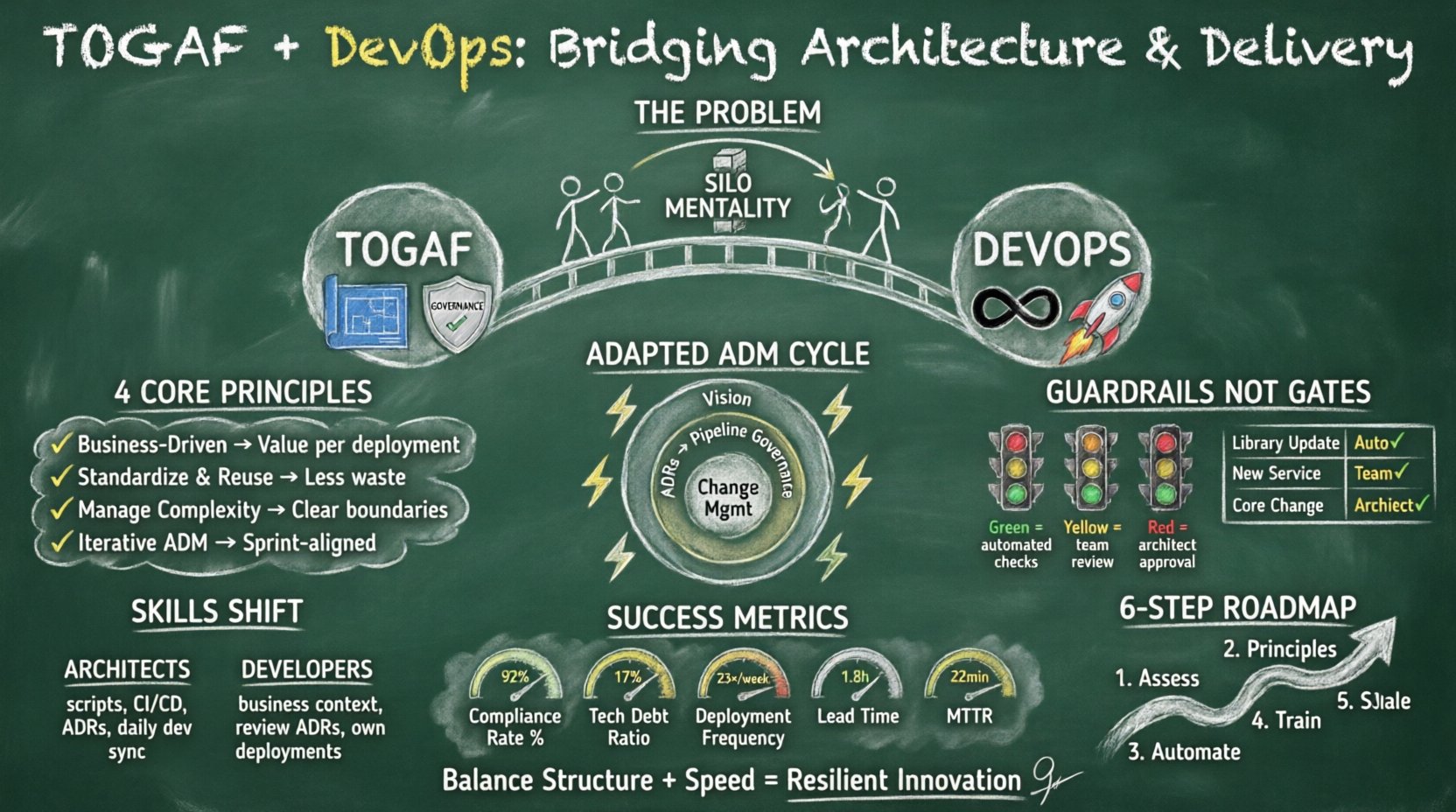
TOGAF is not a rigid set of rules but a flexible framework. Its core principles can be interpreted to support agile and DevOps practices. The key is to shift the mindset from “architecting before building” to “architecting while building”. Here are the fundamental principles that bridge the gap:
- Business-Driven: Architecture must serve business needs. In a DevOps environment, this means ensuring that every deployment delivers measurable business value.
- Standardize and Reuse: Building on existing components reduces risk. This aligns with the DevOps goal of reducing waste and increasing efficiency.
- Manage Complexity: Systems are becoming more distributed. TOGAF helps manage this complexity by defining clear boundaries and interfaces.
- Iterative Approach: The ADM cycle is iterative. This mirrors the sprint cycles used in agile development.
By applying these principles, organizations can maintain a coherent vision while allowing teams the autonomy to innovate. The architecture becomes a living document rather than a static artifact.
Adapting the Architecture Development Method for Speed 🏃
The Architecture Development Method (ADM) is the heart of TOGAF. It consists of phases that guide the creation of an architecture. In a DevOps context, these phases need to be compressed and automated. The goal is to reduce the time between identifying a business requirement and implementing the architectural solution.
Phase A: Architecture Vision
In traditional settings, this phase can take weeks. In an integrated model, the vision is established at the start of a program increment. The scope is defined clearly, but the details are left for subsequent iterations. This allows teams to start work immediately while the high-level direction is confirmed.
Phases B, C, and D: Business, Information Systems, and Technology Architecture
These phases define the target state. Instead of producing full documentation, architects create Architecture Decision Records (ADRs). These are lightweight documents that capture the decision, the context, and the consequences. This approach ensures that decisions are traceable without requiring heavy documentation overhead.
Phases E, F, and G: Opportunities, Migration, and Implementation Governance
This is where the integration with DevOps is most critical. Migration plans become release plans. Governance is embedded into the pipeline. Automated checks verify that deployments adhere to architectural standards. If a deployment violates a constraint, the pipeline fails, preventing non-compliant code from reaching production.
Phase H: Architecture Change Management
In a fast-paced environment, change is constant. This phase ensures that the architecture evolves in response to new requirements. It prevents the architecture from becoming obsolete.
Governance Without Bottlenecks 🛑➡️🚦
Governance is often the biggest concern when discussing architecture in agile environments. Teams fear that approval processes will slow them down. The solution is to shift governance from a gatekeeping function to a supporting function. This is often referred to as “guardrails” rather than “gates”.
Automated governance tools can check code, configuration, and infrastructure against architectural policies. This allows developers to receive immediate feedback. If a service is not compliant with the security architecture, the build fails. The developer fixes the issue before it becomes a production problem.
Human review is reserved for high-risk decisions. For example, changing the core data model of a critical system requires architect approval. Routine updates to existing services do not. This distinction ensures that architectural attention is focused where it matters most.
| Decision Type | Approval Level | Method | Impact on Speed |
|---|---|---|---|
| Library Update | Automated | Policy Check | None |
| New Microservice | Team Lead | ADR Review | Minimal |
| Core Data Model Change | Chief Architect | Formal Review | High |
| Infrastructure Migration | Architecture Board | Impact Analysis | Medium |
This table illustrates how different levels of decisions require different levels of scrutiny. By automating the low-risk decisions, the team maintains speed while preserving control over high-risk areas.
The Architecture Landscape in a Continuous Environment 🗺️
The Enterprise Continuum in TOGAF describes the organization of architectural artifacts. In a DevOps environment, this continuum must be dynamic. The repository of reusable assets becomes a library of services and patterns that teams can consume.
Foundation Architecture: These are the common standards and protocols. They are static and rarely change. Examples include naming conventions and security protocols.
Common Systems Architecture: This includes shared services like authentication or logging. These are maintained by a central team but consumed by all development teams.
Industry Architecture: Standards specific to the industry. Compliance with these is mandatory and often automated.
Organization Specific Architecture: This is the unique value of the organization. It is where innovation happens. Teams have the freedom to experiment here, provided they adhere to the foundational and common standards.
Maintaining this landscape requires visibility. A catalog of services allows teams to find existing solutions rather than building new ones. This reduces duplication and simplifies the overall system.
Building the Skills for Hybrid Delivery 🛠️
Technical frameworks are only as good as the people who use them. Integrating TOGAF and DevOps requires a shift in skills. Architects need to understand automation. Developers need to understand architectural constraints.
For Architects:
– Learn to write scripts for policy enforcement.
– Understand CI/CD pipeline configurations.
– Practice writing ADRs instead of thick documents.
– Engage with developers daily.
For Developers:
– Understand the business context of their code.
– Review ADRs before starting work.
– Participate in architecture reviews.
– Own the deployment process.
This cross-training creates a culture of shared responsibility. Everyone understands that architecture is not just about design, but about the lifecycle of the system.
Measuring Success Beyond Time-to-Market 📊
Success in a hybrid environment is measured by more than just release frequency. While speed is important, the quality and stability of the system are paramount. We need metrics that reflect the health of both the architecture and the delivery process.
- Architecture Compliance Rate: The percentage of deployments that pass automated architectural checks.
- Technical Debt Ratio: The amount of effort spent fixing architectural issues versus building new features.
- Deployment Frequency: How often code is moved to production.
- Lead Time for Changes: The time from code commit to code running in production.
- Mean Time to Recovery: How quickly the system recovers from a failure.
These metrics provide a balanced view. They ensure that the organization is not just moving fast, but moving in the right direction. If the compliance rate drops, the architecture is losing control. If the recovery time increases, the system is becoming fragile.
Strategic Implementation Steps 📍
Implementing this integration is a journey, not a flip of a switch. It requires a structured approach to ensure adoption and success.
- Assess the Current State: Understand where the organization stands. Are there existing architectural artifacts? Is there a CI/CD pipeline? Identify the gaps.
- Define the Principles: Establish the core architectural principles that will guide the organization. Keep them simple and actionable.
- Build the Automation: Create the tools to enforce these principles. Start with security and basic compliance checks.
- Train the Teams: Educate architects and developers on the new ways of working. Focus on the benefits to them.
- Pilot the Process: Select one team or project to test the new model. Gather feedback and refine the approach.
- Scale Gradually: Expand the model to other teams as confidence grows. Provide support and resources during the transition.
This roadmap ensures that the organization does not attempt to change everything at once. It allows for learning and adaptation along the way.
Conclusion
The integration of TOGAF and DevOps is about finding the balance between structure and speed. It requires a commitment to collaboration, automation, and continuous improvement. By adapting the ADM for modern delivery and shifting governance to a supportive role, organizations can achieve both stability and agility.
The gap between architecture and delivery is not a barrier; it is an opportunity. When these disciplines work together, they create systems that are resilient, scalable, and capable of supporting business innovation. The path forward involves continuous learning and adaptation. As the technology landscape changes, so must the methods used to govern it.
Start with the principles. Automate the checks. Empower the teams. The result will be an enterprise that is ready for the future.