

The Architecture Development Method (ADM) is the backbone of the TOGAF (The Open Group Architecture Framework) standard. It provides a structured approach for designing, planning, implementing, and governing enterprise architecture. This guide explores the ADM cycle in depth, breaking down each phase to understand how organizations align IT capabilities with business goals.
🏗️ Understanding the TOGAF Framework
TOGAF is not a single product or a rigid set of rules. It is a flexible framework that adapts to organizational needs. The core of this framework is the ADM, an iterative process that helps architects create and manage an architecture that supports the organization’s strategy.
- Enterprise Architecture: A conceptual blueprint that defines the structure and operation of an organization.
- Business Architecture: Defines business strategy, governance, organization, and key business processes.
- Information Systems Architectures: Covers data and application architectures.
- Technology Architecture: Describes the hardware and software infrastructure.
The ADM ensures that these layers are integrated coherently. It moves beyond theoretical concepts into actionable planning and execution.
🔄 The ADM Cycle Overview
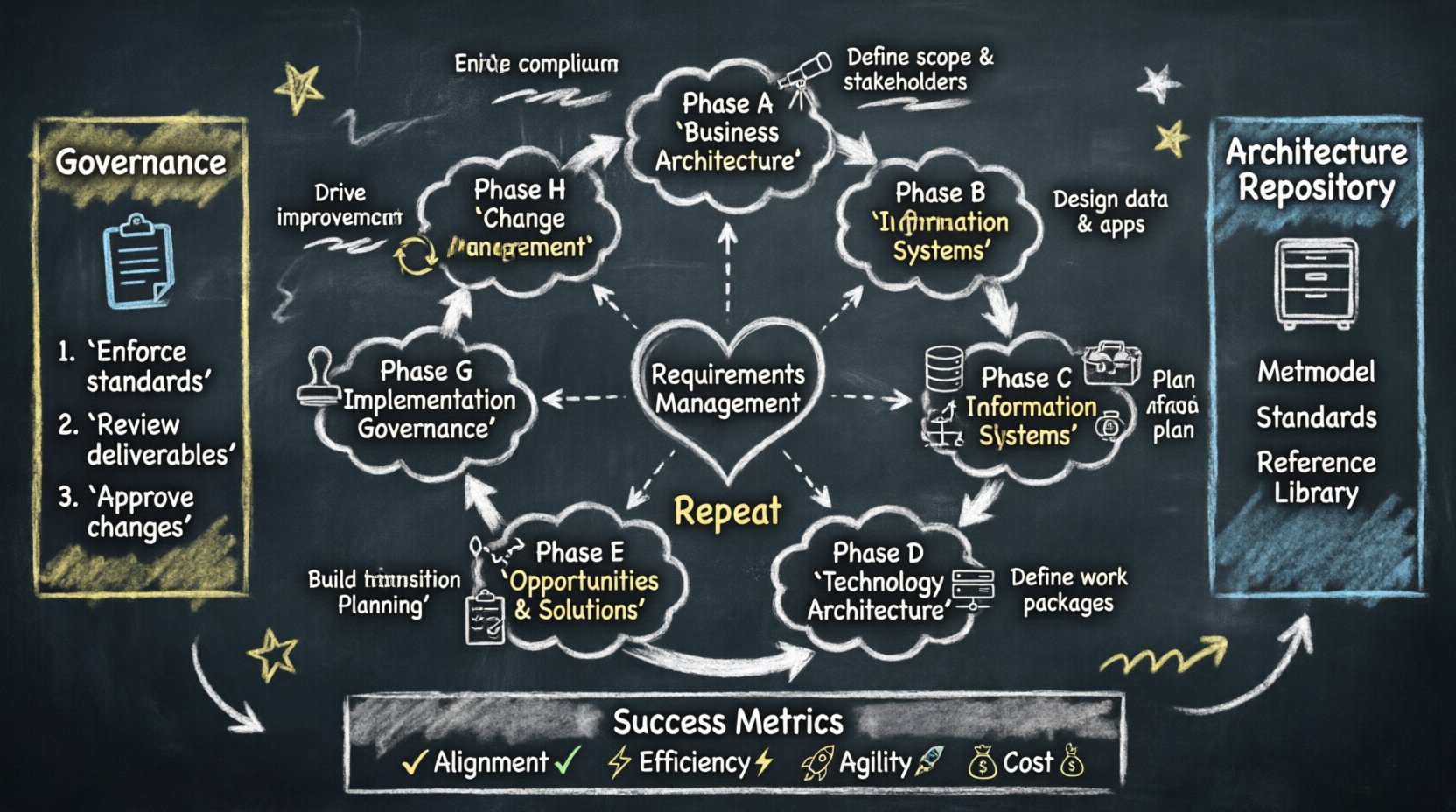
The ADM is a cycle, meaning it repeats as the enterprise evolves. It begins with a high-level vision and narrows down to specific implementation details before looping back for refinement. Below is a breakdown of the core phases.
Phase A: Architecture Vision
This phase sets the stage. It defines the scope, constraints, and stakeholders involved in the architecture project.
- Key Activities:
- Identify the business drivers and strategic goals.
- Define the scope of the architecture engagement.
- Confirm the existence of an Architecture Vision.
- Identify stakeholders and their concerns.
- Obtain approval to proceed.
Key Outputs:
- Architecture Vision Document
- Statement of Architecture Work
- Stakeholder Map
Phase B: Business Architecture
Here, the focus shifts to the business side. The goal is to develop a Business Architecture that supports the vision defined in Phase A.
- Key Activities:
- Understand the business strategy and drivers.
- Define the business processes and capabilities.
- Map organizational structures and governance.
- Identify business rules and constraints.
Key Outputs:
- Business Capability Map
- Business Process Model
- Business Service and Function Analysis
Phase C: Information Systems Architectures
This phase is split into two sub-domains: Data Architecture and Application Architecture.
Data Architecture
- Defines the logical and physical data assets and data management resources.
- Ensures data is treated as a corporate asset.
Application Architecture
- Provides a blueprint for individual application systems.
- Interactions and relationships between applications.
- Defines the application portfolio.
Phase D: Technology Architecture
The Technology Architecture describes the hardware and software infrastructure required to support the business and data architectures.
- Key Activities:
- Define the technical standards and protocols.
- Select the infrastructure components.
- Ensure security and performance requirements are met.
- Plan for scalability and reliability.
Phase E: Opportunities and Solutions
This phase bridges the gap between the architecture and the implementation. It involves identifying the best ways to achieve the target architecture.
- Key Activities:
- Identify implementation projects.
- Group projects into work packages.
- Identify dependencies between work packages.
- Review and update the Architecture Vision.
Phase F: Migration Planning
Once the solutions are identified, a detailed plan is created to transition from the baseline to the target state.
- Key Activities:
- Create a detailed Implementation and Migration Plan.
- Sequence the work packages.
- Estimate resources and costs.
- Establish a governance framework for the transition.
Phase G: Implementation Governance
During the actual implementation, the architecture team ensures that the projects remain aligned with the defined architecture.
- Key Activities:
- Monitor compliance with the architecture.
- Manage architectural contracts.
- Handle any deviations or exceptions.
- Ensure the solution meets the requirements.
Phase H: Change Management
The final phase ensures that the architecture remains relevant as the enterprise changes over time.
- Key Activities:
- Monitor the effectiveness of the architecture.
- Manage requests for change.
- Update the Architecture Repository.
- Prepare for the next cycle of the ADM.
📊 ADM Phase Comparison Table
To visualize the flow and outputs of the method, refer to this summary table.
| Phase | Focus Area | Primary Output |
|---|---|---|
| A | Vision | Architecture Vision |
| B | Business | Business Architecture |
| C | Data & Apps | Information Systems Architecture |
| D | Technology | Technology Architecture |
| E | Solutions | Implementation Plan |
| F | Migration | Migration Plan |
| G | Governance | Compliance Report |
| H | Change | Architecture Update |
🛡️ Architecture Governance and Principles
Governance is the mechanism that ensures the architecture is followed. It involves the Architecture Board, which reviews and approves changes.
- Architecture Board: A body responsible for overseeing the architecture.
- Architecture Principles: General rules and guidelines that guide the architecture.
- Compliance: Ensuring projects adhere to the defined standards.
Principles should be simple, understandable, and enduring. They act as a compass for decision-making throughout the lifecycle.
🗃️ The Architecture Repository
This is the central store for all architecture artifacts. It contains models, diagrams, and documents created during the ADM process.
- Architecture Metamodel: Defines the structure of the repository.
- Standards Information Base: Contains standards and guidelines.
- Reference Library: Contains patterns and best practices.
- Architecture Landscape: Shows the current and target architectures.
Maintaining the repository is critical. It ensures that knowledge is preserved and accessible for future projects.
🚀 Implementation Considerations
Implementing the ADM requires organizational commitment. It is not just a technical exercise but a management discipline.
- Culture Change: Teams must adopt a mindset of long-term planning and standardization.
- Communication: Clear communication between architects and project teams is essential.
- Tools: While software aids the process, the framework itself is independent of specific tools.
- Skills: Architects need training in both business strategy and technical design.
⚠️ Common Challenges
Organizations often face hurdles when adopting this framework. Understanding these can help mitigate risks.
- Complexity: The process can be seen as overly complex for smaller projects.
- Resistance: Stakeholders may resist the overhead of architecture governance.
- Static Views: Treating the architecture as a static document rather than a living model.
- Resource Constraints: Lack of skilled personnel to manage the architecture function.
Addressing these challenges requires leadership support and a phased approach to adoption. Starting with a pilot project can demonstrate value before full-scale rollout.
🔍 The Role of Requirements Management
Requirements Management is a central loop in the ADM. It runs through all phases, ensuring that requirements are captured, analyzed, and tracked.
- Input: Requirements from stakeholders and business strategy.
- Processing: Mapping requirements to architecture components.
- Output: Validated requirements that drive design decisions.
This loop ensures that the architecture remains aligned with the evolving needs of the business.
📈 Measuring Success
How do you know if the architecture is working? Metrics are essential for measuring success.
- Alignment: Degree to which IT supports business goals.
- Efficiency: Reduction in redundant systems and processes.
- Agility: Speed at which the organization can respond to market changes.
- Cost: Reduction in total cost of ownership.
🌐 Future Trends in Enterprise Architecture
The landscape of enterprise architecture is evolving. New technologies and business models require adaptation.
- Cloud Integration: Moving towards cloud-native architectures.
- Automation: Using automation to manage infrastructure and deployments.
- Data Driven: Increased focus on data governance and analytics.
- Security: Embedding security into the architecture from the start.
Staying updated on these trends ensures the architecture remains relevant and effective.
🤝 Conclusion
The Architecture Development Method provides a robust structure for managing enterprise change. By following the ADM phases, organizations can ensure that their technology investments align with their strategic objectives. The key is consistency, governance, and a willingness to adapt as the business environment shifts.