Building a business involves navigating uncertainty. Entrepreneurs often start with a vision, but without validation, that vision remains a hypothesis. The Business Model Canvas (BMC) serves as a strategic management template that describes the logic of how an organization creates, delivers, and captures value. However, a canvas filled with static blocks is not enough. The real work begins when you treat each block as a set of testable assumptions.
Testing market assumptions allows you to reduce risk before investing significant capital. By systematically challenging your beliefs about customers, costs, and revenue, you move from guessing to knowing. This guide explores how to leverage the Business Model Canvas for validation, ensuring your venture is built on solid ground rather than fragile guesses.
📋 Understanding the Foundation: The Business Model Canvas
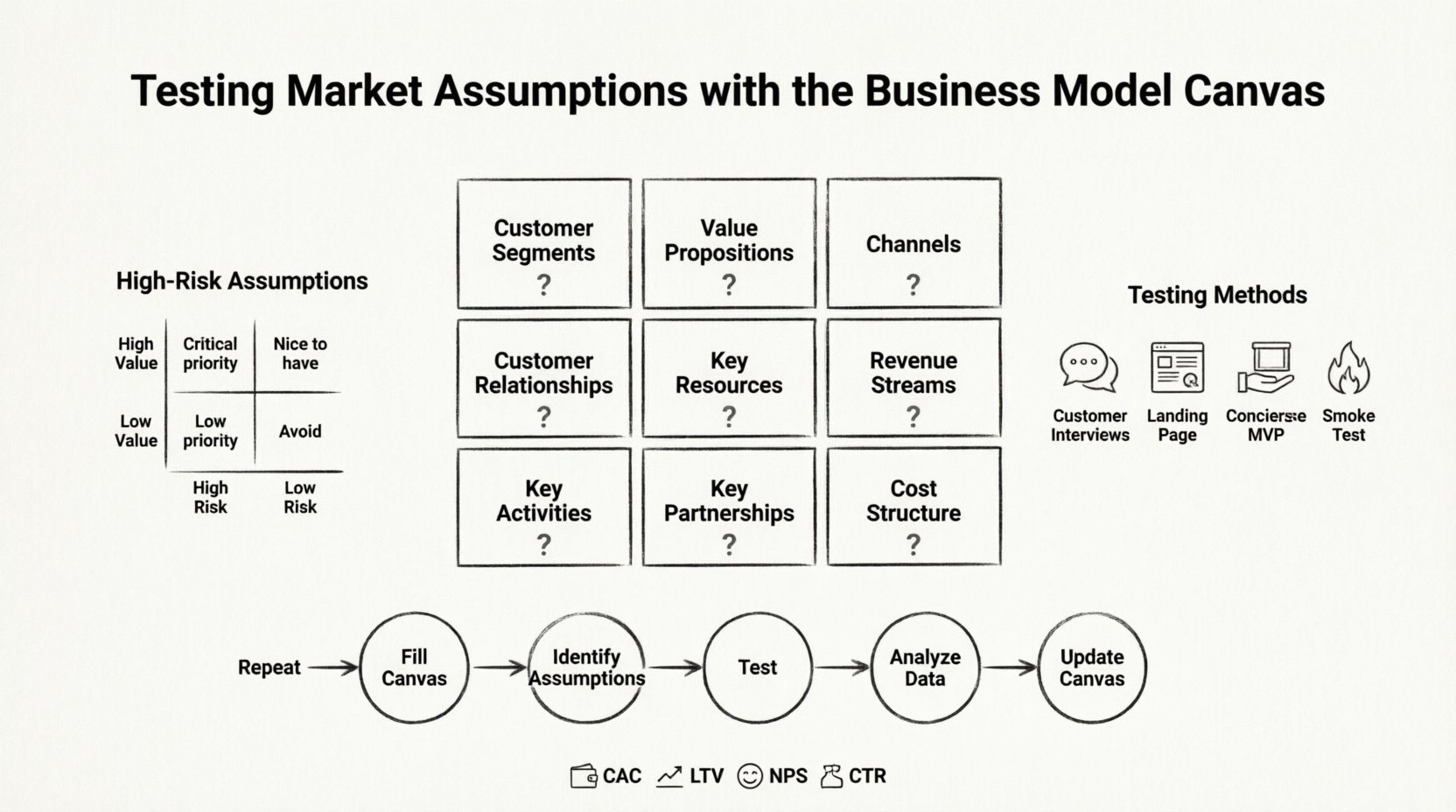
The Business Model Canvas consists of nine building blocks that describe the logic of a business. When used for testing, these blocks shift from descriptive elements to hypotheses about reality. Each block represents a specific area of uncertainty that requires evidence.
Traditional business planning often focuses heavily on financial projections and product features. The Canvas forces a broader view. It highlights the relationship between what you offer and who you serve. In the context of validation, the Canvas acts as a map of your knowledge gaps. Where you do not have data, you have assumptions.
🔍 The Nine Blocks as Hypotheses
To validate effectively, you must identify what is unknown in each section. Below is a breakdown of the nine blocks and the specific questions they raise during the testing phase.
- Customer Segments: Who are we serving? Are they real? Do they have the problem we think they have?
- Value Propositions: What value do we deliver? Does the customer care about this specific benefit?
- Channels: How do we reach them? Are the channels they use accessible and cost-effective?
- Customer Relationships: What type of relationship does each segment expect? Is it automated or personal?
- Revenue Streams: How does the business earn money? Will customers actually pay for this value?
- Key Resources: What assets are required? Do we have access to them?
- Key Activities: What critical things must we do? Are these activities feasible?
- Key Partnerships: Who are our suppliers? Do they exist and are they reliable?
- Cost Structure: What are the major costs? Can we sustain these costs against our revenue?
🚀 Identifying High-Risk Assumptions
Not all assumptions are created equal. Some are foundational to the business survival, while others are operational details. To save time, you must prioritize which assumptions to test first. A high-risk assumption is one where, if proven false, the entire business model collapses.
📊 Risk vs. Importance Matrix
| Assumption Type | Impact if False | Testing Priority | Example |
|---|---|---|---|
| High Value / High Risk | Business Failure | Critical | Customers will pay $50/month for the service. |
| Low Value / High Risk | Operational Cost | Medium | Customers prefer email over phone support. |
| High Value / Low Risk | Minor Inefficiency | Low | Website loads in under 2 seconds. |
| Low Value / Low Risk | Minimal Impact | Low | Office supply costs are under budget. |
Focus your energy on the High Value / High Risk quadrant. These are the deal-breakers. If customers do not want the value proposition, no amount of optimization in the cost structure will save the venture.
🔬 Methods for Testing Assumptions
Validation requires active experimentation. Passive observation is rarely sufficient because people often say one thing and do another. You need to observe behavior.
1. Customer Discovery Interviews
Direct conversation is the most common method for validating the Customer Segments and Value Proposition blocks. However, the framing of questions matters immensely.
- Ask about past behavior: Instead of asking “Will you buy this?”, ask “Tell me about the last time you solved this problem.”
- Identify emotional triggers: Look for signs of frustration or urgency in their stories. This indicates a strong pain point.
- Avoid leading questions: Do not suggest the solution. Let them describe the problem in their own words.
2. Landing Page Experiments
Before building a full product, create a simple web page describing the offering. This tests the Value Proposition and Revenue Streams.
- Call to Action: Use buttons like “Join Waitlist” or “Pre-order” to gauge interest without taking money immediately.
- Conversion Rate: A high click-through rate indicates the message resonates. A low rate suggests the value proposition is unclear.
- Cost Per Acquisition: If you run paid traffic, calculate the cost to get a visitor. This helps validate Channel and Cost Structure assumptions.
3. Concierge MVPs
A Concierge Minimum Viable Product involves manually delivering the service to a few customers. This is excellent for testing Key Activities and Customer Relationships.
- Manual Process: Perform tasks yourself rather than building software. This reveals hidden complexities in the workflow.
- Feedback Loop: You get immediate feedback on what works and what doesn’t during the delivery.
- Validation of Demand: If people pay for a manual service, they will likely pay for an automated version later.
4. Smoke Tests
A smoke test checks if a fire starts. In business, it checks if demand exists. This involves advertising a product that does not fully exist yet.
- Ad Clicks: Run ads for a product feature. Measure the click-through rate to see if the concept is appealing.
- Sign-up Funnel: Send users to a sign-up page. Measure how many complete the process.
- Interpretation: If users click but do not sign up, the value is unclear. If they sign up but do not convert, the offer is not strong enough.
📉 Analyzing Data and Avoiding Bias
Collecting data is only half the battle. Interpreting it correctly is where many ventures fail. Cognitive biases often lead teams to ignore negative feedback.
Common Pitfalls in Validation
- Satisfaction Bias: Friends and family will often say they like your idea to be supportive. This skews data.
- Survivor Bias: Focusing only on the successes and ignoring the failures that followed similar paths.
- Confirmation Bias: Seeking information that supports your existing beliefs while dismissing contradictory evidence.
- Feature Creep: Adding more features to the canvas to make it look more robust without validating the core value.
To mitigate these issues, set clear success metrics before starting the test. Define what “success” looks like in numbers. For example, “10% of visitors will sign up for the newsletter” rather than “We will get some interest.”
🔄 Iterating the Canvas
Validation is not a one-time event. It is a continuous cycle. As you learn, you must update the Business Model Canvas. This process is often called “Pivoting” or “Persevering”.
When to Pivot
A pivot is a structured course correction. It happens when the data proves a fundamental assumption wrong. Common pivot types include:
- Zoom-in Pivot: A single feature becomes the whole product.
- Customer Segment Pivot: The product works, but for a different group of people.
- Platform Pivot: Changing the technology used to deliver the value.
- Value Proposition Pivot: The problem is real, but the solution is wrong.
When to Persevere
Perseverance is valid when the data shows traction but the metrics are not yet profitable. This is common in growth stages. The focus shifts from testing assumptions to optimizing operations.
📈 Metrics for Validation Success
Different blocks of the Canvas require different metrics. Tracking the right KPIs ensures you are measuring what matters.
- For Customer Segments: Total Addressable Market (TAM), Customer Acquisition Cost (CAC).
- For Value Propositions: Net Promoter Score (NPS), Customer Satisfaction (CSAT).
- For Revenue Streams: Lifetime Value (LTV), Churn Rate, Average Revenue Per User (ARPU).
- For Channels: Click-Through Rate (CTR), Conversion Rate.
- For Cost Structure: Burn Rate, Fixed vs. Variable Costs.
Use these metrics to create a feedback loop. If CAC is higher than LTV, the model is unsustainable. You must adjust the Value Proposition to increase LTV or find cheaper Channels to reduce CAC.
🛠️ Practical Steps for Implementation
How do you start this process tomorrow? Follow this structured approach.
- Fill the Canvas: Draft the initial model based on your best knowledge.
- Highlight Assumptions: Circle every statement that is not a fact. These are your hypotheses.
- Rank by Risk: Use the Risk vs. Importance Matrix to decide what to test first.
- Design Experiments: Choose the testing method (Interview, Landing Page, Concierge) that fits the assumption.
- Execute: Run the test and gather data.
- Update: Modify the Canvas based on the results.
- Repeat: Move to the next highest risk assumption.
🌐 The Role of External Feedback
Internal validation is not enough. You need external perspectives. Mentors, industry experts, and potential customers provide reality checks.
- Mentors: They have seen other businesses fail. They can spot flaws in the logic of the model.
- Industry Experts: They know the regulatory and technical constraints that might affect Key Activities.
- Customers: They are the ultimate judges of the Value Proposition. Their actions speak louder than words.
Do not isolate the team. Share the Canvas with others. Transparency invites scrutiny, which improves the quality of the model.
📝 Final Considerations
The Business Model Canvas is a living document. It evolves as the market evolves. Testing market assumptions is not about proving you are right; it is about finding out what is true. This mindset shift reduces ego and increases learning speed.
By treating every block as a hypothesis, you build resilience. You prepare for failure by anticipating it. You save resources by killing bad ideas early. This disciplined approach to validation separates successful ventures from those that fade away.
Start with the highest risk. Test aggressively. Listen to the data. Adapt the model. This is the path to sustainable growth.