Building a successful Software as a Service (SaaS) company requires more than just code. It demands a strategic arrangement of assets that allow the business to deliver value consistently. Within the Business Model Canvas framework, the Key Resources block serves as the foundation. For SaaS enterprises, these resources differ significantly from traditional product-based models. They are often intangible, scalable, and heavily reliant on intellectual property.
This guide examines how to structure these critical assets effectively. Understanding the composition of your resource base helps align operational capabilities with market needs. We will explore the specific categories relevant to software companies, from cloud infrastructure to specialized talent, and how they interact with other building blocks of your strategy.
The Role of Key Resources in the SaaS Business Model 🧩
Key Resources are the assets required to make a business model work. In a SaaS context, these assets enable the creation, delivery, and capture of value. Unlike a retail business that relies on inventory, a software company relies on access to platforms, proprietary algorithms, and skilled teams. The distinction is vital because it dictates how you scale.
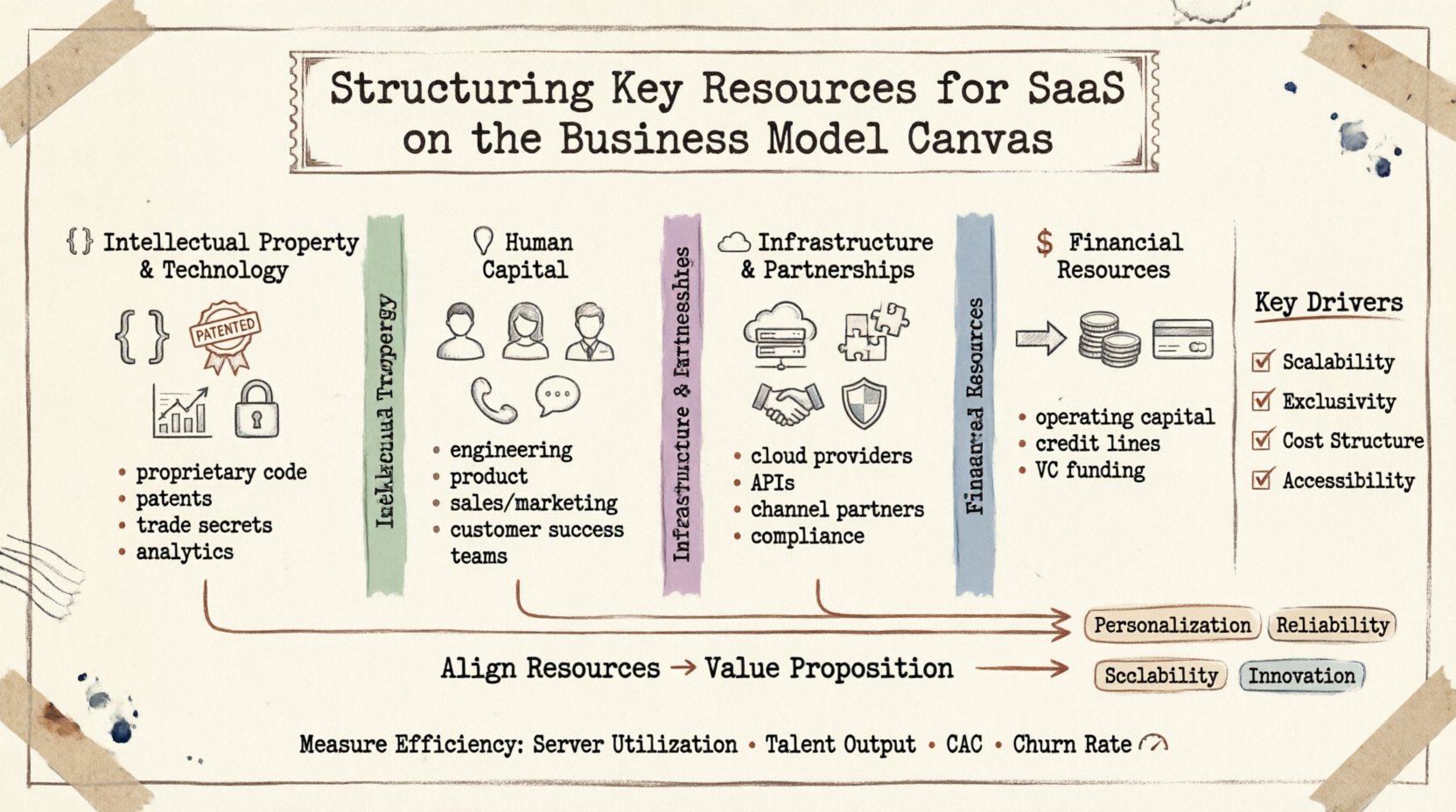
When structuring this section of your canvas, consider the following primary drivers:
- Scalability: Can the resource support growth without linear cost increases?
- Exclusivity: Does the resource provide a competitive moat?
- Cost Structure: What is the financial burden of maintaining this resource?
- Accessibility: Is the resource available to all teams or restricted to specific units?
In the SaaS sector, the interplay between technology and human capital is the most critical dynamic. A robust infrastructure ensures uptime and security, while skilled personnel drive innovation and customer success. Balancing these elements defines the operational health of the company.
Categorizing Intangible Assets for Software Companies 🧠
SaaS businesses typically operate with high operating leverage. This means a large portion of the cost structure is fixed, derived from the development and maintenance of the platform. Consequently, the Key Resources block must reflect assets that support this leverage model. We can group these into four distinct categories.
1. Intellectual Property and Technology
This is often the most valuable asset class for a SaaS firm. It includes:
- Proprietary software code and source code repositories.
- Patents, trademarks, and copyrights protecting unique algorithms.
- Trade secrets regarding data processing methods.
- Customer data analytics and behavioral insights.
These assets are intangible but form the core of the value proposition. If the technology is easily replicable, the competitive advantage diminishes. Therefore, structuring this resource involves continuous investment in research and development.
2. Human Capital
Software is built by people. The talent required extends beyond developers. A SaaS business needs a multi-disciplinary team to sustain operations. Key roles include:
- Engineering Teams: Architects, backend developers, frontend specialists, and QA engineers.
- Product Management: Individuals who define the roadmap and prioritize features.
- Sales and Marketing: Specialists who understand the niche and drive adoption.
- Customer Success: Teams focused on retention, onboarding, and support.
The availability of this talent is often a bottleneck. In many markets, skilled technical labor is scarce. Securing this resource requires a strategy for retention, culture building, and competitive compensation.
3. Physical and Digital Infrastructure
While SaaS is cloud-native, it still requires physical backing. This includes:
- Server farms and data center access.
- Network security hardware and software.
- Office spaces for collaborative work.
- Development hardware and testing environments.
Most SaaS companies outsource physical infrastructure to third-party cloud providers (IaaS). This shifts the resource from ownership to access. The structure changes from maintaining hardware to managing API integrations and cloud accounts.
4. Financial Resources
Cash flow management is critical for SaaS. Unlike transactional businesses, SaaS often requires significant upfront investment before recurring revenue stabilizes. Resources here include:
- Operating capital for payroll and server costs.
- Lines of credit for expansion.
- Investment from venture capital or angel investors.
Access to capital determines the speed at which you can acquire resources like talent or marketing reach. Without sufficient liquidity, even a strong product can stall.
Deep Dive: Intellectual Property and Technology 🔐
For many SaaS organizations, the technology itself is the product. However, in the Business Model Canvas, technology is treated as a resource that enables value delivery. This distinction matters. It implies that the code is an input, not just the output.
Ownership vs. Licensing
Deciding whether to own or license technology impacts the resource structure. Open-source software reduces development time but may require maintenance resources. Proprietary code increases value but increases development costs. A hybrid approach is common.
Data as a Resource
Data collected from users is a critical intangible asset. It fuels machine learning models, improves product features, and informs sales strategies. Structuring this resource involves:
- Establishing data governance policies.
- Ensuring compliance with privacy regulations (GDPR, CCPA).
- Creating secure storage solutions.
If data is treated merely as a byproduct, it is wasted. If structured as a key resource, it becomes a strategic lever for differentiation.
Deep Dive: Human Capital and Talent 🧑💻
Human resources in SaaS are not just administrative; they are the engine of the business. Unlike manufacturing, where labor can be standardized, software development requires high cognitive engagement. This makes human resources a critical, non-replicable asset.
Specialization and Cross-Functional Skills
In early-stage SaaS, generalists are valuable. As the company scales, specialization becomes necessary. The resource structure must evolve to accommodate:
- DevOps engineers managing deployment pipelines.
- Security experts ensuring compliance.
- Customer support managers handling high-volume inquiries.
Knowledge Management
Talent turnover is a risk in the tech industry. When key personnel leave, knowledge leaves with them. To mitigate this, organizations must structure knowledge as a resource. This includes:
- Documentation of code architecture.
- Standard operating procedures for support.
- Training programs for new hires.
By treating knowledge as an asset, you reduce dependency on specific individuals and ensure continuity.
Deep Dive: Infrastructure and Partnerships 🌐
No SaaS company operates in a vacuum. Partnerships act as external key resources that extend your capabilities. This concept is central to the lean startup methodology.
Third-Party Integrations
Building every feature from scratch is inefficient. Leveraging existing APIs allows you to integrate payment gateways, email services, or analytics tools. These partnerships reduce the internal resource burden.
Channel Partners
Resellers or affiliates can expand market reach without increasing internal sales headcount. These partners function as an extension of your sales force. Structuring this relationship requires clear agreements and support mechanisms.
Cloud Service Providers
Choosing a cloud provider (AWS, Azure, Google Cloud) is a strategic decision. Each offers different pricing models and resource constraints. The choice affects:
- Latency and performance.
- Cost predictability.
- Scalability limits.
Managing these relationships is a key resource activity. It involves monitoring usage, negotiating contracts, and ensuring service level agreements are met.
Aligning Resources with Value Propositions 🤝
Resources should not exist in isolation. They must directly support the Value Proposition. If a resource does not contribute to the core offering, it is a drain on the business model.
The Fit Check
Review each resource against the following questions:
- Does this resource enable the unique value we promise?
- Is this resource critical for customer retention?
- Can we deliver the value without this resource?
For example, if your value proposition is “Real-time collaboration,” you require low-latency infrastructure and robust real-time data syncing. If your proposition is “Offline accessibility,” you require local storage capabilities and sync logic.
Resource Allocation Strategy
Not all resources deserve equal investment. A prioritization matrix helps allocate budget and attention. High-impact, high-dependency resources receive the most focus. Low-impact resources are candidates for outsourcing or elimination.
Common Pitfalls in Resource Allocation ⚠️
Many SaaS founders make structural errors when defining Key Resources. These mistakes often lead to bottlenecks or financial strain later.
Over-Investing in Early Stages
Building a massive team or expensive infrastructure before validating demand is a common error. Premature scaling burns cash without generating revenue. Resources should match the current stage of the business.
Underestimating Maintenance Costs
Developing software is only the beginning. Maintenance, security patches, and updates require ongoing resources. Underestimating this creates technical debt that slows future development.
Ignoring Compliance Resources
Data security and privacy regulations are tightening. Failing to allocate resources for legal compliance and security audits exposes the company to risk. This is often overlooked until an incident occurs.
Measuring Resource Efficiency 📊
To ensure the Key Resources block remains healthy, you must measure efficiency. This involves tracking metrics related to your assets.
- Server Utilization: Are you paying for capacity you do not use?
- Talent Output: Is the development velocity matching the headcount?
- Customer Acquisition Cost (CAC): How much resource spend is required to gain one user?
- Churn Rate: Are resources allocated to retention sufficient to keep users?
Regular audits of these metrics allow for course correction. If a resource is underperforming, it should be re-evaluated or replaced.
Resource Mapping Table
The following table illustrates how specific Key Resources map to other blocks in the Business Model Canvas. This visual aid helps clarify dependencies.
| Key Resource Category | Supporting Value Proposition | Enabling Customer Relationships | Driving Revenue Streams |
|---|---|---|---|
| Proprietary Algorithm | Personalization & Accuracy | Automated Insights | Premium Tier Pricing |
| Customer Support Team | Reliability & Trust | 24/7 Human Assistance | Reduced Churn / Retention |
| Cloud Infrastructure | Scalability & Uptime | Seamless Access | Enterprise Contracts |
| Brand Reputation | Market Authority | Community Building | Referral Traffic |
| Development Team | Feature Innovation | Feedback Integration | New Feature Upsells |
Strategies for Sustainable Resource Management 🔄
Managing resources is an ongoing process. As the market evolves, so must the resource structure. The following strategies promote long-term stability.
Automation
Automating routine tasks reduces the need for manual labor. This allows human resources to focus on high-value activities like strategy and complex problem-solving. Automation tools should be integrated into the workflow to maximize efficiency.
Outsourcing Non-Core Functions
Functions like payroll, legal, or basic IT support can often be outsourced. This converts fixed costs into variable costs, providing flexibility during economic downturns.
Continuous Learning
The technology landscape changes rapidly. Encouraging continuous learning within the team ensures that human resources remain relevant. This might involve budgeting for certifications, conferences, or internal workshops.
Agile Resource Allocation
Adopting an agile approach allows you to shift resources quickly. If a feature is gaining traction, you can move developers to support it. If a channel is underperforming, you can reduce marketing spend. Flexibility is a key asset in itself.
Final Considerations for SaaS Growth 📈
Structuring Key Resources is not a one-time task. It requires constant review as the business scales. What worked for a startup with ten employees may not work for a scale-up with a hundred. The relationship between resources and activities must remain tight.
Focus on assets that provide leverage. A small investment in a powerful API might yield more value than a large investment in internal tools. Prioritize quality over quantity. A smaller team of elite developers can outperform a larger team of average performers.
Remember that resources are the inputs, and the Value Proposition is the output. Ensure the input quality matches the output promise. If you promise speed, you need fast infrastructure. If you promise security, you need robust compliance protocols. Aligning these elements creates a coherent business model capable of sustaining growth over the long term.
By carefully defining and managing these assets, SaaS companies can navigate market shifts and maintain a competitive edge. The Business Model Canvas provides the structure, but the strategic allocation of resources provides the engine. Treat every asset with intention, and the business will follow.