
Enterprise architecture serves as the backbone for organizational alignment, bridging the gap between business goals and IT capabilities. Within this complex landscape, the ability to model how decisions are made, tracked, and executed is critical. ArchiMate provides a standardized language to represent these structures. Specifically, the Behavior Layer offers mechanisms to depict processes and activities. One of the most vital elements within this layer for strategic planning is the Decision Node. This element allows architects to visualize branching logic and governance points without ambiguity.
Strategic decision making often suffers from opacity. Stakeholders may not see where choices are made, what criteria influence them, or how they impact downstream capabilities. By utilizing ArchiMate Decision Nodes effectively, organizations can gain transparency into their operational logic. This guide explores the technical application, strategic value, and implementation best practices of these nodes. It focuses on the standard framework rather than specific tooling, ensuring applicability across various modeling environments.
Understanding the Challenge of Strategic Visibility 🔍
Complex organizations operate through layers of abstraction. High-level strategy must trickle down into executable processes. Often, the link between a strategic goal and a specific process step is broken or poorly documented. When decisions are made implicitly, rather than explicitly, risk increases. Ambiguity leads to inconsistent execution.
Architects face the task of capturing these moments of choice. Traditional flowcharts often lack the formal structure required for rigorous analysis. ArchiMate introduces a structured approach to behavior modeling. The Behavior Layer encompasses processes, functions, and events. Within this layer, the Decision Node acts as a distinct marker for a point where the flow of control branches based on a condition.
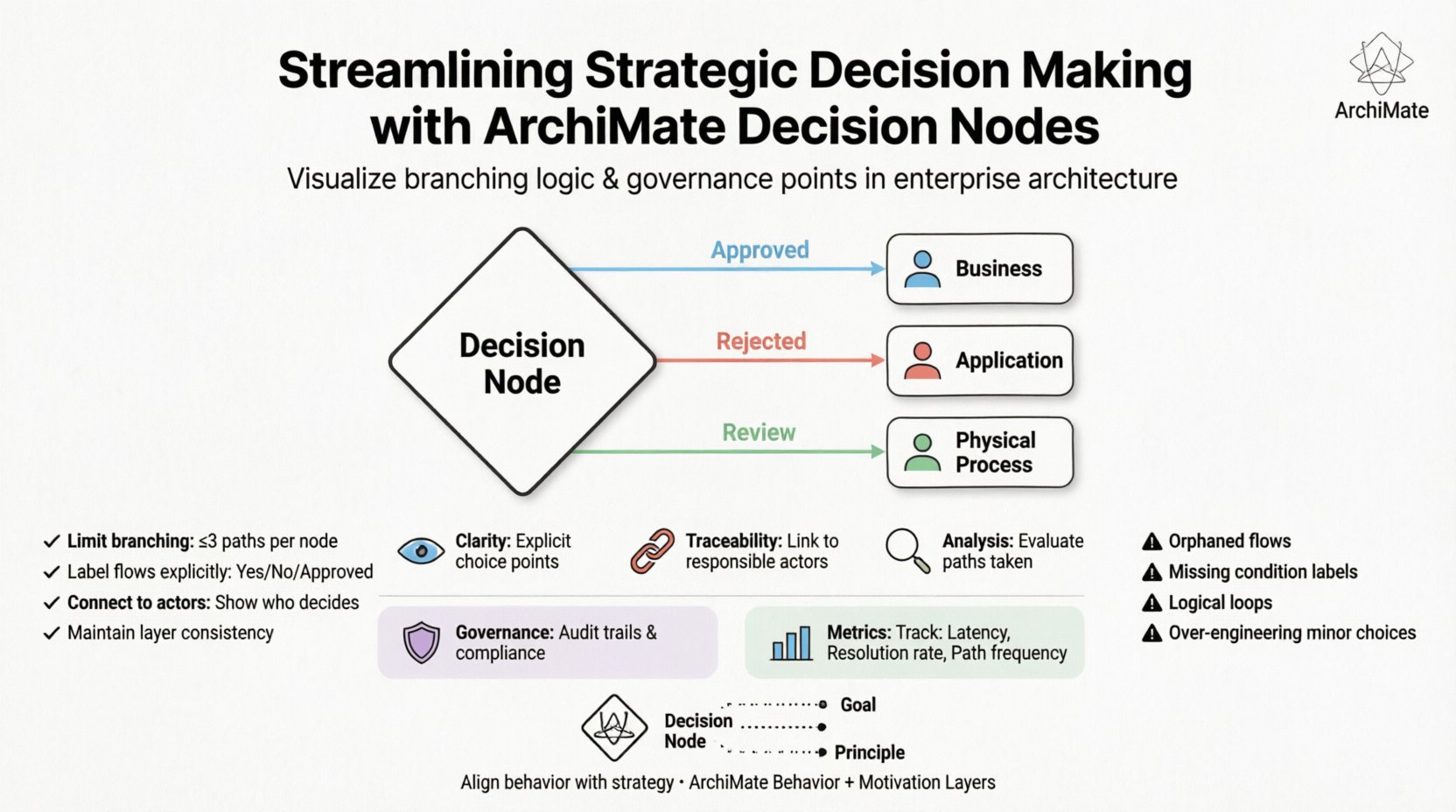
- Clarity: Explicitly marks where a choice occurs.
- Traceability: Links decisions to the actors or capabilities responsible.
- Analysis: Allows for the evaluation of paths taken versus paths not taken.
Without a formal representation of decision points, auditing processes becomes difficult. Compliance frameworks often require evidence of how specific outcomes were reached. Modeling these nodes provides the necessary audit trail within the architecture itself.
The Role of Decision Nodes in the ArchiMate Framework 🧩
The ArchiMate specification defines specific elements to represent the behavior of the enterprise. A Decision Node is not merely a visual marker; it carries semantic weight. It represents a point where the flow of control is determined by the evaluation of one or more conditions. Unlike a standard activity, a Decision Node does not perform work itself. It directs the flow.
These nodes are typically found within Business Processes, Application Processes, or Physical Processes. They connect to other behavior elements via flow relations. The connections leaving a decision node are labeled with the specific conditions that trigger the path. For example, a flow might be labeled “Approved” or “Rejected”.
Distinguishing Decision Nodes from Other Elements
It is important to differentiate a Decision Node from a Process or an Activity. An Activity represents a unit of work. A Process represents a sequence of activities. A Decision Node represents a control point. Confusing these leads to models that are either too cluttered or too abstract.
- Activity: Represents work being done.
- Process: Represents the logical grouping of activities.
- Decision Node: Represents the logic determining the path.
This distinction ensures that the model remains clean. If every step of work is labeled as a decision, the diagram becomes unreadable. If decisions are hidden inside activities, the logic is lost. Balancing these elements is a core skill in architecture modeling.
Integrating Decision Nodes with the Motivation Layer 💡
Decisions do not happen in a vacuum. They are driven by motivations, requirements, and goals. The ArchiMate Motivation Layer provides the context for *why* a decision is made. A Decision Node in the Behavior Layer should ideally be linked to elements in the Motivation Layer.
Consider a scenario where a customer application requires validation. The Behavior Layer shows the validation step as a Decision Node. The Motivation Layer might show a Business Goal requiring customer satisfaction, or a Principle requiring data integrity. Linking these layers creates a cohesive narrative.
Mapping Motivations to Decisions
Architects should establish relationships between the decision point and the driving forces. This can be done through association relations. The following table outlines common motivations associated with decision nodes.
| Motivation Element | Decision Context | Impact |
|---|---|---|
| Business Goal | Strategic Approval | Aligns process with long-term objectives |
| Principle | Compliance Check | Ensures adherence to governance rules |
| Requirement | Functional Validation | Confirms specific business needs are met |
| Assessment | Risk Evaluation | Quantifies potential negative outcomes |
By mapping these elements, the architecture becomes a tool for strategic alignment rather than just a diagramming exercise. It answers the question: “What drives this specific branch in the process?”
Best Practices for Modeling Decision Nodes 🛠️
Effective modeling requires discipline. A common mistake is overloading the diagram with too many decision points. This creates a “spaghetti” effect where the flow is difficult to follow. Another error is under-specifying the conditions on the flow lines. If a flow leaving a decision node has no label, the logic is undefined.
To maintain high quality, follow these guidelines.
1. Limit Branching Complexity
Keep the number of outgoing flows from a single decision node manageable. If a node has five or more paths, consider splitting the logic into nested decision nodes or a separate sub-process. This reduces cognitive load for anyone reading the model.
2. Label Flows Explicitly
Every flow relation leaving a Decision Node must have a label. Common labels include “Yes”, “No”, “Approved”, “Failed”, or specific status codes. Avoid vague labels like “Path A” or “Result”. The label must be self-explanatory.
3. Connect to Responsible Actors
Decisions are rarely automatic. They often require human intervention or specific capability assessment. Use Application Functions or Business Roles to show who or what is responsible for making the decision. This clarifies accountability.
4. Maintain Consistency Across Layers
If a Business Process uses a Decision Node, ensure the corresponding Application Process reflects the same logic. Consistency between layers prevents gaps between what is planned and what is executed.
Common Pitfalls to Avoid ⚠️
Even experienced architects encounter challenges when modeling behavior. Recognizing these pitfalls early can save significant rework later. Below are the most frequent issues observed in enterprise architecture projects.
- Orphaned Flows: Leaving a flow line without a destination node. Every flow must terminate at another node.
- Missing Conditions: Failing to label the paths leaving a decision node. This creates ambiguity.
- Logical Loops: Creating cycles where a decision node points back to itself without an exit condition. This implies an infinite loop in the process.
- Over-Engineering: Modeling every minor choice as a decision node. Reserve the element for significant branching points that affect the process outcome.
- Ignoring Time: Failing to account for the time it takes to make the decision. While not always modeled explicitly, it is a factor in process performance.
Avoiding these errors ensures the model remains a reliable source of truth. It reduces the friction between the design phase and the implementation phase.
Impact on Governance and Compliance 📜
Governance frameworks require clear lines of authority. Decision nodes provide a structural representation of where authority is exercised. In regulated industries, such as finance or healthcare, documenting how decisions are made is often a legal requirement.
By modeling these nodes, organizations can demonstrate adherence to policies. Auditors can trace a specific outcome back to the decision point that authorized it. This traceability is crucial for risk management.
Enhancing Audit Trails
When a process is executed, the path taken through the decision nodes is recorded. If the architecture model accurately reflects the system, the model serves as the definition of the audit trail. This allows for retrospective analysis of process performance.
- Traceability: Link decisions to specific policy requirements.
- Accountability: Identify the actor responsible for each branch.
- Consistency: Ensure all branches adhere to the same standards.
Without this formalization, governance becomes reactive. Issues are discovered after they occur. With formalization, governance is proactive. Potential risks are identified during the design phase.
Measuring Impact and Performance 📊
Once the decision nodes are modeled, they can be used to analyze process efficiency. By examining the paths taken, architects can identify bottlenecks. If a specific decision node consistently slows down the process, it may require optimization.
Performance metrics can be attached to the decision nodes. For example, the average time taken to resolve a decision can be measured. This data helps in capacity planning and resource allocation.
Key Performance Indicators
When evaluating decision nodes, consider the following metrics.
- Decision Latency: How long does the decision take?
- Resolution Rate: What percentage of decisions are resolved on the first attempt?
- Path Frequency: Which branch of the decision is taken most often?
- Error Rate: How often does a decision lead to a failure state?
These metrics transform the architecture from a static document into a dynamic management tool. They provide data-driven insights for continuous improvement.
Future Considerations and Evolution 🔮
Enterprise architecture is not static. As organizations evolve, so do their processes. Decision nodes must be maintained to reflect these changes. Regular reviews of the model ensure it remains relevant.
Emerging trends in automation and artificial intelligence are changing how decisions are made. Some decision nodes may eventually be automated. The model should be flexible enough to represent human decisions today and automated decisions tomorrow. This flexibility is key to long-term relevance.
Adapting to Change
When a decision node is replaced by an automated rule, the model should be updated. The element type might change, or the label might become more technical. The goal is to maintain the logical integrity of the process.
- Version Control: Maintain versions of the model to track changes over time.
- Change Management: Ensure any change to a decision node is reviewed by stakeholders.
- Documentation: Keep the rationale for changes documented alongside the model.
This proactive approach ensures the architecture remains a valuable asset. It prevents the model from becoming obsolete shortly after creation.
Final Thoughts on Strategic Alignment 🎯
Streamlining strategic decision making requires precision. ArchiMate Decision Nodes offer a standardized way to achieve this precision. They bring clarity to complex processes and ensure that strategic intent is preserved throughout execution.
By adhering to best practices and avoiding common pitfalls, architects can build models that are robust and useful. These models serve as a foundation for better governance, improved compliance, and more efficient operations. The investment in accurate modeling pays dividends in reduced risk and increased agility.
Focus on the logic, maintain the connections, and keep the model aligned with business reality. This approach ensures that the architecture supports the enterprise effectively.